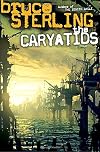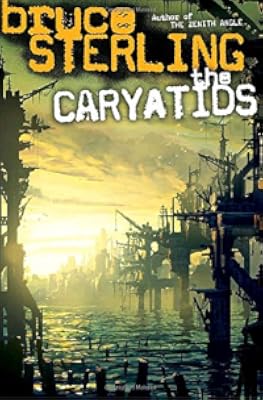
The Caryatids
by Bruce Sterling
On This Page
Description
Despite the family history that has led to their estrangement from one another, three identical clone sisters--Vera, a pollution expert dealing with global clean-up efforts; Mila, a media star; and Sonja, a medical specialist stationed in the Gobi Desert--hold the key to saving the world from global warming, runaway pollution, and political intrigue.Tags
Recommendations













Member Reviews
With the world undergoing disastrous disintegration from man-made causes, who better to bring together the man-made solutions than three female clones as damaged and traumatised and dysfunctional as the world they're supposed to save? Most of their sisters are dead, their mother/sister is out of reach from the forces of law and order in orbit and the four surviving clones are scattered over the world, engaged in various morally dubious projects of reclamation, amelioration, sterilisation and terrorism. One man sets out to bring them together and hopes by doing so to mend the ideological divisions hampering the task of global salvation.
Well, I liked it. Sterling is too optimistic to let the world die screaming, but too much of a realist show more to make survival easy or cost free. The clones are like a fractured human psyche, half-mad and self-hating, to the extent that getting anything useful other than tragedy and heartbreak out of them seems impossible. Whether they succeed, and whether Sterling succeeds, is for the reader to decide. show less
Well, I liked it. Sterling is too optimistic to let the world die screaming, but too much of a realist show more to make survival easy or cost free. The clones are like a fractured human psyche, half-mad and self-hating, to the extent that getting anything useful other than tragedy and heartbreak out of them seems impossible. Whether they succeed, and whether Sterling succeeds, is for the reader to decide. show less
Women hold up half the sky. But what if the sky is something to fear?
Once, there were seven of them, seven identical sisters, all clones of their sinister mother, being raised to wield power in the mid twenty first century. One of the many, bloody conflicts stemming from the world climate crisis killed three, and scattered the remaining four across the globe, while their mother retreated to an orbital habitat. As we meet each, we see another view of the high-tech, devasted world of 2065, a decade after their parting.
Vera has joined a project to reclaim, from environmental damage, the Adriatic Sea island where she and her sisters were raised. She works with intrusive neural technologies that enhance people's capabilities while leaving show more them no privacy. Radmila has married into a wealthy, civic-minded Los Angeles show-business dynasty, selling distraction to the global media. Sonja has lived in China, Earth's last true nation-state, working to rescue the survivors of terrible droughts and other disasters. Biserka - well, Biserka causes a great deal of trouble for the other three.
All Sterling's usual interests are here: the strangeness of social and technological trends we take for granted, the contrast beween how things work and how we think about them, the possible forms posthumanity might take, the ferocious consequences of ignoring climate change, the love of a good one-liner:
Radmila walked the artificial beach, vamped before the floating cameras, and gazed into the sun-glittering Pacific. Six lunatics were surfing out there. For the life of her, Radmila could not understand surfers in Los Angeles. Obviously riding on a wave was a nice stunt performance, but inside the ocean? There were whole chunks and shoals of broken China bobbing around out there, all glass, nails, slime, and toxic jellyfish.
[...]
Radmila was looking sexy today, as contractually required. Looking sexy was a basic theatrical craft. [...]
Certain men direly wanted to have sexy sex with professionally beautiful women: sex with the stars. Those men were delusionary. Sex with a star was an awful idea, like having sex with a rosebush. You were not supposed to get in bed with a rosebush.
Environmental terror and a witty observation in one short passage. For an observation on posthumanity, take this exchange between Radmila's husband and Vera, who, like everyone in her project, voluntarily wears a brain-scanning helmet for operating machinery and monitoring herself and others:
Montalban looked at her soberly. "You really look a lot prettier without that canteen on your head."
"Scanning helps me. It is a powerful tool."
"That," said Montalban, "is why that tool has been restricted to a very small group of users in an otherwise hopeless situation."
She could see that her tears were affecting him strongly. His face had grown much softer. He looked thoughtful and handsome, truly sympathetic. He looked at her as if he loved her more than anything in the world.
"If you never scan your own brain," said Vera, wiping at her cheeks, "how do you know what you feel about all this?"
I'm not sure if Sterling means this as satire. We do misunderstand our own motivations, and maybe that'd be harder with a continuously updated display of what major brain centers show about our emotions. Here as always, Sterling is brilliant on envisioning the profound (or are they?) changes wrought by technology.
But the focus of the novel remains on the women, who are all, really, unreliable narrators. Just behind them, a bit out of focus but present, is a world in which the population of China has dropped by half over twenty years, and all our technology still leaves the issue of human survival in doubt.
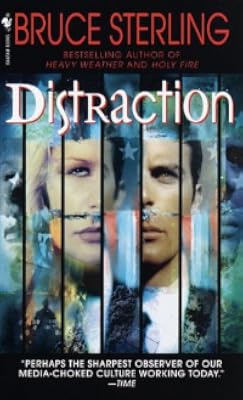
If you've never read Sterling, I suggest Distraction for a first try, but this novel well displays his talents. show less
Once, there were seven of them, seven identical sisters, all clones of their sinister mother, being raised to wield power in the mid twenty first century. One of the many, bloody conflicts stemming from the world climate crisis killed three, and scattered the remaining four across the globe, while their mother retreated to an orbital habitat. As we meet each, we see another view of the high-tech, devasted world of 2065, a decade after their parting.
Vera has joined a project to reclaim, from environmental damage, the Adriatic Sea island where she and her sisters were raised. She works with intrusive neural technologies that enhance people's capabilities while leaving show more them no privacy. Radmila has married into a wealthy, civic-minded Los Angeles show-business dynasty, selling distraction to the global media. Sonja has lived in China, Earth's last true nation-state, working to rescue the survivors of terrible droughts and other disasters. Biserka - well, Biserka causes a great deal of trouble for the other three.
All Sterling's usual interests are here: the strangeness of social and technological trends we take for granted, the contrast beween how things work and how we think about them, the possible forms posthumanity might take, the ferocious consequences of ignoring climate change, the love of a good one-liner:
Radmila walked the artificial beach, vamped before the floating cameras, and gazed into the sun-glittering Pacific. Six lunatics were surfing out there. For the life of her, Radmila could not understand surfers in Los Angeles. Obviously riding on a wave was a nice stunt performance, but inside the ocean? There were whole chunks and shoals of broken China bobbing around out there, all glass, nails, slime, and toxic jellyfish.
[...]
Radmila was looking sexy today, as contractually required. Looking sexy was a basic theatrical craft. [...]
Certain men direly wanted to have sexy sex with professionally beautiful women: sex with the stars. Those men were delusionary. Sex with a star was an awful idea, like having sex with a rosebush. You were not supposed to get in bed with a rosebush.
Environmental terror and a witty observation in one short passage. For an observation on posthumanity, take this exchange between Radmila's husband and Vera, who, like everyone in her project, voluntarily wears a brain-scanning helmet for operating machinery and monitoring herself and others:
Montalban looked at her soberly. "You really look a lot prettier without that canteen on your head."
"Scanning helps me. It is a powerful tool."
"That," said Montalban, "is why that tool has been restricted to a very small group of users in an otherwise hopeless situation."
She could see that her tears were affecting him strongly. His face had grown much softer. He looked thoughtful and handsome, truly sympathetic. He looked at her as if he loved her more than anything in the world.
"If you never scan your own brain," said Vera, wiping at her cheeks, "how do you know what you feel about all this?"
I'm not sure if Sterling means this as satire. We do misunderstand our own motivations, and maybe that'd be harder with a continuously updated display of what major brain centers show about our emotions. Here as always, Sterling is brilliant on envisioning the profound (or are they?) changes wrought by technology.
But the focus of the novel remains on the women, who are all, really, unreliable narrators. Just behind them, a bit out of focus but present, is a world in which the population of China has dropped by half over twenty years, and all our technology still leaves the issue of human survival in doubt.
If you've never read Sterling, I suggest Distraction for a first try, but this novel well displays his talents. show less
Absent from mention of Publisher's Weekly review by Greg Bear is the ubiquity of poverty, death and despair throughout all areas of the world that acts as a constant background noise in contrast with the glamour and privilege of the protagonists. Moreover, the dual-edged sword of ubiquity of computers/computing and its resulting surveillance and lack of privacy is examined (but not solved); through the three main characters, Sterling paints a triptych of what the near future might be were our world, our bodies, our minds to become networked and assisted by computers. I found the most enjoyment from reading about the far-out technologies being tried (and many proven) to desperately combat challenges on an Earth in profound ruin from the show more results of global climate change.
The narrative, characteristic of this author, runs fast, with new ideas and words to trip you up along the way...it's a fun, tech-heavy, bouncy ride, but when it's all over you are left sitting, a bit bored, in the roller coaster car, wondering when the carny's coming back to let you out.
I recommend this book if you love ideas and tech and can enjoy reading it for ideas and tech alone. If you find you like it, definitely read [Holy Fire] too. show less
The narrative, characteristic of this author, runs fast, with new ideas and words to trip you up along the way...it's a fun, tech-heavy, bouncy ride, but when it's all over you are left sitting, a bit bored, in the roller coaster car, wondering when the carny's coming back to let you out.
I recommend this book if you love ideas and tech and can enjoy reading it for ideas and tech alone. If you find you like it, definitely read [Holy Fire] too. show less
There were a ton of great big ideas in this book, but the story wrapped around them was hard to follow. Each section was difficult to get invested in, and then it switched perspective to a new character. I was never quite sold on any of the characters by the time their section was done, and even with the book completely finished I still have a lot of unanswered questions. I feel like I could really love a TV or film adaptation, but as it stands I feel ambivalent about this one.
Lots of flowery writing. Too much flower, not enough soil... and the author got so busy making political commentary about environmental degradation, technological advancements gone awry, and capitalism as potential hero that the plot got lost.
The technology is believably futuristic and if it wasn't for all the childish "touchy-feelyness" and the green politics versus capitalism politics, I might have rated the story as an average one.
The technology is believably futuristic and if it wasn't for all the childish "touchy-feelyness" and the green politics versus capitalism politics, I might have rated the story as an average one.
The strongest characters in a Sterling novel since Distraction. He sometimes has trouble maintaining strong characterization while getting his ideas across. The ideas are interesting as always.
all the usual Sterling goodness, which I read as an ode to Southern Slav women
Members
- Recently Added By
Published Reviews
ThingScore 100
Bruce Sterling has been one of the most important and challenging writers in science fiction since 1977 -- and 32 years later, his books are progressively better, smarter and more important.
added by lampbane
Author Information

131+ Works 20,986 Members
Bruce Sterling is a recent winner of the Nebula Award and the author of the nonfiction book "The Hacker Crackdown" as well as novels and short story collections. He co-authored, with William Gibson, the critically acclaimed novel "The Difference Engine." He lives in Austin, Texas, with his wife and daughter. (Publisher Provided)
Awards and Honors
Work Relationships
Is contained in
Common Knowledge
- Dedication
- To Jasmina
- First words
- Poisons, pumped down here at enormous pressure, had oozed deep into the water table.
- Last words
- (Click to show. Warning: May contain spoilers.)He was even daring to hope for the best.
- Blurbers
- Doctorow, Cory
Classifications
Statistics
- Members
- 373
- Popularity
- 84,259
- Reviews
- 11
- Rating
- (3.11)
- Languages
- English
- Media
- Paper, Audiobook, Ebook
- ISBNs
- 2
- ASINs
- 2