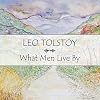
What Men Live By
by Leo Tolstoy
On This Page
Description
Settle in with a collection of tales from the pen of one of the world's most acclaimed authors, Leo Tolstoy. The stories brought together in What Men Live By and Other Tales tackle heady philosophical questions in an engaging, easy-to-read, almost fable-like format, highlighting Tolstoy's unique genius..
Tags
Recommendations







Member Reviews
Four late short stories by Tolstoy are a pleasant break from reading a Stalinist-era memoir. This collection includes a story of which James Joyce wrote: "[it] is the greatest story that the literature of the world knows". It is a rich group of parables which Tolstoy imbues with the passionate religious feeling of his later years.
The title story concerns a poor shoemaker named Simon and his wife who, moved by pity, take in a man Simon finds naked and hungry. The man rarely talks but turns out to have wonderful skill at making and repairing shoes. After six years of living and working with them the man is revealed as the angel Michael, who had disobeyed God and as a result had been sent to earth to live as a man until he learned three show more lessons. The first of these is what dwells in man (love); the second of these is what is not given to man (to know his own needs); and the third of these is what men live by:
The title story concerns a poor shoemaker named Simon and his wife who, moved by pity, take in a man Simon finds naked and hungry. The man rarely talks but turns out to have wonderful skill at making and repairing shoes. After six years of living and working with them the man is revealed as the angel Michael, who had disobeyed God and as a result had been sent to earth to live as a man until he learned three show more lessons. The first of these is what dwells in man (love); the second of these is what is not given to man (to know his own needs); and the third of these is what men live by:
I have now understood that though it seems to men that they live by care for themselves, in truth it is love alone by which they live. He who has love, is in God, and God is in him, for God is love.The second story, "Three Questions", is a brief tale of a King who goes to see a hermit to ask him, well, three questions that occupy his mind: when is the right time to begin any action, whom it is most important to listen to, and what is the most important thing to do.
Remember then: there is only one time that is important - Now! It is the most important time because it is the only time when we have any power. The most necessary man is he with whom you are, for no man knows whether he will ever have dealings with any one else, and the most important affair is, to do him good, because for that purpose alone was man sent into this life.The third story, "The Coffee House of Surat", is an engaging argument for religious brotherhood and tolerance that a great many people would do well to read 125 years now after it was published.
They all argued about the nature of God, and how He should be worshipped. Each of them asserted that in his country alone was the true God known and rightly worshipped...
"So on matters of faith," continued the Chinaman, the student of Confucius, "it is pride that causes error and discord among men. As with the sun, so it is with God. Each man wants to have a special God of his own, or at least a special God for his native land. Each nation wishes to confine in its own temples Him, whom the world cannot contain. Can any temple compare with that which God Himself has built to unite all men in one faith and one religion?
But in what temple is there such a font as the ocean; such a vault as that of the heavens; such lamps as the sun, moon, and stars; or any figures to be compared with living, loving, mutually helpful men? Where are there any records of God's goodness so easy to understand as the blessings which God has strewn abroad for man's happiness? Where is there any book of the law so clear to each man as that written in his heart? What sacrifices equal the self-denials which loving men and women make for one another? And what altar can be compared with the heart of a good man, on which God Himself accepts the sacrifice? The higher a man's conception of God, the better will he know Him. And the better he knows God, the nearer will he draw to Him, imitating His goodness, His mercy, and His love of man. Therefore, let him who sees the sun's whole light filling the world, refrain from blaming or despising the superstitious man, who in his own idol sees one ray of that same light. Let him not despise even the unbeliever who is blind and cannot see the sun at all."The final story, "How Much Land Does A Man Need?", is the story so well thought of by Joyce. It tells of a peasant who is provoked by the Devil to keep seeking ever more land for himself, greed continually making him envious of those he meets who seem to have found better fortune than him, filling his heart so that he cannot be happy with that which he already has, no matter how many times he "moves up in the world", so to speak. He ends up with a nomadic tribe of Bashkirs, a Turkic people in Southern Russia, whose Chief tells him that for a thousand rubles he can have all the rich virgin land of theirs that he can encircle on foot from sun up to sun down. The catch is that if he is not back at the starting point when the sun sets, he forfeits his money. Naturally, the peasant Pahom lets his greed get the better of him and walks too far away from the start/finish point. It is a brutally hot day and he forces himself to run as hard as he can once he realizes his error in order to try to make it back to the spot where the Chief and tribe wait. He barely makes it, as the Chief sits holding his sides in laughter, but the strenuous effort was too much, and he falls dead. His grave is dug right there, all six feet of it - all the land he needs. show less
Tolstoy's allegorical tale about a fallen angel, Michael, who (like many of us) believed he knew better than God. Michael is sent to earth naked and alone during a harsh Russian winter to discover what men live by. If Michael survives and makes this discovery, he can regain his wings and return to the heavenly realm. With his simple yet precise use of language, Tolstoy is a master storyteller! I loved this story so much and was unsuccessful at convincing my husband and children to read it that one year on a twenty hour road trip out west, I read it aloud to them. At first, they moaned and groaned but at the stories end, they admitted that they enjoyed it.
I first heard about this story in Cancer Ward, and I was immediately curious. Had I understood at the time how very short a story it is, I would have realized that the summary given by the characters in Cancer Ward pretty much covered the entire thing, but still, when I saw this charming little hardback at my favorite used bookstore, I was enchanted and couldn't pass it up.
What Men Live By is a parable/fairy tale -- and because it's by Tolstoy you know it will be religious, moral, and austere. I confess I have a lot of sympathy for his philosophy, so I could hardly fail to be charmed by this story, with or without its religious motivations.
What Men Live By is a parable/fairy tale -- and because it's by Tolstoy you know it will be religious, moral, and austere. I confess I have a lot of sympathy for his philosophy, so I could hardly fail to be charmed by this story, with or without its religious motivations.
I'm not religious, but these stories by Tolstoy certainly nudged me in that direction. An allegory about an angel who takes up residence with a poor shoemaker, Simon. The angel is being punished by God and needs to learn what men live by. Not self-interest, but love, is Tolstoy's answer. Trite idea, but not from the pen of a great writer. The other stories are equally compelling.
A simple story at first glance, narrated by the one of the world's most magnificent writers, so naturally, it couldn't have been "a simple story" but one with a profound message at the end. I can tell, though, that the story suffered in the process of translation and I am going to find the original Russian version.
Originally written for an audience of children, peasants, and the newly-literate, this short story is simple and easy to understand. It is a religious parable, but can be enjoyed by anyone as a critique of morality and the best way to live life. This work is entertaining the entire way through, and is surprising and thought-provoking on many levels. It can be interpreted as simply as it is written, or as philosophically as it was intended.
I found it a very entertaining and easy read. It is a basic philosophy book at its core with a religious theme. Reminds me of Aesop's Fables. I enjoyed it.
Members
- Recently Added By
Lists

Five star books
1,755 works; 108 members
Author Information

2,496+ Works 129,435 Members
Count Lev Nikolayevich Tolstoy was born on September 9, 1828 in Russia. He is usually referred to as Leo Tolstoy. He was a Russian author who is regarded as one of the greatest authors of all time. Leo Tolstoy is best known for his novels War and Peace (1869) and Anna Karenina (1877). Tolstoy's fiction includes dozens of short stories and several show more novellas such as The Death of Ivan Ilyich, Family Happiness, and Hadji Murad. He also wrote plays and numerous philosophical essays. Tolstoy had a profound moral crisis and spiritual awakening in the 1870's which he outlined in his work, A Confession. His literal interpretation of the ethical teachings of Jesus, centering on the Sermon on the Mount, caused him to become a fervent Christian anarchist and pacifist. His ideas of nonviolent resistance which he shared in his works The Kingdom of God is Within You, had a profund impact on figures such as Mohandas Gandhi and Martin Luther King, Jr. On September 23, 1862 Tolstoy married Sophia Andreevna Behrs. She was the daughter of a court physician. They had 13 children, eight of whom survived childhood. Their early married life allowed Tolstoy much freedom to compose War and Peace and Anna Karenina with his wife acting as his secretary and proofreader. The Tolstoy family left Russia in the aftermath of the Russian Revolution and the subsequent establishment of the Soviet Union. Leo Tolstoy's relatives and descendants moved to Sweden, Germany, the United Kingdom, France and the United States. Tolstoy died of pneumonia at Astapovo train station, after a day's rail journey south on November 20, 1910 at the age of 82. (Bowker Author Biography) Count Leo Tolstoy was born in 1828 on the family estate of Yasnaya Polyana in the Tula province. He married in 1862 & was the father of 13 children. Tolstoy managed the estate of Yasnaya Polyana & ran its peasant schools, while writing his great novels, "War & Peace" (1869) & "Anna Karenina" (1877). He died in 1910. (Publisher Provided) show less
Some Editions
Series
Belongs to Publisher Series
Work Relationships
Is contained in
Common Knowledge
Classifications
- Genres
- Fiction and Literature, General Fiction
- DDC/MDS
- 813 — Literature & rhetoric American literature in English American fiction in English
- LCC
- PG3367 .T8 .C520 — Language and Literature Slavic languages and literatures. Baltic languages. Albanian language Slavic. Baltic. Albanian Russian literature Individual authors and works 1800-1870 Tolstoi
- BISAC
Statistics
- Members
- 466
- Popularity
- 65,205
- Reviews
- 9
- Rating
- (3.81)
- Languages
- 7 — Chinese, English, German, Italian, Korean, Russian, Turkish
- Media
- Paper, Audiobook, Ebook
- ISBNs
- 71
- ASINs
- 27