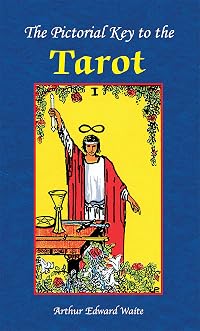
The Pictorial Key to the Tarot
by Arthur Edward Waite
On This Page
Description
Long used in telling fortunes and popular today among New Agers, Tarot cards are regarded by many as "the training wheels" on the bicycle of psychic development. Centuries of scientific progress have not diminished the irresistible attraction of gazing at picture cards to see the future and determine one's fate. This book by Arthur Edward Waite, the designer of the most widely known Tarot deck and distinguished scholar of the Kabbalah, is the essential Tarot reference. The pictorial key show more contains a detailed description of each card in the celebrated 78-card Rider-Waite Tarot deck, along with regular and reversed meanings. Contents describe symbols and secret tradition; the four suits of Tarot, including wands, cups, swords, and pentacles; the recurrence of cards in dealing; an ancient Celtic method of divination; as well as wonderful illustrations of Tarot cards. While the perfect complement to old-style fortune telling, The Pictorial Key to the Tarot also serves to make the Tarot entirely accessible to modern-day readers. It is also the classic guide to the Rider-Waite deck and to Tarot symbolism in general. show lessTags
Recommendations
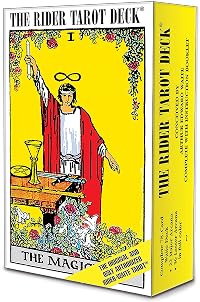







Member Recommendations
by anonymous user
by anonymous user
Member Reviews
"... the rectified and perfected tarot which accompanies this work." (page 33) a phrase which says much about its author, Edward Waite. A self-proclaimed "master" of arcane knowledge who pretentiously imposed his miscellanic recycled multi-sourced esoteric constructs, creating a distorted and childishly obvious beginner's pack of cards (RWS tarot deck) explicitly intended for the lowly divinatory use he repeatedly pretended to scorn.
Overall it's a mere set of Victorian/Edwardian caricatures of the ancient original tarot Renaissance symbolism. The gratuitously swapped "Force"/"Justice" numerals and the ugly ridiculous Wheel of Fortune card with irrelevant Egyptian, Hebrew, Arabic and obscure symbols sums-up this disgraceful deck.
Waite show more wasn't even original, copying most of the restricted and sometimes aleatory Alliette's (18th century made-up "Book of Thoth" card deck) card divination meanings and robbing some imagery of the genuine "Sola busca" Italian tarot of the Renaissance. Even the unsuspecting artist Pamela Smith seems to have been underpaid for her hard work (from her own account) all for the glory of Waite. Even the Rider company seem to have originally neglected to put Mrs. Smith name in the published pack's name ("Rider-Waite").
A very controversial pack of cards and this accompanying book which irremediably "polluted" the last century of the already more than six centuries old tarot tradition creating a large following of uninformed and misguided wannabe "tarologists" and fancy deck creators who by restricting themselves to Waite's pretentious lucubrations are condemned to remain permanently "in the dark".
A totally undeserved "classic". show less
Overall it's a mere set of Victorian/Edwardian caricatures of the ancient original tarot Renaissance symbolism. The gratuitously swapped "Force"/"Justice" numerals and the ugly ridiculous Wheel of Fortune card with irrelevant Egyptian, Hebrew, Arabic and obscure symbols sums-up this disgraceful deck.
Waite show more wasn't even original, copying most of the restricted and sometimes aleatory Alliette's (18th century made-up "Book of Thoth" card deck) card divination meanings and robbing some imagery of the genuine "Sola busca" Italian tarot of the Renaissance. Even the unsuspecting artist Pamela Smith seems to have been underpaid for her hard work (from her own account) all for the glory of Waite. Even the Rider company seem to have originally neglected to put Mrs. Smith name in the published pack's name ("Rider-Waite").
A very controversial pack of cards and this accompanying book which irremediably "polluted" the last century of the already more than six centuries old tarot tradition creating a large following of uninformed and misguided wannabe "tarologists" and fancy deck creators who by restricting themselves to Waite's pretentious lucubrations are condemned to remain permanently "in the dark".
A totally undeserved "classic". show less
I know that it isn't popular to like A. E. Waite in modern occultism, but I really do appreciate him. While some of his sincerest opinions are a bit ridiculous, most of his research is sound and he was clearly speaking from experience on a number of important points. His insight into the Tarot is second to none, though it should be noted that as a member of the Hermetic Order of the Golden Dawn, he was oathbound not to reveal certain secrets. Hence, some of his interpretations of the Minor Arcana are purposefully flip-flopped and some of the symbolism of the Major Arcana is incomplete. Those knowledgeable in the Tarot will find a lot of gold here, while those who are just beginning had best look elsewhere.
It should be noted that Waite considers the actual divinatory uses of his subject with some aversion. He prefers the 'higher' realms of thought and he seems to fancy-flowery rosy-intellectual philosophical sorts of sentences...
For all that, though, I think the boy has won his spurs more, or, at least, *at least as much* by what he has *permitted*, than by what he has thought or written or decided. It is clear to me, at least, and I think it's proven, even, that certain bits of it, say, Part III, Section 4, "Some Additional Meanings Of The Lesser Arcana", were actually written by certain others, which is really--if you think about it, right!--a rather shocking concession for a man like M. Waite, I mean, such a thing to *do*, after all, show more he protested so much, and so *earnestly* that it was really "the doctrine behind the veil" and not "the outer method of the oracles" which drew him, all the way back in distant 1909 or 1910 or 1911 or whenever this thing hit the presses of M. Rider for the first time.
And of course, you have to ask yourself, if he really loved the philosophical sort of esotericism as exclusively as he would have you believe if you actually believed some of the things he wrote--though that's really just words, and any student of myth ought to know what lies words are--well, if all that's so, why would he go out of his way to unveil what's now the most famous Tarot spread of them all, which even a newbie (and a boy!) like me now knows, I mean, what a thing to *do*, if he really scorned the oracles as much he said he did, back when the sun never set on the British Empire, and Queen Victoria wasn't even dead ten years yet, hell, she was hardly even cold, back then...
And the cards themselves are good.
(9/10) show less
For all that, though, I think the boy has won his spurs more, or, at least, *at least as much* by what he has *permitted*, than by what he has thought or written or decided. It is clear to me, at least, and I think it's proven, even, that certain bits of it, say, Part III, Section 4, "Some Additional Meanings Of The Lesser Arcana", were actually written by certain others, which is really--if you think about it, right!--a rather shocking concession for a man like M. Waite, I mean, such a thing to *do*, after all, show more he protested so much, and so *earnestly* that it was really "the doctrine behind the veil" and not "the outer method of the oracles" which drew him, all the way back in distant 1909 or 1910 or 1911 or whenever this thing hit the presses of M. Rider for the first time.
And of course, you have to ask yourself, if he really loved the philosophical sort of esotericism as exclusively as he would have you believe if you actually believed some of the things he wrote--though that's really just words, and any student of myth ought to know what lies words are--well, if all that's so, why would he go out of his way to unveil what's now the most famous Tarot spread of them all, which even a newbie (and a boy!) like me now knows, I mean, what a thing to *do*, if he really scorned the oracles as much he said he did, back when the sun never set on the British Empire, and Queen Victoria wasn't even dead ten years yet, hell, she was hardly even cold, back then...
And the cards themselves are good.
(9/10) show less
This book was written with Arthur Waite's famous tarot deck in mind, illustrated by Pamela Colman Smith (aka "Pixie).
I was hoping to find detailed description of the meaning of every detail found in the pictures. It left me rather disappointed. In his book, he explains many things about his cards, but he doesn't go as deep as I would have liked. At times he writes that he is not allowed to reveal deeper meanings he has learned in certain societies. This is rather disappointing.
Furthermore, Waite's writing style is not exactly easily understandable and condescending towards fellow writers about tarot.
However, there is still some benefit to this book. His comments on other works about tarot will save time to those who are interested in show more studying cartomancy. It is revealing in how the Rider-Waite (or rather Rider-Waite-Smith) deck is ground-breaking in this art. Waite sets the scene for our modern understanding of tarot and dispels myths about the history of the tarot cards. All criticism aside, it is a solid choice to learn about the basics of cartomancy. show less
I was hoping to find detailed description of the meaning of every detail found in the pictures. It left me rather disappointed. In his book, he explains many things about his cards, but he doesn't go as deep as I would have liked. At times he writes that he is not allowed to reveal deeper meanings he has learned in certain societies. This is rather disappointing.
Furthermore, Waite's writing style is not exactly easily understandable and condescending towards fellow writers about tarot.
However, there is still some benefit to this book. His comments on other works about tarot will save time to those who are interested in show more studying cartomancy. It is revealing in how the Rider-Waite (or rather Rider-Waite-Smith) deck is ground-breaking in this art. Waite sets the scene for our modern understanding of tarot and dispels myths about the history of the tarot cards. All criticism aside, it is a solid choice to learn about the basics of cartomancy. show less
Esoterism, via the undertakings of this book, negatively reinforces its position of authority. In an apparent attempt to ensure the latter's own ensuant demand (whether attributed to a more "significant" praxis or a willful seduction of the perpetually curious, superstitious masses), Arthur Waite altogether eschews and inverts certain intuitive insights as to the deeper meanings of the various tarot symbolisms under examination—albeit, in a no less peculiarly insightful manner. For any serious interpreter, the underlying rules for reading this particular tarot guide should include: in some instances, skepticism; in others, contrariety; and even, occasionally, elaborate deconstructive analysis à la Derrida. Taken as a general point of show more departure for tarot beginners, the text will unearth a few somewhat intriguing pathways to greater knowledge—combining, of course, a vigilant understanding that, typically, wherever Waite repudiates a given iconography, therein lies a veritable nexus of narrower routes to a more holistic apprehension of the vast Cosmos represented by this obscured-in-time, mysterious-yet-systematic discipline. show less
Waite is interesting, both because of his broad reading of all things occult and because of the contempt with which he holds most occultists. It's difficult to tell how much he believes anything. The Key is primarily a description of the tarot deck Waite designed. I was a little disappointed in that it doesn't discuss divination by tarot more; he doesn't seem to feel there's any validity to it, which of course is quite odd for someone who bothered to write a book on tarot. Waite draws on other tarot decks to a limited extent, but doesn't describe why he chooses particular symbols rather than others well enough, in my opinion. I think I would have preferred if he'd presented various old cards and then explained why he chose particular show more designs over others. But I suppose that would be outside the scope of the book, and would cost more to produce than he could have charged for such a popular work. show less
Good, basic, very early tarot learning based on the Rider/Waite deck, which is kind of the King James Version of Tarot (learn it, and you know the basics and can go on to other stuff).
This also happens to be the only book I ever in my life shoplifted. I took it from a mega bookstore at which I was working when the managers instituted a search everyone on entry and exit policy. Little paperback, 1.95 at the time. No, they didn't discover it in the extremely thorough search of my nice 20 something self. And I kept it. But I still feel a frisson of guilt. (it no longer exists, the stolen book; rain and mice got to it years ago).
This also happens to be the only book I ever in my life shoplifted. I took it from a mega bookstore at which I was working when the managers instituted a search everyone on entry and exit policy. Little paperback, 1.95 at the time. No, they didn't discover it in the extremely thorough search of my nice 20 something self. And I kept it. But I still feel a frisson of guilt. (it no longer exists, the stolen book; rain and mice got to it years ago).
Members
- Recently Added By
Author Information

213+ Works 5,639 Members
Arthur Edward Waite was born on October 2, 1857 in Brooklyn, New York. He was a poet and scholarly mystic who wrote extensively on occult and esoteric matters, and was the co-creator of the Rider-Waite Tarot deck. Waite joined the Outer Order of the Hermetic Order of the Golden Dawn in January 1891 after being introduced by E.W. Berridge. In 1899 show more he entered the Second order of the Golden Dawn. He became a Freemason in 1901, and entered the Societas Rosicruciana in Anglia in 1902. In 1903 Waite founded the Independent and Rectified Order R. R. et A. C. Waite was a prolific author and many of his works were well received in academic circles. He wrote occult texts on subjects including divination, esotericism, Rosicrucianism, Freemasonry, and ceremonial magic, Kabbalism and alchemy; he also translated and reissued several important mystical and alchemical works. His works on the Holy Grail, influenced by his friendship with Arthur Machen, were particularly notable. A number of his volumes remain in print, including The Book of Ceremonial Magic (1911), The Holy Kabbalah (1929), A New Encyclopedia of Freemasonry (1921), and his edited translation of Eliphas Levi's 1896 Transcendental Magic, its Doctrine and Ritual (1910), having seen reprints in recent years. Waite also wrote two allegorical fantasy novels, Prince Starbeam (1889) and The Quest of the Golden Stairs (1893). (Bowker Author Biography) show less
All Editions
Some Editions
Series
Belongs to Publisher Series
Work Relationships
Is a supplement to
Common Knowledge
- Canonical title
- The Pictorial Key to the Tarot
- Original publication date
- 1910
- First words
- The pathology of the poet says that "The undevout astronomer is mad"; the pathology of the very plain man says that genius is mad; and between these two extremes, which stand for ten thousand analogous excesses, the sovereign... (show all) reason takes the part of a moderator and does what it can.
- Last words
- (Click to show. Warning: May contain spoilers.)If he does,he will see also why I have concerned myself with the subject, even at the risk of writing about divination by cards.
- Canonical DDC/MDS
- 133.32424
Classifications
- Genres
- Nonfiction, Religion & Spirituality, General Nonfiction
- DDC/MDS
- 133.32424 — Philosophy & psychology Parapsychology & occultism Specific topics in parapsychology and occultism Divinatory arts Fortune-telling by crystals and stones; dowsing; fortune-telling by cards, tea leaves and coffee grounds, oracles and sibyls Fortune-telling by cards, tea leaves and coffee grounds, oracles and sibyls Fortune-telling by cards (Cartomancy) Fortune-telling by tarot
- LCC
- BF1879 .T2 .W3 — Philosophy, Psychology and Religion Psychology Occult sciences Fortune-telling
- BISAC
Statistics
- Members
- 1,412
- Popularity
- 16,787
- Reviews
- 19
- Rating
- (3.40)
- Languages
- 5 — English, German, Greek, Italian, Spanish
- Media
- Paper, Audiobook, Ebook
- ISBNs
- 57
- ASINs
- 40