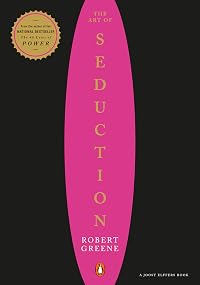
The Art of Seduction
by Robert Greene
On This Page
Description
Robert Greene's previous bestseller, The 48 Laws of Power, distilled 3,000 years of scheming into a guide People praised as 'beguiling. . . literate. . . fascinating' and Kirkus denounced as 'an anti-Book of Virtues. 'In Art of Seduction, Greene returns with a new instruction book on the most subtle, elusive, and effective form of power because seduction isn't really about sex. It's about manipulating other people's greatest weakness: their desire for pleasure. Synthesizing the work of show more thinkers including Freud, Diderot, Nietzsche, and Einstein, reporting the enticing strategies of characters throughout history, The Art of Seduction is a comprehensive guide to getting what we want any way we can. show lessTags
Recommendations






Member Reviews
Almost hypnotically repetitively at times, this might be the book that Machiavelli could have written about love if he had been a jaded modern.
Unfortunately for those determined to be 'nice' in the world, there is scarcely a line in this book that does not ring true.
For better or worse (depending on your stance), Greene is persuasive that seduction is a game between equal partners where the 'victim' is willing enough for what they will get out of the process.
It is about the flow of power between sexually alive people and no means to be compared with the 'game' genre of Neil Strauss and others.
Far more sophisticated than Strauss' manuals for adolescent losers and the sexually autistic, Greene is not interested in seduction as a show more mechanical application of rules for sex. He writes of art, not science.
What he is showing us is something closer to a dance or a ritual (think of the tango perhaps) which obeys rules derived from a deeper level of shared or unconscious desires and fears and where, while the sexual element is central, it is the process that matters.
The book is also pleasurable for entirely different reasons. Greene is master of the historical anecdote. Every chapter has well chosen illustrative examples from literature and history.
Although he does not preclude rational love between consenting adults by any means, there is enough evidence here of eternal truths about sexual relations which apply to male and female alike (albeit with different ‘modes’) and in homosexual liaisons as well.
We are talking here about a flow of power and desire between equals. There is no game if the other is not a free and equal participant. It is chess played by bodies in time and space.
One’s reaction to this book will come down to aesthetics and to anxiety. It is a very unromantic book by conventional and Anglo-Saxon standards but it is not reductionist about sex.
The person who will be entranced by this book will be the natural seducer, one who takes simple pleasure in pleasure and treats life like a game. I was not entranced, just interested and appreciative.
Many of the tales derive from high-ranking courtly cultures where seduction and romance were bound by rules of conduct that were strict enough to suggest appropriate behavior but not so strict as to introduce bourgeois guilt or shame into the game of sexual conquest.
Indeed, there is no room at all for shame or guilt, only for winning and losing … or perhaps for playing elegantly and still losing, more than winning too easily or in an ignoble way.
The attitude to sex is also counter-intuitive to Anglo-Saxon moderns. It is presented as a prize and not as some 'sacred' thing alienated from the bodies that couple. It is a fact on the ground. A pleasure.
Greene occasionally applies his analysis of technique to politics and there are many ‘democratic’ era cases of seductive power – Marilyn Monroe, Errol Flynn, Duke Ellington are all cited at length.
If the cynicism of his political analysis reminds us that people are stupid rather than eliciting admiration for the political seducers, when it comes to sex, there is no question of stupidity.
In every tale of sexual seduction, we are not dealing with coercion but with something like a willing suspension of disbelief where the seduced often gets precisely what they want, whatever the rest of us may think.
He refers to the festival and to the theatre often, but also to seduction as the means by which our 'dark side', which is important to us to recognise in order to be whole persons, is allowed full play.
I would add that the transgressive aspects of seduction can allow individuation to both parties – it would often seem that seducers get trapped in the game, while the seduced move on into something different.
Greene more than once tells stories that suggest that a seduction becomes an integral memory that moulds the future mind for the better, removing someone from past habits that do not reflect who they are.
Naturally ‘Les Liaisons Dangereuses’ pops up as a case study in more than one chapter (designed to be a sequence that draws you into the seduction process).
The Presidente de Tourvel is presented as being liberated from her boredom and obligations by the cynical seduction by Valmont. There is truth in this.
Greene is far too simplistic here about politics (one wishes he would just say ‘people are stupid’ and have done with it) but he is far from simplistic on sexual psychology.
He offers a sound corrective to moralists who, like repressed ideologues in politics, seem to leave more pain and suffering in their wake than do cynics and a-moralists.
Strangely and counter-intuitively, while some seducers come across as the worst sort of bully (D H Lawrence was an utter monster), others come across in quite a different way - providing a sort of liberatory service that costs them far more than it costs their alleged ‘victims’.
In short, seduction emerges to be morally far more interesting than we thought. Quite often we see the ostensible predator out-classed by a skilful 'victim' so that roles are reversed ...
If morality is good order as dictated by some Iron Age text, then seduction is to be consigned to the pits of hell. But if it is the hand-maiden or servant of creative individuation, then it is conventional morality that might stand in the dock.
Of course, nothing is so simple. Just as religion brings solace as well as repression, so some seducers are simply cynical and cruel while others are exciting and challenging.
This book is recommended not as a ‘how to’ (since, for most people, it is would be like reading a book on how to win an Olympic Medal), but as an insight into what we are as human beings.
If we all had developed the art of seduction and of being seduced to meet our own dark desires, then perhaps there might be a lot less boredom and neurosis in the world.
If we knew how to play our own part in the game with others who knew how to play theirs (if, in fact, the aristocratic court of Japan or Louis XVI became democratised with leisure and an instinct for pleasure for all) might not life be not only more interesting but less deadly dull?
But anyone who thinks that human beings are basically ‘good’, that ‘caring’ cannot become unutterably boring and intrusive or who thinks that most relationships can last forever without some transgression and hysteria will hate this book. It is only for grown-ups. show less
Unfortunately for those determined to be 'nice' in the world, there is scarcely a line in this book that does not ring true.
For better or worse (depending on your stance), Greene is persuasive that seduction is a game between equal partners where the 'victim' is willing enough for what they will get out of the process.
It is about the flow of power between sexually alive people and no means to be compared with the 'game' genre of Neil Strauss and others.
Far more sophisticated than Strauss' manuals for adolescent losers and the sexually autistic, Greene is not interested in seduction as a show more mechanical application of rules for sex. He writes of art, not science.
What he is showing us is something closer to a dance or a ritual (think of the tango perhaps) which obeys rules derived from a deeper level of shared or unconscious desires and fears and where, while the sexual element is central, it is the process that matters.
The book is also pleasurable for entirely different reasons. Greene is master of the historical anecdote. Every chapter has well chosen illustrative examples from literature and history.
Although he does not preclude rational love between consenting adults by any means, there is enough evidence here of eternal truths about sexual relations which apply to male and female alike (albeit with different ‘modes’) and in homosexual liaisons as well.
We are talking here about a flow of power and desire between equals. There is no game if the other is not a free and equal participant. It is chess played by bodies in time and space.
One’s reaction to this book will come down to aesthetics and to anxiety. It is a very unromantic book by conventional and Anglo-Saxon standards but it is not reductionist about sex.
The person who will be entranced by this book will be the natural seducer, one who takes simple pleasure in pleasure and treats life like a game. I was not entranced, just interested and appreciative.
Many of the tales derive from high-ranking courtly cultures where seduction and romance were bound by rules of conduct that were strict enough to suggest appropriate behavior but not so strict as to introduce bourgeois guilt or shame into the game of sexual conquest.
Indeed, there is no room at all for shame or guilt, only for winning and losing … or perhaps for playing elegantly and still losing, more than winning too easily or in an ignoble way.
The attitude to sex is also counter-intuitive to Anglo-Saxon moderns. It is presented as a prize and not as some 'sacred' thing alienated from the bodies that couple. It is a fact on the ground. A pleasure.
Greene occasionally applies his analysis of technique to politics and there are many ‘democratic’ era cases of seductive power – Marilyn Monroe, Errol Flynn, Duke Ellington are all cited at length.
If the cynicism of his political analysis reminds us that people are stupid rather than eliciting admiration for the political seducers, when it comes to sex, there is no question of stupidity.
In every tale of sexual seduction, we are not dealing with coercion but with something like a willing suspension of disbelief where the seduced often gets precisely what they want, whatever the rest of us may think.
He refers to the festival and to the theatre often, but also to seduction as the means by which our 'dark side', which is important to us to recognise in order to be whole persons, is allowed full play.
I would add that the transgressive aspects of seduction can allow individuation to both parties – it would often seem that seducers get trapped in the game, while the seduced move on into something different.
Greene more than once tells stories that suggest that a seduction becomes an integral memory that moulds the future mind for the better, removing someone from past habits that do not reflect who they are.
Naturally ‘Les Liaisons Dangereuses’ pops up as a case study in more than one chapter (designed to be a sequence that draws you into the seduction process).
The Presidente de Tourvel is presented as being liberated from her boredom and obligations by the cynical seduction by Valmont. There is truth in this.
Greene is far too simplistic here about politics (one wishes he would just say ‘people are stupid’ and have done with it) but he is far from simplistic on sexual psychology.
He offers a sound corrective to moralists who, like repressed ideologues in politics, seem to leave more pain and suffering in their wake than do cynics and a-moralists.
Strangely and counter-intuitively, while some seducers come across as the worst sort of bully (D H Lawrence was an utter monster), others come across in quite a different way - providing a sort of liberatory service that costs them far more than it costs their alleged ‘victims’.
In short, seduction emerges to be morally far more interesting than we thought. Quite often we see the ostensible predator out-classed by a skilful 'victim' so that roles are reversed ...
If morality is good order as dictated by some Iron Age text, then seduction is to be consigned to the pits of hell. But if it is the hand-maiden or servant of creative individuation, then it is conventional morality that might stand in the dock.
Of course, nothing is so simple. Just as religion brings solace as well as repression, so some seducers are simply cynical and cruel while others are exciting and challenging.
This book is recommended not as a ‘how to’ (since, for most people, it is would be like reading a book on how to win an Olympic Medal), but as an insight into what we are as human beings.
If we all had developed the art of seduction and of being seduced to meet our own dark desires, then perhaps there might be a lot less boredom and neurosis in the world.
If we knew how to play our own part in the game with others who knew how to play theirs (if, in fact, the aristocratic court of Japan or Louis XVI became democratised with leisure and an instinct for pleasure for all) might not life be not only more interesting but less deadly dull?
But anyone who thinks that human beings are basically ‘good’, that ‘caring’ cannot become unutterably boring and intrusive or who thinks that most relationships can last forever without some transgression and hysteria will hate this book. It is only for grown-ups. show less
This is a successful book. It is not a how-to for creating lasting, loving, intimate relationships of mutual respect and trust. Some of those may arise of their own accord out of the advice given in this book, but it is in fact a how-to for conquests. Notches on the belt or the bed-post. Luring victims, capturing their interest until they are sick with lust/love and can think only of you, pouncing on their vulnerability. The advice is smart, sexy, and mindful of gender equality. It conveys well the information it wishes to impart. Suggested reading for active and prospective sex workers.
There is a lot of fluff in this book. Most of the concepts are standard but dressed up in esoteric language to make the reader feel like he is reading a secret code. The book is a historical account of seduction methods in their many forms. The book does not function as an instructional manual unless one is willing to sit down and take notes, separating the wheat from the chaff.
Seduction is the most elusive, subtle and effective form of power that exists.
It is based on a simple fact of psychology: humans are perverse, stubborn creatures who by nature will rarely do what you want. If you try to force them, they resist. The best way to bypass their natural resistance is to hit at their weakest spot, what they can least control, their desire for pleasure. Stir such desires, pleasantly confuse and lead them astray, inflame them, and they will succumb to your will.
It is based on a simple fact of psychology: humans are perverse, stubborn creatures who by nature will rarely do what you want. If you try to force them, they resist. The best way to bypass their natural resistance is to hit at their weakest spot, what they can least control, their desire for pleasure. Stir such desires, pleasantly confuse and lead them astray, inflame them, and they will succumb to your will.
Excellent book. At times the author almost shocks with his blunt interpretations of the art of seduction. But, this is a fascinating historical, psychological work. It is well organized for both an interesting read and for later study. Great marginal quotes enrich the text. And, Greene's analysis of historical texts is succiently stated. I'll read it again.
Quyến rũ là hình thức tinh tế, khó nắm bắt và hiệu quả nhất của quyền lực. Điều này được nhìn thấy rõ ràng qua ảnh hưởng của Tổng thống Hoa Kỳ John E Kenneddy lên công chúng cũng như qua ảnh hưởng của nàng Cleopatra lên tướng Antony.
Nghệ thuật quyến rũ giúp chúng ta nắm bắt các tính cách và phẩm chất của 10 mẫu người điển hình có sức lôi cuốn người khác (trong đó có mẫu mỹ nhân, mẫu người tình lý tưởng, mẫu người công tử, mẫu hồn nhiên…) đồng thời liệt kê 24 chước mà ai cũng có thể sử dụng để bẻ gãy sự kháng cự của nạn nhân trước hình thức nghệ show more thuật đầy ấn tượng và không bị ảnh hưởng bởi thời gian này.
Nghệ thuật Quyến rũ là một quyển sách vỡ lòng cần thiết dạy ta cách thuyết phục người khác, một trong những vũ khí quan trọng nhất lịch sử và cũng là hình thức tối thượng của quyền lực. show less
Nghệ thuật quyến rũ giúp chúng ta nắm bắt các tính cách và phẩm chất của 10 mẫu người điển hình có sức lôi cuốn người khác (trong đó có mẫu mỹ nhân, mẫu người tình lý tưởng, mẫu người công tử, mẫu hồn nhiên…) đồng thời liệt kê 24 chước mà ai cũng có thể sử dụng để bẻ gãy sự kháng cự của nạn nhân trước hình thức nghệ show more thuật đầy ấn tượng và không bị ảnh hưởng bởi thời gian này.
Nghệ thuật Quyến rũ là một quyển sách vỡ lòng cần thiết dạy ta cách thuyết phục người khác, một trong những vũ khí quan trọng nhất lịch sử và cũng là hình thức tối thượng của quyền lực. show less
Great read by master in explaining by analogy, Robert Greene.
Uses historical stories to explain manipulative strategies that can be used to win lovers. Uses key archetypes that supposedly most people would fall within (or are a combination of).
Uses historical stories to explain manipulative strategies that can be used to win lovers. Uses key archetypes that supposedly most people would fall within (or are a combination of).
Members
- Recently Added By
Lists

The Joe Rogan Experience Library
254 works; 3 members

Men's healing resources
747 works; 1 member
Author Information

24+ Works 15,715 Members
Robert Greene was born on May 14, 1959 in Los Angeles, California. He attended the University of California, Berkeley before transferring to the University of Wisconsin-Madison, where he received a B.A. in classical studies. Before becoming an author, he worked a variety of jobs including construction worker, translator, magazine editor, and show more Hollywood movie writer. In 1995, he worked as a writer at Fabrica, an art and media school in Italy, and met a book packager named Joost Elffers. Greene pitched a book about power to Elffers and wrote a draft, which eventually became his first book, The 48 Laws of Power. His other works include The Art of Seduction, The 33 Strategies of War, The 50th Law, and Mastery. (Bowker Author Biography) show less
Work Relationships
Is contained in
Is abridged in
Has as a student's study guide
Common Knowledge
- Canonical title
- The Art of Seduction
- Original publication date
- 2001
Classifications
Statistics
- Members
- 2,409
- Popularity
- 8,103
- Reviews
- 19
- Rating
- (3.80)
- Languages
- 8 — Dutch, English, French, German, Greek, Italian, Portuguese, Spanish
- Media
- Paper, Audiobook, Ebook
- ISBNs
- 41
- UPCs
- 2
- ASINs
- 10