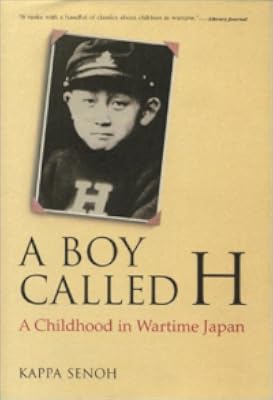
A Boy Called H: A Childhood in Wartime Japan
by Kappa Senoh
On This Page
Description
This is the fascinating true story of a Japanese boy's growing disillusionment with the conduct of a patriotic war. Boy H's father was a tailor, his mother a tambourine-banging Christian in a country of very few Christians. His childhood unfolded in the 1930s, when militarism was steadily strengthening its grip on Japan; it ended when the nation lay in ruins. What set H apart from other kids, despite the sharedpreoccupation with schoolmates, movies, and sex, was an unusually sharp eye and a show more precociously skeptical attitude that made him a bit of a loner in a conformist society. Though at times dark, his anecdotes are arranged with the lightest of touches and a sharp sense of humor. The total effect is of a rich, varied, and intensely readable novel, but one that involves real lives, actual events. show lessTags
Recommendations















Member Reviews
When you pick up this book, its size is intimidating. However, I became enthralled with it from the first page and looked forward to tackling its 500 plus pages at every opportunity. It is a novel but it is based on the experiences of Senoh living as a youth during the rise of the Japanese move to militarism in the 1930's and the disaster to which this led with the country's defeat in 1945.
The reader learns about the culture of the country and the education system as conducted before 1945. Through the eyes of a very unconventional and skeptical youth, we follow the rise of the military and and the corresponding power of the secret police. The similarity between Japans fear based society and Nazi Germany in the same time period, is show more fascinating. The leaders never seemed to realize how destructive to their goals this oppressive system was. Both countries entered the war already short of key resources to fight a long war. Both had already instituted rationing before the war. I know one reason for the war was to obtain those resources but leaders in both countries had been to America and knew about the industrial might that was there. Reading this volume definitely shows what a backward country both socially and industrially Japan was on entering the war.
The protagonist is a youth who is constantly questioning what he is told and with the aid of his father who is a Christian in a country that looks on Christianity as the religion of the enemy, quietly reinforces his son's doubts about government claims. show less
The reader learns about the culture of the country and the education system as conducted before 1945. Through the eyes of a very unconventional and skeptical youth, we follow the rise of the military and and the corresponding power of the secret police. The similarity between Japans fear based society and Nazi Germany in the same time period, is show more fascinating. The leaders never seemed to realize how destructive to their goals this oppressive system was. Both countries entered the war already short of key resources to fight a long war. Both had already instituted rationing before the war. I know one reason for the war was to obtain those resources but leaders in both countries had been to America and knew about the industrial might that was there. Reading this volume definitely shows what a backward country both socially and industrially Japan was on entering the war.
The protagonist is a youth who is constantly questioning what he is told and with the aid of his father who is a Christian in a country that looks on Christianity as the religion of the enemy, quietly reinforces his son's doubts about government claims. show less
I enjoyed this entertaining and educational book about an adventurous boy surviving WWII in Japan. It is a novel based on the author's experiences, and the reader should take into account that the historical perspective is often hindsight.
Ratings
Members
- Recently Added By
Author Information
10 Works 74 Members
Some Editions
Work Relationships
Has as a student's study guide
Common Knowledge
- Canonical title
- A Boy Called H: A Childhood in Wartime Japan
Classifications
- Genres
- Biography & Memoir, Literature Studies and Criticism
- DDC/MDS
- 809 — Literature & rhetoric Literature, rhetoric & criticism History, description, critical appraisal of more than two literatures
- LCC
- PL861 .E58 .S4613 — Language and Literature Languages and literatures of Eastern Asia, Africa, Oceania Languages of Eastern Asia, Africa, Oceania Japanese language and literature Japanese literature Individual authors and works
- BISAC
Statistics
- Members
- 40
- Popularity
- 732,858
- Reviews
- 2
- Rating
- (3.88)
- Languages
- English
- Media
- Paper
- ISBNs
- 2