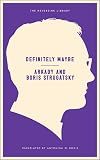
Definitely Maybe
by Arkady Strugatsky, Boris Strugatski, Boris Strugatsky (Author)
On This Page
Description
Originally written in 1974, Definitely Maybe is here presented in its first ever unexpurgated edition. Its protagonist, Dmitry Alekseyevich Malyanov is an astrophysicist; just as he begins to realise that he is on the verge of a revolutionary discovery worthy of a Nobel Prize, his life becomes plagued by strange events. Malyanov suspects that his discovery is in the way of someone (or something) intent on preventing the completion of his work. An explanation is proposed by Malyanov's friend: show more the force is the Universe's adverse reaction to mankind's scientific pursuit. show lessTags
Recommendations















Member Reviews
This work delves far deeper into the realm of self-awareness than into emotion, in comparison to Roadside Picnic, and despite its less detailed narrative, it places a much stronger focus on the characters and their thoughts. Interestingly, it can resonate both with someone afraid to follow their own path and afraid of finding friends and enemies alike, and with someone who has already given up in the name of something more “grounded.”
At the same time, the work feels more like a painting that conveys the mood of an idea rather than a profound abyss of meaning. Although two opposing worldviews are presented, they are shown primarily on the level of emotion, which is precisely why both are met with understanding within the story. Yet show more once you have fully grasped its themes and understood the people striving for the sake of their loved ones, it does not inspire you toward new horizons.
It is a pleasant work — throughout the reading there is a sense of unspoken understanding — but in the end it remains only a beautiful floral still life. show less
At the same time, the work feels more like a painting that conveys the mood of an idea rather than a profound abyss of meaning. Although two opposing worldviews are presented, they are shown primarily on the level of emotion, which is precisely why both are met with understanding within the story. Yet show more once you have fully grasped its themes and understood the people striving for the sake of their loved ones, it does not inspire you toward new horizons.
It is a pleasant work — throughout the reading there is a sense of unspoken understanding — but in the end it remains only a beautiful floral still life. show less
No, not the 2008 romantic comedy, though that was good too. :)
Written in 1977 in the Soviet Union under the title “A Billion Years Before the End of the World”, this is the story of a group of scientists who are on the verge of making important discoveries in their various fields, when their work is interrupted by a series of random events which range from the sensual to the ominous. There is an unseen force at work that threatens them, something they’ll never completely comprehend, though one of their more interesting speculations is that it’s the Universe organically ‘striking back’ against rationality and the advances of science, essentially in an entropic counterbalance, in order to maintain stasis.
The novella is show more described as “science fiction”, but it was a vehicle for the Strugatsky brothers to comment on life in the Soviet Union, a fact not lost on the censors at the time. The full text was not published until 2000, and just recently translated into English. It was a very personal story for them, one of the difficulties of having courage in the face of an oppressive power which is absurd, faceless, and blind. Some back down out of fear for themselves or their family, knowing that it’s wrong, will mean that they won’t be able to look their kids in the eyes the same way again, and that others will have to carry forward the fight without them. The spiritual desolation that results is captured in this haunting line which recurs: “I was told that this road would take me to the ocean of death, and turned back halfway. Since then crooked, roundabout, godforsaken paths stretch out before me.” show less
Written in 1977 in the Soviet Union under the title “A Billion Years Before the End of the World”, this is the story of a group of scientists who are on the verge of making important discoveries in their various fields, when their work is interrupted by a series of random events which range from the sensual to the ominous. There is an unseen force at work that threatens them, something they’ll never completely comprehend, though one of their more interesting speculations is that it’s the Universe organically ‘striking back’ against rationality and the advances of science, essentially in an entropic counterbalance, in order to maintain stasis.
The novella is show more described as “science fiction”, but it was a vehicle for the Strugatsky brothers to comment on life in the Soviet Union, a fact not lost on the censors at the time. The full text was not published until 2000, and just recently translated into English. It was a very personal story for them, one of the difficulties of having courage in the face of an oppressive power which is absurd, faceless, and blind. Some back down out of fear for themselves or their family, knowing that it’s wrong, will mean that they won’t be able to look their kids in the eyes the same way again, and that others will have to carry forward the fight without them. The spiritual desolation that results is captured in this haunting line which recurs: “I was told that this road would take me to the ocean of death, and turned back halfway. Since then crooked, roundabout, godforsaken paths stretch out before me.” show less
This book had been on my TBR for a long while. The back cover claims the Strugatsky brothers were the greatest science fiction writers of the Soviet era, so I was a little embarrassed to have not read them yet. Once I picked it up, I read the whole thing over my birthday weekend.
It starts out as almost a comedy of errors. Malianov, an astrophysicist, is on the brink of a breakthrough, but every time he sits down to work on his paper, a bigger and more demanding distraction interrupts him -- from wrong numbers to a surprise food delivery to neighbors dropping by to a criminal investigation. It starts to get suspicious when the friends drop in, who also have strange tales of interruptions and roadblocks sidetracking them from taking on show more bold new work. Things rapidly progress to competing conspiracy theories and alien vs. governmental control, and strong disagreements on whether it is safe, or if there is even a point to resist.
The story is very Soviet in nature and also sometimes Kafka-esque. There ends up being some meditating on the ties that bind -- those who have wives (of course only wives in this story, there are no female or LGBTQ scientists or engineers) and children and those who don't -- and how that impacts who has the luxury of both resistance and also dedicating themselves to research.
Messy, sometimes madcap, sometimes sinister. Always interesting. show less
It starts out as almost a comedy of errors. Malianov, an astrophysicist, is on the brink of a breakthrough, but every time he sits down to work on his paper, a bigger and more demanding distraction interrupts him -- from wrong numbers to a surprise food delivery to neighbors dropping by to a criminal investigation. It starts to get suspicious when the friends drop in, who also have strange tales of interruptions and roadblocks sidetracking them from taking on show more bold new work. Things rapidly progress to competing conspiracy theories and alien vs. governmental control, and strong disagreements on whether it is safe, or if there is even a point to resist.
The story is very Soviet in nature and also sometimes Kafka-esque. There ends up being some meditating on the ties that bind -- those who have wives (of course only wives in this story, there are no female or LGBTQ scientists or engineers) and children and those who don't -- and how that impacts who has the luxury of both resistance and also dedicating themselves to research.
Messy, sometimes madcap, sometimes sinister. Always interesting. show less
What an extraordinary book this is. Think Bulgakov combined with the Asimov of 'Asimov’s Mysteries' meets Wallace Shawn. It’s a wholly sustained SF novel set exclusively in an apartment. That description of course belies its scope and ambition. The very informative Afterword by Boris Strugatsky describes the first idea for the book as ‘“Faust, 20th century.” Hell and Heaven try to stop the development of science.’ Perfect. They carry it off.
A short but captivating tale of confusion on a cosmic scale, all taking place inside a few units of some undescribed soviet era apartment building. Vonnegut-esque with a Russian twist. This still feels very modern today here in America, possibly due to so much talk about government control and all of the paranoia that accompanies such talk. A novel from a time and place where there was actually that sort of government influence in everyday lives rings true in the cultural climate of America circa 2014. A very fun read, too.
Something is keeping leading scientists from getting any work done, threatening the future of scientific progress.
Is it a meddling alien civilization, intent on keeping the human race from ascendancy?
Is it an unyielding law of conservation, preserving order in an uncaring universe?
Is it an Era of Stagnation in a poorly-planned socialist economy?
This is an enjoyable little book, intent more on the human reaction to the ongoing interference than on its actual cause. One can even glimpse the novel's inspiration behind the mysterious events: an author, constantly distracted and interrupted by neighbors, friends, spouses, the telephone, the doorbell, and the relentless heat, wonders what it would be like if these were all part of a concerted show more effort, and what would that mean for the individual and for humanity.
N.B.: The title in Russian is apparently "One Billion Years Before the End of the World" (or Universe), which is drawn directly from the text, but which is somehow less evocative of its themes than the English edition title "Definitely Maybe". show less
Is it a meddling alien civilization, intent on keeping the human race from ascendancy?
Is it an unyielding law of conservation, preserving order in an uncaring universe?
Is it an Era of Stagnation in a poorly-planned socialist economy?
This is an enjoyable little book, intent more on the human reaction to the ongoing interference than on its actual cause. One can even glimpse the novel's inspiration behind the mysterious events: an author, constantly distracted and interrupted by neighbors, friends, spouses, the telephone, the doorbell, and the relentless heat, wonders what it would be like if these were all part of a concerted show more effort, and what would that mean for the individual and for humanity.
N.B.: The title in Russian is apparently "One Billion Years Before the End of the World" (or Universe), which is drawn directly from the text, but which is somehow less evocative of its themes than the English edition title "Definitely Maybe". show less
Completely bizarre...so just like Roadside Picnic, then...except, no, bizarre in a totally different way...
I feel a bit dense because it took until near the end for me to figure out what the allegorical/satirical point behind it all was. Having done so, I'm surprised it got published at all in the USSR.
Also, does that darned integral equal zero or not?!
I feel a bit dense because it took until near the end for me to figure out what the allegorical/satirical point behind it all was. Having done so, I'm surprised it got published at all in the USSR.
Also, does that darned integral equal zero or not?!
Members
- Recently Added By
Published Reviews
ThingScore 25
The Definitely Maybe is a novel by Arkady Strugatsky & Boris Strugatsky, published in 1974 or 1975. The version I've read is the Hungarian edition, published by Kozmosz Könyvek in 1978. It is a drama about researchers who face strange phenomena, hindering their works. I did not enjoy the book from the Strugatsky brothers, and I think there are better stories out there to read.
added by Kadmon06
Lists

Reading LIst
648 works; 1 member
Author Information

289+ Works 12,078 Members
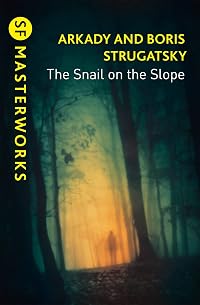
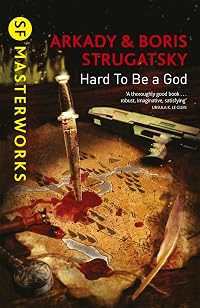
Popular science-fiction writers, the Strugatsky brothers have used the genre since the 1960s to comment on contemporary society, at times provoking major controversy. It's Hard to Be a God (1964) is a dysutopia with commentary on historical theories. The Snail on the Slope (1966--68) features a KGB-like organization and an extraordinarily show more oppressive atmosphere. Pre-glasnost, glasnost, some of the Strugatskys' major works had to be circulated in samizdat, but the brothers' situation is now dramatically better. (Bowker Author Biography) show less
7+ Works 1,662 Members

Popular science-fiction writers, the Strugatsky brothers have used the genre since the 1960s to comment on contemporary society, at times provoking major controversy. It's Hard to Be a God (1964) is a dysutopia with commentary on historical theories. The Snail on the Slope (1966--68) features a KGB-like organization and an extraordinarily show more oppressive atmosphere. Pre-glasnost, glasnost, some of the Strugatskys' major works had to be circulated in samizdat, but the brothers' situation is now dramatically better. (Bowker Author Biography) show less
Some Editions
Awards and Honors
Distinctions
Series
Belongs to Publisher Series
Work Relationships
Is contained in
Strugatzki Gesammelte Werke 2: Drei Romane in einem Band: Picknick am Wegesrand; Eine Milliarde Jahre vor dem Weltuntergang; Das Experiment by Arkadi Strugatzki
Piknik na obochine ;: Paren iz preispodnei ; Za milliard let do kontsa sveta ; Povest o druzhbe i nedruzhbe (Sobranie sochinenii) (Russian Edition) by Аркадий Натанович Стругацк
Common Knowledge
- Canonical title
- Definitely Maybe
- Original title
- За миллиард лет до конца света (One billion years to the end of the world) (One billion years to the end of the world); За миллиард лет до конца света
- Alternate titles
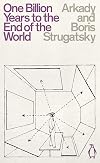
- One Billion Years to the End of the World
- Original publication date
- 1978 (English translation) (English translation); 1976
- People/Characters*
- Maljanow (Wissenschaftler), Valka Waingarten, Lidka Ponomorskaja (unerwarteter Besuch), Kaljam (Kater), (Wissenschaftler | unerwarteter Besuch | Kater)
- First words*
- ...weiße Juliglut, wie es sie seit zweihundert Jahren nicht mehr gegeben hatte, peinigte die Stadt.
- Last words*
- (Click to show. Warning: May contain spoilers.)Ende der Handschrift
- Original language
- Russian
*Some information comes from Common Knowledge in other languages. Click "Edit" for more information.
Classifications
- Genres
- Fiction and Literature, Science Fiction
- DDC/MDS
- 891.73 — Literature & rhetoric Literatures of other languages East Indo-European and Celtic literatures Russian and East Slavic languages Russian fiction
- LCC
- PG3476 .S78835 .Z3213 — Language and Literature Slavic languages and literatures. Baltic languages. Albanian language Slavic. Baltic. Albanian Russian literature Individual authors and works 1917-1960
- BISAC
Statistics
- Members
- 567
- Popularity
- 52,128
- Reviews
- 13
- Rating
- (3.85)
- Languages
- 15 — Czech, English, Estonian, Finnish, French, German, Hungarian, Italian, Japanese, Polish, Romanian, Russian, Spanish, Swedish, Turkish
- Media
- Paper, Ebook
- ISBNs
- 27
- ASINs
- 7