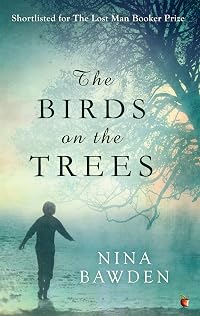
The Birds on the Trees
by Nina Bawden
On This Page
Description
The expulsion from school of their eldest son shatters the middle-class secutiry of Maggie, a writer, and Charlie, a journalist. Since childhood, Toby has been diffident and self-absorbed, but the threat of drug taking and his refusal (or inability) to discuss his evident unhappiness, disturbs them sufficiently to seek professional help. Veering between private agony and public cheerfulness, Maggie and Charlie struggle to support their son and cope with the reactions- and advice- of friends show more and relatives. Noted for the acuity with which she reaches into the heart of relationships, Nina Bawden here excels in revealing the painful, intimate truths of a family in crisis. Toby's situation is explored with great tenderness, while Maggie's grief and self-recrimination are rigorously, if compassionately, observed. It is a novel that raises fundamental questions about parents and their children, and offers tentative hope but no tidy solutions. show lessTags
Recommendations
















Member Reviews
Written and set in the early 1970s, this is ostensibly about Toby, who is expelled from his private school for taking pot, shortly before his 18th birthday and Oxford exams. However, all the most important relationships in the book are between mothers and daughters; the men are generally less astute and more passive.
The prologue has no immediately obvious relevance to the story outlined on the cover and above, and the rest of the book switches viewpoints and style quite often: a common technique nowadays, and one I'm familiar with, but I did find it slightly confusing at times in this book, partly because it wasn't always clear who was speaking or what their relationship with other characters was.
The family ticks along in a middle show more class way until Toby's expulsion exposes how troubled and dysfunctional they really are. The over-anxious Islington-type parents are desperate to understand, and their attempts at analysis give the story depth and complexity, but their relationships with their own parents and siblings impair their efforts. They (and all their friends) live vicariously through their children, project their own ambitions on them, then pathologise any discrepancies. Even a psychiatrist friend has demons of his own, makings his wife take tranquilizers "so HE can be bad-tempered with impunity."
Blame does not always lie where it first seems: there are secrets and skeletons, and those who know about them often pretend they don't. At times it feels as if almost everyone is trying to analyse everyone else, whilst hiding things about themselves - and getting it wrong. Which narrators can the reader trust?
A pivotal character is 12 year old Lucy, the middle child. Many sections are told by her, but she is inconsistently naive and knowing. She feels the pain and frustration of wanting to understand and help (whilst also being afraid of the truth), but being left out and ignored.
Yet other types of awkwardness are well described: teenage party encounters; first fumblings; fear that anything one says to a psychiatrist may be misinterpreted; in a disco/dance, "the young swayed separately; shut off from each other like autistic children"; meeting old school friends who only talk about (and live through) their children when you don't want to talk about yours.
I have no experience of drug taking, drug takers or nervous breakdowns, so I have no idea how plausible that aspect is; it seems a little melodramatic in places, but that may be a feature of the era as much as the chemicals and condition. But who can not be moved by the pain of "It was rather as if we had had a photograph of our son and it had suddenly been replaced by the negative: thin and transparent. And slightly blurred."
If this story were retold in the twenty-teens, it would be a little different, but I think the essential message would remain. Toby's father, Charlie, sums it up well: "All generations face, on the surface, much the same problems; each knows its situation to be unique. Ours, for example. Children before the war, emerged through it into parenthood, Freud in one hand, Spock in the other, into a world where truth is relative, uncertainty a virtue, nothing known... Except guilt, possibly. That is our hall-mark. Out parents did their duty, knew what was right; our sins were original, no fault of theirs."
The final wish (curse?) is perhaps impossible: "Be well, be happy". show less
The prologue has no immediately obvious relevance to the story outlined on the cover and above, and the rest of the book switches viewpoints and style quite often: a common technique nowadays, and one I'm familiar with, but I did find it slightly confusing at times in this book, partly because it wasn't always clear who was speaking or what their relationship with other characters was.
The family ticks along in a middle show more class way until Toby's expulsion exposes how troubled and dysfunctional they really are. The over-anxious Islington-type parents are desperate to understand, and their attempts at analysis give the story depth and complexity, but their relationships with their own parents and siblings impair their efforts. They (and all their friends) live vicariously through their children, project their own ambitions on them, then pathologise any discrepancies. Even a psychiatrist friend has demons of his own, makings his wife take tranquilizers "so HE can be bad-tempered with impunity."
Blame does not always lie where it first seems: there are secrets and skeletons, and those who know about them often pretend they don't. At times it feels as if almost everyone is trying to analyse everyone else, whilst hiding things about themselves - and getting it wrong. Which narrators can the reader trust?
A pivotal character is 12 year old Lucy, the middle child. Many sections are told by her, but she is inconsistently naive and knowing. She feels the pain and frustration of wanting to understand and help (whilst also being afraid of the truth), but being left out and ignored.
Yet other types of awkwardness are well described: teenage party encounters; first fumblings; fear that anything one says to a psychiatrist may be misinterpreted; in a disco/dance, "the young swayed separately; shut off from each other like autistic children"; meeting old school friends who only talk about (and live through) their children when you don't want to talk about yours.
I have no experience of drug taking, drug takers or nervous breakdowns, so I have no idea how plausible that aspect is; it seems a little melodramatic in places, but that may be a feature of the era as much as the chemicals and condition. But who can not be moved by the pain of "It was rather as if we had had a photograph of our son and it had suddenly been replaced by the negative: thin and transparent. And slightly blurred."
If this story were retold in the twenty-teens, it would be a little different, but I think the essential message would remain. Toby's father, Charlie, sums it up well: "All generations face, on the surface, much the same problems; each knows its situation to be unique. Ours, for example. Children before the war, emerged through it into parenthood, Freud in one hand, Spock in the other, into a world where truth is relative, uncertainty a virtue, nothing known... Except guilt, possibly. That is our hall-mark. Out parents did their duty, knew what was right; our sins were original, no fault of theirs."
The final wish (curse?) is perhaps impossible: "Be well, be happy". show less
Apparently Toby is a troubled teen (I think somewhere in the book it says he's 19, but then why is he getting kicked out of school at that old age?). His parents, Maggie and Charlie, don't really know what to do with him, but they get all sorts of comments and suggestions from their friends and family. This short novel is told from a variety of different character's points of view, but we never hear from Toby himself.
This novel started out very strong, but then fizzled into I don't know what. There are some well written and interesting bits, but overall it seemed rather pointless. Everyone is worried about Toby, but I couldn't see him actually doing anything extreme. I know lots of people who were asked to leave school and who smoked show more pot but still went on to become tax paying law abiding citizens with jobs and mortgages and children. And unlike Toby, none of them ended up in the psych ward of a hospital being treated for suspected schizophrenia that had been brought on by experimentation with marijuana and LSD.
In 2008, the people at the Booker Prize came up with an award called the Lost Booker so that they could honour some books published in 1970 that had missed out due to a rule change at that time. The Birds on the Trees was one of those Lost Booker nominees. I can't understand why, as I think it's dated, and not in a good Jane Austen-Virginia Woolf sort of way. show less
This novel started out very strong, but then fizzled into I don't know what. There are some well written and interesting bits, but overall it seemed rather pointless. Everyone is worried about Toby, but I couldn't see him actually doing anything extreme. I know lots of people who were asked to leave school and who smoked show more pot but still went on to become tax paying law abiding citizens with jobs and mortgages and children. And unlike Toby, none of them ended up in the psych ward of a hospital being treated for suspected schizophrenia that had been brought on by experimentation with marijuana and LSD.
In 2008, the people at the Booker Prize came up with an award called the Lost Booker so that they could honour some books published in 1970 that had missed out due to a rule change at that time. The Birds on the Trees was one of those Lost Booker nominees. I can't understand why, as I think it's dated, and not in a good Jane Austen-Virginia Woolf sort of way. show less
The drugs...why did he take them, that's the point! We must have failed him terribly...'
By sally tarbox on 25 Dec. 2013
Format: Paperback
I adored Nina Bawden's books as a child; this is her first adult work I've read.
It tells the story of Toby, child of middle-class academic parents, and always a little strange. Now aged 18, he's been expelled for his drug taking and long hair, leaving his family unsure how to proceed. From his little sister Lucy who adores him (Nina Bawden succeeds wonderfully in her depiction of the child: her resentment at no longer being noticed in light of the other disaster); his mother, who refuses to accept that her son doesn't want to go on to university; the relationships with friends and extended family...
I show more liked the author's style of having different 'voices' incorporated in the novel: sections written 'by' Lucy, the mother, the grandmother, expressing their feelings, thoughts, memories. I couldn't bear the pretentious, patronising parents. This was a well-written novel but I didn't massively enjoy it. show less
By sally tarbox on 25 Dec. 2013
Format: Paperback
I adored Nina Bawden's books as a child; this is her first adult work I've read.
It tells the story of Toby, child of middle-class academic parents, and always a little strange. Now aged 18, he's been expelled for his drug taking and long hair, leaving his family unsure how to proceed. From his little sister Lucy who adores him (Nina Bawden succeeds wonderfully in her depiction of the child: her resentment at no longer being noticed in light of the other disaster); his mother, who refuses to accept that her son doesn't want to go on to university; the relationships with friends and extended family...
I show more liked the author's style of having different 'voices' incorporated in the novel: sections written 'by' Lucy, the mother, the grandmother, expressing their feelings, thoughts, memories. I couldn't bear the pretentious, patronising parents. This was a well-written novel but I didn't massively enjoy it. show less
Dysfunctional family saga that was oddly disconcerting, Bawden packs a punch.
Engrossing and not dated.
Ratings
Members
- Recently Added By
Lists

Booker Prize
491 works; 62 members

Lost Man Booker Prize Longlist 1970
6 works; 2 members

Booker Prize Shortlist: Titles Not Yet Read
161 works; 4 members
Author Information

53+ Works 4,539 Members
Nina Bawden was born in Ilford, Essex, England on January 19, 1925. She received a B.A. in 1946 and a M.A. in 1951 from Somerville College, Oxford. During her lifetime, she wrote more than 40 books for both children and adults. Her first adult novel was published in 1953. Her books for adults include Circles of Deceit, The Ruffian on the Stair, show more and Dear Austen. Her first children's book The Secret Passage was published in 1963. Her children's books include Kept in the Dark, Humbug, The Birds on the Trees, Carrie's War, The Outside Child, Granny the Pag, and Off the Road. She received numerous awards for her work including the 1976 Guardian Children's Fiction Prize for The Peppermint Pig and the 1977 Yorkshire Post Novel of the Year Award for Afternoon of a Good Woman. She was made a CBE in 1995 and received the ST Dupont Golden Pen Award for a lifetime's contribution to literature in 2004. She died on August 22, 2012 at the age of 87. (Bowker Author Biography) show less
Awards and Honors
Awards
Series
Belongs to Publisher Series
Virago Modern Classics (369)
Common Knowledge
- Canonical title
- The Birds on the Trees
- Original title
- The Birds on the Trees
- Original publication date
- 1970
- People/Characters
- Toby; Maggie; Charlie; Lucy; Hermia
- Dedication
- To John Guest
with affection and gratitude - First words
- 'I hope we've done right,' Clara Tilney said.
- Last words
- (Click to show. Warning: May contain spoilers.)'But I promise it'll be better than this.'
Classifications
Statistics
- Members
- 147
- Popularity
- 222,807
- Reviews
- 5
- Rating
- (3.20)
- Languages
- English, German
- Media
- Paper, Audiobook, Ebook
- ISBNs
- 13
- ASINs
- 3