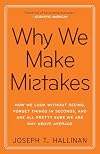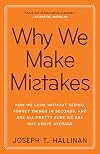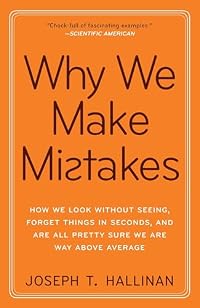
Why We Make Mistakes: How We Look Without Seeing, Forget Things in Seconds, and Are All Pretty Sure We Are Way Above Average
by Joseph T. Hallinan
On This Page
Description
Hallinan sets out to explore the captivating science of human error, and delves into psychology, neuroscience, and economics to discover why some of the same qualities that make us efficient also make us error-prone.Tags
Recommendations



Member Recommendations
LynnB A somewhat deeper examination of cognitive bias.
Member Reviews
This is an informative and often entertaining book about the psychology of decision-making and behaviour. If you are looking for advice on how to avoid making mistakes, this probably isn't the right book. However, it does have many thought-provoking sections and I may give more thought to minor decision-making.
One segment I found interesting was on the topic of finality vs the possibility of change.
"Hope impedes adaptation, meaning if you are stuck with something, you learn to live with it. Voters, for instance, have been shown to recognize the strengths of a candidate they opposed once that candidate is elected."
Looks like this will be put to the test in the US since the 2016 election results.
One segment I found interesting was on the topic of finality vs the possibility of change.
"Hope impedes adaptation, meaning if you are stuck with something, you learn to live with it. Voters, for instance, have been shown to recognize the strengths of a candidate they opposed once that candidate is elected."
Looks like this will be put to the test in the US since the 2016 election results.
This is a light, accessible book that gives an overview of why humans make mistakes, and how difficult it is to fix mistakes that are the result of ingrained processes that our brains have developed to make us more efficient. It treads over ground covered in such books as Predictably Irrational (Ariely), The Idiot Brain (Burnett), and The Design of Everyday Things (Norman). In fact, Norman even blurbs this book. (If you read Why We Make Mistakes and are interested in learning about affordances and constraints when designing products, definitely read The Design of Everyday Things.)
The book covers a lot of ground and provides a good starting point for reading about the weirdness of human behaviour; the bibliography at the back will show more provide further avenues to explore. show less
The book covers a lot of ground and provides a good starting point for reading about the weirdness of human behaviour; the bibliography at the back will show more provide further avenues to explore. show less
Another pop psychology synthesis of research into how humans understand and interact with the world. I enjoy finding out about how our mind interprets our sensations and creates a world around us. We often take for granted what we see, hear, and think about until we come across a book like this that shows how easily we can be mislead by others and ourselves.
An interesting book that I thought did a good job of summarizing the research and putting forward in a logical construction. Much better than Snoop.
An interesting book that I thought did a good job of summarizing the research and putting forward in a logical construction. Much better than Snoop.
This was the most comforting book I have read in a long while. It explains that our brains are wired in a certain way and so are the mistakes we all make. For example, names are hard to remember because they have very little meaning, other than as random syllables that indicate a certain person. We can remember their job or their family status or their connection to us much more easily because that has more content we can remember.
The book was full of that type of explanation for mistakes we all make. It suggests that instead of trying to change the way people are, we make adjustments for it to prevent errors; things like checklists and written reminders.
The book was full of that type of explanation for mistakes we all make. It suggests that instead of trying to change the way people are, we make adjustments for it to prevent errors; things like checklists and written reminders.
Interesting examination of some of the psychological principles behind human error. My two reservations are that the author sometimes seems to stop abruptly in explaining a concept and switch to a different topic. Perhaps he doesn't want to let the explanation get too involved? My other issue is that while many of the illustrating examples are entertaining, not all of them seem well-chosen to illustrate the principles he is trying to define. Often he attributes a certain action or situation to one principle that could have been influenced by many other variables. This seems like rather sloppy work to me.
Cognitive psychology is a fairly young discipline and as such, can only give vague, sweeping generalized answers to questions like “why do we make mistakes?” Hallinan’s book attempts to answer that question in an easy to read book that relates the results studies to the many types of mistakes we make. But it’s not a deep book. And it can’t be a deep book because everything anyone knows about how cognition works can be written in a few short sentences, one of which is “We don’t know how things work.”
I wanted more. I always want more from books like this. Aside from the common sense things like paying more attention to our surroundings and being more disciplined about not using our cell phones while driving or walking show more (that includes sending text messages), it turns out that some of our mistakes come from biases so deep there’s little chance of identifying them, must less fixing them.
One of the more interesting stories Hallinan writes about is the exact opposite of what I had been taught about test-taking. Many of us have had it drilled into us that going with our instinct and using our instincts is the best way to take a test, going back and second-guessing ourselves and changing the answer only hurts our score. But Hallinan says studies show differently. Anecdotally, I’m not sure I believe this. I’ve seen the “go with your gut” scenario play out far too many times to be willing to dismiss it completely; but I am willing to give Hallinan the benefit of the doubt.
I think that’s another problem with this book, one has to be willing to give the author the benefit of the doubt. Do anesthesiologists and radiologists really make that many mistakes? Or is there a bias in the presentation? Some of this stuff comes off a little slick and a little, “you have no idea how bad things are.” But in an era where so many believe the President of the United States somehow got into office without a valid birth certificate, I suppose it shouldn’t surprise me that Why We Make Mistakes could be viewed as just another attempt at skewed data.
If you want to read it, I’d say “enjoy, but keep the salt nearby.” show less
I wanted more. I always want more from books like this. Aside from the common sense things like paying more attention to our surroundings and being more disciplined about not using our cell phones while driving or walking show more (that includes sending text messages), it turns out that some of our mistakes come from biases so deep there’s little chance of identifying them, must less fixing them.
One of the more interesting stories Hallinan writes about is the exact opposite of what I had been taught about test-taking. Many of us have had it drilled into us that going with our instinct and using our instincts is the best way to take a test, going back and second-guessing ourselves and changing the answer only hurts our score. But Hallinan says studies show differently. Anecdotally, I’m not sure I believe this. I’ve seen the “go with your gut” scenario play out far too many times to be willing to dismiss it completely; but I am willing to give Hallinan the benefit of the doubt.
I think that’s another problem with this book, one has to be willing to give the author the benefit of the doubt. Do anesthesiologists and radiologists really make that many mistakes? Or is there a bias in the presentation? Some of this stuff comes off a little slick and a little, “you have no idea how bad things are.” But in an era where so many believe the President of the United States somehow got into office without a valid birth certificate, I suppose it shouldn’t surprise me that Why We Make Mistakes could be viewed as just another attempt at skewed data.
If you want to read it, I’d say “enjoy, but keep the salt nearby.” show less
The back cover categorises this book as "Popular Psychology". It covers the general topic of behavioural effects of the human mind makeup and the way this manifests in mistakes we make. It is a well condensed book with a good set of references/ sources. I have read several books in this field, but this still had several examples that were new to me. There are insert summary paragraphs thoughout and a good structure of quite small blocks of information, all with headers so that you are not wading through acres of print waiting for a point to come up for air. The only problem I had occasionally, and this in some ways made it more interesting, is that I'm European/British but this is written heavily to American cultural references. So show more that, for example, in the error case when familiarity means we don't remember details; the pictures and descriptions are of US coins. For geography, the example is California/ Nevada cities. Overall this didn't matter as I've seen reference examples for Europe (Italy slopes SEasterly much more that people assume so cities even halfway down like Rome will mindmap West of "East Europe" countries/ cities like Poland/ Hungary etc.), in fact this was a nice additional layer to the book for anyone that read already in this area. show less
Members
- Recently Added By
Lists

The Great Courses: Your Deceptive Mind
60 works; 1 member

Mind Expanding Books by hackerkid
581 works; 8 members
Author Information

3 Works 932 Members
Common Knowledge
- Original publication date
- 2009
- Epigraph
- Mike's belief, and I subscribe to it myself, is that at the exact moment any decision seems to be being made, it's usually long after the real decision was actually made—like light we see emitted from stars. Which means we ... (show all)usually make up our minds about important things far to soon and usually with poor information. But we then convince ourselves we haven't done that because (a) we know it's boneheaded, and no one wants to be accused of boneheaded-ness; (b) we've ignored our vital needs and don't like to think about them; (c) deciding but believing we haven't decided gives us a secret from ourselves that's too delicious not to keep. In other words, it makes us happy to bullshit ourselves. — Richard Ford, The Lay of the Land.
- Dedication
- For Jack, for Kate, for Anne, but most of all for Pam
To Howard K. Hess, the best friend a man could have - First words
- There are all kinds of mistakes.
- Last words
- (Click to show. Warning: May contain spoilers.)Forgetting that may be the biggest mistake of all.
- Blurbers
- Norman, Don
Classifications
Statistics
- Members
- 738
- Popularity
- 38,062
- Reviews
- 21
- Rating
- (3.60)
- Languages
- Dutch, English, Italian, Spanish
- Media
- Paper, Audiobook, Ebook
- ISBNs
- 13
- ASINs
- 2