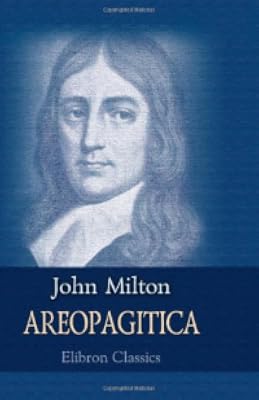
Areopagitica
by John Milton
On This Page
Description
Areopagitica: A speech for the Liberty of Unlicensed Printing to the Parliament of England is John Milton's famous tract against censorship. Published in 1644, Areopagitica is named after a speech by Isocrates, a fifth century BC Athenian orator. The work is counted as one of the most influential and inspired defenses of the right to freedom of expression in history. It is also a personal issue for Milton who was submitted to censorship himself when he tried to publish his defenses of show more divorce, radical works for the time that gained no quarter with censors. Distributed as a pamphlet, Milton's powerful arguments against 1643's Licensing Order note that classical Greek and Roman society was never subjected to such censorship, and he uses many classical and biblical references to reinforce his argument.. show less
Tags
Recommendations



















Member Reviews
I used Areopagitica as the basis for my term paper in one of my history courses. Milton was one of the first to claim the need for a free press as an essential check on the powerful. I purchased this copy when I was still in high school for 25 cents at a garage sale of a neighbour up the street.
An important piece of writing, but what a slog
This guy is the apologist for freedom of the press. An LSE Public Lecture Tribute to the late Roger Silverstone is the inspiration.
Milton's passion of liberty lasted throughout his life. Areopagitica is the literary embodiment of that passion and, to quote Harold Laski, remains "a majestic hymn to the power of truth to prevail over falsehood in the battle of ideas." -- The Classics of Liberty
La decisione di complicare la vita a me e alla mia societta è tutta mia. Traduciamo e ripubblichiamo l’areopagitica di Milton, probabilmente il primo testo sulla libertà di stampa. Testo breve, avvincente, in cui Milton condanna la decisione del Parlamento inglese di introdurre la censura preventiva con l’imprimatur, l’autorizzazione alla stampa. L’Areopagitica non è un testo giuridico, ma una sorta di poema sul valore del libro e, in genere, della libertà di espressione e di formazione del pensiero. La premessa è proprio nella contrarietà che Milton espone con linearità nell’ipotizzare un collegio chiamato a giudicare sulla qualità di un libro: con quali competenze, con quale autonomia di pensiero. Il pensiero show more dominante rischia di essere l’unico faro conduttore di un percorso che non può che generare una limitazione alla libertà di chi scrive e, di conseguenza, di chi legge. L’ottima introduzione dei due traduttori, Mariano Gatti e Hilary Gatti, aiuta a contestualizzare il testo anche se pone a me e alla societta un ulteriore problema sulla complessità del lavoro che ci accingiamo a fare. show less
Nov 29, 2020 (Edited)Italian
Trovo sempre più convincente la decisione di ripubblicare l’areopagitica di John Milton tra le attività della rivista. E di farlo utilizzando l’ottima traduzione di Salvatore Breglia. Perché è un modo per rendere omaggio ad un editore, ai tempi, coraggioso e per riscoprire l’enorme attualità del pensiero di Milton. La prosa rende l’Areopagitica una sorta di poema a difesa delle libertà. Il progetto è di rileggere le riflessioni di Milton alla luce dell’attualità e dei diversi contesti in cui inquadrare oggi la libertà di stampa e di opinione. Il potere di autorizzare la diffusione del pensiero si è mutuato dagli Stati alle grandi multinazionali che sono diventate, a loro volta, degli Stati senza confini. Il potere di show more censura di facebook o di google rischia di sostituire quello dei re e dei vescovi anglicani di una volta. Forse è arrivata la volta buona che entro nel merito delle mie divagazioni culturali oltre la consueta coltre di superficialità che contraddistingue, da sempre, la mia produzione scientifica che, infatti, di scientifico ha poco. Ho terminato di leggere questa edizione durante un ricovero quasi picaresco alla clinica Cobellis. È da lì che devo provare a fare ripartire una nuova fase della mia vita. Partendo da quello che mi rimane, un lavoro che funziona bene, un debito enorme, un fratello, una bella societta, Gennariella, un oceano felino e, comunque, la voglia di non mollare anche con la testa. show less
Mar 19, 2021Italian
Members
- Recently Added By
Lists

100 Books to Read in a Lifetime (That Are Older Than 200 Years)
415 works; 174 members

Libertarian Books
102 works; 19 members

Harold Bloom - The Western Canon: B. The Aristocratic Age
231 works; 13 members

Philip Ward's Lifetime Reading Plan
592 works; 22 members

Literary Works Read in College
316 works; 15 members

Western World's Greatest Books - Project Gutenberg
295 works; 15 members

How to Read a Book's Recommended Reading List
309 works; 10 members

Greatest Books, allegedly
484 works; 9 members
New Lifetime Reading Plan by Fadiman and Major
225 works; 5 members

Books You Read For University
184 works; 3 members

Book Titles Mentioned In Newberry Medal And Honor Books
884 works; 3 members

Recommended Reading : 600 Classics Reviewed, Editors of Salem Press, 2015
634 works; 6 members

Works Cited in The Life and Death of Democracy by John Keane
278 works; 1 member
Author Information

764+ Works 35,355 Members
John Milton, English scholar and classical poet, is one of the major figures of Western literature. He was born in 1608 into a prosperous London family. By the age of 17, he was proficient in Latin, Greek, and Hebrew. Milton attended Cambridge University, earning a B.A. and an M.A. before secluding himself for five years to read, write and study show more on his own. It is believed that Milton read evertything that had been published in Latin, Greek, and English. He was considered one of the most educated men of his time. Milton also had a reputation as a radical. After his own wife left him early in their marriage, Milton published an unpopular treatise supporting divorce in the case of incompatibility. Milton was also a vocal supporter of Oliver Cromwell and worked for him. Milton's first work, Lycidas, an elegy on the death of a classmate, was published in 1632, and he had numerous works published in the ensuing years, including Pastoral and Areopagitica. His Christian epic poem, Paradise Lost, which traced humanity's fall from divine grace, appeared in 1667, assuring his place as one of the finest non-dramatic poet of the Renaissance Age. Milton went blind at the age of 43 from the incredible strain he placed on his eyes. Amazingly, Paradise Lost and his other major works, Paradise Regained and Samson Agonistes, were composed after the lost of his sight. These major works were painstakingly and slowly dictated to secretaries. John Milton died in 1674. (Bowker Author Biography) show less
Awards and Honors
Series
Belongs to Publisher Series
Work Relationships
Common Knowledge
- Original publication date
- 1644
- First words
- They who to states and governors of the Commonwealth direct their speech, High Court of Parliament, or, wanting such access in a private condition, write that which they foresee may advance the public good; I suppose them, as... (show all) at the beginning of no mean endeavor, not a little altered and moved inwardly in their minds—some with doubt of what will be the success, others with fear of what wiIl be the censure; some with hope, others with confidence of what they have to speak. And me perhaps each of these dispositions, as the subject was whereon I entered, may have at other times variously affected; and likely might in these foremost expressions now also disclose which of them swayed most, but that the very attempt of this address thus made, and the thought of whom it has recourse to, has got the power within me to a passion far more welcome than incidental to a preface.
- Quotations
- This is true liberty, when freeborn men,
Having to advise the public, may speak freely,
And he who can and will, deserves high praise;
Who neither can nor will, may hold his peace;
What can be juster in a State th... (show all)an this?
Euripides —The Suppliants - Last words
- (Click to show. Warning: May contain spoilers.)But of these sophisms and refutations of merchandise I skill not. This I know, that errors in good government and in a bad are equally almost incident; for what magistrate may not be misinformed and much the sooner, if liberty of printing be reduced into the power of a few? But to redress willingly and speedily what has been erred, and in highest authority to esteem a plain advertisement
more than others have done a sumptuous bribe, is a virtue, honored Lords and Commons, answerable to your highest actions, and whereof none can participate but greatest and wisest men. - Disambiguation notice
- This is John Milton's >work< "Aeropagitica". Some >books< may have been published to include other >works< as well. However, please do not combine these editions of this work (Aeropagitica) with other works. Remember, we c... (show all)ombine works, not books.
Classifications
- Genres
- Nonfiction, Philosophy
- DDC/MDS
- 323.445 — Society, government, & culture Political science Civil Rights & Liberties/ Human Rights The state and the individual Liberty Freedom of the press
- LCC
- Z657 .M66 — Bibliography, Library Science and Information Resources Book industries and trade Freedom of the press. Censorship
- BISAC
Statistics
- Members
- 409
- Popularity
- 76,255
- Reviews
- 7
- Rating
- (3.91)
- Languages
- 10 — Catalan, Danish, English, Estonian, French, Italian, Norwegian (Bokmål), Portuguese, Spanish, Turkish
- Media
- Paper, Audiobook, Ebook
- ISBNs
- 70
- ASINs
- 20