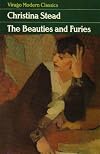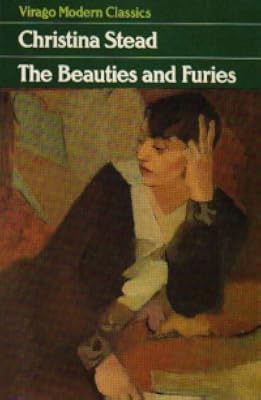
The Beauties and Furies
by Christina Stead
On This Page
Description
It is 1934. Elvira Western has left London and her dull marriage to Paul, a doctor, for Paris and her waiting lover, Oliver, a student radical. But drab hotels and interminable discussions of politics are not her idea of romance, and soon Elvira is longing to escape.Tags
Recommendations











Member Reviews
What a pleasant surprise to read such an intelligent novel set in 1930's Paris. Expert writing, a solid plot and verbal fireworks that outdo Anthony Burgess.
There are three principal characters, whose flaws are all drawn with high perception. Elvira Western has abandoned her dull married life in London and propelled herself into the vacuous charms of a young good-looking lover, Oliver who dabbles in socialist research. The third is dastardly, Marpurgo who insinuates himself with the pair and creates discord and destruction in Elvira's new arrangements. He also has the most fantastic dialogue at his disposal; Stead draws this vile piece of work so well.
Great book. Another hidden gem in Australian writing.
There are three principal characters, whose flaws are all drawn with high perception. Elvira Western has abandoned her dull married life in London and propelled herself into the vacuous charms of a young good-looking lover, Oliver who dabbles in socialist research. The third is dastardly, Marpurgo who insinuates himself with the pair and creates discord and destruction in Elvira's new arrangements. He also has the most fantastic dialogue at his disposal; Stead draws this vile piece of work so well.
Great book. Another hidden gem in Australian writing.
It’s not easy to explain how much pleasure there was in reading Christina Stead’s second novel The Beauties and Furies, (1936), published by Peter Davies, London in 1936. It is such a dynamic novel, rich with wonderfully complex characters and a compelling storyline, and all through it there are little surprises alluding to contemporary political events, which remind us that Europe was becoming alarmed about the rise of fascism.
As can be seen from the Opening Lines which I posted last week, the novel is set in Paris, and now that I’ve read the book, I know that those lines introduce the curious triangle of characters who dominate the action of the novel. The young woman on her way to Paris is Elvira Western, abandoning her husband show more in London to meet her lover Oliver Fenton, a student of socialism. The Italian gentleman is the villain of the piece, a Machiavellian pseudo-sorcerer, who interferes in the lives of others for the amusement of it. Elvira doesn’t know it yet, but he is going to cause all sorts of trouble…
The reader, however, knows from the very first chapter that the relationship with Oliver is doomed, and that is because Elvira exhibits signs of irritation and boredom already. Oliver is very interested in politics, but she’s not. She gets a crick in her neck from resting her head on his shoulder. She keeps mentioning her husband, and she smiles at Oliver’s vanity. And she bristles when he starts trying to remake her to suit Paris:
To read the rest of my review please visit https://anzlitlovers.com/2016/11/15/the-beauties-and-furies-by-christina-stead/ show less
As can be seen from the Opening Lines which I posted last week, the novel is set in Paris, and now that I’ve read the book, I know that those lines introduce the curious triangle of characters who dominate the action of the novel. The young woman on her way to Paris is Elvira Western, abandoning her husband show more in London to meet her lover Oliver Fenton, a student of socialism. The Italian gentleman is the villain of the piece, a Machiavellian pseudo-sorcerer, who interferes in the lives of others for the amusement of it. Elvira doesn’t know it yet, but he is going to cause all sorts of trouble…
The reader, however, knows from the very first chapter that the relationship with Oliver is doomed, and that is because Elvira exhibits signs of irritation and boredom already. Oliver is very interested in politics, but she’s not. She gets a crick in her neck from resting her head on his shoulder. She keeps mentioning her husband, and she smiles at Oliver’s vanity. And she bristles when he starts trying to remake her to suit Paris:
‘You’re beautiful,’ he said, but you don’t know how to dress. A French woman built like you would build up her bosom. I’ll take you to a dressmaker who will study your style and bring out your femininity. You kust go, the very first thing, to the Printemps, or to Antoine, and have your hair done too. Oh, you’ll spend fortunes on yourself before you’ve been in Paris long. You’ll be quite a different woman. You can dress, you know. You’ll be splendid when you’re dressed like a French woman. Everyone will say, How adaptable she is.’
She gave him a long surprised look and began to laugh.
‘Oliver, so I don’t suit you? You brought me over to make me a French woman. You’re an incredible chauvinist.’ (p. 13-14)
To read the rest of my review please visit https://anzlitlovers.com/2016/11/15/the-beauties-and-furies-by-christina-stead/ show less
Ratings
Members
- Recently Added By
Lists

Shaking a Leg
111 works; 3 members

Kirkus Starred Fiction Reviews of Books Published in 2017
412 works; 7 members
Author Information

24+ Works 3,512 Members
Author Christina Stead was born in Rockdale, New South Wales, Australia on July 17, 1902. She left Australia in 1928 and spent time in Europe, England, and the United States before permanently returning in 1974. She wrote fifteen novels and numerous volumes of short stories. She is best known for her novel, The Man Who Loved Children, which was show more based on her childhood. Her novels were unpublished in Australia until 1965 and she was denied the Britannica-Australia award in 1967 on the grounds that she was no longer considered an Australian. In 1974, she won the Patrick White award. While living in the United States during the 1940s, she worked as a Hollywood scriptwriter and contributed to Madame Curie and They Were Expendable. She died on March 31, 1983. (Bowker Author Biography) show less
Some Editions
Series
Belongs to Publisher Series
Work Relationships
Has as a commentary on the text
Common Knowledge
- Canonical title
- The Beauties and Furies
- Original publication date
- 1936
- First words
- The express flew towards Paris over the flooded March swamps.
The Beauties and Furies is the second novel, although the third book, written by Christina Stead. (Introduction) - Last words
- (Click to show. Warning: May contain spoilers.)She tossed back her unruly hair and looked at him earnestly.
Classifications
Statistics
- Members
- 99
- Popularity
- 326,717
- Reviews
- 2
- Rating
- (3.80)
- Languages
- English
- Media
- Paper, Ebook
- ISBNs
- 4
- ASINs
- 2