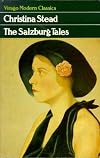
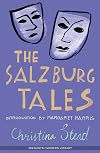
The Salzburg Tales
by Christina Stead
On This Page
Description
A group of visitors to the Salzburg Festival, brought together by chance, decides to mark time by telling tales. Their fantasies, legends, tragedies, jokes and parodies come together as The Salzburg Tales.Dazzling in their richness and vitality, the tales are grounded in Christina Stead's belief that 'the story is magical. what is best about the short story [is] it is real life for everyone; and everyone can tell one'. Originally published eighty years ago, these are thoroughly modern show more stories that invite comparison with Boccaccio's Decameron and Chaucer's The Canterbury Tales. The Salzburg Tales are published here with a new introduction by Margaret Harris, Challis Professor of English Literature Emerita at the University of Sydney, and literary executor for Christina Stead. show lessTags
Recommendations














Member Reviews
And why shouldn't we fill in our leisure hours this way, listening to tales! What a company we are! We come from every corner of the earth; we have seen the world; we know Life. Let us amuse each other."
This, I can confidently say, is one of the strangest books I have ever read.
I have long had a fascination-cum-adoration for Christina Stead, one of the most difficult writers to emerge from our Great Southern Continent, but even compared to her often violently idiosyncratic novels, The Salzburg Tales is a beguiling, deeply individual work. Over the course of 7 days, a bunch of socially disparate visitors to the annual Salzburg Festival (still occurring as of 2020, almost nine decades after the novel's publication) tell tales with each show more other, in a plot device that is consciously Boccaccio with a touch of Chaucer, and what tales they are.
Stead's stories have a much deeper fairytale element than Boccaccio's, seem to draw less on existing folk myth and more on a repository of subconscious Freudian ideas, buried tropes, and a limitless imagination. There is really no explaining the contents of this book as the stories often have no great power outside of the author's endlessly versatile prose. The marionettist who abandons his family for the glitzy life of an urbane sculptor, the dead wife whose golden statue takes her place in the mind of her late husband and his adulterous brother... the stories could easily fill the annals of O. Henry or John Cheever or, indeed, the works of R.L. Stine!
Here, however, Stead transforms these unsettling tales into something mystical yet earthy, intangible yet heartpoundingly visceral, abstract but sentimental. Her turns of phrase, unsurprisingly for those who have read her novels such as The Man Who Loved Children or Letty Fox: Her Luck are cuttingly precise, startlingly poetic. The absolute best, for my money, are those told in the first person. It saddens me that Stead didn't become a playwright; even reading some of the first-person stories out loud at home (hey, we commit weird acts during pandemic lockdown), I found myself close to tears with the poignancy and dare I say magical-realism of the experience.
Perhaps best read as a nightly story before bed, rather than rushed through for the sake of completion. These are delicacies to be savoured, jewels to be plucked from a box for quiet contemplation. Stead remains criminally underrated, but she is also an author one must approach on her terms - rather like a caged leopard. Look the wrong way, allow her to take control, and you may as well surrender your life. She writes on her terms; approach with caution. show less
This, I can confidently say, is one of the strangest books I have ever read.
I have long had a fascination-cum-adoration for Christina Stead, one of the most difficult writers to emerge from our Great Southern Continent, but even compared to her often violently idiosyncratic novels, The Salzburg Tales is a beguiling, deeply individual work. Over the course of 7 days, a bunch of socially disparate visitors to the annual Salzburg Festival (still occurring as of 2020, almost nine decades after the novel's publication) tell tales with each show more other, in a plot device that is consciously Boccaccio with a touch of Chaucer, and what tales they are.
Stead's stories have a much deeper fairytale element than Boccaccio's, seem to draw less on existing folk myth and more on a repository of subconscious Freudian ideas, buried tropes, and a limitless imagination. There is really no explaining the contents of this book as the stories often have no great power outside of the author's endlessly versatile prose. The marionettist who abandons his family for the glitzy life of an urbane sculptor, the dead wife whose golden statue takes her place in the mind of her late husband and his adulterous brother... the stories could easily fill the annals of O. Henry or John Cheever or, indeed, the works of R.L. Stine!
Here, however, Stead transforms these unsettling tales into something mystical yet earthy, intangible yet heartpoundingly visceral, abstract but sentimental. Her turns of phrase, unsurprisingly for those who have read her novels such as The Man Who Loved Children or Letty Fox: Her Luck are cuttingly precise, startlingly poetic. The absolute best, for my money, are those told in the first person. It saddens me that Stead didn't become a playwright; even reading some of the first-person stories out loud at home (hey, we commit weird acts during pandemic lockdown), I found myself close to tears with the poignancy and dare I say magical-realism of the experience.
Perhaps best read as a nightly story before bed, rather than rushed through for the sake of completion. These are delicacies to be savoured, jewels to be plucked from a box for quiet contemplation. Stead remains criminally underrated, but she is also an author one must approach on her terms - rather like a caged leopard. Look the wrong way, allow her to take control, and you may as well surrender your life. She writes on her terms; approach with caution. show less
Christina Stead is finally and thankfully going through a revival as new readers are introduced to her works. Australia seems to have a habit of not celebrating its female authors and it is wonderful to see this renewed focus.
Stead in my humble opinion is one of Australia’s greatest authors and having read this novel just seals the deal for me.
A group of strangers have a chance meeting at the Salzburg Festival and over seven days they tell stories. The tales involve tragedy, humour, fantasy and myth. The characters are beautifully realised It is an extraordinary collection of stories and I was moved, engaged and transported into these diverse lives.
The way that Stead captures the elements of a character in her personages’ show more introduction is just divine ‘her arms were thin, muscular and rough skinned as a shark’s fin with too much exercise.’ There are so many gems like this as they make reading such a joy.
I know I am going on with the platitudes but seriously when you place this book in context, the time it was written (1934) by an Australian female author who was even denied a literary prize based on the grounds that she had been so long overseas that she had ceased to be an Australian. You begin to realise just how much that is a novel of great ambition and I am not sure that any other writer that Stead could have pulled it off. It is an extraordinary piece of work.
Thanks to Netgalley for the opportunity to review. show less
Stead in my humble opinion is one of Australia’s greatest authors and having read this novel just seals the deal for me.
A group of strangers have a chance meeting at the Salzburg Festival and over seven days they tell stories. The tales involve tragedy, humour, fantasy and myth. The characters are beautifully realised It is an extraordinary collection of stories and I was moved, engaged and transported into these diverse lives.
The way that Stead captures the elements of a character in her personages’ show more introduction is just divine ‘her arms were thin, muscular and rough skinned as a shark’s fin with too much exercise.’ There are so many gems like this as they make reading such a joy.
I know I am going on with the platitudes but seriously when you place this book in context, the time it was written (1934) by an Australian female author who was even denied a literary prize based on the grounds that she had been so long overseas that she had ceased to be an Australian. You begin to realise just how much that is a novel of great ambition and I am not sure that any other writer that Stead could have pulled it off. It is an extraordinary piece of work.
Thanks to Netgalley for the opportunity to review. show less
I'm not quite sure what to make of this novel of a group of people at a festival in Salzburg who start talking to each and end up telling stories during afternoon wanderings. The influence of the Decamerone is obvious and acknowledged. There's a long chapter about the people, which I struggled through and didn't really remember any more when the group members were actually telling their stories. On the whole, interesting as something a bit different.
The novel is a series of short stories, each told from the view point of a different character and related to Salzburg. Some of the stories were enjoyable, others were tedious.
Ratings
Members
- Recently Added By
Lists

Shaking a Leg
111 works; 3 members
Author Information

24+ Works 3,512 Members
Author Christina Stead was born in Rockdale, New South Wales, Australia on July 17, 1902. She left Australia in 1928 and spent time in Europe, England, and the United States before permanently returning in 1974. She wrote fifteen novels and numerous volumes of short stories. She is best known for her novel, The Man Who Loved Children, which was show more based on her childhood. Her novels were unpublished in Australia until 1965 and she was denied the Britannica-Australia award in 1967 on the grounds that she was no longer considered an Australian. In 1974, she won the Patrick White award. While living in the United States during the 1940s, she worked as a Hollywood scriptwriter and contributed to Madame Curie and They Were Expendable. She died on March 31, 1983. (Bowker Author Biography) show less
Some Editions
Series
Belongs to Publisher Series
Virago Modern Classics (229)
Work Relationships
Has as a commentary on the text
Common Knowledge
- Canonical title
- The Salzburg Tales
- Original publication date
- 1934
- Important places
- Salzburg, Austria
- First words
- A fresh wind blew in from the woods, the pigeons massed in the Residenz Platz, tooting because the sky was bright, and the fountain dropped loudly on the weedgrown stones.
- Last words
- (Click to show. Warning: May contain spoilers.)After a moment, they ceased, and the twelve strokes of midnight were heard ; and thus the seventh day ended for the Salzburg guests.
Classifications
Statistics
- Members
- 133
- Popularity
- 246,348
- Reviews
- 4
- Rating
- (3.75)
- Languages
- English
- Media
- Paper, Ebook
- ISBNs
- 9
- ASINs
- 2