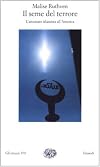
A Fury for God: The Islamist Attack on America
by Malise Ruthven
On This Page
Description
A respected scholar and bestselling writer on the subject of Islam examines what lay behind the attack of 11th September 2001.Tags
Recommendations


































Member Reviews
Ruthven’s book would make a good follow-up to any introductory book on Islam. (He assumes some knowledge, especially about Shia beliefs, but you can read the book without this.) Written in 2002 and updated in 2003, the book’s main focus is understanding Islamic radicalism (of the Sunni, Wahabi sort).
He defines Islamic militancy as characterized by an uneducated religiosity that advocates apocalyptic thinking, textualism rather than interpretation of the Quran, and the quixotic belief that virtue can work as a political principle. These ideas are then heated up by social anomie and technical sophistication into a volatile mix that has not benefited from a cultural evolution into modernity.
The philosophical underpinnings of radical show more Islam are well-covered: Maududi in Asia, and his most infamous disciple, Qutb in Egypt. Sayyid Qutb, Ruthven maintains, “more than any other recent Muslim writer … is the inspiration behind September 11th.”
Qutb’s idea of peace is not just security within a sphere of Islam, but “that all people should obey Allah alone, and every system that permits some people to rule over others be abolished.” For Qutb, internalized religion is weakness; as Ruthven summarizes, “the ‘spiritual’ jihad must give way to the ‘jihad of the sword.’” (Writing as he was in the face of colonialism and imperialism, one could relate a bit to why he might feel that way.)
Ruthven reviews different theories of sociological variables that contribute to militant behaviors in Islam. In particular, since Islam is a religion of orthopraxy (in which proper conduct, rather than proper belief, determines the path to salvation), it is no wonder that women are perceived as dangerous; giving in to one’s drives could scuttle one’s soul. On the other hand, not giving in to them results in a lot of pent-up frustration. (Religions, Ruthven notes astutely, are not just belief systems, but also communication systems “through which a great deal of human impulses are given expression.”) Ruthven also makes the fascinating point that violence in religions help give a sense of control to even the worst aspects of death.
Perhaps his most interesting and controversial chapter deals with Samuel Huntington’s theory that a “clash of civilizations” has become the dominant fissure in the world since the end of the Cold War. His response to Huntington incorporates a very provocative theory of the intimate and symbiotic relationship between Christianity and capitalism. He then invokes Benjamin Barber’s arguments in “Jihd versus McWorld” to show how that capitalism has gone bad, and that it is little wonder that Muslims get disaffected.
And what is to be done? Ruthven doesn’t have a lot of ideas except for cessation of support for Israel. His animosity towards Israel seems a little beyond a position of academic impartiality. He also stresses the importance of the secularization of politics, but observes that this process in the West took centuries of institutional evolution. In short, we’re probably in for more bad times, and Bush’s alienating invasion of Iraq and born-again fealty to Israel have not helped matters a bit.
(JAF) show less
He defines Islamic militancy as characterized by an uneducated religiosity that advocates apocalyptic thinking, textualism rather than interpretation of the Quran, and the quixotic belief that virtue can work as a political principle. These ideas are then heated up by social anomie and technical sophistication into a volatile mix that has not benefited from a cultural evolution into modernity.
The philosophical underpinnings of radical show more Islam are well-covered: Maududi in Asia, and his most infamous disciple, Qutb in Egypt. Sayyid Qutb, Ruthven maintains, “more than any other recent Muslim writer … is the inspiration behind September 11th.”
Qutb’s idea of peace is not just security within a sphere of Islam, but “that all people should obey Allah alone, and every system that permits some people to rule over others be abolished.” For Qutb, internalized religion is weakness; as Ruthven summarizes, “the ‘spiritual’ jihad must give way to the ‘jihad of the sword.’” (Writing as he was in the face of colonialism and imperialism, one could relate a bit to why he might feel that way.)
Ruthven reviews different theories of sociological variables that contribute to militant behaviors in Islam. In particular, since Islam is a religion of orthopraxy (in which proper conduct, rather than proper belief, determines the path to salvation), it is no wonder that women are perceived as dangerous; giving in to one’s drives could scuttle one’s soul. On the other hand, not giving in to them results in a lot of pent-up frustration. (Religions, Ruthven notes astutely, are not just belief systems, but also communication systems “through which a great deal of human impulses are given expression.”) Ruthven also makes the fascinating point that violence in religions help give a sense of control to even the worst aspects of death.
Perhaps his most interesting and controversial chapter deals with Samuel Huntington’s theory that a “clash of civilizations” has become the dominant fissure in the world since the end of the Cold War. His response to Huntington incorporates a very provocative theory of the intimate and symbiotic relationship between Christianity and capitalism. He then invokes Benjamin Barber’s arguments in “Jihd versus McWorld” to show how that capitalism has gone bad, and that it is little wonder that Muslims get disaffected.
And what is to be done? Ruthven doesn’t have a lot of ideas except for cessation of support for Israel. His animosity towards Israel seems a little beyond a position of academic impartiality. He also stresses the importance of the secularization of politics, but observes that this process in the West took centuries of institutional evolution. In short, we’re probably in for more bad times, and Bush’s alienating invasion of Iraq and born-again fealty to Israel have not helped matters a bit.
(JAF) show less
Ratings
Members
- Recently Added By
Lists

Non-Fiction Worth Reading
1,015 works; 260 members
Author Information

25+ Works 1,790 Members
Malise Ruthven is a writer and historian of the Islamic world. He has been a scriptwriter with the BBC Arabic and World Services and has taught Islamic Studies and Comparative Religion at the University of Aberdeen, the University of California and at Dartmouth. He is a frequent contributor to the New York Review of Books, among other show more publications, and is the author of several books, including Fury for God, Fundamentalism and Encounters with Islam (I.B.Tauris, 2012). show less
Classifications
- Genres
- Nonfiction, Religion & Spirituality, General Nonfiction, Politics and Government, History
- DDC/MDS
- 322.10917671 — Society, Government, and Culture Political science Relation of the state to organized groups and their members Religious organizations and groups Biography And History
- LCC
- HV6432 .R88 — Social sciences Social pathology. Social and public welfare. Criminology Social pathology. Social and public welfare. Criminology Crimes and offenses
- BISAC
Statistics
- Members
- 79
- Popularity
- 399,657
- Reviews
- 1
- Rating
- (3.80)
- Languages
- English, Italian
- Media
- Paper
- ISBNs
- 3