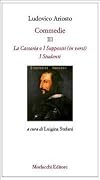
The comedies of Ariosto
by Lodovico Ariosto
On This Page
Tags
Members
- Recently Added By
Author Information

122+ Works 3,074 Members
Born in Reggio, Italy, in 1474, Ludovico Ariosto lived most of his life in Ferrara, in northern Italy. He enjoyed the patronage first of Cardinal Ippolito and then of the cardinal's brother, Alfonso, Duke of Este, who had been his inseparable companion in youth. Aristo composed a mock epic of chivalry titled Orlando Furioso. It appeared in 1516 show more and 1521 before the definitive edition of 1532. Hegel observed that Ariosto prepared the way for the treatment of chivalry in Cervantes's Don Quixote and Shakespeare's Falstaff in a gently veiled humor. A translation of Orlando Furioso into English heroic verse by Sir John Harrington was published in 1591, but by then Edmund Spenser had already sought to outdo Ariosto's epic in his own Faerie Queene. Walter Scott read a translation by John Hoole in 1783, and Byron drew on it for his Don Juan. In addition to the mock epic, Ariosto wrote many lyric poems in Latin and Italian, seven satires in terza rima, and five comedies in unrhymed lines of 11 syllables. His satires were read and imitated by Thomas Wyatt. One of his comedies, I suppositi, was translated and adapted into English by George Gascoigne and performed at Gray's Inn in 1566. It provided Shakespeare with much of the content and inspiration for The Taming of the Shrew. Ariosto died on July 6,1533. (Bowker Author Biography) Ludovico Ariosto was born on September 8, 1474 in Italy. Although his father had planned for him to have a legal career and he reluctantly studied law, he eventually turned to the study of literature. This was abruptly halted by the death of his father in 1500 and Ludovico, as the eldest, had to support his nine younger siblings. To this end, he spent the majority of his life in the service of the Este family of Ferrara. Ariosto wrote many popular plays, poems, and satires. The poem Orlando Furioso is his masterpiece and is considered one of the greatest embodiments of the literary and spiritual ideas of the Italian Renaissance. A long narrative written in octave stanzas, it consists of several episodes deftly modeled on epics, romances, and heroic poems. His seven Satires reveal his sorrow at his inability to complete his literary studies. Other works include Cassaria, La Lena, and I Suppositi, particularly notable because they were written in the vernacular. Ariosto spent his last years of life in Ferrara married to Alessandra Benucci, during which time he revised Orlando Furioso. He died on July 6, 1533. (Bowker Author Biography) show less
Classifications
- Genres
- Fiction and Literature, Literature Studies and Criticism
- DDC/MDS
- 852.3 — Literature & rhetoric Italian, Romanian & related literatures Italian drama Age of Leo the Tenth 1492–1542
- LCC
- PQ4582 .E5 .A4 — Language and Literature French, Italian, Spanish and Portuguese literatures Italian literature Individual authors, 1400-1700
Statistics
- Members
- 10
- Popularity
- 2,144,281
- Languages
- English, Italian
- Media
- Paper
- ISBNs
- 4