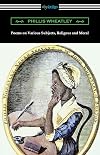
Poems on Various Subjects, Religious and Moral
by Phillis Wheatley 
On This Page
Description
Born in West Africa in approximately 1753, Wheatley was sold into slavery as a child and transported to the American colonies in 1761. She was bought by a wealthy Boston merchant named John Wheatley to serve as a servant to his family. They gave the young girl the name Phillis, after the ship that had transported her to America. The Wheatley family soon recognized her amazing intellect and talent and started giving her an education very unusual for a slave at that time. Wheatley was taught show more Greek, Latin, classic literature, and the Bible and began writing poetry at age 14. In 1773, when she was 20 years-old, Wheatley traveled to London with her owner's son and it was there that she published her first collection of poems, "Poems on Various Subjects, Religious and Moral". Her work was an instant success and the Wheatley family subsequently freed her from slavery. Wheatley's work reflects her African heritage, religious faith, and her classical education. Her elegant and contemplative odes and elegies are some of the most beautiful poems in early American literature. show lessTags
Recommendations




















Member Reviews
Not amazing, but historically significant. I find Phillis Wheatley's place in American literary history to be exceptionally interesting and nuanced, a slave turned artist turned prop turned forgotten tragedy. This book has some great writing in it, albeit clearly marked by it's era and not necessarily transcendent of that era's tendencies and shortfalls.
Poetically it isn't enough to stand on it's own, but the context is incredibly important. Worth owning and knowing about, moreso than worth reading and analyzing.
Poetically it isn't enough to stand on it's own, but the context is incredibly important. Worth owning and knowing about, moreso than worth reading and analyzing.
Gambia.
I learned little about Gambia, but, I think, much about colonization. The precocious Wheatley writes rhyming religious verse with occasional reference to being torn from her home as a child. I'm sure this was considered laudable and charming in its era. Reading it from this perspective, it's a testament to cultural overthrow and puts me strongly in mind of Anderson's [b:Octavian Nothing: The Pox Party|169762|The Pox Party (The Astonishing Life of Octavian Nothing, Traitor to the Nation, #1)|M.T. Anderson|http://photo.goodreads.com/books/1172369018s/169762.jpg|577024]. You can write prettily in Latin, and this may avail you some, but you're still a slave.
I learned little about Gambia, but, I think, much about colonization. The precocious Wheatley writes rhyming religious verse with occasional reference to being torn from her home as a child. I'm sure this was considered laudable and charming in its era. Reading it from this perspective, it's a testament to cultural overthrow and puts me strongly in mind of Anderson's [b:Octavian Nothing: The Pox Party|169762|The Pox Party (The Astonishing Life of Octavian Nothing, Traitor to the Nation, #1)|M.T. Anderson|http://photo.goodreads.com/books/1172369018s/169762.jpg|577024]. You can write prettily in Latin, and this may avail you some, but you're still a slave.
Derivative but all American poetry was then
The poems of Wheatley are as good as anything being written in the colonies at the time, and no worse than much British poetry of the 18th Century written by the average poet. That she was a slave and English her second language makes the quality if her writing exceptional. But I am not a big fan of the Classically allusive pomposity of much written at this time, so I cannot rate this collection more than okay.
As evidence of the racial brainwashing, this is an historical artifact worth reading.
The poems of Wheatley are as good as anything being written in the colonies at the time, and no worse than much British poetry of the 18th Century written by the average poet. That she was a slave and English her second language makes the quality if her writing exceptional. But I am not a big fan of the Classically allusive pomposity of much written at this time, so I cannot rate this collection more than okay.
As evidence of the racial brainwashing, this is an historical artifact worth reading.
Should you, my lord, while you peruse my song,
Wonder from whence my love of Freedom sprung,
Whence flow these wishes for the common good,
By feeling hearts alone best understood,
I, young in life, by seeming cruel fate
Was snatch'd from Afric's fancy'd happy seat:
What pangs excruciating must molest,
What sorrows labour in my parent's breast?
Steel'd was that soul and by no misery mov'd
That from a father seiz'd his babe belov'd:
Such, such my case. And can I then but pray
Others may never feel tyrannic sway?
Brought as a slave from Africa to America in 1761, Wheatley’s only schooling was in the family she served. Yet within twelve years she had begun writing these poems. The subjects vary from nature to the re-telling of a myth; many show more are written as memorials to people who have died. Though not of high literary value, they are historically significant. show less
Wonder from whence my love of Freedom sprung,
Whence flow these wishes for the common good,
By feeling hearts alone best understood,
I, young in life, by seeming cruel fate
Was snatch'd from Afric's fancy'd happy seat:
What pangs excruciating must molest,
What sorrows labour in my parent's breast?
Steel'd was that soul and by no misery mov'd
That from a father seiz'd his babe belov'd:
Such, such my case. And can I then but pray
Others may never feel tyrannic sway?
Brought as a slave from Africa to America in 1761, Wheatley’s only schooling was in the family she served. Yet within twelve years she had begun writing these poems. The subjects vary from nature to the re-telling of a myth; many show more are written as memorials to people who have died. Though not of high literary value, they are historically significant. show less
Born in Senegal, Phyllis Wheatley (1753-1784) was kidnapped age age 7and sold to Wheatleys in Boston.
Given encouragement and a strong education, she was sent to England to recover from Asthma.
Following her return, she became the first African American published Poet.
She bravely wrote about the horror of being stolen from her home, along with a lot of poetic Classical musing:
"Soon the same beauties should my mind adorn,
And the same ardors in my soul should burn;
Then should my song in bolder notes arise..."
Given encouragement and a strong education, she was sent to England to recover from Asthma.
Following her return, she became the first African American published Poet.
She bravely wrote about the horror of being stolen from her home, along with a lot of poetic Classical musing:
"Soon the same beauties should my mind adorn,
And the same ardors in my soul should burn;
Then should my song in bolder notes arise..."
I surprised myself by liking this one. I like her iambic pentameter, and her use of heroic couplets, and when she chooses not to do these things. Her poems are sprinkled throughout with mythological allusions, and, frankly, read more like renaissance poetry to me than 18th C. And I like renaissance poetry.
I surprised myself by liking this one. I like her iambic pentameter, and her use of heroic couplets, and when she chooses not to do these things. Her poems are sprinkled throughout with mythological allusions, and, frankly, read more like renaissance poetry to me than 18th C. And I like renaissance poetry.
Members
- Recently Added By
Lists

Books Read in 2026
2,061 works; 69 members
Author Information

30+ Works 723 Members
Seized in Senegal/Gambia, West Africa by slave traders, Phillis Wheatley arrived in Boston when she was about seven years old. Purchased as a domestic in 1761, by Susanna and John Wheatley, Phillis Wheatley was frail and asthmatic. Perhaps because of her delicate constitution, she was excused from the most tiring aspects of her domestic duties. show more Instead, she was taught to read and write and was instructed in the Bible and the classics. Before she was thirteen, Wheatley was writing poetry that gained quick and widespread acclaim; in 1770 she published her first poem---"An Elegiac Poem on the Death of that Celebrated Divine, and Eminent Servant of Jesus Christ, the Reverend and Learned George Whitefield"---a work that touched on the terrible conditions of her own Atlantic crossing. By 1772 Phillis Wheatley had compiled a collection of verse. Unfortunately, despite the best efforts of John and Susanna Wheatley, no publisher within the colonies was willing to print literature written by an African. Nonetheless, the Wheatleys persisted in their search, and through the intervention of Benjamin Franklin and various British sympathizers, including the abolitionist Earl of Dartmouth, they succeeded in finding a publisher for the work. Poems on Various Subjects, Religious and Moral was printed in London in 1772; it is the first collection of poetry written by an African American to be published. Three months before Susanna Wheatley died in 1774 she manumitted (freed) Phillis Wheatley. But with Susanna's death, the Wheatley family disintegrated, and Phillis Wheatley suffered from severe financial difficulties during the Revolutionary War. Despite the voiced misgivings of her friends, Phillis Wheatley married John Peters in 1778. Their marriage was troubled by penury and sickness; in 1784, John Peters was confined to jail because of debt. Wheatley bore three children. Of these, two died in infancy and the third outlived her mother by only a few days. Desperate for assistance, Wheatley worked as a charwoman and maid. Destitute, sick, and alone, Phillis Wheatley died in 1784; she was barely thirty. Wheatley wrote approximately 145 poems, including the 64-line work "Liberty and Peace," published as a pamphlet under the name of Phillis Peters. Criticized during the early part of this century for not more openly addressing the theme of slavery, Wheatley's work combines Christian imagery and classical typology with an undeniably elegiac tone. Recent scholarship suggests that her Biblical allusions and metaphors demonstrate an antipathy to slavery and that her elegant and educated verse served to undermine colonial institutions of power. (Bowker Author Biography) show less
Phillis Wheatley has a Legacy Library. Legacy libraries are the personal libraries of famous readers, entered by LibraryThing members from the Legacy Libraries group.
Work Relationships
Common Knowledge
- Canonical title
- Poems on Various Subjects, Religious and Moral
- Original publication date
- 1773-9-1
Classifications
Statistics
- Members
- 72
- Popularity
- 437,612
- Reviews
- 9
- Rating
- (3.06)
- Languages
- English
- Media
- Paper, Audiobook, Ebook
- ISBNs
- 24
- ASINs
- 8