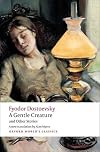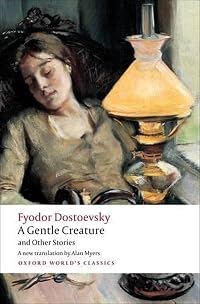
A Gentle Creature and Other Stories: White Nights; A Gentle Creature; The Dream of a Ridiculous Man (Oxford World's Classics)
by Fyodor Dostoyevsky 
On This Page
Description
In the stories in this volume Dostoevsky explores both the figure of the dreamer divorced from reality and also his own ambiguous attitude to utopianism, themes central to many of his great novels.In White Nights the apparent idyll of the dreamer's romantic fantasies disguises profound loneliness and estrangement from 'living life'. Despite his sentimental friendship with Nastenka, his final withdrawal into the world of the imagination anticipates the retreat into the 'underground' of many show more ofDostoevsky's later intellectual heroes. A Gentle Creature and The Dream of a Ridiculous Man show how such withdrawal from reality can end in spiritual desolation and moral indifference and how, in Dostoevsky's view, the tragedy of the alienated individual can be resolved only by the rediscovery of asense of compassion and responsibility towards fellow human beings.This new translation captures the power and lyricism of Dostoevsky's writing, while the introduction examines the stories in relation to one another and to his novels. show lessTags
Recommendations












Member Reviews
A Dostoievski tale where a love triangle is explored in the minimum psychological details. A humble clerk courts a woman who awaits her lover's return night after night. Actually, it shows the impact of a powerful passion on human behavior, it tries to explore the incredible power that love has on people's behavior, mainly when passion and irresistible attraction are present. The author tries to show that we are capable of believing anything as well as having childish attitudes when we are confronted with passion.
Jan 17, 2026English (UK)
Ratings
Members
- Recently Added By
Author Information

1,522+ Works 181,261 Members
One of the most powerful and significant authors in all modern fiction, Fyodor Dostoevsky was the son of a harsh and domineering army surgeon who was murdered by his own serfs (slaves), an event that was extremely important in shaping Dostoevsky's view of social and economic issues. He studied to be an engineer and began work as a draftsman. show more However, his first novel, Poor Folk (1846), was so well received that he abandoned engineering for writing. In 1849, Dostoevsky was arrested for being a part of a revolutionary group that owned an illegal printing press. He was sentenced to be executed, but the sentence was changed at the last minute, and he was sent to a prison camp in Siberia instead. By the time he was released in 1854, he had become a devout believer in both Christianity and Russia - although not in its ruler, the Czar. During the 1860's, Dostoevsky's personal life was in constant turmoil as the result of financial problems, a gambling addiction, and the deaths of his wife and brother. His second marriage in 1887 provided him with a stable home life and personal contentment, and during the years that followed he produced his great novels: Crime and Punishment (1886), the story of Rodya Raskolnikov, who kills two old women in the belief that he is beyond the bounds of good and evil; The Idiots (1868), the story of an epileptic who tragically affects the lives of those around him; The Possessed (1872), the story of the effect of revolutionary thought on the members of one Russian community; A Raw Youth (1875), which focuses on the disintegration and decay of family relationships and life; and The Brothers Karamazov (1880), which centers on the murder of Fyodor Karamazov and the effect the murder has on each of his four sons. These works have placed Dostoevsky in the front rank of the world's great novelists. Dostoevsky was an innovator, bringing new depth and meaning to the psychological novel and combining realism and philosophical speculation in his complex studies of the human condition. (Bowker Author Biography) show less
Fyodor Dostoyevsky has a Legacy Library. Legacy libraries are the personal libraries of famous readers, entered by LibraryThing members from the Legacy Libraries group.
Some Editions
Work Relationships
Classifications
- Genres
- Fiction and Literature, General Fiction
- DDC/MDS
- 891.733 — Literature & rhetoric Literatures of other languages East Indo-European and Celtic literatures Russian and East Slavic languages Russian fiction 1800–1917
- LCC
- PG3326 .A2 — Language and Literature Slavic languages and literatures. Baltic languages. Albanian language Slavic. Baltic. Albanian Russian literature Individual authors and works 1800-1870 Dostoyevsky
- BISAC
Statistics
- Members
- 267
- Popularity
- 121,595
- Reviews
- 1
- Rating
- (4.11)
- Languages
- English, Portuguese, Russian
- Media
- Paper, Ebook
- ISBNs
- 6
- ASINs
- 4