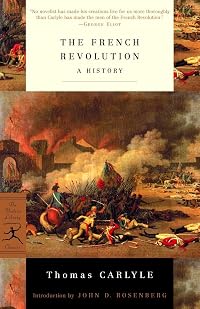
The French Revolution: A History
by Thomas Carlyle
On This Page
Description
The book that established Thomas Carlyle’s reputation when first published in 1837, this spectacular historical masterpiece has since been accepted as the standard work on the subject. It combines a shrewd insight into character, a vivid realization of the picturesque, and a singular ability to bring the past to blazing life, making it a reading experience as thrilling as any novel. As John D. Rosenberg observes in his Introduction, The French Revolution is “one of the grand poems of show more [Carlyle’s] century, yet its poetry consists in being everywhere scrupulously rooted in historical fact.” This Modern Library Paperback Classics edition, complete and unabridged, is unavailable anywhere else. show lessTags
Recommendations


















Member Reviews
Perhaps the most remarkable thing to note about Carlyle's masterpiece is that he had to rewrite from scratch the first volume of the work after the only copy he had was accidentally lost in a fire at the home of John Stuart Mill with whom he had left the copy for his review and comment. Carlyle is famous for his idiosyncratic style which is demanding and captivating. His politics were not that easy to get a fix on. He is frequently described as a Tory Radical or radical conservative. He is one of the few modern writers who subscribe to what is referred to as the "Great Man" theory of history, but he is also clearly influenced by German Idealism and subscribes to a philosophy of history that is based on the notion of a spirit of the show more times and the progress of ideas and movements that is inexorable.
In his history of the French Revolution, Carlyle covers the period from the latter stages of the rule of Louis XV through the famous "Whiff of Grapeshot" employed by Napoleon Bonaparte to quell the uprising of the Jacobins against the National Convention in the aftermath of the downfall of Robespierre and his associates. This is about as close to a day to day or play by play of the events of the revolution as you are likely to encounter. It bears no resemblance to the typical academic history of the revolution, much less the typical textbook treatment of this world historical event. In Carlyle's retelling which was published a mere twenty-two years after the Battle of Waterloo you are introduced to what seems like the proverbial "cast of thousands". Anyone who was anyone appears on Carlyle's stage and his or her role is accounted for and judged according to his influence and merit. On the whole Carlyle is, if not on the side of, definitely sympathetic to the Revolution. The historicist in him seems to require that he pronounce in favor of what is, because it was, a movement, a spirit, an energy whose time had come and was accordingly irresistible. There is no sympathy expressed for the institutions and actors of the ancien regime, although one does detect a certain admiration for the character of Marie Antoinette. Louis XVI, on the other hand, is doomed by the circumstances he is unequipped to deal with and a Hamlet like inability to make up his mind to follow through on a plan of action. He is reduced to a passive, hope for the best, response at every major turning point where a different course of action might have salvaged his situation.
Carlyle takes a harsh attitude toward the nobility and the clergy. He frequently employs the epithets Jesuitical and Jesuitism to criticize anyone of either a royalist or moderate republican bent. He is dismissive of the emigres, approves of the abolition of feudalism. His sympathies are with what he constantly refers to as the 'twenty-five millions", i.e., the population of France suffering from the want of basic means of subsistence, not just political oppression. I was a little surprised at the harsh assessment of the Girondins who are dismissed along with their "Formulas" a term Carlyle employs to indicate his contempt for political theory as opposed to what in other contexts you might call will to power. He seems to approve of the winning side because it is the winning side and therefore deserved to win. He only criticizes the extreme left of the Jacobins after they have completely wiped out their political opposition and committed themselves to a kind of permanent revolution in the manner of their totalitarian admirers and successors in the 20th century.
Carlyle's prose is difficult albeit elegant. It is as if Shakespeare decided to write a 700-page history instead of a five-act play. If you want to fully follow the story it is really valuable to keep your access to the Internet handy to look up all of the characters he introduces who were significant players if only for a brief time in this drama. Also, the text is replete with references to Greek mythology, ancient and medieval history, and the Bible. I found myself constantly pausing to do a search on my cell phone. Sometimes it is necessary to look up a proper name to understand if he refers to a person or a place. And his vocabulary is as challenging as his literary and historical store of knowledge.
I need to mention by way of a recommendation some benefits of the Modern Library edition which may be wanting in other versions. First, there is an index of proper names which although a common feature is not universal but advantageous when a character reappears in the narrative dozens or more pages after being initially introduced. Also, at the top of each page is a reference to the date of the action being described, at least the year, more frequently the month and sometimes the specific date. In the beginning of the book before Carlyle's text there is a Chronology of the events covered in his work. I found it a useful reference. The only negative associated with the Modern Library edition which is shares with other titles published in the Modern Library series is a poor quality of the typescript.
I should like to conclude by way of an example of Carlyle's rhetoric and thought a paragraph from the chapter Rushing Down in the Book entitled Terror the Order of the Day.
"No inconsiderable Oath, truly; forming, as has been often said, the most remarkable transaction in these last thousand years. Wherefrom likewise there follow, and will follow, results. The fulfillment of this Oath; that is to say the black desperate battle of Men against their whole Condition and Environment, -a battle, alas, withal against the Sin and Darkness that was in themselves as in others; this is the Reign of Terror. Transcendental despair was the purport of it, though not consciously so. False hopes, of Fraternity, Political Millenium, and what not, we have always seen: but the unseen heart of the whole, the transcendental despair, was not false; neither has it been of no effect. Despair, pushed far enough, completes the circle, so to speak; and becomes kind of genuine productive hope again." show less
In his history of the French Revolution, Carlyle covers the period from the latter stages of the rule of Louis XV through the famous "Whiff of Grapeshot" employed by Napoleon Bonaparte to quell the uprising of the Jacobins against the National Convention in the aftermath of the downfall of Robespierre and his associates. This is about as close to a day to day or play by play of the events of the revolution as you are likely to encounter. It bears no resemblance to the typical academic history of the revolution, much less the typical textbook treatment of this world historical event. In Carlyle's retelling which was published a mere twenty-two years after the Battle of Waterloo you are introduced to what seems like the proverbial "cast of thousands". Anyone who was anyone appears on Carlyle's stage and his or her role is accounted for and judged according to his influence and merit. On the whole Carlyle is, if not on the side of, definitely sympathetic to the Revolution. The historicist in him seems to require that he pronounce in favor of what is, because it was, a movement, a spirit, an energy whose time had come and was accordingly irresistible. There is no sympathy expressed for the institutions and actors of the ancien regime, although one does detect a certain admiration for the character of Marie Antoinette. Louis XVI, on the other hand, is doomed by the circumstances he is unequipped to deal with and a Hamlet like inability to make up his mind to follow through on a plan of action. He is reduced to a passive, hope for the best, response at every major turning point where a different course of action might have salvaged his situation.
Carlyle takes a harsh attitude toward the nobility and the clergy. He frequently employs the epithets Jesuitical and Jesuitism to criticize anyone of either a royalist or moderate republican bent. He is dismissive of the emigres, approves of the abolition of feudalism. His sympathies are with what he constantly refers to as the 'twenty-five millions", i.e., the population of France suffering from the want of basic means of subsistence, not just political oppression. I was a little surprised at the harsh assessment of the Girondins who are dismissed along with their "Formulas" a term Carlyle employs to indicate his contempt for political theory as opposed to what in other contexts you might call will to power. He seems to approve of the winning side because it is the winning side and therefore deserved to win. He only criticizes the extreme left of the Jacobins after they have completely wiped out their political opposition and committed themselves to a kind of permanent revolution in the manner of their totalitarian admirers and successors in the 20th century.
Carlyle's prose is difficult albeit elegant. It is as if Shakespeare decided to write a 700-page history instead of a five-act play. If you want to fully follow the story it is really valuable to keep your access to the Internet handy to look up all of the characters he introduces who were significant players if only for a brief time in this drama. Also, the text is replete with references to Greek mythology, ancient and medieval history, and the Bible. I found myself constantly pausing to do a search on my cell phone. Sometimes it is necessary to look up a proper name to understand if he refers to a person or a place. And his vocabulary is as challenging as his literary and historical store of knowledge.
I need to mention by way of a recommendation some benefits of the Modern Library edition which may be wanting in other versions. First, there is an index of proper names which although a common feature is not universal but advantageous when a character reappears in the narrative dozens or more pages after being initially introduced. Also, at the top of each page is a reference to the date of the action being described, at least the year, more frequently the month and sometimes the specific date. In the beginning of the book before Carlyle's text there is a Chronology of the events covered in his work. I found it a useful reference. The only negative associated with the Modern Library edition which is shares with other titles published in the Modern Library series is a poor quality of the typescript.
I should like to conclude by way of an example of Carlyle's rhetoric and thought a paragraph from the chapter Rushing Down in the Book entitled Terror the Order of the Day.
"No inconsiderable Oath, truly; forming, as has been often said, the most remarkable transaction in these last thousand years. Wherefrom likewise there follow, and will follow, results. The fulfillment of this Oath; that is to say the black desperate battle of Men against their whole Condition and Environment, -a battle, alas, withal against the Sin and Darkness that was in themselves as in others; this is the Reign of Terror. Transcendental despair was the purport of it, though not consciously so. False hopes, of Fraternity, Political Millenium, and what not, we have always seen: but the unseen heart of the whole, the transcendental despair, was not false; neither has it been of no effect. Despair, pushed far enough, completes the circle, so to speak; and becomes kind of genuine productive hope again." show less
I wasn't sure it would ever happen, but I finished Carlyle's French Revolution.
It’s tough going! Carlyle’s style is poetic, a little bit archaic, and very much idiosyncratic. The author introduces important historical figures without pausing to explain who these characters are, where they are from, or what their significance to events will be. Often people and places will be referred to interchangeably by several different names. The cadance of the text is often more akin to speech than clear-headed literature. Throw in a bunch of (sometimes untranslated) French, Latin, and Greek expressions and the result can only be confusion and bewilderment. Prudent readers will go into this book having already acquired at least some knowledge show more of the events it describes, else risk being irrecoverably lost. Those looking for an informative and authoritative account of the Revolution might be better served by a modern work such as Schama’s Citizens.
All that said, Carlyle’s epic of history does have its merits. Firstly, there’s something captivating in its prose, which has the quality of epic poetry mixed with thumping energy. Secondly, Carlyle has an uncanny knack for making the reader feel like they are a face peering out of the crowed watching events unfold, rather than the more sterile role of omnipotent observer in which more modern and academic histories tend to cast their reader. In the climatic chapters that detail key world-changing events (the execution of Louis XVI or Marie Antoinette, Corday’s killing of Marat, the flight to Varennes) the book is positively thrilling. Overall, then, this is an interesting book, but one to read more as a piece of literature than as an accessible historical reference. In light of this, I’d urge potential readers to peruse at least a couple of chapters (they’re short) of the eBook at Project Gutenberg to figure out if this is likely to be a work they will enjoy before taking the plunge on an expensive fine press copy.
I wrote a bit more about this book and the specific LEC edition that I read on my book blog https://ubiquitousbooks.wordpress.com/2020/07/04/the-french-revolution/ show less
It’s tough going! Carlyle’s style is poetic, a little bit archaic, and very much idiosyncratic. The author introduces important historical figures without pausing to explain who these characters are, where they are from, or what their significance to events will be. Often people and places will be referred to interchangeably by several different names. The cadance of the text is often more akin to speech than clear-headed literature. Throw in a bunch of (sometimes untranslated) French, Latin, and Greek expressions and the result can only be confusion and bewilderment. Prudent readers will go into this book having already acquired at least some knowledge show more of the events it describes, else risk being irrecoverably lost. Those looking for an informative and authoritative account of the Revolution might be better served by a modern work such as Schama’s Citizens.
All that said, Carlyle’s epic of history does have its merits. Firstly, there’s something captivating in its prose, which has the quality of epic poetry mixed with thumping energy. Secondly, Carlyle has an uncanny knack for making the reader feel like they are a face peering out of the crowed watching events unfold, rather than the more sterile role of omnipotent observer in which more modern and academic histories tend to cast their reader. In the climatic chapters that detail key world-changing events (the execution of Louis XVI or Marie Antoinette, Corday’s killing of Marat, the flight to Varennes) the book is positively thrilling. Overall, then, this is an interesting book, but one to read more as a piece of literature than as an accessible historical reference. In light of this, I’d urge potential readers to peruse at least a couple of chapters (they’re short) of the eBook at Project Gutenberg to figure out if this is likely to be a work they will enjoy before taking the plunge on an expensive fine press copy.
I wrote a bit more about this book and the specific LEC edition that I read on my book blog https://ubiquitousbooks.wordpress.com/2020/07/04/the-french-revolution/ show less
In 1834, the philosopher John Stuart Mill discovered that although he had signed a contract with his publisher to produce a general history of the French revolution, he was actually too busy with other commitments to come up with the promised work. So he proposed to his friend Thomas Carlyle that Carlyle write it instead. Carlyle, struggling to make ends meet, and unwilling to stoop to mere journalism, took on the project with a fury — it was, he hoped, the work that would make his literary reputation.
Throughout 1834, Carlyle slaved over his history of the French Revolution with passion late into the night. When he had completed Volume One, he sent it to Mill to for his review.
On the evening of the 6th of March, 1835, Mill turned up show more at Carlyle’s house in Cheyne Walk, looking, Carlyle later wrote, “the very picture of desperation”.
Mill had left the manuscript at the house of his friend, Mrs Taylor. Her servant, who could not read, had used it to light the fire. All that was left of Carlyle’s passion and fury were a few charred leaves. Mill brought the leaves, as confirmation.
While most of us would greet this circumstance with hysteria and retribution, Carlyle was the epitome of politeness. Mill was beside himself with grief and self-recrimination. Carlyle probably offered him some tea. Mill offered to pay Carlyle for the damage, but Carlyle refused, saying that he could simply start again. Mill stayed very late, meaning that Carlyle, and his wife, Jane, had to stay up late, too, to comfort him.
When Mill left, Carlyle’s first words to Jane were: “Mill, poor fellow, is terribly cut up. We must endeavour to hide from him how very serious this business is for us.” And it was serious. The Carlyles had no money, and Thomas knew he could never write that book again. He had destroyed his notes and could not remember what he had written: “I remember and can still remember less of it than of anything I ever wrote with such toil. It is gone.” He would have to tell Mill he couldn’t carry on.
That night, however, he had a dream. His father and brother rose from the grave and begged him not to abandon the work. The next morning, Carlyle told Mill that he would take the money after all. He used it to buy paper, and started writing again.
First, he wrote volumes two and three. Then, he recreated volume one. Carlyle wrote the entire manuscript from memory, words that came “direct and flamingly from the heart”.
The three-volume work — a heroic undertaking which charts the course of the French Revolution from 1789 to 1795 — was completed and published in 1837. It has never been out of print and is still in print nearly 200 years later.
Carlyle kept the charred leaves in his study for the rest of his life. Many of his readers have wished they would have been forced to study the charred leaves rather than have had to read his revision. show less
Throughout 1834, Carlyle slaved over his history of the French Revolution with passion late into the night. When he had completed Volume One, he sent it to Mill to for his review.
On the evening of the 6th of March, 1835, Mill turned up show more at Carlyle’s house in Cheyne Walk, looking, Carlyle later wrote, “the very picture of desperation”.
Mill had left the manuscript at the house of his friend, Mrs Taylor. Her servant, who could not read, had used it to light the fire. All that was left of Carlyle’s passion and fury were a few charred leaves. Mill brought the leaves, as confirmation.
While most of us would greet this circumstance with hysteria and retribution, Carlyle was the epitome of politeness. Mill was beside himself with grief and self-recrimination. Carlyle probably offered him some tea. Mill offered to pay Carlyle for the damage, but Carlyle refused, saying that he could simply start again. Mill stayed very late, meaning that Carlyle, and his wife, Jane, had to stay up late, too, to comfort him.
When Mill left, Carlyle’s first words to Jane were: “Mill, poor fellow, is terribly cut up. We must endeavour to hide from him how very serious this business is for us.” And it was serious. The Carlyles had no money, and Thomas knew he could never write that book again. He had destroyed his notes and could not remember what he had written: “I remember and can still remember less of it than of anything I ever wrote with such toil. It is gone.” He would have to tell Mill he couldn’t carry on.
That night, however, he had a dream. His father and brother rose from the grave and begged him not to abandon the work. The next morning, Carlyle told Mill that he would take the money after all. He used it to buy paper, and started writing again.
First, he wrote volumes two and three. Then, he recreated volume one. Carlyle wrote the entire manuscript from memory, words that came “direct and flamingly from the heart”.
The three-volume work — a heroic undertaking which charts the course of the French Revolution from 1789 to 1795 — was completed and published in 1837. It has never been out of print and is still in print nearly 200 years later.
Carlyle kept the charred leaves in his study for the rest of his life. Many of his readers have wished they would have been forced to study the charred leaves rather than have had to read his revision. show less
In the opening chapter of his ground-defining book The Symbolist Movement in Literature, the Edwardian critic and poet Arthur Symonds quotes this dictum from Carlyle’s history of the French Revolution: It is in and through Symbols that man, consciously or unconsciously, lives, works and has his being. First published in 1837 – only 40 years after the events it depicts- and around the same time that Ranke and Comte were trying to establish history as a more scientific discipline, with an underlying theory and a rigorous methodology, Carlyle’s History occupies an ambiguous position in historiography today.
On the one hand, Carlyle’s work is still cited as a source in the most up-to-date studies of the Revolution. It’s a show more must-go-to text for students of the period. On the other, there are those who argue that Carlyle’s methods and project are not empirical enough; that his high-flown, epic, symbolic style undermines any scientific contribution the work might make for an objective understanding of the Revolution. Modern academic historians have done much to lay open the economic causes of the Revolution, studying tax returns and harvest yields etc, while Marxists have given us a framework for understanding the underlying political and structural causes. Against this kind of academic, objective approach, Carlyle’s work reads more naively, more like a novel, or an epic of Revolution, and less like a serious scientific study.
But to hold this view is to miss the point Carlyle is trying to make about history, and to be blind to the very sophisticated awareness the work displays of the difficulties inherent in doing history. And not to read Carlyle is to miss out on the pleasure of encountering one of the greatest works in English of the 19th century.
The French Revolution may be regarded as a prototype of Symbolist literature, a non-fictional Symbolist work avant la lettre. This Symbolism is present in the work in at least two ways...
read the full review on The Lectern: show less
On the one hand, Carlyle’s work is still cited as a source in the most up-to-date studies of the Revolution. It’s a show more must-go-to text for students of the period. On the other, there are those who argue that Carlyle’s methods and project are not empirical enough; that his high-flown, epic, symbolic style undermines any scientific contribution the work might make for an objective understanding of the Revolution. Modern academic historians have done much to lay open the economic causes of the Revolution, studying tax returns and harvest yields etc, while Marxists have given us a framework for understanding the underlying political and structural causes. Against this kind of academic, objective approach, Carlyle’s work reads more naively, more like a novel, or an epic of Revolution, and less like a serious scientific study.
But to hold this view is to miss the point Carlyle is trying to make about history, and to be blind to the very sophisticated awareness the work displays of the difficulties inherent in doing history. And not to read Carlyle is to miss out on the pleasure of encountering one of the greatest works in English of the 19th century.
The French Revolution may be regarded as a prototype of Symbolist literature, a non-fictional Symbolist work avant la lettre. This Symbolism is present in the work in at least two ways...
read the full review on The Lectern: show less
1038 History of the French Revolution, by Thomas Carlyle (read 27 Dec 1969) This is an account of one of the most fantastic events in the history of the human race. I do not know if Carlyle's account is still good history--but it certainly has verve, Jan 21, 1793: "As the clocks strike 10, behold the Place de la Revolution . . . the Guillotine, mounted near the old Pedestal where once stood the Statue of the Louis! Far round, all bristles with cannons and armed men . . . His hands are tied, his head bare, the fatal moment is come. He advances to the edge of the Scaffold, 'his face very red,' and says "Frenchmen, I die innocent: it is from the Scaffold and near appearing before God that I tell you so. I pardon my enemies; I desire that show more France--'. . . The drums drown the voice . . . Abbe Edgeworth, stooping, bespeaks him: 'Son of Saint Louis, ascend to Heaven.' The Axe clanks down; a King's Life is shorn away..." show less
You have to already know the French Revolution to get use out of this book. It is really just sarcastic commentary (wonderfully written sarcastic commentary) on the people and events. It’s like a heap of whipped cream on a slight bit of cake.
I got tired of having to look up every character and event in Wikipedia.
I got tired of having to look up every character and event in Wikipedia.
Not only a literary classic, but to my taste a better popular history of the revolution than Schama's Citizens, which has an unpleasantly contemptuous attitude. Carlyle
certainly can be sarcastic, but he takes the revolution
seriously as an important event.
certainly can be sarcastic, but he takes the revolution
seriously as an important event.
Members
- Recently Added By
Lists

The Road to Freedom (Will Durant's 100 Best Books for an Education)
100 works; 8 members

Best manuscripts lost on public transport (or elsewhere...)
7 works; 3 members

Trinity College Booklist (1951): Class Four, History
120 works; 2 members
Author Information

477+ Works 6,281 Members
Thomas Carlyle was a social critic and historian born in Ecclefechan, Dumfriesshire, Scotland, December 4, 1795, the same year as John Keats, but Carlyle is considered an early Victorian rather than a Romantic. After completing his elementary studies, he went to the University of Edinburgh but left in 1814 without a degree. His parents wanted him show more to become a minister in the Scottish church, but his independence of spirit made such a life program impossible. In 1816 he fell in love with, and was rejected by, a young woman. His love affair was followed by a period of doubt and uncertainty described vividly in Sartor Resartus, a work published in 1833 that attracted much attention. Carlyle's first literary work reveals his admiration for German thought and philosophy, and especially for the two great German poets Schiller and Goethe. The fictional autobiography of a philosopher deeply impressed Ralph Waldo Emerson who brought it back to the United States to be published there. History of the French Revolution (1837), rewritten after parts of it were mistakenly burned as kindling by John Stuart Mill, cemented Carlyle's reputation. The work brought him fame but no great wealth. As a result of his comparative poverty he was induced to give four series of public lectures. Of these the most famous were those On Heroes, Hero-Worship, and the Heroic of History delivered in 1840 and published in 1841. Past and Present (1843), and Latter Day Pamphlets (1850) present his economic and industrial theories. With The Letters and Speeches of Oliver Cromwell (1845), The Life of John Sterling (1851), and History of Frederick II of Prussia, Called Frederick the Great (1858-1865) he returned to biography. In 1865, Carlyle was made Lord Rector of Edinburgh. (Bowker Author Biography) show less
All Editions
Some Editions
Awards and Honors
Series
Belongs to Publisher Series
Common Knowledge
- Canonical title
- The French Revolution: A History
- Original title
- The French Revolution
- Original publication date
- 1837
- People/Characters
- Maximilien de Robespierre
- Important places
- France; Paris, France
- Important events
- French Revolution (1789)
- First words
- The archetypal Victorian, Thomas Carlyle was born in the same year (1795) as the Romantic Keats. - Introduction
President Henault, remarking on royal Surnames of Honour how difficult it often is to ascertain not only why, but even when, they were conferred, takes occasion in his sleek official way to make a philosophical reflection. - Last words
- (Click to show. Warning: May contain spoilers.)Ill stands it with me if I have spoken falsely: thine also it was to hear truly. Farewell.
- Original language
- English
Classifications
- Genres
- History, Nonfiction, General Nonfiction
- DDC/MDS
- 944.04 — History & geography History of Europe France and Monaco France Revolution 1789-1804
- LCC
- DC161 .C3 — History of Europe, Asia, Africa and Oceania France – Andorra – Monaco History of France Modern, 1515- Revolutionary and Napoleonic period, 1789-1815
- BISAC
Statistics
- Members
- 1,442
- Popularity
- 16,303
- Reviews
- 14
- Rating
- (3.81)
- Languages
- 8 — Dutch, English, German, Italian, Lithuanian, Portuguese, Russian, Spanish
- Media
- Paper, Ebook
- ISBNs
- 41
- ASINs
- 111