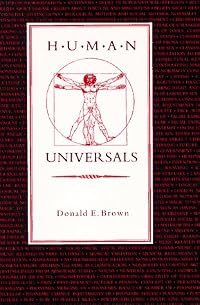
Human Universals
by Donald E. Brown
On This Page
Description
This book covers physical and behavioural characteristics that can be considered universal among all cultures and people. The text is divided into three parts: the problems posed for anthropology by universals; six important studies that have forced anthropologists to rethink; and the distinctions between linguistic, cultural and social universals.Tags
Recommendations























Member Reviews
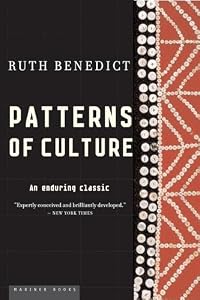
Are there cultural traits shared by all people in the world? That is the core question in the 'Human Universals' debate. It is one of the most essential questions in social anthropology, and at the same time the most intensely debated issue. Donald E Brown (° 1934) theoretical anthropologist from the University of California, Santa Barbara, provides a good overview of that debate in this book. Very interesting, as far as I'm concerned. And actually entertaining too, although I say that with some gloating. Brown exposes how some renowned anthropologists in the first half of the 20th century (especially Margaret Mead, Ruth Benedict and Borislaw Malinowski) unjustifiably claimed that all human behavior was completely culturally show more determined, and that there could therefore be no such thing as universal characteristics or behavior (this is called cultural relativism and determinism). Indeed, this puts us in the middle of the nature-nurture war that was fought within the social sciences for much of the 20th century (and which has actually still not been completely settled).
Brown clearly how this cultural relativism/determinism was based on very inadequate field research, and biased assumption. Brown's own position will be clear by now: according to him, there indeed are universal characteristics that transcend local cultures, and these are simply the result of general human evolution in the Darwinian sense. Brown draws mainly on evolutionary psychology, which was just emerging when his book was published (1991). I must admit that in his treatment of what these universal values are in concrete terms, he remains rather vague and general: for example, that language is very important for all people and in all cultures, both in dealing with the environment, with others and with oneself. Well, I could have come up with that myself. Brown is a little more concrete when it comes to family and kinship: that a family is primarily a mother and children, and that this usually also involves a man and some form of marriage or institutional commitment. But then again: what use are statements like that? Maybe it’s merit just lies in proving cultural determinism wrong, nothing more than that. But perhaps I should see Brown's work as a starting point: it is already 30 years old, and maybe others have built on it to arrive at much more concrete delineations. I keep on searching. show less
Brown clearly how this cultural relativism/determinism was based on very inadequate field research, and biased assumption. Brown's own position will be clear by now: according to him, there indeed are universal characteristics that transcend local cultures, and these are simply the result of general human evolution in the Darwinian sense. Brown draws mainly on evolutionary psychology, which was just emerging when his book was published (1991). I must admit that in his treatment of what these universal values are in concrete terms, he remains rather vague and general: for example, that language is very important for all people and in all cultures, both in dealing with the environment, with others and with oneself. Well, I could have come up with that myself. Brown is a little more concrete when it comes to family and kinship: that a family is primarily a mother and children, and that this usually also involves a man and some form of marriage or institutional commitment. But then again: what use are statements like that? Maybe it’s merit just lies in proving cultural determinism wrong, nothing more than that. But perhaps I should see Brown's work as a starting point: it is already 30 years old, and maybe others have built on it to arrive at much more concrete delineations. I keep on searching. show less
Chapter 6 is Brown's description of what all human cultures have in common. The universals are sufficiently abstract that they are difficult to disagree with, though some of his explanations for the universals seem iffy. I wish he had spent some time on the implicational universals (given X, then generally Y) that are so common in linguistics.
Chapters 1-5 are the arguments for taking chapter 6 seriously. Interesting stuff, even if one does not agree with him.
Chapters 1-5 are the arguments for taking chapter 6 seriously. Interesting stuff, even if one does not agree with him.
Cited by Dehaene, in "Reading in the Brain: The New Science of How We Read"[on page 305 of Kindle edition].
Ratings
Members
- Recently Added By
Lists

Books Cited in Blueprint by Nicholas Christakis
261 works; 1 member
Author Information
6 Works 128 Members
Some Editions
Common Knowledge
- Original publication date
- 1991
- People/Characters
- Ruth Benedict; Margaret Mead; Clifford Geertz; Brent Berlin; David Bidney; Franz Boas (show all 22); Noam Chomsky; Leda Cosmides; Martin Daly; Charles Darwin [Charles Robert: 1809-1882]; Paul Ekman; Derek Freeman (Anthropologist); Sigmund Freud; Paul Kay; Clyde Kluckhohn; Alfred L. Kroeber; Claude Lévi-Strauss; George Peter Murdock; Dan Sperber; Melford Spiro; John Tooby; Edward Westermark
- Dedication
- For Carrie, Barry, and Rosminah
- First words
- This book is a reflection on human universals and what they imply. (Preface)
Many anthropologists, maybe most of them, are skeptical about statements that general about what all people do. (Introduction)
In 1983 the anthropological community was convulsed by reactions to Derek Freeman's Margaret Mead and Samoa : the Making and Unmaking of a Myth. - Quotations
- Kroeber's views warrant an extended digression and will serve to illustrate developments among Boas' successors in American anthropology. His 1915 paper "Eighteen Professions," drew a sharp boundary between biological scienc... (show all)e and cultural anthropology: their "differences in in aim and method," he said, "were irreconcilable." Cultural anthropology was part of history, not science, and "the material studied by history is not man but his works." [...]
When one stops to think about the implications of Kroeber's statement that the subject matter of history, including cultural anthropology, is not humanity -- it was an astounding statement. Since cultural anthropology has long been the greater part of all anthropology, Kroeber was saying that anthropology -- the study of humanity -- was largely unconcerned with humanity itself. Like some sort of intellectual neutron bomb, this formulation left human artifacts intact while humans were obliterated from anthropological purview. [ellisions added] - Last words
- (Click to show. Warning: May contain spoilers.)It would be irresponsible to keep shunting these questions to the side, fraud to deny that they exist.
Classifications
- Genres
- Anthropology, Nonfiction, Science & Nature, General Nonfiction
- DDC/MDS
- 306 — Social sciences Social sciences, sociology & anthropology Culture and institutions
- LCC
- GN357 .B76 — Geography, Anthropology and Recreation Anthropology Anthropology Ethnology. Social and cultural anthropology Culture and cultural processes
- BISAC
Statistics
- Members
- 113
- Popularity
- 286,466
- Reviews
- 3
- Rating
- (3.83)
- Languages
- English
- Media
- Paper, Ebook
- ISBNs
- 2
- ASINs
- 1