On This Page
Description
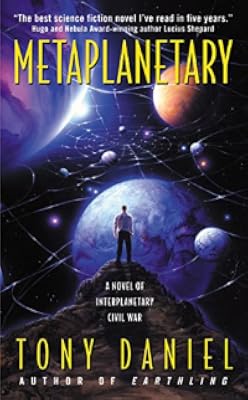
Free download! Peruse "The Metaplanetary Gazetteer," created by the author especially for this PerfectBound e-book. Once or twice in a score of years, the boundlessly inventive realm of speculative fiction reveals a vision of tomorrow that dwarfs everything that came before. These are the dreams of the Asimovs and the Heinleins, the Bears and the Brins. Now Tony Daniel brilliantly dreams the future -- and reinvents humanity itself -- in an epic chronicle of civil war and transcendence that show more plays out on an enormous stage encompassing the solar system in its entirety -- its asteroids, its comets, and all its people, transmuted into astounding forms and living astonishing lives. Metaplanetary The human race has extended itself into the far reaches of our solar system -- and, in doing so, has developed into something remarkable and diverse and perhaps transcendent. The inner system of the Met -- with its worlds connected by a vast living network of cables -- is supported by the repression and enslavement of humanity's progeny, nanotechnological artificial intelligences -- beings whom the tyrant Amés has declared non-human. There is tolerance and sanctuary in the outer system beyond the Jovian frontier. Yet few of the oppressed ever make it post the dictator's well-patrolled boundaries. But the longing for freedom cannot be denied, whatever the risk.A priest of the mystical religion called the Greentree Way senses catastrophe approaching. A vision foretells that the future of our bitterly divided solar system rests in the hands of a mysterious man of destiny and doom who has vanished into the backwater of the Met in search of his lost love. But the priest is not the only one who grasps this man's importance. The despot Am$eacute;s is after the some quarry -- and until now there has been no power in the inner solar system willing to oppose Amés and his fearsome minions. But now a line has been drawn of Neptune's moon Triton. Roger Sherman, a retired military commander from Earth's West Point and a Greentree ally, will not let Amés prevail. Though dwarfed by the strength and wealth of the Met, the cosmos under Sherman's jurisdiction will remain free at all cost -- though defiance will ensure the unspeakable onslaught of the dictator Amés's wrath -- a rage that will soon ravage the solar system. A rage that will plunge all of humankind into the fury of total war. With Metaplanetary, author Tony Daniel fulfills the great promise of his critically acclaimed earlier works. A new master has reached for the stars, with a stunning speculative masterwork of enormous scope and conceptual daring -- an adventure of grand victories and horrific villainy, both human and meta-human alike. show lessTags
Recommendations








Member Reviews
I loved this book. Let's just get that out of the way. I could hardly put it down. But, duty comes calling on all of us eventually, so I did force myself to. Reluctantly. And itched to pick it back up again. That five-star rating sorely tempted me, but... I will also be the first to admit it has some problems. Call it a 4.49. Let's dispense with those problem first so I can get on to gushing about the good stuff.
The first, and not everyone (me included) will necessarily agree this is a problem, is that it tosses you right in with zero exposition or explanation. But to be fair, Daniel created a big, complex world quite different from ours, and you are not going to understand a lot of the terminology he tosses around at the start. show more Understandably, this turned off more than a few readers, which is a shame (see "I loved this book" above).
What was weird in light of this utter absence of lexicography, was that in the middle of the book, he infodumps like a champ. I feel like, well, if you're going to do that sort of thing, you could help your readers at the start a bit too. Again, the beginning unfamiliarity didn't bother me, and if you stick with it and pay attention to the basic meanings of the terms he uses, you can sort things out eventually.
So, a matter of taste, though I sympathize easily with those who were turned off by it, especially given the level of exposition in the middle of the book. (That midway exposition, by the way, was nicely done, and I enjoyed it as much as I did sorting out what the hell was going on at the start.)
The bigger knock I have is the cartoonishly evil bad guys (not in every case, but most of them). A pack of sociopaths led by a megalomaniac, with the goal of take over everything and torture and kill the opposition or those you don't like. Kinda boring if you're looking for some moral complexity. I can't really excuse this as I can the choice to toss the reader in the deep end at the start, which I see as a matter of taste as much as anything else.
The writing is a bit uneven. At times great, at others, a bit cringe. I think this stems from Daniel having a shit ton of ideas in his head he wanted to pack into this book and maybe being a bit manic to give them all their due. I know I would have been. It might have benefited from a stronger editorial hand.
All that said, this book does indeed pack an amazingly cool set of ideas into it. Just fantastic stuff. And Daniel created characters equal to the coolness of the setting. Neither overshadows the other. I got into so many of them.
Sometimes synopses get things wrong or overstate to the point of obscurity. The synopsis (at least on Goodreads of the edition I read) has phrases such as "boundlessly inventive," "brilliantly dreams the future," and "reinvents humanity." None of these overstate if you ask me.
There is a plurality of humanity, real and virtual and a mix of the two, that I can't recall seeing elsewhere. Oh, and people are spaceships too, in case you were wondering. They can be arrays of personalities with presences spread across the solar system. Physical humans can marry purely virtual humans (and reproduce!).
The idea of the Met, the engineering feat of the linking the inner planets up via kilometer thick super-physics cables, staggers. I feel like it should be ridiculous. Okay, sure, maybe in a fantasy novel, you could get away with that, it wouldn't seem ridiculous. But Daniel pulls it off here, courtesy of some invented physics cleverly explained and millennium-distant descendants being vastly more advanced than us.
Because everyone has access to virtuality, few people travel far physically, and those who live on planets less friendly to human live have bodies adapted to the local environment. This includes space itself. Cool! Who wouldn't want to be adapted to survive (at least for a while) in space or live on Triton?
I haven't even touched on the environment of the Met itself, the 'grist' the nanotech substrate that functions as a pervasive network and cloud computing platform, Star Trek-esque replicator, and can be twisted into viral forms for both physical and cyber warfare.
The beginning of this will confuse the hell out of you, but stick with it, because the amazing ideas and engaging characters will kick in soon enough, and you won't want to put it down. show less
The first, and not everyone (me included) will necessarily agree this is a problem, is that it tosses you right in with zero exposition or explanation. But to be fair, Daniel created a big, complex world quite different from ours, and you are not going to understand a lot of the terminology he tosses around at the start. show more Understandably, this turned off more than a few readers, which is a shame (see "I loved this book" above).
What was weird in light of this utter absence of lexicography, was that in the middle of the book, he infodumps like a champ. I feel like, well, if you're going to do that sort of thing, you could help your readers at the start a bit too. Again, the beginning unfamiliarity didn't bother me, and if you stick with it and pay attention to the basic meanings of the terms he uses, you can sort things out eventually.
So, a matter of taste, though I sympathize easily with those who were turned off by it, especially given the level of exposition in the middle of the book. (That midway exposition, by the way, was nicely done, and I enjoyed it as much as I did sorting out what the hell was going on at the start.)
The bigger knock I have is the cartoonishly evil bad guys (not in every case, but most of them). A pack of sociopaths led by a megalomaniac, with the goal of take over everything and torture and kill the opposition or those you don't like. Kinda boring if you're looking for some moral complexity. I can't really excuse this as I can the choice to toss the reader in the deep end at the start, which I see as a matter of taste as much as anything else.
The writing is a bit uneven. At times great, at others, a bit cringe. I think this stems from Daniel having a shit ton of ideas in his head he wanted to pack into this book and maybe being a bit manic to give them all their due. I know I would have been. It might have benefited from a stronger editorial hand.
All that said, this book does indeed pack an amazingly cool set of ideas into it. Just fantastic stuff. And Daniel created characters equal to the coolness of the setting. Neither overshadows the other. I got into so many of them.
Sometimes synopses get things wrong or overstate to the point of obscurity. The synopsis (at least on Goodreads of the edition I read) has phrases such as "boundlessly inventive," "brilliantly dreams the future," and "reinvents humanity." None of these overstate if you ask me.
There is a plurality of humanity, real and virtual and a mix of the two, that I can't recall seeing elsewhere. Oh, and people are spaceships too, in case you were wondering. They can be arrays of personalities with presences spread across the solar system. Physical humans can marry purely virtual humans (and reproduce!).
The idea of the Met, the engineering feat of the linking the inner planets up via kilometer thick super-physics cables, staggers. I feel like it should be ridiculous. Okay, sure, maybe in a fantasy novel, you could get away with that, it wouldn't seem ridiculous. But Daniel pulls it off here, courtesy of some invented physics cleverly explained and millennium-distant descendants being vastly more advanced than us.
Because everyone has access to virtuality, few people travel far physically, and those who live on planets less friendly to human live have bodies adapted to the local environment. This includes space itself. Cool! Who wouldn't want to be adapted to survive (at least for a while) in space or live on Triton?
I haven't even touched on the environment of the Met itself, the 'grist' the nanotech substrate that functions as a pervasive network and cloud computing platform, Star Trek-esque replicator, and can be twisted into viral forms for both physical and cyber warfare.
The beginning of this will confuse the hell out of you, but stick with it, because the amazing ideas and engaging characters will kick in soon enough, and you won't want to put it down. show less
The first thing that you should know before picking up this book is that it isn’t a stand-alone novel. It is the first book of a trilogy. The second book is called “Superluminary.” The third book is called… well I don’t know what it’s called. Eos apparently declined to pay Mr. Daniel to write the third book, so he understandably hasn’t. This is a shame on many levels. This could have been (and hopefully perhaps one day will be) a science fiction epic that might have stood the test of time.
The closest comparison to this book that I have read recently is Peter Hamilton’s “Pandora’s Star” and “Judas Unchained” duology. This book is filled with hard SF and questions of how humanity will move into the future. It show more doesn’t deal with the singularity at all, but deals impressively with questions of how we will cope when human personalities are no longer confined to their individual bodies. In this book we meet humans who primarily reside in their physical bodies, but with a cloud of nanites (called “grist”) to help them with memory and computations. We meet humans who have distributed their personalities between many bodies and the omnipresent grist and are called “Large Array Personalities” or LAPs. There are people who exist only in the grist and are called “free converts” and then the children of “normal” people and free converts who are “half-converts.” And let’s not forget the cloudships!
We meet a huge cast of characters in this, and start many plot lines. None of them are resolved, as one would expect. Basically, the dictator Amés is starting a war between all the factions of the solar system. His ultimate goal involves uniting all the human personalities existing under one rule: his. To this end he is particularly interested in enslaving all the free converts. The descriptions of his concentration camps and their Mengele-type experiments aren’t particularly violent, but they are very disturbing. We also learn the stories of himself, his victims and his opponents, with lots of hard-SF world building and history. This is exactly my sort of thing, and I thoroughly enjoyed it. I will read “Superluminary,” and then I will join the ranks of those who are really annoyed at Eos for not funding the conclusion of this amazing epic of science fiction. show less
The closest comparison to this book that I have read recently is Peter Hamilton’s “Pandora’s Star” and “Judas Unchained” duology. This book is filled with hard SF and questions of how humanity will move into the future. It show more doesn’t deal with the singularity at all, but deals impressively with questions of how we will cope when human personalities are no longer confined to their individual bodies. In this book we meet humans who primarily reside in their physical bodies, but with a cloud of nanites (called “grist”) to help them with memory and computations. We meet humans who have distributed their personalities between many bodies and the omnipresent grist and are called “Large Array Personalities” or LAPs. There are people who exist only in the grist and are called “free converts” and then the children of “normal” people and free converts who are “half-converts.” And let’s not forget the cloudships!
We meet a huge cast of characters in this, and start many plot lines. None of them are resolved, as one would expect. Basically, the dictator Amés is starting a war between all the factions of the solar system. His ultimate goal involves uniting all the human personalities existing under one rule: his. To this end he is particularly interested in enslaving all the free converts. The descriptions of his concentration camps and their Mengele-type experiments aren’t particularly violent, but they are very disturbing. We also learn the stories of himself, his victims and his opponents, with lots of hard-SF world building and history. This is exactly my sort of thing, and I thoroughly enjoyed it. I will read “Superluminary,” and then I will join the ranks of those who are really annoyed at Eos for not funding the conclusion of this amazing epic of science fiction. show less
When I started this book I had no idea it would be the first of several, just that it was highly recommended.
Daniel's potpourri of ideas is wonderfully stimulating. He can "do" deep enough characters when he wants to but he is oddly inconsistent with this skill. For example, we get a lovingly crafted background for Ames early in the novel and then his character is not much more than a 2-dimensional megalomaniac for the remainder. Worse than that, his sexual masochist nature is simply gone later in the book, perhaps twisted to sadism, with no explanation.
Daniel has well-considered thoughts about a possible future virtuality, a staple of cyberpunk SF. His vision feels a bit fresher than most and I like how he combines faster-than-light show more quantum communication and a nanoscopic pervasive medium (grist). It feels like hard SF. I don't think he makes a convincing argument for the continuation of the biological aspect (literally uses that word) of entities that far into the future. Why be subject to the pains, frustrations, life span, and inefficiencies of the flesh if it is not necessary? We might not all be capable of being Large Array Personalities (combinations of multiple minds) but it would seem we're all capable of being converts (algorithmic or on-line representations of the self). Cloudships are a fine alternative but why have a meat body at all?
Perhaps Daniel is portraying a time between meat and no-meat but, for me, the existence of cloudships pushes that credibility too far. Oh, it was intensely useful as a plot device, where some meat-and-virtual people are bigoted against virtual-only copies or evolutions of copies.
I loved his exploration of a family where the husband was meat, wife was purely virtual, and the children are hybrids. And he gave quite chilling accounts of how a virtual entity could be tortured, raped, or damaged. And even a concentration camp-like setting complete with a Dr. Mengele type. Okay, he was clearly having too much fun with the cliche there (or torturing metaphors, lol).
Where the book falls down is in having too many threads either not followed or badly dangling. Some of this is clearly leading to the next book, Superluminary, which I will have to read. But it also feels WAY choppier than necessary. He gets us to care about a character or induce a curiosity about another and then... nothing.
Then there is the whole plot thread of the time tower LAP's and one special LAP. The book was a bit too cryptic in this area. Heck , a huge part of it supposedly revolves around that special time-LAP, how he not only sees the future but affects the present... with almost no visible effect on this book's plot (aside from, possibly, being why Jill came to exist)!
Some of this was very frustrating and brings jarring discontinuities to an otherwise 5-star book.
Maybe Daniel can make it up to me with future books. show less
Daniel's potpourri of ideas is wonderfully stimulating. He can "do" deep enough characters when he wants to but he is oddly inconsistent with this skill. For example, we get a lovingly crafted background for Ames early in the novel and then his character is not much more than a 2-dimensional megalomaniac for the remainder. Worse than that, his sexual masochist nature is simply gone later in the book, perhaps twisted to sadism, with no explanation.
Daniel has well-considered thoughts about a possible future virtuality, a staple of cyberpunk SF. His vision feels a bit fresher than most and I like how he combines faster-than-light show more quantum communication and a nanoscopic pervasive medium (grist). It feels like hard SF. I don't think he makes a convincing argument for the continuation of the biological aspect (literally uses that word) of entities that far into the future. Why be subject to the pains, frustrations, life span, and inefficiencies of the flesh if it is not necessary? We might not all be capable of being Large Array Personalities (combinations of multiple minds) but it would seem we're all capable of being converts (algorithmic or on-line representations of the self). Cloudships are a fine alternative but why have a meat body at all?
Perhaps Daniel is portraying a time between meat and no-meat but, for me, the existence of cloudships pushes that credibility too far. Oh, it was intensely useful as a plot device, where some meat-and-virtual people are bigoted against virtual-only copies or evolutions of copies.
I loved his exploration of a family where the husband was meat, wife was purely virtual, and the children are hybrids. And he gave quite chilling accounts of how a virtual entity could be tortured, raped, or damaged. And even a concentration camp-like setting complete with a Dr. Mengele type. Okay, he was clearly having too much fun with the cliche there (or torturing metaphors, lol).
Where the book falls down is in having too many threads either not followed or badly dangling. Some of this is clearly leading to the next book, Superluminary, which I will have to read. But it also feels WAY choppier than necessary. He gets us to care about a character or induce a curiosity about another and then... nothing.
Then there is the whole plot thread of the time tower LAP's and one special LAP. The book was a bit too cryptic in this area. Heck , a huge part of it supposedly revolves around that special time-LAP, how he not only sees the future but affects the present... with almost no visible effect on this book's plot (aside from, possibly, being why Jill came to exist)!
Some of this was very frustrating and brings jarring discontinuities to an otherwise 5-star book.
Maybe Daniel can make it up to me with future books. show less
One millennium earth time from now, humanity has colonized much of the solar system. However, a social schism of major magnitude has occurred during the post settlement stages. The inner planets are totally ruled by Ames, the great dictator, who decides what is human and what is fodder especially with the growth of technology such as grist to host an individual's consciousness. On the outer ring, control is totally decentralized as diversity in human form is cherished as it is considered a basic freedom.
Though the year is not even half over, METAPLANETARY may be the best science fiction novel of 2001 and will appear on most people's short lists. The story line is fast-paced and filled with action while describing an extremely complex show more and extraordinary solar system that is actually two competing cosmos. The differences between the inner and outer rings seem like a futuristic Cold War or World War II with totalitarianism vs. freedom on a grander scale. In his third science fiction, Tony Daniel has written a novel that is so exemplary that the author will earn a place among the genre's stars, a rarity based on one book (though the other two are very good too). show less
Though the year is not even half over, METAPLANETARY may be the best science fiction novel of 2001 and will appear on most people's short lists. The story line is fast-paced and filled with action while describing an extremely complex show more and extraordinary solar system that is actually two competing cosmos. The differences between the inner and outer rings seem like a futuristic Cold War or World War II with totalitarianism vs. freedom on a grander scale. In his third science fiction, Tony Daniel has written a novel that is so exemplary that the author will earn a place among the genre's stars, a rarity based on one book (though the other two are very good too). show less
Expanded from his novella "Grist", a good synthesis of a Solar-system spanning culture with nanotech, mote-sized comptuers and instantaneous communication. Humans mingle with their electronic counterparts, leading to interesting "individuals" who inhabit multiple bodies across space, or no body at all. A scary leader decides to "unite" humanity by gradually subsuming others to his consciousness; war ensues between those who don't care to be assimilated. Sequel "Superluminal" continues the tale, but the author frustratingly never wrote the third book - probably a dispute with his publisher. Worth it despite being a 2/3 trilogy.
https://rrhorton.blogspot.com/2018/11/birthday-review-metaplanetary-by-tony.html
https://rrhorton.blogspot.com/2018/11/birthday-review-metaplanetary-by-tony.html
I enjoyed this book despite the plethora of characters. The author kept introducing characters and multiplying the plotlines making the scope of the book enormous. Then he finished just as things were starting to draw together.
Now I have to find an eBook of the second book for sale in Australia.
Now I have to find an eBook of the second book for sale in Australia.
This is beautiful. Fuck.
Members
- Recently Added By
Author Information

30+ Works 1,201 Members
Awards and Honors
Distinctions
Notable Lists
Series

Common Knowledge
- Canonical title
- Metaplanetary
- Original publication date
- 2001-04
- Dedication
- For Jerry A. Daniel and Martha Montgomery Daniel, my father and mother
- First words
- Standing over all creation a doubt-ridden priest took a piss.
- Last words
- (Click to show. Warning: May contain spoilers.)"And then let there be war between Amés and me."
Classifications
Statistics
- Members
- 285
- Popularity
- 113,512
- Reviews
- 8
- Rating
- (3.70)
- Languages
- English
- Media
- Paper, Ebook
- ISBNs
- 4
- ASINs
- 3