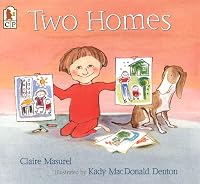
Two Homes
by Claire Masurel
On This Page
Description
A young boy named Alex enjoys the homes of both of his parents who live apart but love Alex very much.Tags
Recommendations

















Member Reviews
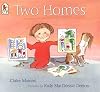
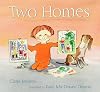
Rising above the standard fare in this genre, with their deadly prose and workaday illustrations, this offering is not afraid to state the obvious: Alex’s mommy and daddy don’t live together. Alex matter-of-factly explains it: “Daddy lives here. Sometimes I live with Daddy. Mommy lives there. Sometimes I’m with Mommy.” Writing about a now-common experience for many young children, Masurel (Good Night!, 1997) has successfully created a reassuring addition to the separated-parents bibliotherapy booklist. Alternating between Dad’s and Mom’s, Denton’s watercolor, gouache, and ink illustrations display an intimate knowledge of the complete lives of the city-dwelling Mom and the country-living Dad. At Mommy’s there’s a show more big, comfy chair to cuddle up in and read; at Daddy’s a child-sized rocking chair. There are separate but equal accommodations, too, including a dog at Dad’s and an aquarium full of fish at Mom’s. Alex is nearly gender-neutral, dressed in a kid uniform of cotton pants and shirt (red at Dad’s and blue at Mom’s) with straight hair bobbed at ear length. This portrayal allows all children the opportunity to identify with the young narrator. On page after page, Alex and his parents engage in the pleasant common activities of early childhood, from playing dress-up with an assortment of friends, taking a bath, and shucking peas at Dad’s, to baking gingerbread men at Mom’s. An extremely positive take on an often-painful subject. (Picture book. 3-5)
-Kirkus Review show less
-Kirkus Review show less
Alex is a little boy whose parents are divorced. He talks about how he two of everything and seems very content with his life. He is well-adjusted to his new life and knows that his parents love him all the time, no matter where they or he may be.
This is another amazing book about divorce. The colors and illustrations are simple but inviting and appropriate for a young child. Alex is the cutest kid. I really loved this story because it can help a sad child feel better about his or her new life and housing situation. Kids love to have more of anything, so the fact that Alex says he has two of each thing discussed in the book will help children of divorced parents adjust more easily. What a positive, fresh take on divorce this story show more exhibits. This book is a fantastic read! show less
This is another amazing book about divorce. The colors and illustrations are simple but inviting and appropriate for a young child. Alex is the cutest kid. I really loved this story because it can help a sad child feel better about his or her new life and housing situation. Kids love to have more of anything, so the fact that Alex says he has two of each thing discussed in the book will help children of divorced parents adjust more easily. What a positive, fresh take on divorce this story show more exhibits. This book is a fantastic read! show less
I really liked this book for a few different readings. First, I felt that the illustrations in this book were great as well as fitting. The illustrations showed the different houses that the child has and I felt that it helped the readers to see how different the two houses were. Additionally, I loved the character in the story and found her to be very well developed. I liked how she was happy because it added light to the situation. Overall, I believe that the message of the story was that even if your family doesn't live under one roof they still love you just the same.
TWO HOMES by Claire Masurel, illustrated by Kady MacDonald Denton, is a sweet book that grapples with a difficult issue. Little Alex's parents each have their own home, so Alex has two homes. How this situation came to be is never discussed. Maybe Alex's parents are divorced (a word that never makes an appearance in the text). Maybe they never married. This book isn't about what happened -- it's about how Alex lives day-to-day. A mini tour of both homes is beautifully illustrated - two bedrooms, two favorite chairs, two kitchens. Alex is loved and happy in both homes.
Ahh, if only shared child custody could always be like this! But I'm not going to criticize this book for what it doesn't do and doesn't address. I believe the author's show more intention is to reassure children in this situation, and TWO HOMES does that beautifully. The recommended age range is 3-6 years. It may best be suited for children whose parents "came to live separately" before the child had an awareness that there is any other way for families to live but is now old enough to make comparisons with the homes of other children.
What I liked best about TWO HOMES is that the author keeps things very simple, the focus is on the child and assuring that the child feels secure and loved. Also, Alex's name and appearance are androgenous, so both girls and boys will be able to relate the character. And, of course, the illustrations are just beautiful. I'll be checking out other titles by both this author and illustrator on the strength of the appeal of TWO HOMES. show less
Ahh, if only shared child custody could always be like this! But I'm not going to criticize this book for what it doesn't do and doesn't address. I believe the author's show more intention is to reassure children in this situation, and TWO HOMES does that beautifully. The recommended age range is 3-6 years. It may best be suited for children whose parents "came to live separately" before the child had an awareness that there is any other way for families to live but is now old enough to make comparisons with the homes of other children.
What I liked best about TWO HOMES is that the author keeps things very simple, the focus is on the child and assuring that the child feels secure and loved. Also, Alex's name and appearance are androgenous, so both girls and boys will be able to relate the character. And, of course, the illustrations are just beautiful. I'll be checking out other titles by both this author and illustrator on the strength of the appeal of TWO HOMES. show less
Alex has two homes and he explains how he has different things at each house from his frot door to his bedroom. Alex says he doesn't like one more then the other because he loves both his parents just same even though they don't live under the same roof. This explains to children that divorce isn't the children's fault and they shouldn't feel at fault for it either and understand that.
There are several reasons why I enjoyed this book. For one, I enjoyed the uplifting language the author wrote this story with. With each new page, the narrator focuses on something Alex has gained from the divorce of his parents, as opposed to something he has lost. For example, at his mother’s house he has a soft chair, while at his father’s house he has a rocking chair. At both houses Alex has a chair, so in total he now has two chairs instead of one. When the circumstances are viewed in a positive light, no longer does the eerie term “divorce” have such a griming effect to it. The language throughout each page is uplifting and reassuring to readers. The second reason why I enjoyed this story is because of its ability to push show more readers to think about divorced families. Though the idea of a divorced family is not always the brightest, the author was able to turn the topic into an optimistic one, by stating how Alex has two of every item, as opposed to just one. This idea can be very reassuring to children. I feel the entire story’s meaning was encapsulated in one sentence, “But whether Alex is with Mommy or with Daddy, one thing always stays the same- Alex is loved.” Divorce can be very hard on children, so it is imperative they feel loved when transitioning back and fourth between two homes. show less
I definitely liked reading Two Homes. I loved the point of view and the illustrations throughout the book. The first person point of view allows the reader to relate to his or her own life while reading the book. They can feel what the little boy feels and connect to it in their own ways. When the little boy shows the reader both of his bedrooms at each parents’ house, it brings a positive spin on a situation that may not be ideal. The first person point of view allows the reader to connect to the little boy’s positivity and see his or her own situations in the same way. I loved the detail within each illustration. The pictures of the boy’s bathrooms are some of my favorites. Each bathroom has fun toys, like rubber ducks and small show more boats, which are appealing to the reader. The overall message that this book has is that even if your parents are divorced, it does not mean they do not love you. The book teaches the reader that your parents will love you no matter where they are. show less
Members
- Recently Added By
Author Information

34 Works 2,819 Members
All Editions
Awards and Honors
Awards
Notable Lists
Classifications
Statistics
- Members
- 840
- Popularity
- 32,569
- Reviews
- 245
- Rating
- (4.15)
- Languages
- English, French, German
- Media
- Paper, Ebook
- ISBNs
- 16
- UPCs
- 2
- ASINs
- 3