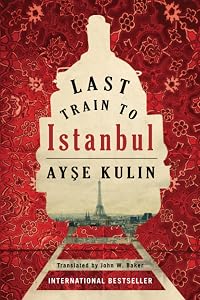
Last Train to Istanbul
by Ayse Kulin
On This Page
Description
International bestseller by one of Turkey's most beloved authors As the daughter of one of Turkey's last Ottoman pashas, Selva could win the heart of any man in Ankara. Yet the spirited young beauty only has eyes for Rafael Alfandari, the handsome Jewish son of an esteemed court physician. In defiance of their families, they marry, fleeing to Paris to build a new life. But when the Nazis invade France and begin rounding up Jews, the exiled lovers will learn that nothing--not war, not show more politics, not even religion--can break the bonds of family. For after they learn that Selva is but one of their fellow citizens trapped in France, a handful of brave Turkish diplomats hatch a plan to spirit the Alfandaris and hundreds of innocents, many of whom are Jewish, to safety. Together, they must traverse a war-torn continent, crossing enemy lines and risking everything in a desperate bid for freedom. From Ankara to Paris, Cairo, and Berlin, Last Train to Istanbul is an uplifting tale of love and adventure from Turkey's beloved bestselling novelist Ayşe Kulin. show lessTags
Recommendations





























Member Reviews
Last Train to Istanbul was slow to leave the station, but once it took off, what a ride it was! The first third of the book introduces various characters and their back stories. Older sister Sabiha and her diplomat husband, Macit, live in Ankara with their young daughter and Sabiha’s parents. Younger sister Selva married Rafael, a Jew, against her Muslim family’s wishes. Selva and Rafo found it more comfortable to live in Marseilles where they won’t have to face the disapproval from both families. Sabiha is the French tutor for Tarik, a young diplomat in her husband’s office, who develops an unrequited passion for Sabiha. His new language skills have him prepared when he’s promoted to a position in the Paris embassy.
The German show more occupation of France changes everything for Selva and Rafo. Their Turkish citizenship is the only thing keeping Rafo from being interred with the other Jews in France. As neutral Turkey faces pressure from both sides in the conflict, their diplomats in France don’t know how long they’ll be able to protect their Jewish citizens on French soil, so they begin to make plans for a train to take the Jews to Istanbul and out of German reach.
Although the characters in this novel are fictional, many are based on real people. The Turkish diplomats in France are said to have saved many Jews from the Holocaust. For instance,Necdet Kent, a Turkish consul in Marseilles during the war who died the year of this book’s release, claimed to have boarded a train filled with Jews (some Turkish) being deported to secure their release .
If I were a film producer, I’d option the film rights for this book. My film version would write out Sabiha, since I think the book would be stronger without her and her neuroses. Her diplomat husband, Macit, might become Selva’s brother, or maybe I’d have her father still working instead of retired. Tarik’s unrequited passion would be for Selva, who chose Rafo instead, and this love would inspire his actions to aid the Turkish Jews in fleeing France.
This is really a 3 ½ star book, but I’ve boosted it by half a star since I loved the last half so much. show less
The German show more occupation of France changes everything for Selva and Rafo. Their Turkish citizenship is the only thing keeping Rafo from being interred with the other Jews in France. As neutral Turkey faces pressure from both sides in the conflict, their diplomats in France don’t know how long they’ll be able to protect their Jewish citizens on French soil, so they begin to make plans for a train to take the Jews to Istanbul and out of German reach.
Although the characters in this novel are fictional, many are based on real people. The Turkish diplomats in France are said to have saved many Jews from the Holocaust. For instance,
If I were a film producer, I’d option the film rights for this book. My film version would write out Sabiha, since I think the book would be stronger without her and her neuroses. Her diplomat husband, Macit, might become Selva’s brother, or maybe I’d have her father still working instead of retired. Tarik’s unrequited passion would be for Selva, who chose Rafo instead, and this love would inspire his actions to aid the Turkish Jews in fleeing France.
This is really a 3 ½ star book, but I’ve boosted it by half a star since I loved the last half so much. show less
Selva is the daughter of a traditional Turkish man who disowned her when she decided to marry Rafael Alfandari, son of a prominent physician--and a Jew. As much as it pained her to lose the connection to her family, Selva had to follow her heart. And to get out of the shadow of disapproval from both sets of parents, Selva and Rafael relocated to France where they had a son and made a life for themselves. But things changed quickly when the Nazis invaded France and began seeking out and rounding up Jews. While Turkey, being neutral in the conflict, has been able to keep some of their Jewish citizens from being taken, they worry that they may not be able to protect them in the face of continuing extreme approaches by Nazi officials. In an show more effort to keep their citizens safe, Turkish officials arrange for a train to bring a single car of Turkish citizens home. But for people like Selva, whose community includes friends who are not Turkish but are clearly in danger, there's a compulsion to take a risk to protect them. And it's a risk that could lead to consequences for everyone...
This is a wonderfully-written and well-researched piece of writing that I am so glad I took the time to read. While this period of humanity's history is challenging to approach and read about, I think it's incredibly important that we don't simply ignore it. And thankfully this story provides the contrast between those who acted with very little regard for others and those who are willing to risk themselves in service of doing what's right. You'll quickly become connected to these characters. You'll laugh. You'll cry. You'll enjoy an excellent story that embodies the better aspects of our nature. show less
This is a wonderfully-written and well-researched piece of writing that I am so glad I took the time to read. While this period of humanity's history is challenging to approach and read about, I think it's incredibly important that we don't simply ignore it. And thankfully this story provides the contrast between those who acted with very little regard for others and those who are willing to risk themselves in service of doing what's right. You'll quickly become connected to these characters. You'll laugh. You'll cry. You'll enjoy an excellent story that embodies the better aspects of our nature. show less
I found this book merely "OK," redeemed mainly by the Turkish history lessons contained in it. Otherwise, I found the characters shallow and unsympathetic, and the story lacking any real drama or tension. The writing (the translation, anyway) was simplistic, often resorting to trite expressions (e.g. "caught between a rock and a hard place," lifeless descriptions ("winters were extremely cold and snowy . . . summers were unbearably hot"), and juvenile onomatopoeia (describing a character typing "as if he was firing a gun, rat-a-tat-tat," or the constant reference to the train's "clickety-clack...clickety-clack").
I switched back and forth between the Kindle ebook and the Audible audio book, and found the reading much more preferable to show more the listening. For one thing, the narrator had an odd way of reading dialog tags (he said, she said, etc). Take a sentence like, "Blah blah blah," he said. Normally the word "said" will be spoken with an upward inflection of the voice. The narrator, instead (after an overly long beat), starts with too high a tone of voice, and gives a downward inflection to the word "said." This was jarring, every time I heard it.
The narrator also employed exaggerated, cartoonish voice characterizations and accents, which was very annoying. At times. while listening, I imagined the story being played out as an episode of "The Simpsons."
Overall, I found the book mildly interesting, and I did want to see it to its conclusion. However, it does not compel me to seek out other works by this author. It was one of 9 free ebooks on Kindle offered in celebration of World Book Day, this past week, and I appreciate the opportunity to expand my literary horizons beyond my usual American and British genre readings. I hope, though, that the 8 remaining titles ahead of me will improve on this disappointing entry. show less
I switched back and forth between the Kindle ebook and the Audible audio book, and found the reading much more preferable to show more the listening. For one thing, the narrator had an odd way of reading dialog tags (he said, she said, etc). Take a sentence like, "Blah blah blah," he said. Normally the word "said" will be spoken with an upward inflection of the voice. The narrator, instead (after an overly long beat), starts with too high a tone of voice, and gives a downward inflection to the word "said." This was jarring, every time I heard it.
The narrator also employed exaggerated, cartoonish voice characterizations and accents, which was very annoying. At times. while listening, I imagined the story being played out as an episode of "The Simpsons."
Overall, I found the book mildly interesting, and I did want to see it to its conclusion. However, it does not compel me to seek out other works by this author. It was one of 9 free ebooks on Kindle offered in celebration of World Book Day, this past week, and I appreciate the opportunity to expand my literary horizons beyond my usual American and British genre readings. I hope, though, that the 8 remaining titles ahead of me will improve on this disappointing entry. show less
This is a compelling story about a part of history that I knew very little about before I began reading. That said, parts of it were better than others. I was debating with myself whether to give it five stars, but I had just a few niggles - a few poorly-written passages, a subplot that seemed completely pointless, and a climax that wasn't particularly climactic. However, this was very worth reading for its account of Turkish diplomats in Nazi-occupied Europe, and the lengths they went to to save their citizens from harm. I'm not sure how much of it is embellished, but the story told here is fascinating and well worth reading.
This is a e-galley that I received in exchange for an honest and fair review from NetGalley. It was published October 8th of 2013. Ayse is an international writer, she is from Turkey and her book has been translated to English. This book takes place during WWII in Turkey. Selva had married Rafael against the wishes of her family and moved to Paris. Rafael is a Jew and the Nazis are now taking over Paris. Sahiba, Selva’s sister is fighting to save her through the Turkish diplomats. They are trying to find a way to help her leave Paris. This story is based on the true story of how Turkey assisted Jews of Europe to freedom.
I have read a lot of holocaust fiction, but this was a new slant on things. This book was a little bogged down with show more the politics of the war and I admit I did have to re-read a couple excerpts twice. This book combines factual events with fictional characters. I thought that it was really interesting what these people went through and the risks that they were willing to take. While this book may not be perfect, I feel that it is definitely a valuable piece of history that should be made known. Jews transported on a carriage train through Germany during the war to Istanbul who would have thought it possible? History is stranger than fiction sometimes!! While it may not be an incredible book it is certainly an incredible story!! I give this book 4/5 stars. show less
I have read a lot of holocaust fiction, but this was a new slant on things. This book was a little bogged down with show more the politics of the war and I admit I did have to re-read a couple excerpts twice. This book combines factual events with fictional characters. I thought that it was really interesting what these people went through and the risks that they were willing to take. While this book may not be perfect, I feel that it is definitely a valuable piece of history that should be made known. Jews transported on a carriage train through Germany during the war to Istanbul who would have thought it possible? History is stranger than fiction sometimes!! While it may not be an incredible book it is certainly an incredible story!! I give this book 4/5 stars. show less
Although the broad events of the book are non-fictional, the individual personalities are mostly fictional people representing the ones who were really there, so I kept this under fiction despite it being heavily weighted toward the real events taking place.
It was a little slow getting started, and I wasn't always sure why we were reading so much about Sabiha's jealousy and her therapy, ect. It seemed...out of place sometimes. I did end up enjoying the book, though, especially once we were in France with Selva and Rafo, and the tension really kicked in.
It was a little slow getting started, and I wasn't always sure why we were reading so much about Sabiha's jealousy and her therapy, ect. It seemed...out of place sometimes. I did end up enjoying the book, though, especially once we were in France with Selva and Rafo, and the tension really kicked in.
This is a heartwarming tale of humanity set mainly in Turkey and France during the Second World War and Hitler's persecution of the Jews. It helped me to know of the people who, with extraordinary courage and compassion, helped thousands of Jews to escape the rotten fate waiting for them in the Concentration Camps. It also is a story of love, in all possible senses of the word. I really enjoyed the glimpses into the Turkish way of life this one offered, and am eager to read more.
Members
- Recently Added By
Lists

Book Riot's 100 must-read works of Jewish Fiction
100 works; 8 members

Violette's Best Historical Fiction 2020
10 works; 1 member

Judaism & Israel
104 works; 2 members
Author Information

55 Works 1,701 Members
Some Editions
Series
Belongs to Publisher Series
Common Knowledge
- Canonical title
- Last Train to Istanbul
- Original title
- Nefes nefese
- Original publication date
- 2002
- Important places
- Paris, France; Marseilles, France; Ankara, Turkey; Istanbul, Turkey
- Important events
- World War II
- First words
- Even though, when leaving that morning, Macit had warned Sabiha that he would be late coming home, his good manners made him uneasy when he realized it was already past eight o'clock.
- Last words
- (Click to show. Warning: May contain spoilers.)He was leaning against one of the cast-iron columns in the distance, without moving a muscle.
- Blurbers
- Bryan, Helen
- Original language
- Turkish
Classifications
- Genres
- Fiction and Literature, General Fiction, Historical Fiction, Romance
- DDC/MDS
- 894.3534 — Literature & rhetoric Asian Literature Literatures of Altaic, Uralic, Hyperborean, Dravidian languages; literatures of miscellaneous languages of south Asia Turkic languages Turkish Turkish fiction 2000–
- LCC
- PL248 .K7755 .N4413 — Language and Literature Languages and literatures of Eastern Asia, Africa, Oceania Languages of Eastern Asia, Africa, Oceania Turkic languages
- BISAC
Statistics
- Members
- 802
- Popularity
- 34,478
- Reviews
- 30
- Rating
- (3.63)
- Languages
- 8 — Dutch, English, French, German, Italian, Portuguese, Spanish, Turkish
- Media
- Paper, Audiobook, Ebook
- ISBNs
- 20
- ASINs
- 6