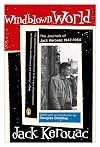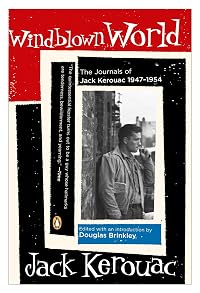
Windblown World: The Journals of Jack Kerouac 1947-1954
by Jack Kerouac  , Douglas Brinkley (Editor)
On This Page
Description
Excerpts from his diaries chronicle a pivotal era in Kerouac's life, describing the creation of his first novel; his special friendships with Allen Ginsberg and Neal Cassady; and his own take on the events described in "On the Road."Tags
Recommendations








Member Reviews
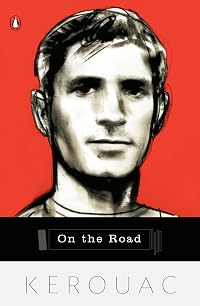
Having been a New York City high school student in the mid 1960s Jack Kerouac’s On The Road has long been a literary touchstone. As a teenager I became enamored with its tale of exploration and beatnik culture. Kerouac, Ginsberg and Corso provided a trilogy of poetic vision which helped formulate my own philosophy of living.
About two years ago, while browsing the bookshelves in the Barnes and Noble in Brooklyn Heights, I came across a new publication: On The Road,The Original Scroll, edited by Howard Cunnell. Once home, it found a resting spot in my bookshelf where it remained until a few months ago. Bored between books I picked it up and started to read first the four introductory essays describing the process by which the scroll show more found a publisher; eventually, the legendary editor Robert Giroux was presented with the 120 foot long scroll Kerouac had typed out in a 30 day benzedrine haze, a single paragraph of creativity. When Giroux told him it would need to be edited, Kerouac protested insisting “the Holy Spirit” had dictated the work. After months of cajoling, the finished product was published with Chapters, names changed to protect against libel and became an instant best seller and modern classic.
I remember reading it with eyes wide open delighting in Kerouac’s adventures crisscrossing the continental United States with a side trip to Mexico. It was populated with aimless adventurers focused on living free of convention with drug induced visions of an alternative consciousness.
As I revisited the book in its original form I was astounded at the poetic flow, a rush of words and scenes depicted as if I had a backseat perch in the old Hudson or variety of other cars Kerouac and Cassidy hightailed on the roads of America…
“that magnificent car made the wind roar; it made the plains unfold like a roll of paper; it cast hot tar from itself with deference---an imperial boat.”
This was a totally different reading experience, within which I felt emerged like a diver in a deep body of water.
At the same time, I had the good fortune of spending considerable time in the Rose Reading Room, a research space located on the third floor of the main branch of the New York Public Library building on 42nd Street and Fifth Avenue. There, I also discovered a one-off copy of Windblown World: The Journals of Jack Kerouac 1947-1954, edited by the American historian Douglas G. Brinkley. In my hands at the library was Kerouac’s personal thoughts and notes about his process while writing On The Road and vast notes taken while he was out on the road traipsing from North Carolina where his family lived and then to Queens, New York where they relocated. His mother an inescapably key figure in supporting the author in his down and out times. Additionally, the journals noted his interactions with other writers and the key figures in the finished classic as he and Neal Cassidy spent considerable time in NYC, Denver, Colorado, San Francisco, New Orleans (hanging out with William Burroughs and family), and finally Mexico City. Within these journal pages Kerouac provides insight into his own state of mind…
“one has to learn history and the stupid study of cause and effect, to enter into an understanding of eternity so far as we may know it. Cause-and-effect is also a prurience of mind and soul, because it pettishly demands surface answers to bottomless matters, though it is not for me to deny the right of men to build bridges over voids…but why walk on such a bridge; an elephant can do that; only a man can stare at the void and know it. Only man cares, not elephants and asses.”
…and his sense of humor
“If you can’t get a girl in the
Springtime
You can’t get a girl
at all.”
...after which Kerouac notes a WC Fields line: “you’re as funny as a cry for help.”
And still from the journals, a direct link to the road trips:
“Neal and I were still dreamily uncertain of whether it was Market St. in Frisco or not – at dreamy moments. This is when the mind surpasses life itself. More will be said and must be said about the sweet, small lake of the mind, which ignores Time & Space in a Preternatural Metaphysical Dream of Life…On we went into the violet darkness up to Baton Rouge on a double highway. Neal drove grimly as the little blond dozed, I dreamed.”
The Windblown World ends with these words:
“And what a revelation to know that I was born sad-that it was no trauma that made me sad-but God-who made me that way...The Eternal Wheel is Infinite Joy…I’m really willing to be conscientious…Death…death…and nothing else. I have to be joyful or I die, because my earthly position is untenable in gloom and I betray God in spite of myself therein.
“I don’t have to go to museums, I know what’s there.”
So, there you have it. I am not so sure it would be feasible nor accessible for those reading this review to simultaneously read The Original Scroll in tandem with the Journals-Windblown World. I now consider this opportunity as being near the pinnacle of my life’s reading experience.
But, if you are interested in reading or revisiting ,On The Road, I urge you to read in its original form, the scroll; it is transformative in its poetry and pace to the edited published editions better known to the reading public. show less
About two years ago, while browsing the bookshelves in the Barnes and Noble in Brooklyn Heights, I came across a new publication: On The Road,The Original Scroll, edited by Howard Cunnell. Once home, it found a resting spot in my bookshelf where it remained until a few months ago. Bored between books I picked it up and started to read first the four introductory essays describing the process by which the scroll show more found a publisher; eventually, the legendary editor Robert Giroux was presented with the 120 foot long scroll Kerouac had typed out in a 30 day benzedrine haze, a single paragraph of creativity. When Giroux told him it would need to be edited, Kerouac protested insisting “the Holy Spirit” had dictated the work. After months of cajoling, the finished product was published with Chapters, names changed to protect against libel and became an instant best seller and modern classic.
I remember reading it with eyes wide open delighting in Kerouac’s adventures crisscrossing the continental United States with a side trip to Mexico. It was populated with aimless adventurers focused on living free of convention with drug induced visions of an alternative consciousness.
As I revisited the book in its original form I was astounded at the poetic flow, a rush of words and scenes depicted as if I had a backseat perch in the old Hudson or variety of other cars Kerouac and Cassidy hightailed on the roads of America…
“that magnificent car made the wind roar; it made the plains unfold like a roll of paper; it cast hot tar from itself with deference---an imperial boat.”
This was a totally different reading experience, within which I felt emerged like a diver in a deep body of water.
At the same time, I had the good fortune of spending considerable time in the Rose Reading Room, a research space located on the third floor of the main branch of the New York Public Library building on 42nd Street and Fifth Avenue. There, I also discovered a one-off copy of Windblown World: The Journals of Jack Kerouac 1947-1954, edited by the American historian Douglas G. Brinkley. In my hands at the library was Kerouac’s personal thoughts and notes about his process while writing On The Road and vast notes taken while he was out on the road traipsing from North Carolina where his family lived and then to Queens, New York where they relocated. His mother an inescapably key figure in supporting the author in his down and out times. Additionally, the journals noted his interactions with other writers and the key figures in the finished classic as he and Neal Cassidy spent considerable time in NYC, Denver, Colorado, San Francisco, New Orleans (hanging out with William Burroughs and family), and finally Mexico City. Within these journal pages Kerouac provides insight into his own state of mind…
“one has to learn history and the stupid study of cause and effect, to enter into an understanding of eternity so far as we may know it. Cause-and-effect is also a prurience of mind and soul, because it pettishly demands surface answers to bottomless matters, though it is not for me to deny the right of men to build bridges over voids…but why walk on such a bridge; an elephant can do that; only a man can stare at the void and know it. Only man cares, not elephants and asses.”
…and his sense of humor
“If you can’t get a girl in the
Springtime
You can’t get a girl
at all.”
...after which Kerouac notes a WC Fields line: “you’re as funny as a cry for help.”
And still from the journals, a direct link to the road trips:
“Neal and I were still dreamily uncertain of whether it was Market St. in Frisco or not – at dreamy moments. This is when the mind surpasses life itself. More will be said and must be said about the sweet, small lake of the mind, which ignores Time & Space in a Preternatural Metaphysical Dream of Life…On we went into the violet darkness up to Baton Rouge on a double highway. Neal drove grimly as the little blond dozed, I dreamed.”
The Windblown World ends with these words:
“And what a revelation to know that I was born sad-that it was no trauma that made me sad-but God-who made me that way...The Eternal Wheel is Infinite Joy…I’m really willing to be conscientious…Death…death…and nothing else. I have to be joyful or I die, because my earthly position is untenable in gloom and I betray God in spite of myself therein.
“I don’t have to go to museums, I know what’s there.”
So, there you have it. I am not so sure it would be feasible nor accessible for those reading this review to simultaneously read The Original Scroll in tandem with the Journals-Windblown World. I now consider this opportunity as being near the pinnacle of my life’s reading experience.
But, if you are interested in reading or revisiting ,On The Road, I urge you to read in its original form, the scroll; it is transformative in its poetry and pace to the edited published editions better known to the reading public. show less
Kerouac began keeping journals in 1936, and continued for the rest of his life. The journals survive and editor Brinkley, writing in The Atlantic Monthly in 1998, promised us publication of "a multi-volume edition." Now it seems that all we will be getting is this 370-page book, covering only some of the material from the years 1947 to 1950, and with just a few pages from 1954 thrown in as extra.
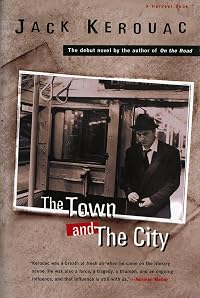
The parts that have been selected for inclusion are apparently aimed at demonstrating the development of Kerouac's first two major works, The Town & the City, and On the Road. Strange, then, that nothing from Kerouac's 1948-49 journal of work on the latter book is included, although some of it did appear as a taster in the extracts Brinkley show more selected for publication in The Atlantic Monthly in 1998. That must surely be one of the most relevant journals for those interested in the development of On the Road and its omission here is a mystery. (Note: Although not in the hardback edition, Kerouac's On the Road journal has been added as a "postscript" to the later paperback edition of this book.) Other journal extracts published in Atlantic, and also in the New Yorker in 1998, are missing from the published book.
In his introduction, it seems to me that Brinkley places far too much emphasis on demolishing the "myth" that On the Road was frantically written in three weeks in April 1951, claiming that Kerouac had begun it much earlier. This may be news to Brinkley, but I'm sure that most Kerouac readers are already aware of that fact. They will have known it since Tim Hunt pointed out that Kerouac began working on the book in 1948, attempting at least five different versions over the next four years. Hunt published this information, with extracts from the earlier attempts, in his PhD thesis in 1975, and in his book, Kerouac's Crooked Road, in 1981.
There's no doubt that Kerouac DID write the version that eventually became the published On the Road in a three-week burst on a scroll of paper in April 1951. However, examination of the scroll reveals that it differs somewhat from the published version, with the insertion of material from his journals being added LATER, at a more leisurely pace, when Kerouac retyped it onto separate pages.
What we have in this volume makes fascinating reading, of course, and offers a little more insight into Kerouac's mind, and his working practices. Brinkley admits to editing the journals heavily in places, and also to mixing together parts from different journals, with no clear indication of the individual sources. The result of this can only be confusion.
This book has been six years in the making. I imagine that all Kerouac scholars and enthusiasts who have been waiting patiently for its appearance will need a copy, and will find the contents valuable. However, I do believe that an important opportunity has been missed to make this the truly outstanding work it could have been. show less
The parts that have been selected for inclusion are apparently aimed at demonstrating the development of Kerouac's first two major works, The Town & the City, and On the Road. Strange, then, that nothing from Kerouac's 1948-49 journal of work on the latter book is included, although some of it did appear as a taster in the extracts Brinkley show more selected for publication in The Atlantic Monthly in 1998. That must surely be one of the most relevant journals for those interested in the development of On the Road and its omission here is a mystery. (Note: Although not in the hardback edition, Kerouac's On the Road journal has been added as a "postscript" to the later paperback edition of this book.) Other journal extracts published in Atlantic, and also in the New Yorker in 1998, are missing from the published book.
In his introduction, it seems to me that Brinkley places far too much emphasis on demolishing the "myth" that On the Road was frantically written in three weeks in April 1951, claiming that Kerouac had begun it much earlier. This may be news to Brinkley, but I'm sure that most Kerouac readers are already aware of that fact. They will have known it since Tim Hunt pointed out that Kerouac began working on the book in 1948, attempting at least five different versions over the next four years. Hunt published this information, with extracts from the earlier attempts, in his PhD thesis in 1975, and in his book, Kerouac's Crooked Road, in 1981.
There's no doubt that Kerouac DID write the version that eventually became the published On the Road in a three-week burst on a scroll of paper in April 1951. However, examination of the scroll reveals that it differs somewhat from the published version, with the insertion of material from his journals being added LATER, at a more leisurely pace, when Kerouac retyped it onto separate pages.
What we have in this volume makes fascinating reading, of course, and offers a little more insight into Kerouac's mind, and his working practices. Brinkley admits to editing the journals heavily in places, and also to mixing together parts from different journals, with no clear indication of the individual sources. The result of this can only be confusion.
This book has been six years in the making. I imagine that all Kerouac scholars and enthusiasts who have been waiting patiently for its appearance will need a copy, and will find the contents valuable. However, I do believe that an important opportunity has been missed to make this the truly outstanding work it could have been. show less
This is an excellent collection of Jack Kerouac's journals written during the writing of his first novels, Town and Country and On the Road. Most of the focus is on the journal entries during the writing of Town and Country. It's very interesting to read about the methods and thoughts of Kerouac during this period. His journal entries are long and detailed. It's amazing to think of how much time he spent writing between the novels and his journals.
The journals that cover his early planning of On the Road are more a collection of ideas as opposed to what went on during the writing of the novel. Kerouac's thoughts are more ambiguous and unorganized in this portion of the collection, but reveal the early influence of Allen Ginsberg and show more Bhuddism on Kerouac.
While extensive, coming in at 422 pages, the Kerouac journals are a great way to gain more insight into the life and writing of Jack Kerouac. The compilation of journals could have perhaps been organized a bit better by the editor, however, this collection is great for aspiring writers along with those interested in Kerouac and the Beats. show less
The journals that cover his early planning of On the Road are more a collection of ideas as opposed to what went on during the writing of the novel. Kerouac's thoughts are more ambiguous and unorganized in this portion of the collection, but reveal the early influence of Allen Ginsberg and show more Bhuddism on Kerouac.
While extensive, coming in at 422 pages, the Kerouac journals are a great way to gain more insight into the life and writing of Jack Kerouac. The compilation of journals could have perhaps been organized a bit better by the editor, however, this collection is great for aspiring writers along with those interested in Kerouac and the Beats. show less
It's still hard to separate Jack Kerouac the novelist from Jack Kerouac the brand. Beginning with the publication of ''On The Road'' in 1957, when Kerouac became a national celebrity and appeared on TV talk shows, and especially since his death in 1969, when he became a minor industry and a leading author's-photo postcard, his name has been used to sell so many attitudes and promote so many fashions that the artist behind the image has been obscured. For certain left-wing baby boomers, Kerouac is a political figure first -- the great Eisenhower-era proto-hippie. For New Agers, he's a spiritual pioneer who helped make America safe for Eastern religion. For college kids with powerful car stereos, he's the original road-trip party hound. show more Even people who may have never read him want a piece of Kerouac, it seems (including the tabloid murder suspect Scott Peterson, who referred to him as ''Jack Cadillac'' in a phone conversation recorded by the police.) Kerouac is no longer just an artist. He's a lifestyle god. - New york times. show less
Windblown World: The Journals of Jack Kerouac 1947-1954 by Jack Kerouac (2004)
Ratings
Members
- Recently Added By
Author Information

217+ Works 68,596 Members
Jack Kerouac was born in Lowell, Massachusetts, in 1922. His first novel, The Town and the City, was published in 1950. He considered all of his "true story novels," including On the Road, to be chapters of "one vast book," his autobiographical Legend of Duluoz. He died in St. Petersburg, Florida, in 1969 at the age of forty-seven. (Publisher show more Provided) show less
Jack Kerouac has a Legacy Library. Legacy libraries are the personal libraries of famous readers, entered by LibraryThing members from the Legacy Libraries group.

Douglas Brinkley was born in Atlanta, Georgia on December 14, 1960. He received a B.A. from Ohio State University in 1982 and a Ph.D. from Georgetown University in 1989. He was a professor at Tulane University, Princeton University, the U.S. Naval Academy, Hofstra University, and the University of New Orleans. In 2007, he became a professor at show more Rice University and the James Baker Institute for Public Policy. He is a commentator for CBS News and a contributing editor to the magazine Vanity Fair. His first book, Jean Monnet: The Path to European Unity, was published in 1992. His other works include Dean Acheson: The Cold War Years, The Unfinished Presidency: Jimmy Carter's Journey Beyond the White House, Wheels for the World: Henry Ford, His Company, and a Century of Progress, The Boys of Pointe du Hoc: Ronald Reagan, D-Day, and the U.S. Army 2nd Ranger Battalion, The Wilderness Warrior: Theodore Roosevelt and the Crusade for America, Cronkite, and Rightful Heritage: Franklin D. Roosevelt and the Land of America. He also wrote three books with historian Stephen E. Ambrose: The Rise to Globalism: American Foreign Policy Since 1938, Witness to History, and The Mississippi and the Making of a Nation: From the Louisiana Purchase to Today. He has won several awards including the Theodore and Franklin Roosevelt Naval History Prize for Driven Patriot and the Robert F. Kennedy Book Award for The Great Deluge: Hurricane Katrina, New Orleans, and the Mississippi Gulf Coast. (Bowker Author Biography) show less
Common Knowledge
- People/Characters
- Jack Kerouac
Classifications
- Genres
- Fiction and Literature, Biography & Memoir, Literature Studies and Criticism
- DDC/MDS
- 818.5403 — Literature & rhetoric American literature in English American miscellaneous writings in English 20th Century 1945-1999 Diaries
- LCC
- PS3521 .E735 .Z478 — Language and Literature American literature American literature Individual authors 1900-1960
- BISAC
Statistics
- Members
- 320
- Popularity
- 100,159
- Reviews
- 5
- Rating
- (4.00)
- Languages
- English, Italian, Portuguese, Spanish
- Media
- Paper
- ISBNs
- 7
- ASINs
- 1