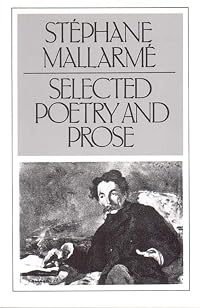
Selected Poetry and Prose
by Stéphane Mallarmé
On This Page
Description
Selected Poetry and Prose of Stéphane Mallarmé presents what can be considered the essential work of the renowned "father of the Symbolists." Mallarmé's major elegies, sonnets, and other verse, including excerpts from the dialogue "Hériodiade," are all assembled here with the French and English texts en face. Also included (not bilingually) are the visual poem "Dice Thrown Never Will Annul Chance" and the drama "Igitur," as well as letters, essays, and reviews. Although his primary show more concern was with poetry, the aesthetics of Stéphane Mallarmé (1842-98) has touched all the arts. During the last twenty years of his life, his Paris apartment was a major literary gathering place. Every Tuesday evening, standing beneath the portrait of himself by his friend Edouard Manet, the poet addressed reverent gatherings which included at various times Paul Valery and André Gide, among many others. The American painter James Whistler was influenced by these "Mardis," and one of the best-known poems in the present collection, "The Afternoon of a Faun," inspired Claude Debussy's famous musical composition. In translation, the subtle and varied shades of Mallarmé's oeuvre may best be rendered by diverse hands. Editor Mary Ann Caws, the author of books on René Char, Robert Desnos, and various aspects of modern French writing, has brought together the work of fourteen translators, spanning a century, from the Symbolists and the Bloomsbury group (George Moore and Roger Fry) to Cid Corman, Brian Coffey, and other contemporary poets and writers. show lessTags
Recommendations




















Member Reviews
These carefully-curated writings span from 1863-97.
“Apparition” (1863) establishes him as an obvious genius right out of the gate. Some of its heart-rending imagery includes “vaporous flowers,” “dying violins,” “white sobs,” “the perfume of sadness,” and “white bouquets of perfumed stars.” (That last one is its final line, and you can see how it seamlessly brings together three topics used previously in the poem.)
The next year, he picked up right where he left off with “The Azure” (1864), which is tumultuously exciting. This homage to the blue canopy lurking above us culminates alarmingly with
“It travels ancient through the fog, and penetrates
Like an unerring blade your native agony;
Where flee in my revolt show more so useless and depraved?
For I am haunted! The Sky! The Sky! The Sky! The Sky!”
The translation of “Sigh” (1864) somewhat reconfigures it, boldly taking it from 10 lines to 14 while keeping the same approximate number of words. The translator, Frederick Morgan, manages to brilliantly tease out some rhymes (“sky” & “eye,” “leaves” & “cleave”) that weren’t necessarily set up to rhyme in the original structure. I’m guessing this is why he decided to mold the clay on the way that he did. I can’t recall ever seeing this done before.
The enigmatic and dreamlike effort “Lace Passes Into Nothingness…” (1884) could be called ambient poetry. Its pacing and precision brings to my mind Emily Dickinson.
The collection concludes spectacularly with the avant-garde “Dice Thrown Never Will Annul Chance” (1895), using an array of font sizes and text splashed across the pages to truly throw the gauntlet down. This proto-Dadaist splurge, superior to Ginsberg’s “Howl” in my opinion, even has its own two-page preface, by Mallarmé himself.
This book presents each poem except for “Dice…” in French on the left pages and English on the right. (The prose is only given in English.) Evidently Mallarmé’s writing style is challenging to translate, as fifteen different translators were recruited, each giving his or her own twist to each item, so it helps to know a good bit of French, as I luckily do.
As Eliot, Baudelaire, and Neruda did to me some years ago, this slim book has rekindled my love of the written word and fired up my imagination to levels that should be illegal. It’s that great. Now to acquire everything this guy ever put to paper…
RIYL: Baudelaire, Neruda, Shakespeare’s sonnets, Jim Morrison, 1980s gothic rock / ethereal wave lyricists show less
“Apparition” (1863) establishes him as an obvious genius right out of the gate. Some of its heart-rending imagery includes “vaporous flowers,” “dying violins,” “white sobs,” “the perfume of sadness,” and “white bouquets of perfumed stars.” (That last one is its final line, and you can see how it seamlessly brings together three topics used previously in the poem.)
The next year, he picked up right where he left off with “The Azure” (1864), which is tumultuously exciting. This homage to the blue canopy lurking above us culminates alarmingly with
“It travels ancient through the fog, and penetrates
Like an unerring blade your native agony;
Where flee in my revolt show more so useless and depraved?
For I am haunted! The Sky! The Sky! The Sky! The Sky!”
The translation of “Sigh” (1864) somewhat reconfigures it, boldly taking it from 10 lines to 14 while keeping the same approximate number of words. The translator, Frederick Morgan, manages to brilliantly tease out some rhymes (“sky” & “eye,” “leaves” & “cleave”) that weren’t necessarily set up to rhyme in the original structure. I’m guessing this is why he decided to mold the clay on the way that he did. I can’t recall ever seeing this done before.
The enigmatic and dreamlike effort “Lace Passes Into Nothingness…” (1884) could be called ambient poetry. Its pacing and precision brings to my mind Emily Dickinson.
The collection concludes spectacularly with the avant-garde “Dice Thrown Never Will Annul Chance” (1895), using an array of font sizes and text splashed across the pages to truly throw the gauntlet down. This proto-Dadaist splurge, superior to Ginsberg’s “Howl” in my opinion, even has its own two-page preface, by Mallarmé himself.
This book presents each poem except for “Dice…” in French on the left pages and English on the right. (The prose is only given in English.) Evidently Mallarmé’s writing style is challenging to translate, as fifteen different translators were recruited, each giving his or her own twist to each item, so it helps to know a good bit of French, as I luckily do.
As Eliot, Baudelaire, and Neruda did to me some years ago, this slim book has rekindled my love of the written word and fired up my imagination to levels that should be illegal. It’s that great. Now to acquire everything this guy ever put to paper…
RIYL: Baudelaire, Neruda, Shakespeare’s sonnets, Jim Morrison, 1980s gothic rock / ethereal wave lyricists show less
This is a fantastic selection of poems, prose pieces, and near-unclassifiables (the very strange and haunting Igitur) by this important French poet. The translations are by various authors and most read wonderfully in English -- it is nice that the poems (with the exception of A Throw of the Dice) are presented bilingually, because if you have a little French (like I do) it is easy to get a little of the music of the originals.
This is a compact, inexpensive, wide-ranging introduction -- it's probably worth the price just for Igitur alone, since this play/narration/object/wtf is -- despite the fact that it is probably unfinished -- pivotal in Mallarme's development.
This is a compact, inexpensive, wide-ranging introduction -- it's probably worth the price just for Igitur alone, since this play/narration/object/wtf is -- despite the fact that it is probably unfinished -- pivotal in Mallarme's development.
Stéphane Mallarmé is a symbolist poet whose work was greatly influenced by Baudelaire and later influential to the Surrealists (who, like Mallarme, explored the relationship of poetry to other artistic media such as painting and music) and modernists like Wallace Stevens, TS Eliot (Four Quartets, especially) and James Joyce (noticeable in Finnegan's Wake). Mallarmé's poetry is metaphysical and musical, composed syntactically as oblique "folds" and dense metaphors of negation and alchemy (Baudelaire). It's such a snob's cliche to say that his poetry should be read in the original French, but this is very true of Mallarmé. The phonemic ambiguity of his words and the inter-relationship of sound to meaning are important to really show more appreciating his work (and make his poems hard to translate into English). But there are good bilingual translations (like MacIntyre's, in my opinion) which capture the striking metaphors and imagery quite nicely. If anyone has read JP Sartre's book on Mallarmé provocatively titled Mallarmé, Poet of Nothingness, I would like to know about it. The book is out of print. show less
Ratings
Members
- Recently Added By
Lists

Harold Bloom - The Western Canon: C. The Democratic Age
336 works; 15 members
Author Information

174+ Works 2,520 Members
Stéphane Mallarmé, 1842 - 1898 French poet Stéphane Mallarmé was born in Paris. His father and grandfather expected him to follow in the family tradition of French civil service but he didn't do well in school. Mallarmé began writing at a young age under the influence of Charles Baudelaire. After Mallarmé left school, he went to England and show more while there he got married. He was a schoolteacher from 1864 until his retirement in 1893. His first poems started appearing in magazines during the 1860's. He wrote his first important poem "L'Azur" and it was published when he was twenty-four years old. His most famous work is "L'Apres-Midi D'un Faune" (1865), and was inspired by Debussy's tone poem of the same name (1894) and illustrated by the famous painter Manet. Some of his other notable works are "Herodiade" (1896), and "Toast Funebre," which was written in memory of the author Theopile Gautier. Mallarmé spent his life putting his literary theories into practice by writing his Grand oeuvre (Great Work). On September 9, 1898, Mallarme died without completing this work. His experimental poem "Un Coup De Des" was published posthumously in 1914. (Bowker Author Biography) show less
Series
Belongs to Publisher Series
New Directions Paperbook (529)
Classifications
Statistics
- Members
- 189
- Popularity
- 173,605
- Reviews
- 3
- Rating
- (4.23)
- Languages
- English
- Media
- Paper, Ebook
- ISBNs
- 3
- ASINs
- 1