On This Page
Description
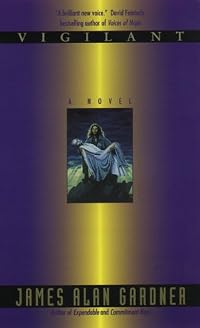
To fight android assassins, a young woman channels her father's heroism--and faces a troubled past--in this "enjoyable, fast-moving, off-planet adventure" (SFSite). In the twenty-fifth century, under the leadership of the League of Peoples, war and crime are things of the past and life is held sacred. That is, as long as you are healthy and beautiful. But those who are deformed or flawed, or who appear to be misfits in any way, are destined--or is "doomed" a better word?--to become show more Explorers, crews assigned to probe worlds so hostile, the chances of returning are somewhere between slim and none. In Vigilant, the third volume of the League of Peoples series, a deadly plague has struck planet Demoth, wiping out millions of the winged Ooloms. Humans, however, were left completely untouched. But before the Oolom population was utterly devastated, Dr. Henry Smallwood found a cure. He lived as a hero for only a year before dying in a mining accident. Having grown up without a father, Dr. Smallwood's daughter Faye attempts to escape her troubled past by joining the Vigil, a planetary organization that monitors the government. But on her first assignment, things go terribly awry and she and her team are targeted by android assassins. Uncovering a conspiracy that threatens the fate of Demoth, Faye turns to the only person she can trust--Festina Ramos. show lessTags
Recommendations


Member Reviews
I plowed through this whole seven-book series in less than two weeks time, joined the author's Patreon, tweeted at him (and received a reply!) and then went looking for more of his books (sadly, there aren't many -- yet!). I don't remember each of the books individually very well (should have reviewed them right away), but I'll leave this review for the series as a whole:
The basic premise is that we aren't alone in the universe, there is a League of Peoples who have agreed to an edict handed down by a far superior (and never actually seen) species, which is basically not to cause harm to any member of any sentient species. There are still people living on Earth: those who refuse to agree to this rule or who have already broken it, but show more the sentient individuals who can abide by it flit around the universe, investigating new planets and species and making trade relationships.
Throughout the series we get to meet various fascinating races of 'aliens' and learn about their cultures and species. We also get to explore the theme of what constitutes "harm" intentional or otherwise, and towards the end make some hypotheses about the nature of this superior race who enforce the no-harm rule by basically immediately killing anyone who has broken it the next time they try to leave one planet for another. The series is packed with fun characters the reader comes to understand and even love, but they are properly flawed and dynamic individuals who are living their own journeys.
I really, really wish (hope?) there were (will be?) more books in this series. You should do yourself a favor and read it. I'll definitely revisit it someday. show less
The basic premise is that we aren't alone in the universe, there is a League of Peoples who have agreed to an edict handed down by a far superior (and never actually seen) species, which is basically not to cause harm to any member of any sentient species. There are still people living on Earth: those who refuse to agree to this rule or who have already broken it, but show more the sentient individuals who can abide by it flit around the universe, investigating new planets and species and making trade relationships.
Throughout the series we get to meet various fascinating races of 'aliens' and learn about their cultures and species. We also get to explore the theme of what constitutes "harm" intentional or otherwise, and towards the end make some hypotheses about the nature of this superior race who enforce the no-harm rule by basically immediately killing anyone who has broken it the next time they try to leave one planet for another. The series is packed with fun characters the reader comes to understand and even love, but they are properly flawed and dynamic individuals who are living their own journeys.
I really, really wish (hope?) there were (will be?) more books in this series. You should do yourself a favor and read it. I'll definitely revisit it someday. show less
Vigiliant is finally a real League of People's book, a high tech mystery on a planet inhabited by multiple species, and a long and forgotten past. The mystery takes a while to get moving, as our narrator Faye describes living through a terrible plague that targeted the avian Ooloom, before it was cured by her father, using ordinary olive oil. When her father was killed in a mining collapse, Faye acted out as hard a teenager could, but at the start of the action, she's gotten her life together and is a member of Vigil, a unique branch of government with the power to look into any official business and to objectively state how a proposed policy will work.
Faye's thrilling career investigating water plant refurbishment is sidelined when a show more team of androids try to assassinate her. Yeah, Rule #1 of the League of Peoples is that murder is impossible, or binds the perpetrator to a single planet. Faye investigates the attacks with a crazy Ooloom senior investigator, and Admiral Festina Ramos of Expendable. What she finds is, well, the soul of the world, machines with feelings, the origins of the plague, and how her father really died.
Gardner definitely has a pattern in his capable-but-emotionally-damaged protagonists, but he has a keen ear for character, and its fun to see the setting expand. Not as good as Expendable, better than Commitment Day. show less
Faye's thrilling career investigating water plant refurbishment is sidelined when a show more team of androids try to assassinate her. Yeah, Rule #1 of the League of Peoples is that murder is impossible, or binds the perpetrator to a single planet. Faye investigates the attacks with a crazy Ooloom senior investigator, and Admiral Festina Ramos of Expendable. What she finds is, well, the soul of the world, machines with feelings, the origins of the plague, and how her father really died.
Gardner definitely has a pattern in his capable-but-emotionally-damaged protagonists, but he has a keen ear for character, and its fun to see the setting expand. Not as good as Expendable, better than Commitment Day. show less
A good continuation of the series with a deadly plague, killer robots, impossible E.T.s and a central mystery that is as cleverly presented as it is solved. I like Gardner's easygoing style of writing too, the action flows along with nary a clunky passage.
Really liked it.
Concepts of The Explorers and The Vigil are terrific. Alien characterization is well done.
Secondary plot elements regarding alternative family structure and female->female love are a bit dated and heavy-handed but somehow manage to be sensitive too in their own way.
Love the way the story teeter totters on the sharp edge between contagious disease and biological weapons -after all the sick need care and the dead need to be buried no matter how they got that way, right?
In a fractional rating system, I would have given this book a 3.7.
Sometimes I pick up a bunch of books really cheap, for ten cents apiece up in Maine. Or I get them three for a dollar in Brookline. At those prices, I can afford to take a chance on writers that I've never read before - even though I only like three modern genre writers.
Once in a very long while, I find a new modern author who can write well.
The Vigilant is actually a surprisingly good book. Gardner's not a new Zelazny, but this long science fiction novel about a plague on a colony planet surprised me several times - and didn't annoy me once. Well, okay, the author's use of the word "Dads" annoyed me. A lot. But apart from that, the characters were well-written, and the show more plot worked pretty well.
The heroine was a bit annoying at times, but that was intentional. And the ideas behind the story were interesting; it takes place in a galactic "League of Peoples" in which unimaginably powerful races have issued a single command: that dangerous non-sentient beings cannot travel from planet to planet.
The novel also features an interesting idea for a non-governmental organization which exists solely to scrutinize the government, and to publicize malfeasance and the consequences of government action and inaction; it's not slanted in any obvious political direction, and doesn't pretend to perfection.
There's a pretty large mystery component to the plot, which when handled properly is always good. I don't know if it would have been possible to solve the mystery before the denouement, but I didn't feel cheated, and I didn't see the various revelations coming in advance. Apparently Gardner has written a number of other books; I'll probably try them. show less
Sometimes I pick up a bunch of books really cheap, for ten cents apiece up in Maine. Or I get them three for a dollar in Brookline. At those prices, I can afford to take a chance on writers that I've never read before - even though I only like three modern genre writers.
Once in a very long while, I find a new modern author who can write well.
The Vigilant is actually a surprisingly good book. Gardner's not a new Zelazny, but this long science fiction novel about a plague on a colony planet surprised me several times - and didn't annoy me once. Well, okay, the author's use of the word "Dads" annoyed me. A lot. But apart from that, the characters were well-written, and the show more plot worked pretty well.
The heroine was a bit annoying at times, but that was intentional. And the ideas behind the story were interesting; it takes place in a galactic "League of Peoples" in which unimaginably powerful races have issued a single command: that dangerous non-sentient beings cannot travel from planet to planet.
The novel also features an interesting idea for a non-governmental organization which exists solely to scrutinize the government, and to publicize malfeasance and the consequences of government action and inaction; it's not slanted in any obvious political direction, and doesn't pretend to perfection.
There's a pretty large mystery component to the plot, which when handled properly is always good. I don't know if it would have been possible to solve the mystery before the denouement, but I didn't feel cheated, and I didn't see the various revelations coming in advance. Apparently Gardner has written a number of other books; I'll probably try them. show less
Mar11:
Characters: The lead is a fun romp. A couple alien mentors are fun and quirky. The carry-over character from the series seems rather flat. Overall okay.
Plot: Part of the mystery was well done. But the end was close to deus ex machina. I give it an okay overall.
Style: Somehow pulled *just* above average sci-fi. I think it's because the world building is well done. And the galactic federation thingie is cute and well done. And the vigils just appeal to me.
Characters: The lead is a fun romp. A couple alien mentors are fun and quirky. The carry-over character from the series seems rather flat. Overall okay.
Plot: Part of the mystery was well done. But the end was close to deus ex machina. I give it an okay overall.
Style: Somehow pulled *just* above average sci-fi. I think it's because the world building is well done. And the galactic federation thingie is cute and well done. And the vigils just appeal to me.
One of the best science fictions I have read in a long time. The main character is well rounded and the reader can relate with the character.
Members
- Recently Added By
Author Information

39+ Works 3,716 Members
Series

Work Relationships
Is contained in
Common Knowledge
- Blurbers
- Feintuch, David
Classifications
Statistics
- Members
- 395
- Popularity
- 78,600
- Reviews
- 7
- Rating
- (3.86)
- Languages
- English
- Media
- Paper, Ebook
- ISBNs
- 8
- ASINs
- 4