
Against a Dark Background
by Iain M. Banks
On This Page
Description
Sharrow was once the leader of a personality-attuned combat team in one of the sporadic little commercial wars in the civilization based around the planet Golter. Now she is hunted by the Huhsz, a religious cult which believes that she is the last obstacle before the faith's apotheosis, and her only hope of escape is to find the last of the apocalyptically powerful Lazy Guns before the Huhsz find her. Her journey through the exotic Golterian system is a destructive and savage odyssey into show more her past, and that of her family and of the system itself. show lessTags
Recommendations








Member Reviews
This one's exquisitely written and full of interesting ideas, which is more-or-less what you can expect from an Iain M. Banks book. But for whatever reason, "Against a Dark Background" failed to hold my attention like the Culture novels I've read, though I did manage to finish it. As usual, it's an example of the shiny, widescreen version of SF. The impossibly skilled and sexy Lady Sharrow, a high-born noble in a universe that's a strange mix of the futuristic and the atavistic, must flee a religion that's made her death central to their belief system while she hunts amusingly strange artifacts for fun, for immense profits, and sometimes for her family's very survival. Fantasy tropes -- castles, hermits, swords, and mounts -- pop up show more here and there while the lady and her chemically-bonded band of adventures confront all manner of dangers. The author doesn't skip out on the blood and pain -- there are some simply excruciating deaths here -- and he constructs some lovely set pieces, most memorably the one that describes the minute-by-minute uncertainties of a crash-landing on a snowbound planet. To show that he's not the average paperback writer, Banks then seamlessly incorporates the long-term effects of this event into his character and narrative. And then there's also the curious pull of the artifacts themselves, specifically that of a lazy gun, a weapon that seems to fool the laws of physics while exerting an inexplicable psychological pull on those who seek it. There's a forest planet and a city built on barges and a nascent religion that hopes to conquer the entire system, just in case you needed more.
But I also thought that there was something missing here, among all the impeccably wrought sentences that drape themselves comfortably across the page. Maybe the fact that the world that Banks describes here isn't as cleanly futuristic as that of his Culture novels that got to me. Set on a star system located by unlucky chance thousands of light years from any others, this world seems to feel the weight of its own limitations. Sometimes the medieval throwbacks or anachronisms suggested that something had gotten stuck, both in the book and in the civilization it describes. Or it's the lack of the Culture itself, that protean, hard-to-define organism that provides a convenient thread through Banks's other works. Or maybe it's just that there's far too much of "Against a Dark Background": while it has its charms, any book, however charming, might struggle to sustain itself over nearly eight hundred pages. Or maybe it's just the fact that Lady Sharrow fulfils every science fiction's checklist a bit too perfectly. Lasers, castles, spaceships, motorcycles, and hot, chemically engineered sex? I'm glad nobody saw me reading this one on the bus.
If you're a big space opera fan, it's possible that none of this will really bother you. But I read Banks between literary novels, and so this one got a bit too purple for me at times, not to mention a bit too long. It's not bad book in its genre, and, for two lousy bucks at the Kindle Store, I certainly got my money's worth. But in my opinion, "Against a Dark Background" just isn't the strongest thing that this author ever wrote. show less
But I also thought that there was something missing here, among all the impeccably wrought sentences that drape themselves comfortably across the page. Maybe the fact that the world that Banks describes here isn't as cleanly futuristic as that of his Culture novels that got to me. Set on a star system located by unlucky chance thousands of light years from any others, this world seems to feel the weight of its own limitations. Sometimes the medieval throwbacks or anachronisms suggested that something had gotten stuck, both in the book and in the civilization it describes. Or it's the lack of the Culture itself, that protean, hard-to-define organism that provides a convenient thread through Banks's other works. Or maybe it's just that there's far too much of "Against a Dark Background": while it has its charms, any book, however charming, might struggle to sustain itself over nearly eight hundred pages. Or maybe it's just the fact that Lady Sharrow fulfils every science fiction's checklist a bit too perfectly. Lasers, castles, spaceships, motorcycles, and hot, chemically engineered sex? I'm glad nobody saw me reading this one on the bus.
If you're a big space opera fan, it's possible that none of this will really bother you. But I read Banks between literary novels, and so this one got a bit too purple for me at times, not to mention a bit too long. It's not bad book in its genre, and, for two lousy bucks at the Kindle Store, I certainly got my money's worth. But in my opinion, "Against a Dark Background" just isn't the strongest thing that this author ever wrote. show less
They could see the nebulae, beautiful and distant and beckoning, and could tell that those faraway galaxies were composed of suns, other stars like Thrial, and could even guess that some of those suns too might have planets around them . . . but they looked in vain for stars anywhere near their own.
The sky was full of darkness. There were planets and moons and the tiny feathery whorls of the dim nebulae, and they had themselves filled it with junk and traffic and the emblems of a thousand different languages, but they could not create the skies of a planet within a galaxy, and they could not ever hope, within any frame of likelihood they could envisage existing, to travel to anywhere beyond their own system, or the show more everywhere-meaningless gulf of space surrounding their own isolated and freakish star.
For a distance that was never less than a million light years in any direction around it, Thrial -- for all its flamboyant dispersion of vivifying power and its richly fertile crop of children planets -- was an orphan.
This book is a stand-alone, and not part of the Culture series, although I suppose it's possible that it takes place in the same universe, and that the isolated position of this star means that the Culture has never come calling.
As the book starts, Lady Sharrow is preparing to go on the run, as the Huhsz, a religious cult who murdered her mother and are determined to destroy the female line of her family, are about to be granted a year-long passport to track her down and kill her. Rather than going into hiding, Sharrow decides to go on the offensive, and track down the Lazy Gun that her ancestor stole form the cult, as its return will end the hunt. It's a strange idea, that giving people carte blanche to kill someone legally for a limited period would prevent assassinations. I can't see it working in reality, especially with a religiously motivated group like the Huhsz. Would they really just give up once the year was up?
But there are some really interesting concepts; a prison without locks, a tree that covers half a planet, and the city that was abandoned due to radiation which is now a city of androids, And of course the Lazy Guns. Lazy Guns are cool. So although I am a huge Culture fan, "Against a Dark Bacjkground" as equally good, just different. show less
The sky was full of darkness. There were planets and moons and the tiny feathery whorls of the dim nebulae, and they had themselves filled it with junk and traffic and the emblems of a thousand different languages, but they could not create the skies of a planet within a galaxy, and they could not ever hope, within any frame of likelihood they could envisage existing, to travel to anywhere beyond their own system, or the show more everywhere-meaningless gulf of space surrounding their own isolated and freakish star.
For a distance that was never less than a million light years in any direction around it, Thrial -- for all its flamboyant dispersion of vivifying power and its richly fertile crop of children planets -- was an orphan.
This book is a stand-alone, and not part of the Culture series, although I suppose it's possible that it takes place in the same universe, and that the isolated position of this star means that the Culture has never come calling.
As the book starts, Lady Sharrow is preparing to go on the run, as the Huhsz, a religious cult who murdered her mother and are determined to destroy the female line of her family, are about to be granted a year-long passport to track her down and kill her. Rather than going into hiding, Sharrow decides to go on the offensive, and track down the Lazy Gun that her ancestor stole form the cult, as its return will end the hunt. It's a strange idea, that giving people carte blanche to kill someone legally for a limited period would prevent assassinations. I can't see it working in reality, especially with a religiously motivated group like the Huhsz. Would they really just give up once the year was up?
But there are some really interesting concepts; a prison without locks, a tree that covers half a planet, and the city that was abandoned due to radiation which is now a city of androids, And of course the Lazy Guns. Lazy Guns are cool. So although I am a huge Culture fan, "Against a Dark Bacjkground" as equally good, just different. show less
A sprawling, imaginative science fiction action-adventure story full of fun stuff: bizarre cults, ancient artifacts, explosions, heists, daring escapes, treasure hunts, manhunts, mysteries of the past, surprise revelations, quirky ideas, life, death, and a darkly whimsical sense of humor. I will admit that the narrative's habit of jumping rapidly back and forth in time on a scale of anything from hours to decades and of not always explaining key plot points immediately sometimes had me feeling briefly confused, but I think that's likely to be more my fault than Banks', as I read much of it in a state of serious sleep-deprivation. This is definitely a book you want to be awake for.
Very, very good. It's less conceptual and more an adventure story than many of his other books - but it's a VERY good adventure story! Lots of action and violence, without neglecting depth of character & emotion.... very effective portrayal of a female protagonist by a male author too! (something I find is rather rare...)
We aren't given much reason to give a damn about Sharrow, we aren't given any feeling for the connection between her and the remaining 4 of her original 7 virally bonded battle companions, and we have no sensory connection to the exotic landscapes they risk on the supposedly(because, really who cares?) harrowing scavenger hunt of antiquities to find the one that will save Sharrow's life. If you like huge pointless body counts, gruesome dismemberment and think there is a point to saving a life by risking all the lives that matter, sure sink more hours than you can really spare in 644 pages of pleated plot that hides the near complete lack of ability to write more than isolated scenes. But that's only if you think that escaping after show more waking up in the custody of your enemies is a valid trope, because that happens repeatedly, past ad nauseam. Banks surely thinks well of himself, but no one else need bother. show less
Vicious stuff; the kind of thing you expect from Banks. The man is just amazing, an imagination more fecund than anything else I've ever encountered.
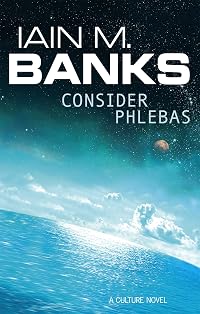
Like Use of Weapons we have the destructive sibling rivalry, like Consider Phlebas we have a grand tour, meeting strange and marvellous things along the way.
But most important, in the background we have the *large* theme.
In the end, like the Culture novels, this is a book about the point of life.
The setting is a planetary system millions of light years from any other star and thus incapable of expanding beyond a very finite space. Given this limitation, civilizations have risen and fallen countless times. The current system is an extreme version of the 20th century west mixed with the show more medieval --- wealthy corporations as more powerful than states, excessive bureaucracy and legalism --- but the specific details are not that important.
The important issue is the question of should it be changed? And if so, too what? If it should be changed, how much suffering is justified in doing so? And what's the point of change, anyway; the new system will be just one more regime like countless regimes that have gone before.
What makes Banks so interesting (and so unpalatable to many readers) is that he has no answers to these questions, and that he doesn't have much faith in the stock answers society provides. IMHO, for the most part his SF books, including this one are arguments by example against the pat ways in which society answers these questions when they arise.
This book is especially upsetting in that he doesn't even offer up the hedonistic comfort of the Culture books, the idea that man is optimized for pleasure and might as well concentrate on that. All we get is a very Buddhist endless cycle of suffering with no escape. show less
Like Use of Weapons we have the destructive sibling rivalry, like Consider Phlebas we have a grand tour, meeting strange and marvellous things along the way.
But most important, in the background we have the *large* theme.
In the end, like the Culture novels, this is a book about the point of life.
The setting is a planetary system millions of light years from any other star and thus incapable of expanding beyond a very finite space. Given this limitation, civilizations have risen and fallen countless times. The current system is an extreme version of the 20th century west mixed with the show more medieval --- wealthy corporations as more powerful than states, excessive bureaucracy and legalism --- but the specific details are not that important.
The important issue is the question of should it be changed? And if so, too what? If it should be changed, how much suffering is justified in doing so? And what's the point of change, anyway; the new system will be just one more regime like countless regimes that have gone before.
What makes Banks so interesting (and so unpalatable to many readers) is that he has no answers to these questions, and that he doesn't have much faith in the stock answers society provides. IMHO, for the most part his SF books, including this one are arguments by example against the pat ways in which society answers these questions when they arise.
This book is especially upsetting in that he doesn't even offer up the hedonistic comfort of the Culture books, the idea that man is optimized for pleasure and might as well concentrate on that. All we get is a very Buddhist endless cycle of suffering with no escape. show less
The first Banks book I have struggled with. I nearly stopped at 100 pages, which is the chance I give most books. As this was one of my favourite authors I extended my 100 page rule to 200, and even then I nearly put it down. This book really struggles to get you involved and the first half feels like a miss mash of 'cool' settings and scenarios. I did in fact pick up another book, but this one had gotten under my skin at that point so I came back to it.
Ultimately I'm giving this 5 stars. I do have a caveat that I generally do not leave reviews for books I do not finish, so all my reviews are 4 or 5 star.
In summary there are two plot hooks here. We have "the main character is being hunted" plot. The solution to this, is "to reunite the show more gang and pull off the heist" plot. There's other stuff going on of course. Cue loads of flashbacks, wacky firefights, weirdo sci-fi characters and a rather pessimistic view of human nature in spite of the joviality of some of the characters. The further into the story you get, the more gripping and tense it becomes. Definitely worth the slog. Banks skill at writing brutality and violence only works due to the implicit understanding the reader has, that this is all abhorrent. Humans are tragic, flawed, and will repeat mistakes. In the end it's not the hope that kills you, it's the lack of hope. show less
Ultimately I'm giving this 5 stars. I do have a caveat that I generally do not leave reviews for books I do not finish, so all my reviews are 4 or 5 star.
In summary there are two plot hooks here. We have "the main character is being hunted" plot. The solution to this, is "to reunite the show more gang and pull off the heist" plot. There's other stuff going on of course. Cue loads of flashbacks, wacky firefights, weirdo sci-fi characters and a rather pessimistic view of human nature in spite of the joviality of some of the characters. The further into the story you get, the more gripping and tense it becomes. Definitely worth the slog. Banks skill at writing brutality and violence only works due to the implicit understanding the reader has, that this is all abhorrent. Humans are tragic, flawed, and will repeat mistakes. In the end it's not the hope that kills you, it's the lack of hope. show less
Members
- Recently Added By
Author Information

66+ Works 93,245 Members
Iain Banks was born in Fife in 1954 and was educated at Stirling University where he studied English Literature, Philosophy and Psychology. Banks came to widespread and controversial public note with the publication of his first novel, The Wasp Factory, in 1984. His first science fiction novel, Consider Phlebas, was published in 1987. He continued show more to write both mainstream fiction (as Iain Banks) and science fiction (as Iain M. Banks). Banks' mainstream fiction included The Wasp Factory (1984), Walking on Glass (1985), The Bridge (1986), Espedair Street (1987), Canal Dreams (1989), The Crow Road (1992), Complicity (1993), Whit (1995), A Song of Stone (1997), The Business (1999), Dead Air (2002) and The Steep Approach to Garbadale (2007). His final book, The Quarry, was released posthumously on June 20, 2013. Banks died on June 9, 2013 of terminal gall bladder cancer. (Bowker Author Biography) show less
Some Editions
Common Knowledge
- Canonical title*
- L'arma finale
- Original title
- Against a Dark Background
- Original publication date
- 1993-05
- Dedication
- For Dave McCartney
- First words
- She put her chin on the wood below the window. (Prologue)
One line was all that came back to her. - Quotations
- "Good afternoon, madam. How may I help you?"
"Good afternoon. I'd like a FrintArms HandCannon, please."
"A--? Oh, now, that's an awfully big gun for such a lovely lady. I mean, not everybody thinks ladies sh... (show all)ould carry guns at all, though I say they have a right to. But I think... I might... Let's have a look down here. I might have just the thing for you. Yes, here we are! Look at that, isn't it neat? Now that is a FrintArms product as well, but it's what's called a laser -- a light-pistol some people call them. Very small, as you see; fits easily into a pocket or bag; won't spoil the line of a jacket; and you won't feel you're lugging half a tonne of iron around with you. We do a range of matching accessories, including -- if I may say so -- a rather saucy garter holster. Wish I got to do the fitting for that! Ha -- just my little joke. And there's *even*... here we are -- this special presentation pack: gun, charged battery, charging unit, beautiful glider-hide shoulder holster with adjustable fitting and contrast stitching, and a discount on your next battery. Full instructions, of course, and a voucher for free lessons at your local gun club or range. Or there's the *special* presentation pack; it has all the other one's got but with *two* charged batteries and a night-sight, too. Here, feel that -- don't worry, it's a dummy battery -- isn't it neat? Feel how light it is? Smooth, see? No bits to stick out and catch on your clothes, *and* beautifully balanced. And of course the beauty of a laser is, there's no recoil. Because it's shooting light, you see? Beautiful gun, beautiful gun; my wife has one. Really. That's not a line, she really has. Now, I can do you that one -- with a battery and a free charge -- for ninety-five; or the presentation pack on a special offer for one-nineteen; or this, the special presentation pack, for one-forty-nine."
"I'll take the special."
"Sound choice, madam, *sound* choice. Now, do--?"
"And a HandCannon, with the eighty-mill silencer, five GP clips, three six-five AP/wire-flechettes clips, two bipropellant HE clips, and a Special Projectile Pack if you have one -- the one with the embedding rounds, not the signalers. I assume the night-sight on this toy is compatible?"
"Aah... yes, And how does madam wish to pay?"
She slapped her credit card on the counter. "Eventually."
Fuck every cause that ends in murder and children crying.
People were always sorry. Sorry they had done what they had done, sorry they were doing what they were doing, sorry they were going to do what they were going to do; but they still did whatever it is. The sorrow never stopped... (show all) them; it just made them feel better. And so the sorrow never stopped.
subnivean
The android paused, then turned to her again. 'I beg your pardon nevertheless, Lady Sharrow,' it said. 'We were, and I was, made in the image of humanity, and in the enthusiasm of the moment I exhibited what was at least a la... (show all)ck of thought, and could have been construed as cruelty. We have always regarded it as our duty to reflect what is best in humankind, given that we are the work of your intellects rather than the processes of blind evolution, however purposeful in that blindness nature may be, and however noble and sophisticated its results. I am guilty at falling beneath both the standards we set ourselves and those humanity has the right to expect of us, and I apologise.'
...
'Contrition so elegant,' she said after a pause, 'needs not the parent of hurt to merit its existence, and what was intended to soothe harm just as fitly pleases contentment.'
The android looked at her for a moment. 'Vitrelian,' it said. 'The Trials of a Patient Man; Act Five, Scene Three.' - Last words
- (Click to show. Warning: May contain spoilers.)A little later the monowheel vehicle spun backward out of the sewer outfall, pirouetted vertically lilke a saluting mount, swung down across the greasy slope of stones at the base of the House's walls, dodged uncoordinated gunfire from a nearby tower and accelerated quickly away across the tide-flooding sands.
- Blurbers
- Spinrad, Norman
- Original language
- English
*Some information comes from Common Knowledge in other languages. Click "Edit" for more information.
Classifications
Statistics
- Members
- 3,181
- Popularity
- 5,449
- Reviews
- 45
- Rating
- (3.78)
- Languages
- 5 — English, French, German, Hungarian, Italian
- Media
- Paper, Audiobook, Ebook
- ISBNs
- 19
- ASINs
- 9