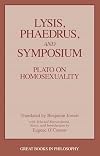
Lysis; Phaedrus; Symposium
by Plato
On This Page
Description
"And when the other is beside him, he shares his respite from anguish; when he is absent, he likewise shares his longing and being longed for, since he possesses that counterlove which is the image of love, though he supposes it to be friendship rather than love, and calls it by that name" (from the Phaedrus). The nature of love and friendship and their varying manifestations have stimulated philosophical interest for centuries. How should we understand such concepts as: the beloved, show more physical beauty, the beauty that transcends the physical, and the power of love between men as the ancient Greeks understood it? In these three dialogues, the Lysis, Phaedrus, and Symposium, Socrates, the gadfly of Athens, searches for the truth about love and friendship. In doing so, he reveals how his Athenian contemporaries regarded homosexual love as an educative, aesthetic, and social force. show lessTags
Recommendations


























Member Reviews
Members
- Recently Added By
Lists

Pre-1969 LGBTQ Literature
182 works; 69 members
Author Information

2,714+ Works 100,311 Members
Plato was born c. 427 B.C. in Athens, Greece, to an aristocratic family very much involved in political government. Pericles, famous ruler of Athens during its golden age, was Plato's stepfather. Plato was well educated and studied under Socrates, with whom he developed a close friendship. When Socrates was publically executed in 399 B.C., Plato show more finally distanced himself from a career in Athenian politics, instead becoming one of the greatest philosophers of Western civilization. Plato extended Socrates's inquiries to his students, one of the most famous being Aristotle. Plato's The Republic is an enduring work, discussing justice, the importance of education, and the qualities needed for rulers to succeed. Plato felt governors must be philosophers so they may govern wisely and effectively. Plato founded the Academy, an educational institution dedicated to pursuing philosophic truth. The Academy lasted well into the 6th century A.D., and is the model for all western universities. Its formation is along the lines Plato laid out in The Republic. Many of Plato's essays and writings survive to this day. Plato died in 347 B.C. at the age of 80. (Bowker Author Biography) show less
Some Editions
Series
Belongs to Publisher Series
Work Relationships
Common Knowledge
- Canonical title
- Lysis; Phaedrus; Symposium
Classifications
- Genres
- Philosophy, Nonfiction, LGBTQ+, Sexuality and Gender Studies
- DDC/MDS
- 306.7662 — Society, Government, and Culture Social sciences, sociology & anthropology Social Behavior - Dating, Marriage, Divorce Sexual relations Sexual orientation, transgender identity, intersexuality Homosexuality Male homosexuality
- LCC
- B358 .J865 — Philosophy, Psychology and Religion Philosophy (General) By period Ancient
- BISAC
Statistics
- Members
- 195
- Popularity
- 167,131
- Reviews
- 1
- Rating
- (3.75)
- Languages
- English, Finnish, Greek
- Media
- Paper
- ISBNs
- 1
- ASINs
- 18