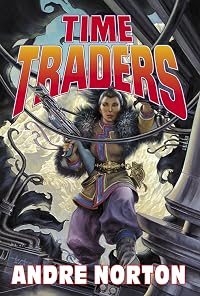
Time Traders
by Andre Norton
Ross Murdock (Collections and Selections — Omnibus 1-2), Time Traders (Collections and Selections — Omnibus 1-2)
On This Page
Description
Andre Norton weaves another spellbinding science fiction tale that takes place in multiple layers of time and during different periods of history. If it is possible to conquer space, then perhaps one can also conquer time. To test this theory Ross Murdock finds him¬self transplanted to the North Pole to participate in a top secret project. It is suspected that Russian scientists have discovered how to transport themselves back to prehistoric times in order to learn long forgotten secrets. A show more convicted criminal in his own time period, Ross becomes a volunteer in the government program that hopes to beat the Russians to the discovery of these scientific secrets. Can time travel be artificially created? Can people from different time periods be brought forward from the past through the use of technology? Perhaps the real question is, can they return.. show less
Tags
Recommendations






Member Reviews
Andre Norton was a very prolific writer, and I read a lot of her novels in my youth, but I hadn't revisited her in many years. This volume consists of the first two books in her Time Traders series, SF adventure stories written in the 1950s. I'm fairly sure I'd read both of them before, but I didn't remember much of anything about them, and I thought it would be interesting to see what I thought of them now.
The first installment is The Time Traders, in which it's the 21st century, time travel has recently been invented, and the Russians have been showing up with some surprisingly advanced pieces of technology. Which, since you can't time travel into your own future, they must somehow have been getting from the past. So US time agents show more have been sent back to various periods, trying to figure out what the Russians have found, and when.
It's a good premise (if rather dated in its cold-war sensibilities), but I felt the story really never lived up to it. The problem is that even if you're happy to accept time travel as a concept (which I am), the plot is still full of details that are utterly unconvincing. It could still have been interesting if the societies of prehistoric Britain that the time agents infiltrate for their mission had been really brought to life, but they're not. There are complexities there that are hinted at a little, but they're never delved into. So even though it's readable enough and there are some not-bad action scenes, this one just never held my attention all that well.
In the second novel, Galactic Derelict, the time agents find a crashed spaceship in the past, and, after being brought forward into the present, it takes off with them on it. I enjoyed this one a lot more than the first one. Once you get past the beginning, in which a completely random guy is brought in on a secret mission and told all about it just because he happens to stumble across it, this installment doesn't have the same plot difficulties and implausibilities the first one did. Maybe because it doesn't really have all that much of a plot, but I was mostly okay with that. Also, the alien planets that our protagonists end up on really aren't fleshed out any better than the bronze-age civilization of the first novel, but in this case it feels like more of a feature then a bug, as we're supposed to only be getting little glimpses of places that are intended to be mysterious. Not that any of it was super-exciting, but there was something at least a little pleasantly nostalgic about revisiting this kind of old-fashioned story I used to enjoy as a kid.
Although it may be old-fashioned in a slightly less pleasant way, too. Because the POV character in this one is an Apache. The way he's written is actually really well-meaning and pretty good for the 1950s, I guess. Norton is clearly actively trying to de-exoticize the guy for readers who are mostly familiar with Native Americans from 50s TV Westerns, while still honoring his heritage. But what was good for the 1950s is still not exactly up to 21st century standards of sensitivity and cluefulness when writing about other cultures, especially when you also factor in some unrelated comments about "civilized" vs "primitive" people. I found it didn't bother me enough that I couldn't shrug it off easily, but then, Native American stereotypes aren't personal for me, so other readers' mileage may vary.
Rating: I'm going to give it a perhaps overly generous 3/5, mostly on the strength of Galactic Derelict and the nostalgic appeal it had for my inner 12-year old. show less
The first installment is The Time Traders, in which it's the 21st century, time travel has recently been invented, and the Russians have been showing up with some surprisingly advanced pieces of technology. Which, since you can't time travel into your own future, they must somehow have been getting from the past. So US time agents show more have been sent back to various periods, trying to figure out what the Russians have found, and when.
It's a good premise (if rather dated in its cold-war sensibilities), but I felt the story really never lived up to it. The problem is that even if you're happy to accept time travel as a concept (which I am), the plot is still full of details that are utterly unconvincing. It could still have been interesting if the societies of prehistoric Britain that the time agents infiltrate for their mission had been really brought to life, but they're not. There are complexities there that are hinted at a little, but they're never delved into. So even though it's readable enough and there are some not-bad action scenes, this one just never held my attention all that well.
In the second novel, Galactic Derelict, the time agents find a crashed spaceship in the past, and, after being brought forward into the present, it takes off with them on it. I enjoyed this one a lot more than the first one. Once you get past the beginning, in which a completely random guy is brought in on a secret mission and told all about it just because he happens to stumble across it, this installment doesn't have the same plot difficulties and implausibilities the first one did. Maybe because it doesn't really have all that much of a plot, but I was mostly okay with that. Also, the alien planets that our protagonists end up on really aren't fleshed out any better than the bronze-age civilization of the first novel, but in this case it feels like more of a feature then a bug, as we're supposed to only be getting little glimpses of places that are intended to be mysterious. Not that any of it was super-exciting, but there was something at least a little pleasantly nostalgic about revisiting this kind of old-fashioned story I used to enjoy as a kid.
Although it may be old-fashioned in a slightly less pleasant way, too. Because the POV character in this one is an Apache. The way he's written is actually really well-meaning and pretty good for the 1950s, I guess. Norton is clearly actively trying to de-exoticize the guy for readers who are mostly familiar with Native Americans from 50s TV Westerns, while still honoring his heritage. But what was good for the 1950s is still not exactly up to 21st century standards of sensitivity and cluefulness when writing about other cultures, especially when you also factor in some unrelated comments about "civilized" vs "primitive" people. I found it didn't bother me enough that I couldn't shrug it off easily, but then, Native American stereotypes aren't personal for me, so other readers' mileage may vary.
Rating: I'm going to give it a perhaps overly generous 3/5, mostly on the strength of Galactic Derelict and the nostalgic appeal it had for my inner 12-year old. show less
This book is an omnibus of Norton's first two Time Traders books, The Time Traders, and Galactic Derelict.
In The Time Traders, Ross Murdock, a young man and a minor criminal, who has taken some advantage of the services offered by the New York Public Library, is caught one more time. This time, he gets a judge with a reputation for harsh sentences. He has a little talk with a Major Kelgarries, and is offered a choice between "rehab," and ?joining the Major's project, which is not explained. "Rehab" isn't explained, either, but Murdock knows about it, and quickly decides that the unknown project is a better bet.
He's not quite so sure when he's loaded into a very unusual aircraft, and taken to the arctic.
The artic isn't the final show more destination, though. He's going someplace else, once he gets some training. Well, a lot of training. Self-defense, including the use of bronze knives, boy and arrow, spears. Languages he's never heard of. Bronze Age people called the Beaker People. He's going to travel through time, looking for high tech the Russians have apparently found by traveling into the past. But how could Earth have had a civilization, so deep in the past that no trace of it has been found yet, that's so far ahead of 21st century Earth? (I will note here that what we do see of Norton's 21st century, concocted in the 1950s, doesn't in fact clash much with our 21st century.)
In Galactic Derelict, Ross is now an experienced time agent, and he's found the answers to some of the questions about where that ancient high tech came from. Yes, it came from alien ships that crashed on Earth--twelve to fifteen thousand years ago. They need to find at least one in American territory--and maybe they have. It's in the American west, and the evidence they have says that yes, it crashed at the time the Folsom people were hunting mammoths and giant sloths. Ross Murdock, his guide and partner from his trip to the Bronze Age, Gordon Ashe, are preparing to go back and look.
While they're preparing, Travis Fox, a young Apache man with an interest in archaeology and now working on his brother's ranch, accidentally wanders into their staging area. He's seen too much to just let go, but a quick check into his background reveals he might be a good recruit. Travis decides to take the chance, though he doesn't entirely believe what they're telling him.
They go back, encounter scary animals, successfully avoid actual contact with the Folsom people, and find the derelict ship they're looking for--except it's not a derelict. It's intact, but the crew are all dead, for no obvious reason. They don't have Russians to cope with here, and they set to work preparing to move the ship to the 21s century. A major volcanic eruption starts when they're just about ready--and the eruption and accompanying earthquake trigger the ship's engines, That happens at just about the same moment the time transfer is started. They may have made it to the 21st century, but they're also headed for whatever destination the dead pilot had logged into the ship's computer.
They're headed into hyperspace, and they don't know what their destination is. The involuntary crew is Ashe, Fox, Murdock, and a tech named Renfry, who has been working on figuring out the controls of the ship. He hasn't gotten far, and they have no idea where they'd be if they exited hyperspace before reaching their destination. They're in for quite an adventure, with no idea whether they'll be able to get home afterward. And while it seems unlikely that the civilization that made the ship they're on still exists, they can't know for sure.
I was a little worried when I started reading, because I remember these books with great fondness, and too many fondly remembered books from that era don't stand up well to rereading. I was surprised, relieved, delighted. At this point, Norton was still avoiding certain issues by not including women as major characters, but the ones we do meet, in the Bronze Age, are intelligent, strong, respected members of their tribes. That the USSR collapsed and then eventually Russia started getting aggressively expansionist with its neighbors, is almost a throwaway, and yet surprisingly accurate.
The characterization is good, and satisfying. I don't know if Native Americans would find Travis Fox and what he has to say about his own culture to be really satisfying, but it did at least feel respectful. Good plotting, good pacing, and thoroughly enjoyable.
Recommended.
I bought this book. show less
In The Time Traders, Ross Murdock, a young man and a minor criminal, who has taken some advantage of the services offered by the New York Public Library, is caught one more time. This time, he gets a judge with a reputation for harsh sentences. He has a little talk with a Major Kelgarries, and is offered a choice between "rehab," and ?joining the Major's project, which is not explained. "Rehab" isn't explained, either, but Murdock knows about it, and quickly decides that the unknown project is a better bet.
He's not quite so sure when he's loaded into a very unusual aircraft, and taken to the arctic.
The artic isn't the final show more destination, though. He's going someplace else, once he gets some training. Well, a lot of training. Self-defense, including the use of bronze knives, boy and arrow, spears. Languages he's never heard of. Bronze Age people called the Beaker People. He's going to travel through time, looking for high tech the Russians have apparently found by traveling into the past. But how could Earth have had a civilization, so deep in the past that no trace of it has been found yet, that's so far ahead of 21st century Earth? (I will note here that what we do see of Norton's 21st century, concocted in the 1950s, doesn't in fact clash much with our 21st century.)
In Galactic Derelict, Ross is now an experienced time agent, and he's found the answers to some of the questions about where that ancient high tech came from. Yes, it came from alien ships that crashed on Earth--twelve to fifteen thousand years ago. They need to find at least one in American territory--and maybe they have. It's in the American west, and the evidence they have says that yes, it crashed at the time the Folsom people were hunting mammoths and giant sloths. Ross Murdock, his guide and partner from his trip to the Bronze Age, Gordon Ashe, are preparing to go back and look.
While they're preparing, Travis Fox, a young Apache man with an interest in archaeology and now working on his brother's ranch, accidentally wanders into their staging area. He's seen too much to just let go, but a quick check into his background reveals he might be a good recruit. Travis decides to take the chance, though he doesn't entirely believe what they're telling him.
They go back, encounter scary animals, successfully avoid actual contact with the Folsom people, and find the derelict ship they're looking for--except it's not a derelict. It's intact, but the crew are all dead, for no obvious reason. They don't have Russians to cope with here, and they set to work preparing to move the ship to the 21s century. A major volcanic eruption starts when they're just about ready--and the eruption and accompanying earthquake trigger the ship's engines, That happens at just about the same moment the time transfer is started. They may have made it to the 21st century, but they're also headed for whatever destination the dead pilot had logged into the ship's computer.
They're headed into hyperspace, and they don't know what their destination is. The involuntary crew is Ashe, Fox, Murdock, and a tech named Renfry, who has been working on figuring out the controls of the ship. He hasn't gotten far, and they have no idea where they'd be if they exited hyperspace before reaching their destination. They're in for quite an adventure, with no idea whether they'll be able to get home afterward. And while it seems unlikely that the civilization that made the ship they're on still exists, they can't know for sure.
I was a little worried when I started reading, because I remember these books with great fondness, and too many fondly remembered books from that era don't stand up well to rereading. I was surprised, relieved, delighted. At this point, Norton was still avoiding certain issues by not including women as major characters, but the ones we do meet, in the Bronze Age, are intelligent, strong, respected members of their tribes. That the USSR collapsed and then eventually Russia started getting aggressively expansionist with its neighbors, is almost a throwaway, and yet surprisingly accurate.
The characterization is good, and satisfying. I don't know if Native Americans would find Travis Fox and what he has to say about his own culture to be really satisfying, but it did at least feel respectful. Good plotting, good pacing, and thoroughly enjoyable.
Recommended.
I bought this book. show less
Andre Norton was a prolific mid-century science fiction and fantasy author who is listed in Gary Gygax’s Appendix N, but despite her popularity I was entirely unfamiliar with her work. To rectify that, I picked up the 2000 Baen omnibus edition titled The Time Traders that contains the orignal 1958 novel The Time Traders and its sequel Galactic Derelict.
I am glad that I got the omnibus edition, as I found the original The Time Traders only okay, while Galactic Derelict had a better structure and execution. To me, The Time Traders felt like a somewhat generic adventure novel of the era, with a protagonist from the wrong side of the law getting into a series of fantastical adventures involving time travel and secret government projects. show more The plot structure felt almost episodic, as Ross Murdock, a rebellious young man given a chance to escape prison by volunteering for a dangerous but critical mission, repeatedly gets into a jam, and then gets back out again through some combination of luck and grit.
What interest there is in the novel comes from the anthropological descriptions of the Bell Beaker and Axe Cultures that populate the past world Ross is transported to. Part of the enduring appeal of this branch of the literature of fantastic adventures is that many authors managed to usefully instruct the reader in some interesting topic while writing a story that otherwise resembles a Western. What is now called hard sci-fi has contracted down to mostly physics and engineering, but as Norton here shows us, anthropology and archaeology are fit subjects for this kind of fiction/non-fiction hybrid.
Since Norton wrote The Time Traders, the biggest addition to the field has been the ability to use ancient DNA to trace the movements of people through the world. Norton’s description of the invasion of the Battle Axe culture among the hunter-gatherers of southern Scandinavia matches up pretty well with what the DNA tells us: the Battle Axe Culture newcomers killed almost everyone who was already living there. There was a period in the mid-twentieth century when archaeologists liked to claim this wasn’t so, but the adventure novelists ended up having a better idea of what life was like then than some scientists.
The 2000 Baen edition of The Time Traders was edited by Norton to replace references to “the Soviets” with “the Russians” and to update some references to spaceflight, as she felt that intervening events had moved beyond the initial setting. However, the very premise of the book is about the most Cold War thing ever: a grand secret project of vast expense run by scientists and adventurers racing to gain any advantage possible over an ideological enemy. Just changing the name of the enemy and moving the book forward a few decades doesn’t change the geopolitical context.
Galactic Derelict follows directly on the events of The Time Traders, but introduces us to a new protagonist, Travis Fox, an Apache working as a ranch hand in Arizona. I am of course a sucker for any book that uses Arizona as a setting, but Travis is an interesting character, a bright man who is proud of his heritage, but feeling trapped in the modern world which dismisses him and his ancestors.
Travis stumbles on the workings of the secret project in the desert, but Ross and crew find him a congenial soul and recruit him instead of imprisoning him. This is possible because even in the Cold War, not every project was run like the Manhattan or Apollo projects, grand testaments to the power of the Gantt chart and the form in triplicate. The time travel project is run like China Lake in the 1950s, small, informal, and efficient. They vet Travis in a day, checking to make sure he isn’t a Russian plant. From that point, the structure of the novel is much the same as the first, but it flows better in my opinion.
There are another four novels in the Ross Murdock series, and using the series rating methodology in my post What authors like versus what readers like, I see the star ratings going up after the first book, matching my assessment of book 2 and suggesting that books 3-6 would be as enjoyable as book 2.
Overall, this was a fun 1950s style adventure novel, and if you’ve never tried such a thing and are curious, make sure you get the omnibus with the first two novels in it, as the second one is a better example of the style, and Amazon has it for free. I’m going to check out some more of Norton’s work after this. show less
I am glad that I got the omnibus edition, as I found the original The Time Traders only okay, while Galactic Derelict had a better structure and execution. To me, The Time Traders felt like a somewhat generic adventure novel of the era, with a protagonist from the wrong side of the law getting into a series of fantastical adventures involving time travel and secret government projects. show more The plot structure felt almost episodic, as Ross Murdock, a rebellious young man given a chance to escape prison by volunteering for a dangerous but critical mission, repeatedly gets into a jam, and then gets back out again through some combination of luck and grit.
What interest there is in the novel comes from the anthropological descriptions of the Bell Beaker and Axe Cultures that populate the past world Ross is transported to. Part of the enduring appeal of this branch of the literature of fantastic adventures is that many authors managed to usefully instruct the reader in some interesting topic while writing a story that otherwise resembles a Western. What is now called hard sci-fi has contracted down to mostly physics and engineering, but as Norton here shows us, anthropology and archaeology are fit subjects for this kind of fiction/non-fiction hybrid.
Since Norton wrote The Time Traders, the biggest addition to the field has been the ability to use ancient DNA to trace the movements of people through the world. Norton’s description of the invasion of the Battle Axe culture among the hunter-gatherers of southern Scandinavia matches up pretty well with what the DNA tells us: the Battle Axe Culture newcomers killed almost everyone who was already living there. There was a period in the mid-twentieth century when archaeologists liked to claim this wasn’t so, but the adventure novelists ended up having a better idea of what life was like then than some scientists.
The 2000 Baen edition of The Time Traders was edited by Norton to replace references to “the Soviets” with “the Russians” and to update some references to spaceflight, as she felt that intervening events had moved beyond the initial setting. However, the very premise of the book is about the most Cold War thing ever: a grand secret project of vast expense run by scientists and adventurers racing to gain any advantage possible over an ideological enemy. Just changing the name of the enemy and moving the book forward a few decades doesn’t change the geopolitical context.
Galactic Derelict follows directly on the events of The Time Traders, but introduces us to a new protagonist, Travis Fox, an Apache working as a ranch hand in Arizona. I am of course a sucker for any book that uses Arizona as a setting, but Travis is an interesting character, a bright man who is proud of his heritage, but feeling trapped in the modern world which dismisses him and his ancestors.
Travis stumbles on the workings of the secret project in the desert, but Ross and crew find him a congenial soul and recruit him instead of imprisoning him. This is possible because even in the Cold War, not every project was run like the Manhattan or Apollo projects, grand testaments to the power of the Gantt chart and the form in triplicate. The time travel project is run like China Lake in the 1950s, small, informal, and efficient. They vet Travis in a day, checking to make sure he isn’t a Russian plant. From that point, the structure of the novel is much the same as the first, but it flows better in my opinion.
There are another four novels in the Ross Murdock series, and using the series rating methodology in my post What authors like versus what readers like, I see the star ratings going up after the first book, matching my assessment of book 2 and suggesting that books 3-6 would be as enjoyable as book 2.
Overall, this was a fun 1950s style adventure novel, and if you’ve never tried such a thing and are curious, make sure you get the omnibus with the first two novels in it, as the second one is a better example of the style, and Amazon has it for free. I’m going to check out some more of Norton’s work after this. show less
A riveting historical wilderness adventure with science fiction accents.
This mix is not for everyone I guess but for me it was firing on all cylinders and it was hard to put down (especially during the last few chapters). Andre Norton was a master storyteller.
I picked up this and the next two sequels as original Ace paperbacks, and if the second volume is even half as good as this one I’ll have to chase down the rest somehow.
Gaming the Book
Timewatch allows players to roleplay similar missions to correct the time stream as several opposing factions attempt to adjust past events according to their own agendas. I haven't gotten to play this much but it is a very promising system -- you find some odd event in history and dig up a little show more about it, then plot out what happened to derail things, and allow the players to travel around and try to solve what's happening and why, using their personal devices (pads, phones, etc.) to see how "our" chronology should have occurred. show less
This mix is not for everyone I guess but for me it was firing on all cylinders and it was hard to put down (especially during the last few chapters). Andre Norton was a master storyteller.
I picked up this and the next two sequels as original Ace paperbacks, and if the second volume is even half as good as this one I’ll have to chase down the rest somehow.
Gaming the Book
Timewatch allows players to roleplay similar missions to correct the time stream as several opposing factions attempt to adjust past events according to their own agendas. I haven't gotten to play this much but it is a very promising system -- you find some odd event in history and dig up a little show more about it, then plot out what happened to derail things, and allow the players to travel around and try to solve what's happening and why, using their personal devices (pads, phones, etc.) to see how "our" chronology should have occurred. show less
I picked up this book because 1. I've never read anything by the author before and 2. I was curious to see what a time travel SF book first published in 1958 would be like.
To be honest, I struggled to finish it, despite there being only around 150 pages. It read like a series of encounters where main character Murdock lands in various scrapes and gets out of them again, often by means of coincidence or through a sudden surge of determination/inspiration/realisation. Events happened, and Murdock was more or less carried along with them.
I didn't develop any interest in the characters, or any sympathy for them. Challenges felt like they were glossed over... "Somehow, despite all the difficulties facing him, he succeeded in doing the show more thing." Not exactly satisfying.
And usually I'm happy to go along for the ride and accept handwaving away of magic and technological powers. But the idea that opposing Earth powers had both developed time travel *and were using it to look for super-weapon technology*—as if time travel is easier than making WMD—just felt weird.
Time Traders came in a bundle with its sequel, but I suspect I won't be moving on to that. show less
To be honest, I struggled to finish it, despite there being only around 150 pages. It read like a series of encounters where main character Murdock lands in various scrapes and gets out of them again, often by means of coincidence or through a sudden surge of determination/inspiration/realisation. Events happened, and Murdock was more or less carried along with them.
I didn't develop any interest in the characters, or any sympathy for them. Challenges felt like they were glossed over... "Somehow, despite all the difficulties facing him, he succeeded in doing the show more thing." Not exactly satisfying.
And usually I'm happy to go along for the ride and accept handwaving away of magic and technological powers. But the idea that opposing Earth powers had both developed time travel *and were using it to look for super-weapon technology*—as if time travel is easier than making WMD—just felt weird.
Time Traders came in a bundle with its sequel, but I suspect I won't be moving on to that. show less
A swashbuckling, non-sensitive time travelling sci-fi from the 1950's. The characters were not deeply delved into but the story had a lot of action and plot twists crammed into 220 pages. Scene transitions were quick. This story could have been written w many more pages. But I liked the ending w its pro-America Cold War tilt. I read this book 40 years ago in high school. It is still really enjoyable.
This is a very well written journey story. As the main character travels from location and time to another, he has experiences and slowly learns about being part of something bigger than himself. It is exciting enough to keep you reading, even though it is vintage sci-fi, it isn't t0o out of keeping with the today of 2017. You will enjoy it if you love adventure set in a technological environment. The tech is a device that just moves the story along as it should in any good sci-fi. The "Reds" as the bad guys dates it, but just insert anything else in its place and the story still works.
Members
- Recently Added By
Author Information

435+ Works 76,471 Members
Born Alice Mary Norton on February 17, 1912 in Cleveland, Ohio, she legally changed her name to Andre Alice Norton in 1934. She attended the Flora Stone Mather College of Western Reserve University (now Case Western Reserve) for a year then took evening courses in journalism and writing that were offered by Cleveland College, the adult division of show more the same university. Norton was a librarian for the Cleveland Library System then a reader at Gnome Press. After that position, she became a full-time writer. She is most noted for writing fantasy, in particular the Witch World series. Her first book The Prince of Commands was published in 1934. Other titles include Ralestone Luck, Magic in Ithkar, Voorloper, Uncharted Stars, The Gifts of Asti and All Cats are Gray. She also wrote under the pen names Andre Norton, Andrew North and Allen Weston She was the first woman to receive the Gandalf Grand Master of Fantasy and the Nebula Grand Master Award. She has also received a Phoenix Award for overall writing achievement, a Jules Verne Award, and a Science Fiction Book Club Book of the Year Award for her title The Elvenbane. In 1997 she was inducted into the Science Fiction and Fantasy Hall of Fame. She died on March 17, 2005. (Bowker Author Biography) show less
Series


Work Relationships
Contains
Common Knowledge
- Original publication date
- 2000
- People/Characters
- Ross Murdock; Gordon Ashe; Major John Kelgarries; Nelson Millaird; Dr. Miles Webb; McNeill (show all 11); Cassca, First Sower; Lal, of the Quick Tongue; Ulffa; Travis Fox; Case Renfry
- Important places
- Britain; Baltic; Arizona, USA
- First words
- Ross Murdock wouldn't have seemed formidable to any one glancing casually at him as he sat within the detention cell.
- Quotations
- "A wise guy doesn't spill his ignorance. He uses his eyes and ears and keeps his trap shut—" [Said by Ross Murdock]
"And goes off half cocked as a result . . ." the major added.
they are all of the type once heralded as the frontiersman. History is sentimental about that type—when he is safely dead—but the present finds him difficult to live with.
The reactions of most men to given sets of circumstances have become set in such regular patterns that they cannot break that conditioning, or if personal danger forces them to change those patterns, they are afterward so adr... (show all)ift they cannot function at their highest potential. Teach a man to kill, as in war, and then you have to recondition him later. - Disambiguation notice
- This is the omnibus of The Time Traders and Galactic Derelict, not the first volume of the series which is just The Time Traders.
Classifications
Statistics
- Members
- 497
- Popularity
- 60,634
- Reviews
- 21
- Rating
- (3.40)
- Languages
- English
- Media
- Paper, Audiobook, Ebook
- ISBNs
- 28
- ASINs
- 7