
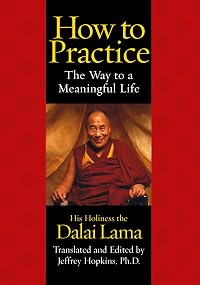
How to Practice : The Way to a Meaningful Life
by Dalai Lama, Jeffrey Hopkins (Author)
On This Page
Description
As human beings, we possess one common desire: the need for happiness and a meaningful life. According to His Holiness the Dalai Lama, the ability to find true fulfillment lies within each of us. Now, the spiritual and temporal leader of Tibet, Nobel Prize winner, and bestselling author helps readers begin the path to enlightenment in a very special book -- an easy-access reference for daily practice as well as stunning illumination of the timeless wisdom of His Holiness. How to Practice show more will guide you toward opening your heart, refraining from doing harm, maintaining mental tranquility, and more. Divided into a series of distinct steps that will lead spiritual seekers of all faiths toward enlightenment, this accessible book is a constant and daily companion in the quest to practice morality, meditation, and wisdom. The Dalai Lama shows us how to overcome our everyday obstacles, from feelings of anger and mistrust to jealousy, insecurity, and counterproductive thinking. Imbued with His Holiness' vivacious spirit and sense of playfulness, How to Practice offers the Dalai Lama's own sage and very practical insight into the human psyche and what binds us all together. show lessTags
Recommendations










Member Reviews
It was with some trepidation that I thought I might adapt some of the Dalai Lama's ideas about "practice" to my own daily routine. I find the Dalai Lama to be more than charismatic; there is something about him that permeates the television. I was rather pleased when I read (p. 223):
Though my own knowledge is limited and my experience is also very poor, I have tried my best to help you understand the full breadth of the Buddha's teaching. Please implement whatever in these pages appears to be helpful. If you follow another religion, please adopt whatever might assist you. If you do not think it would be helpful, just leave it alone.
So, I have decided to adopt some things, and to leave others alone.
Things to keep:
I am impressed by show more the extent that Stoicism mirrors Buddhism in terms of logic and practice. I wonder to what extent Zeno of Cition (the founder of Stoicism) was influenced by Buddhist thought? Buddhism had reached the Seleucid Empire, and Zeno was apparently of Phoenician decent, so it is quite possible.
According to Leesa Davis and Matthew Sharpe of Deakin University, it is not uncommon to see parallels between Stoicism and Buddhism, but there is not much in Western academic literature about it. I suspect this is because the boastfulness of "Western" thought would crumble once facts overcome pride. But I digress.
First, the "practice"of Buddhism is about changing ourselves (p. 9):
Individually we have to work to change the basic perspectives on which our feelings depend. We can only do so through training, by engaging in practice with the aim of gradually reorienting the way we perceive ourselves and others.
For the Stoics, this is based on the logic of what we can and cannot control (see Epictetus' Enchiridion), and then managing our impressions (or how we judge external events). Marcus Aurelius, often referred to as a "cosmopolitan", extended this to how we treat and respond to other people, reflected by the Dalai Lama, thus (p. 10):
The essential objective of daily practice is to cultivate an attitude of compassion and calm - a state of mind particularly crucial in human society today for its power to yield true harmony among nations, races, and people from diverse religious, political, and economic systems.
Second, the Dalai Lama confirms my approach to daily reflection, echoing Benjamin Franklin's Book of Virtues (p. 40):
Examine your motivation as often as you can. Even before getting out of bed in the morning, establish a nonviolent, nonabusive outlook for your day. At night examine what you did during the day.
The idea of examining my motivations is new to me, in that I rarely do this deliberately and certainly not every day. Yet the idea of reinforcing the logic of the philosophy/religion is key. In my practice of Stoic philosophy over the past two years, I have found that if I do not constantly return to the logic, I act unconsciously, thus the maxim on my desk reads "avoid unconscious reaction, find the logic, create good habits".
The Dalai Lama says something similar, echoing Socrates (p. 38):
It is important to diminish undisciplined states of mind, but it is even more important to meet adversity with a positive attitude.
I find here some divergence from Stoic practice. Arguably, this highlights some of the weaknesses of the Stoic idea of the "common good". The Dalai Lama is more utilitarian in his outlook (p. 39):
...ingesting [others'] negatives is not much of a problem for me, but it lessens their problems. I do this with such strong feeling that if later in the day in my office I hear of their atrocities, although one part of my mind is a little irritated and angry, the main part is still under the influence of the morning practice; the intensity of the hatred is reduced to where it is groundless.
Moreover, he sees hope as important, whereas the Stoics would see hope and fear as want and worry; things to be abandoned as beyond our control and therefore not worth pursuing. But for the Dalai Lama (p. 39):
Under no circumstances should you lose hope. Hopelessness is a real cause of failure. Be calm, even when the external environment is confused or complicated; it will have little effect if your mind is at peace.
Both Buddhism and Stoicism agree that anger is useless. This quote from the Dalai Lama could equally apply to the Stoics (p. 41):
Analyze your life closely. If you do, you will eventually find it difficult to misuse your life by becoming an automaton or by seeking money as the path to happiness.
Third, the idea of choosing how we react to external events lends some credence to the idea that, with practice, we can control how we react to our emotions, and not encourage emotions that are not useful (or at least prevent useless emotions based on our misjudged perceptions) (p. 42):
Regularly evaluate the possible negative and positive effects of feelings such as lust, anger, jealousy, and hatred. When it becomes obvious that their effects are very harmful, continue your analysis. Gradually your conviction will strengthen. Repeated reflection on the disadvantages of anger, for example, will cause you to realize that anger is senseless. This decision will cause your anger to diminish gradually.
Here is confirmation of the idea of finding the logic, and for me, it necessitates what religious and philosophical practice has preached for centuries.
The key point is that once we have found the logic, when we can believe that the logic is true, there is no switch that enables a rational re-alignment of our behaviours from then on. The belief in the logic has to be reinforced, over and over again, through daily practice, so that we achieve what Paul Colaianni in The Overwhelmed Brain says is "congruence" (p. 29):
...aligning your intentions with your behavior (congruence).
This is no easy task and it requires reflection (morning and night at a minimum), judgement (of ourselves, not others), and practice (the doing). But unless we can recall the logic (memorise it) and believe in the logic (in effect, remembering the logic and remembering to believe in it), then congruence readily remains aloof.
Things to consider:
The idea of "the middle way" was interesting, and echoes to some extent Aristotle's idea of the "golden mean" of virtue. But that is a rather flaky comparison. For example, the Dalai Lama writes of three categories of non-virtues (physical, verbal, and mental), and that virtues are the opposite of non-virtues. The non-virtues are:
- Physical: Killing, stealing, and sexual misconduct.
- Verbal: Lying, divisive talk, harsh speech, and senseless chatter.
- Mental: Covetousness, harmful intent, and wrong views.
But the idea of the "middle way" is more about a sense of logic. This is difficult to achieve and explain, but it is basically a process of being (p. 169):
...pulled from one side to the other... [between] how phenomena arise in dependence on causes and conditions... [and how] persons and things appear to be so solidly existent, to exist in their own right, to exist inherently... the true middle way takes time to find.
Things to leave alone:
Of course, I have my own religious beliefs, so the religious practices of Sutra and Tantra are not for me. Not that it wasn't useful learning about Buddhist religious practice, and the Dalai Lama did this with such humour, at one point I burst out laughing (p. 124):
A yogi's meditation transforms [sex, delicious meat and drink, even human excrement and urine] into real ambrosia. For people like us, however, this is beyond our reach. As long as you cannot transform piss and shit, these other things should not be done!
Generally, the Dalai Lama suggests that a Buddha has no use for alcohol, drugs, or sexual intercourse (p. 195). There are many parallels between various religions, and the Dalai Lama does not shy away from speaking at or to other religions.
Reflections:
One thing I found interesting counters a critique by a Salvation Army preacher I once heard. He said that the Buddhist idea of meditating on nothing was dangerous, as the emptiness enabled the devil to enter. But the Dalai Lama says that a Christian could focus on Jesus. The idea of nothingness and emptiness are not the same, and that preacher knew enough to be dangerous.
The Dalai Lama speaks of ignorance thus (p. 44):
...ignorance is not just lack of knowledge but a consciousness that imagines the exact opposite of the truth; it misapprehends what is actually so. There are many levels of misperception, as in failing to understand what to adopt in practice and what to discard in daily behavior.
The biggest lesson for me is the importance of daily practice, especially as a way to cement a belief. Religions and religious practice make sense in this regard. I don't mean that one should adopt a belief and force it upon oneself (or, indeed, others!). Rather, if there is a logic that one agrees with, then one must believe that logic.
The point is that unless we can turn to our logic in assessing events which we cannot control (in the Stoic sense), then how can we expect to behave rationally? If I have learnt anything from this journey into Buddhist theology and practice, logic and rational thinking rely on belief. But this is an examined belief, not one given to us, and it must be practised.
What I like most about the Dalai Lama is that he invited me to do so with this book and I am all the richer for it. And wouldn't it be wonderful if Stoicism has a direct link to Buddhism? The East-West divide perpetuated by ignoramuses would come crashing down in an instant! show less
The Dalai Lama is such a witty character. He cracks me up and surprises me with every page of this book! It's so refreshing to read the words and advice of a religious leader that isn't stuffy and in your face about beliefs and religion.
He offers great wisdom and tips on living more peacefully and happily with an open heart and mind. I came away from this feeling lighthearted and motivated to be a better person, live more fully, and experience one day at a time, with grace. I respect him so much more after finishing this book!
He offers great wisdom and tips on living more peacefully and happily with an open heart and mind. I came away from this feeling lighthearted and motivated to be a better person, live more fully, and experience one day at a time, with grace. I respect him so much more after finishing this book!
I've read this book previously, many years ago so I thought I should revisit it. When I picked it off the bookshelf it had a bookmark stuck in so it appears I tried to read it again in 2005 but gave up about half way through.
I don't agree entirely with the above synopsis when it mentions that it is easy to understand. Whilst this is true in the most part, the later sections of the book are very hard going and I would have thought that a reader with little or no prior knowledge of Buddhist psychology would have complete brain melt reading it. It does lend it self to being a long term guide/companion to buddhist study and that is where it is aimed.
The Dalai Lama does have a good way with words and his explaination of topics in general is show more very good, especially for the uninitiated. It should also be noted that he does not shy away from controversial topics which some scholars avoid like the plague.
The Dalai Lama has written many books which deal with themes in everyday life with a Buddhist slant in it. Whilst this certainly isn't one of those and for this reason and the complexity of the later chapters I have given in 2/5. It's an interesting read but by no means an easy one. show less
I don't agree entirely with the above synopsis when it mentions that it is easy to understand. Whilst this is true in the most part, the later sections of the book are very hard going and I would have thought that a reader with little or no prior knowledge of Buddhist psychology would have complete brain melt reading it. It does lend it self to being a long term guide/companion to buddhist study and that is where it is aimed.
The Dalai Lama does have a good way with words and his explaination of topics in general is show more very good, especially for the uninitiated. It should also be noted that he does not shy away from controversial topics which some scholars avoid like the plague.
The Dalai Lama has written many books which deal with themes in everyday life with a Buddhist slant in it. Whilst this certainly isn't one of those and for this reason and the complexity of the later chapters I have given in 2/5. It's an interesting read but by no means an easy one. show less
A good, interesting, fascinating look at meditation through the Dalai Lama's mindview. This isn't so much a guide to a "meaningful life" as it is a guide to "meditation to try and create a meaningful life". (A bit of a subtle difference there.) Its obviously through the views of the Tibetan Buddhist philosophy, and reincarnation is the prime principle behind the entirety of this work. Everything is leading up to working on bettering yourself for the cyclic nature and trying to forego all of that to eventually stop it and reach enlightenment. Some very good practices and ideas and ways to meditate on various topics. Some things are very esoteric, especially if you don't believe in the idea of reincarnation (I personally do not) and show more therefore are not quite practical. show less
An overview and practical guide to the practice of Tibetan Buddhism, interesting with some useful ideas although, with all due respect to His Holiness , I simply can't get on with some of the concepts, for instance I am fairly sure that the world is real and things do really exist, or then I might have misunderstood him (but I don't think so).
Charmingly he says at the end ' Please implement whatever in these pages appears to be helpful........If you do not think it would be helpful, just leave it alone' and thank you I will take the parts I find helpful.
Charmingly he says at the end ' Please implement whatever in these pages appears to be helpful........If you do not think it would be helpful, just leave it alone' and thank you I will take the parts I find helpful.
As human beings, we possess one common desire: the need for happiness and a meaningful life. According to His Holiness the Dalai Lama, the ability to find true fulfillment lies within each of us. Now, the spiritual and temporal leader of Tibet, Nobel Prize winner, and bestselling author helps readers begin the path to enlightenment in a very special book -- an easy-access reference for daily practice as well as stunning illumination of the timeless wisdom of His Holiness."How to Practice" will guide you toward opening your heart, refraining from doing harm, maintaining mental tranquility, and more. Divided into a series of distinct steps that will lead spiritual seekers of all faiths toward enlightenment, this accessible book is a show more constant and daily companion in the quest to practice morality, meditation, and wisdom. The Dalai Lama shows us how to overcome our everyday obstacles, from feelings of anger and mistrust to jealousy, insecurity, and counterproductive thinking. Imbued with His Holiness' vivacious spirit and sense of playfulness, "How to Practice" offers the Dalai Lama's own sage and very practical insight into the human psyche and what binds us all together. show less
As human beings, we all share the desire for happiness and meaning in our lives. According to His Holiness the Dalai Lama, the ability to find true fulfillment lies within each of us. In this very special book, the spiritual and temporal leader of Tibet, Nobel Prize winner, and bestselling author helps readers embark upon the path to enlightenment with a stunning illumination of the timeless wisdom and an easy-access reference for daily practice.
Divided into a series of distinct steps that will lead spiritual seekers toward enlightenment, How to Practice is a constant companion in the quest to practice morality, meditation, and wisdom. This accessible book will guide you toward opening your heart, refraining from doing harm, and show more maintiaining mentaltranquility as the Dalai Lama shows you how to overcome everyday obstacles, from feelings of anger and mistrust to jealousy, insecurity, and counterproductive thinking. Imbued with His Holiness' vivacious spirit and sense of playfulness, How to Practice offers sage and practical insight into the human psyche and into the deepest aspirations that bind us all together. show less
Divided into a series of distinct steps that will lead spiritual seekers toward enlightenment, How to Practice is a constant companion in the quest to practice morality, meditation, and wisdom. This accessible book will guide you toward opening your heart, refraining from doing harm, and show more maintiaining mentaltranquility as the Dalai Lama shows you how to overcome everyday obstacles, from feelings of anger and mistrust to jealousy, insecurity, and counterproductive thinking. Imbued with His Holiness' vivacious spirit and sense of playfulness, How to Practice offers sage and practical insight into the human psyche and into the deepest aspirations that bind us all together. show less
Members
- Recently Added By
Author Information

1,138+ Works 42,585 Members
The exiled 14th Dalai Lama was born on July 6, 1935 to a peasant family living in a former Tibetan village. He was recognized as the reincarnation of the previous spiritual leader of his nation at the age of two and enthroned on February 22, 1940. In 1959 he and 100,000 followers fled the country following a failed revolt against the Communist show more Chinese forces that had occupied Tibet for almost a decade. Since that time, the Dalai Lama has met with numerous world leaders and U. N. officials in a tireless effort to free his country and preserve the traditional Tibetan way of life. He received the Nobel Peace Prize in 1989 and has been awarded honorary citizenships by many international cities and countries, as well as multiple honorary degrees and human rights awards. In 2007 the Dalai Lama received the United States Congressional Gold Medal. He has written many books and lectures around the world. His book, My Spiritual Journey, made the iBooks bestseller list in 2016. He is the author of the best seller, The Book of Joy: Lasting Happiness in a Changing World, with the Desmond Tutu and Douglas Carlton Abrams. (Bowker Author Biography) show less

All Editions
Some Editions
Common Knowledge
- Original publication date
- 2002
- People/Characters
- Tenzin Gyatso, 14th Dalai Lama
- First words
- I first heard His Holiness the Dalai Lama teach in 1972.
- Original language
- Tibetan
Classifications
- Genres
- Religion & Spirituality, Nonfiction, General Nonfiction, Philosophy
- DDC/MDS
- 294.3444 — Religion Other religions Buddhism/Hinduism Buddhism Buddhism - practice Religious experience, life, practice Religious life and practice
- LCC
- BQ4302 .B77 — Philosophy, Psychology and Religion Buddhism Buddhism Doctrinal and systematic Buddhism Special doctrines
- BISAC
Statistics
- Members
- 1,714
- Popularity
- 12,898
- Reviews
- 15
- Rating
- (3.73)
- Languages
- 9 — Chinese, Dutch, English, Finnish, French, German, Lithuanian, Norwegian (Bokmål), Swedish
- Media
- Paper, Audiobook, Ebook
- ISBNs
- 28
- ASINs
- 6