On This Page
Description
Noel Wells, curate in the sleepy village of Saltmarsh, likes to spend his time dancing in the study with the vicar's niece, until one day the vicar's unpleasant wife discovers her unmarried housemaid is pregnant and trouble begins. It is left to Noel to call for the help of sometimes detective and full-time Freudian Mrs Bradley, who sets out on an unnervingly unorthodox investigation into the mysterious pregnancy, and investigation that also takes in smuggling, the village lunatic, a missing show more corpse, a public pillory, an exhumation and, of course, a murderer. Mrs Bradley is easily one of the most memorable personalities in crime fiction, and in this classic whodunnit she proves that some English villages can be murderously peaceful. show lessTags
Recommendations















Member Reviews
As ever the books of Gladys Mitchell require a little adjustment if you are used to the more famous golden era writers*
However usually the writing compensates for the any effort, and Bradley is a sly, quirky, witty heroine, whom you like in spite of yourself.
However The Saltmarsh Murders is not a book that modern readers will warm to, or at least, I sincerely hope not. Between the deeply offensive racism, and I don't mean a casual of-its-time racism, I mean truly offensive even by the era descriptions of a Black manservant, his relationship to another character and the excusing of certain actions because of the "provocation" of race to a white community, from midway through made this a book I wouldn't recommend.
I know some people will show more happily read it, excusing it as "the period" attitude but personally I would sooner not leave these attitudes go unremarked or unchallenged.
*It takes a while to adjust to the style of the Mrs. Bradley series; certainly I find them unlike most of the other golden era offerings. The writing is superb, the settings range from melodramatic to classic (country house, quiet village etc.) but there are elements of gothic fiction not just in the plotting but in the characters. Mrs. Bradley is a grotesque if likeable figure. Her infuriating habit of explaining the crime away one way, only to renounce that explanation and explain it another way, coupled with her rather ungenerous habit of holding the cards too close to her chest for even the reader to see, can be irritating but the compensation of the witty, and atmospheric writing helps. show less
However usually the writing compensates for the any effort, and Bradley is a sly, quirky, witty heroine, whom you like in spite of yourself.
However The Saltmarsh Murders is not a book that modern readers will warm to, or at least, I sincerely hope not. Between the deeply offensive racism, and I don't mean a casual of-its-time racism, I mean truly offensive even by the era descriptions of a Black manservant, his relationship to another character and the excusing of certain actions because of the "provocation" of race to a white community, from midway through made this a book I wouldn't recommend.
I know some people will show more happily read it, excusing it as "the period" attitude but personally I would sooner not leave these attitudes go unremarked or unchallenged.
*It takes a while to adjust to the style of the Mrs. Bradley series; certainly I find them unlike most of the other golden era offerings. The writing is superb, the settings range from melodramatic to classic (country house, quiet village etc.) but there are elements of gothic fiction not just in the plotting but in the characters. Mrs. Bradley is a grotesque if likeable figure. Her infuriating habit of explaining the crime away one way, only to renounce that explanation and explain it another way, coupled with her rather ungenerous habit of holding the cards too close to her chest for even the reader to see, can be irritating but the compensation of the witty, and atmospheric writing helps. show less
I love the classic detectives of the Golden Age of British cozies: Miss Jane Marple, Miss Maud Silver, and Lord Roderick Alleyn. But I have a new favorite: Mrs. Beatrice Bradley. She's considerably less likable than any of the aforementioned, what with her yellowed, shriveled looks, her cackling laugh, her domineering personality, and her malicious wit. Yet, she's so sly, and the satire of early 20th century refined society is so delicious, that I think she may well dethrone Miss Marple in my heart. (Forgive me, Dame Agatha!)
In this novel, Mrs. Bradley sleuths out the murderer of a "ruined" housemaid who had been keeping the father of her illegitimate baby a secret. Needless to say, police officials leap at the obvious, only to be shown show more up by "the Bradley," as curate Noël Wells calls her. The curate narrates the tale, and his timidity and conformity to the conventional thinking of his day only add to the fun. So does his lack of self-awareness, which lead Reverend Wells to make some unintentionally funny remarks.
Of course, I love the television version of Mrs. Bradley; however, that production, featuring a more chic and less quirky Mrs. Bradley, is quite, quite different from the books. You can view the television programs without ruining in the least the enjoyment of the novels. show less
In this novel, Mrs. Bradley sleuths out the murderer of a "ruined" housemaid who had been keeping the father of her illegitimate baby a secret. Needless to say, police officials leap at the obvious, only to be shown show more up by "the Bradley," as curate Noël Wells calls her. The curate narrates the tale, and his timidity and conformity to the conventional thinking of his day only add to the fun. So does his lack of self-awareness, which lead Reverend Wells to make some unintentionally funny remarks.
Of course, I love the television version of Mrs. Bradley; however, that production, featuring a more chic and less quirky Mrs. Bradley, is quite, quite different from the books. You can view the television programs without ruining in the least the enjoyment of the novels. show less
The Saltmarsh Murders by Gladys Mitchell is the fourth book in her Mrs. Bradley series of murder mysteries. Originally published in 1932, this book felt more like a spoof on Agatha Christie than a full on mystery what with the odd characters and Mrs. Bradley’s rather off-hand approach to solving the murders. I did find some of the social issues that it raised rather outdated but the story is clever and the memorable characters, including that of Mrs. Bradley, made the book a fun read.
The book is narrated by the curate, Noel Wells, and through him we are privy to a number of village secrets and concerns. The vicar’s wife thinks that her ex-housemaid’s illegitimate baby was fathered by her husband. As the baby has been kept from show more public view, there are also rumors that the baby was fathered by a negro. When this young mother is strangled, her ex-boyfriend is arrested but most in the village don’t think he did it. Mrs. Bradley and Noel band together to try and figure out both who the father is and who murdered the young woman. Meanwhile another woman goes missing and upon Mrs. Bradley’s advice they find her body in the grave of the first murder victim which then gives them another murder to solve and a missing body to find.
The story takes many twists and turns with plenty of red herrings being thrown about. Mrs. Bradley is a larger than life character who uses psychology to solve her cases. There is no examination of a murder scene or intensive study of the victim, instead we are treated to assorted conjectures and witness statements that are pieced together and used to discover who the murderer is. show less
The book is narrated by the curate, Noel Wells, and through him we are privy to a number of village secrets and concerns. The vicar’s wife thinks that her ex-housemaid’s illegitimate baby was fathered by her husband. As the baby has been kept from show more public view, there are also rumors that the baby was fathered by a negro. When this young mother is strangled, her ex-boyfriend is arrested but most in the village don’t think he did it. Mrs. Bradley and Noel band together to try and figure out both who the father is and who murdered the young woman. Meanwhile another woman goes missing and upon Mrs. Bradley’s advice they find her body in the grave of the first murder victim which then gives them another murder to solve and a missing body to find.
The story takes many twists and turns with plenty of red herrings being thrown about. Mrs. Bradley is a larger than life character who uses psychology to solve her cases. There is no examination of a murder scene or intensive study of the victim, instead we are treated to assorted conjectures and witness statements that are pieced together and used to discover who the murderer is. show less
Burns, I believe, considered her a queer old party and wondered whether she would bite at an investment if it were put to her in sufficiently attractive terms. He could not believe that she had ever been married.
“You don’t tell me any man not under the influence of dope ever married her , ”he said to me one day when I was there alone with him.
I understood, I replied, that Mrs. Bradley had been married and widowed twice.
“Gosh!” said Mr. Burns, impressed. “Got that amount of money has she?”
It was a pity, perhaps, that I could not bring myself to repeat this observation to Mrs. Bradley, for I am convinced, from what I know of her, that she would have appreciated it to the full. I often caught the financier’s decidedly show more fishlike eye fixed ruminatingly upon her. He was trying, I fancy, to estimate exactly how much she was worth, and the problem was difficult. Her clothes, although odd, and, in some cases, positively hideous, were manifestly good. On the other hand, she had a gift for repartee and a fund of bonhomie which he could not associate with a woman who possessed a large fortune, unless, of course, as he said, she was a music hall star or a duchess who had floated the ancestral hall as a limited liability company. She was a far better bridge player than either Burns or Sir William, and was an adept at pool and snooker. She was also the most brilliant darts player and knife thrower that I have ever seen. She was also a dead shot with an airgun, and annoyed Burns considerably by winning five pounds from him one miserably wet afternoon by knocking the necks off ten empty wine bottles with ten successive shots. I know she did that, because I saw her do it.
I think that this is the first of the Mrs. Bradley mysteries that I have read although I did see a few episodes of the TV series starring Diana Rigg. Gladys Mitchell wrote over 60 of the between the late 1920s and the early 1980s, and The Saltmarsh Murders is the fourth in the series.
The housemaid from the vicarage giving birth is the catalyst for murder, and the young curate narrates events as Mrs Bradley uses her psychiactric knowledge to identify the murderer. At one point I thought it might turn out to be an Ackroydal murder, but it wasn’t and I didn’t manage to work out who had done it. show less
“You don’t tell me any man not under the influence of dope ever married her , ”he said to me one day when I was there alone with him.
I understood, I replied, that Mrs. Bradley had been married and widowed twice.
“Gosh!” said Mr. Burns, impressed. “Got that amount of money has she?”
It was a pity, perhaps, that I could not bring myself to repeat this observation to Mrs. Bradley, for I am convinced, from what I know of her, that she would have appreciated it to the full. I often caught the financier’s decidedly show more fishlike eye fixed ruminatingly upon her. He was trying, I fancy, to estimate exactly how much she was worth, and the problem was difficult. Her clothes, although odd, and, in some cases, positively hideous, were manifestly good. On the other hand, she had a gift for repartee and a fund of bonhomie which he could not associate with a woman who possessed a large fortune, unless, of course, as he said, she was a music hall star or a duchess who had floated the ancestral hall as a limited liability company. She was a far better bridge player than either Burns or Sir William, and was an adept at pool and snooker. She was also the most brilliant darts player and knife thrower that I have ever seen. She was also a dead shot with an airgun, and annoyed Burns considerably by winning five pounds from him one miserably wet afternoon by knocking the necks off ten empty wine bottles with ten successive shots. I know she did that, because I saw her do it.
I think that this is the first of the Mrs. Bradley mysteries that I have read although I did see a few episodes of the TV series starring Diana Rigg. Gladys Mitchell wrote over 60 of the between the late 1920s and the early 1980s, and The Saltmarsh Murders is the fourth in the series.
The housemaid from the vicarage giving birth is the catalyst for murder, and the young curate narrates events as Mrs Bradley uses her psychiactric knowledge to identify the murderer. At one point I thought it might turn out to be an Ackroydal murder, but it wasn’t and I didn’t manage to work out who had done it. show less
Inconsistent, implausible crime novel. The one up-side is that the narrator's voice is mildly Bertie Wooster-ish, throwing in a few jokes and wry comments, but it can't detract from the racism, sexism, and class-prejudice - of its time, perhaps, but still jarring.
Still Cackling
Review of the Thomas & Mercer Kindle edition (December 31, 2013) of the original Gollancz (UK) hardcover (1932).
After getting over the shock of meeting Mrs. Bradley in Speedy Death (Mrs. Bradley #1 - 1929) I was hesitant to try another book with Gladys Mitchell's singularly odd psychoanalyst detective. I was curious however to know whether Mitchell show more would have pulled back on her physical descriptions which had constantly emphasized the shrivelled features and claw-like hands. Jumping ahead to read book #4, The Saltmarsh Murders, proved that this was not the case, as can be read in the above extract. The shrieking laughter continues as well.
Mrs. Bradley is on the scene in the coastal village of Saltmarsh when a series of murders occurs. The book is narrated by the village curate Noel Wells who becomes Mrs. Bradley's Watson as the case progresses. Almost all of the odd features of the first book continue in this one. The case becomes enormously complex as aside from the murders it also involves various assaults and imprisonments, a disappearance, a smuggling operation, and mystery persons scrambling across roofs in the night. Mrs. Bradley explains it all in the end of course.
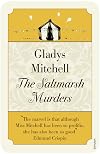
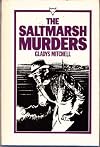
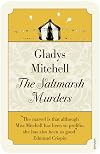
See cover at https://upload.wikimedia.org/wikipedia/en/9/97/The_Saltmarsh_Murders.jpg
The spine and the front cover of the original 1932 Gollancz (UK) hardcover edition. Image sourced from Wikipedia.
I discovered the Mrs. Bradley Mysteries by Gladys Mitchell from reading Christopher Fowler's excellent The Book of Forgotten Authors (2017) which I recently reviewed and rated as Five Stars. Although Mitchell was a contemporary of such Golden Age of Crime Fiction authors such as Agatha Christie and Dorothy Sayers, I had never heard of her previously and she is the first of the "Forgotten" that I chose to investigate. All 66 Mrs. Bradley novels have been republished in eBook & paperback by Amazon's Thomas & Mercer imprint in the recent years 2013 to 2018.
Trivia and Links
The Saltmarsh Murders was not adapted for television as part of the short-lived The Mrs. Bradley Mysteries (1998-2000) starring Diana Rigg as Mrs. Bradley (the casting of Rigg ignores Mitchell's description of the character). There is a delightful homemade tribute edit which uses clips from the series at Get the Party Started: The Mrs. Bradley Mysteries. show less
Review of the Thomas & Mercer Kindle edition (December 31, 2013) of the original Gollancz (UK) hardcover (1932).
One of the most frightful-looking old ladies—(according to William, of course)—that he’d ever seen. She was smallish, thin and shrivelled, and she had a yellow face with sharp black eyes, like a witch, and yellow, claw-like hands. She cackled harshly when William was introduced and chucked him under the chin, and then squealed like a macaw that’s having its tail pulled.
After getting over the shock of meeting Mrs. Bradley in Speedy Death (Mrs. Bradley #1 - 1929) I was hesitant to try another book with Gladys Mitchell's singularly odd psychoanalyst detective. I was curious however to know whether Mitchell show more would have pulled back on her physical descriptions which had constantly emphasized the shrivelled features and claw-like hands. Jumping ahead to read book #4, The Saltmarsh Murders, proved that this was not the case, as can be read in the above extract. The shrieking laughter continues as well.
Mrs. Bradley is on the scene in the coastal village of Saltmarsh when a series of murders occurs. The book is narrated by the village curate Noel Wells who becomes Mrs. Bradley's Watson as the case progresses. Almost all of the odd features of the first book continue in this one. The case becomes enormously complex as aside from the murders it also involves various assaults and imprisonments, a disappearance, a smuggling operation, and mystery persons scrambling across roofs in the night. Mrs. Bradley explains it all in the end of course.
See cover at https://upload.wikimedia.org/wikipedia/en/9/97/The_Saltmarsh_Murders.jpg
The spine and the front cover of the original 1932 Gollancz (UK) hardcover edition. Image sourced from Wikipedia.
I discovered the Mrs. Bradley Mysteries by Gladys Mitchell from reading Christopher Fowler's excellent The Book of Forgotten Authors (2017) which I recently reviewed and rated as Five Stars. Although Mitchell was a contemporary of such Golden Age of Crime Fiction authors such as Agatha Christie and Dorothy Sayers, I had never heard of her previously and she is the first of the "Forgotten" that I chose to investigate. All 66 Mrs. Bradley novels have been republished in eBook & paperback by Amazon's Thomas & Mercer imprint in the recent years 2013 to 2018.
Trivia and Links
The Saltmarsh Murders was not adapted for television as part of the short-lived The Mrs. Bradley Mysteries (1998-2000) starring Diana Rigg as Mrs. Bradley (the casting of Rigg ignores Mitchell's description of the character). There is a delightful homemade tribute edit which uses clips from the series at Get the Party Started: The Mrs. Bradley Mysteries. show less
The dialogue was occasionally witty in a 1930's kind of way, and Mrs. Bradley is an enjoyable character but there wasn't much else going for this mystery.
Members
- Recently Added By
Lists

Books Read in 2014
2,344 works; 86 members

Must Read Detective Stories (Nick Fuller)
278 works; 2 members
Author Information

91+ Works 5,146 Members
Author Gladys Mitchell was born in Cowley, Oxfordshire, England on April 19, 1901. She was educated at Goldsmiths' College and University College, London. After graduating, she became a teacher and taught English, history, and games at numerous schools until her retirement in 1961. She is best known for her detective novels featuring Mrs. Bradley. show more She also wrote under the pseudonyms Stephen Hockaby and Malcolm Torrie. In 1976, she received the Crime Writers' Association Silver Dagger award. She died on July 27, 1983. (Bowker Author Biography) show less
Series

Common Knowledge
- Canonical title
- The Saltmarsh Murders
- Original title
- The Saltmarsh Murders
- Original publication date
- 1932
- People/Characters
- Beatrice Adela Lestrange Bradley; Edwy David Burt; Bedivere Coutts; Mrs. Coutts; Mrs. Gatty; Ferdinand Lestrange (show all 8); Meg Tosstick; Noel Wells
- Important places
- Saltmarsh, England, UK; England, UK
- First words
- There are all sorts of disadvantages in telling a story in the first person, especially a tale of murder.
- Last words
- (Click to show. Warning: May contain spoilers.)And I have committed my second murder.
Classifications
Statistics
- Members
- 278
- Popularity
- 115,834
- Reviews
- 11
- Rating
- (3.27)
- Languages
- English
- Media
- Paper, Audiobook, Ebook
- ISBNs
- 15
- ASINs
- 6