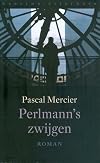
Perlmann's Silence
by Pascal Mercier
On This Page
Description
Prominent linguist and widower Philipp Perlmann contemplates drastic measures when he faces exposure after plagiarizing a colleague's work for his keynote address at an important academic gathering in Genoa.Tags
Recommendations










































Member Recommendations
bluepiano Two good books similar inasmuch as the main setting is an international academic conference the protagonist attends.
Member Reviews
Philip Perlmann, prominent linguist and speaker at a gathering of renowned international academics in a picturesque seaside town near Genoa, is struggling to maintain his grip on reality. Derailed by grief and no longer confident of his professional standing, writing his keynote address seems like an insurmountable task, and, as the deadline approaches, Perlmann realizes that he will have nothing to present. Terror-stricken, he decides to plagiarize the work of Leskov, a Russian colleague. But when Leskov’s imminent arrival is announced and threatens to expose Perlmann as a fraud, Perlmann’s mounting desperation leads him to contemplate drastic measures.
I found this book tedious, much less readable than the author's previous work. show more At 600 pages and with Perlmann's inner doubts recounted in forensic detail, this is a long and demanding novel. Here - as in certain Hitchcock films - little of consequence happens in the exterior world. It could have been much shorter – and still made the point. show less
I found this book tedious, much less readable than the author's previous work. show more At 600 pages and with Perlmann's inner doubts recounted in forensic detail, this is a long and demanding novel. Here - as in certain Hitchcock films - little of consequence happens in the exterior world. It could have been much shorter – and still made the point. show less
Perlman's Silence demands a lot of courage, patience and persistence of the reader, but it is worth it. Bieri's insightful description of the slow inner deterioration of the middle aged academic Perlman is a compelling read. At first I thought that it was all too detailed and long, but that is the way it also is for the protagonist. As a reader you have to crawl so deeply into Perlamn's skin that his thoughts almost become yours. And that is great writing!
Just like in 'Ńight train to Lisbon', the protagonist is a man who is well settled in his academic interest, but through an emotional upheaval starts to obsess about something completely illogical, which changes the way he experiences the world around him, and the course of his life. show more Both books are sort of a quest for the right relationship with reality.
I found Perlman's quest harder to read, because I didn't like Perlman as a person, so I was not always sympathetic to crooked reasoning of this egocentric man.
By the way the English translation of this book is a lot better than the one for 'Night train to Lisbon'. show less
Just like in 'Ńight train to Lisbon', the protagonist is a man who is well settled in his academic interest, but through an emotional upheaval starts to obsess about something completely illogical, which changes the way he experiences the world around him, and the course of his life. show more Both books are sort of a quest for the right relationship with reality.
I found Perlman's quest harder to read, because I didn't like Perlman as a person, so I was not always sympathetic to crooked reasoning of this egocentric man.
By the way the English translation of this book is a lot better than the one for 'Night train to Lisbon'. show less
Ein Hotel an der ligurischen Küste im Spätherbst. Philipp Perlmann, ein angesehener Sprachwissenschaftler, erwartet eine Gruppe von berühmten Kollegen zu einem Forschungsaufenthalt. Umstellt von den hohen Erwartungen der anderen, wird Perlmann von der Einsicht überwältigt, dass ihm seine beruflichen Gewissheiten völlig abhanden gekommen sind. Diese Erfahrung macht die anderen zu bedrohlichen Gegnern. Verschanzt in einem entlegenen Zimmer des Hotels, flüchtet er sich in das Übersetzen eines russischen Textes. Durch diese Flucht nach innen gerät Perlmann mit jedem Tag mehr in eine ausweglose Situation, die ihn schließlich in einen Strudel von Lügen und an den Rand eines Mordes treibt. Ein psychologischer Roman par excellence, show more der den Hörer durch raffinierte Komposition und einen großen Spannungsbogen von der ersten bis zur letzten Zeile in Atem hält. show less
Author
Peter Bieri was born in Bern on June 23th 1944. He is better known under his pseudonym Pascal Mercier. Bieri studied philosophy, English studies and Indian studies in both London and Heidelberg. He currently lives in Berlin where he is a professor of philosophy.
Review
I finished this book. I would say finally but that does not sound nice. Still I am not sure if I want to write nice things about this book because though I finished it I kind of despised it too. It took me a few rants to people in my surrounding to understand that my experienced feeling on the book and the fact that I could not put it away where not really making sense until I realized that I actually was interested in how it would finish and what would happen to all show more the characters. So to start with them.
The book's main character is Phillip Perlmann. A man of whom I do not remember an age but he must be around 50. During the book you live inside his head and this man should really stop thinking for just a second and realize what is really going on. His thoughts are scary and there are to many. It does not matter what happens to him he can see it all go wrong. His thoughts take him to all the dark spots. As you see the other characters trough his eyes you get a very dark colored view on them, even though not all of them are having that effect on Perlmann, specially not the woman in the book. Still you really want to slap his face to get him back to reality, cause the actions the other characters show, even seen trough his eyes are really not all that bad. As I am a more positive personality myself I could not relate to him at all, in would probably not want to spend more than an hour with that man.
The story itself is dragging and kind of depressing still you get curious eventually if Perlmann gets away with all the evil he comes up with in his head. So I did finish the book but am now doubting between giving it 2or 3 stars. Under indifferent circumstances I would have given it two stars for sure but because there where some very beautifull written sentences in the book I will be generous and give three stars.
Favorite quotes:
"Things were obtrusively only themselves, they had not significance and no lustre." ~9
"To think of these things you have to be right inside - as I am no longer inside." ~79
“What separates me from my present is like a fine mist, an intangible veil, an invisible wall. They don't put up the slightest resistance. Nothing would shatter if I were to walk trough it. Because there is actually nothing at all between me and the world. A single step would be enough. Why didn't I take it long ago?” ~183 show less
Peter Bieri was born in Bern on June 23th 1944. He is better known under his pseudonym Pascal Mercier. Bieri studied philosophy, English studies and Indian studies in both London and Heidelberg. He currently lives in Berlin where he is a professor of philosophy.
Review
I finished this book. I would say finally but that does not sound nice. Still I am not sure if I want to write nice things about this book because though I finished it I kind of despised it too. It took me a few rants to people in my surrounding to understand that my experienced feeling on the book and the fact that I could not put it away where not really making sense until I realized that I actually was interested in how it would finish and what would happen to all show more the characters. So to start with them.
The book's main character is Phillip Perlmann. A man of whom I do not remember an age but he must be around 50. During the book you live inside his head and this man should really stop thinking for just a second and realize what is really going on. His thoughts are scary and there are to many. It does not matter what happens to him he can see it all go wrong. His thoughts take him to all the dark spots. As you see the other characters trough his eyes you get a very dark colored view on them, even though not all of them are having that effect on Perlmann, specially not the woman in the book. Still you really want to slap his face to get him back to reality, cause the actions the other characters show, even seen trough his eyes are really not all that bad. As I am a more positive personality myself I could not relate to him at all, in would probably not want to spend more than an hour with that man.
The story itself is dragging and kind of depressing still you get curious eventually if Perlmann gets away with all the evil he comes up with in his head. So I did finish the book but am now doubting between giving it 2or 3 stars. Under indifferent circumstances I would have given it two stars for sure but because there where some very beautifull written sentences in the book I will be generous and give three stars.
Favorite quotes:
"Things were obtrusively only themselves, they had not significance and no lustre." ~9
"To think of these things you have to be right inside - as I am no longer inside." ~79
“What separates me from my present is like a fine mist, an intangible veil, an invisible wall. They don't put up the slightest resistance. Nothing would shatter if I were to walk trough it. Because there is actually nothing at all between me and the world. A single step would be enough. Why didn't I take it long ago?” ~183 show less
tense, strong, descriptive. I so much hated the guy Perlmann, that I almost stopped reading - but the book was compelling enough to read through.
to be honest I was disappointed in this novel. I loved Night Train to Lisbon, and was very excited to see a new English novel by Pascal Mercier. The main character, Perlmann, a college teacher had just lost his wife, he is in deep grief, is asked to organize a conference. He is unable to come up with paper so he decides to use a paper written by a Russian, thinking that person would never know. of course the Russian ends up at the conference. The novel is about Perlmann's angust, for far to many pages. At first I liked him, at the end not so much
Audio. Intersting subject. Some suspense and twists. Good writing style.
Members
- Recently Added By
Lists

Novels featuring language professionals
98 works; 12 members

CH-Autoren (Swiss Authors)
265 works; 9 members
Author Information

25+ Works 4,660 Members
Some Editions
Series
Belongs to Publisher Series
Common Knowledge
- Canonical title
- Perlmann's Silence
- Original title
- Perlmanns Schweigen
- Original publication date
- 1995
- People/Characters*
- Philipp Perlmann
- Epigraph*
- De anderen zijn werkelijk anderen. Anderen.
- First words
- Philipp Perlmann war es gewohnt, dass die Dinge keine Gegenwart für ihn hatten.
- Last words
- (Click to show. Warning: May contain spoilers.)Es war nichts geschehen.
- Original language
- German
*Some information comes from Common Knowledge in other languages. Click "Edit" for more information.
Classifications
- Genres
- Fiction and Literature, General Fiction
- DDC/MDS
- 833.914 — Literature & rhetoric German & related literatures German fiction 1900- 1900-1990 1945-1990
- LCC
- PT2673 .E6827 .P4713 — Language and Literature German, Dutch and Scandinavian literatures German literature Individual authors or works 1961-2000
- BISAC
Statistics
- Members
- 346
- Popularity
- 90,692
- Reviews
- 19
- Rating
- (3.63)
- Languages
- 5 — Danish, Dutch, English, French, German
- Media
- Paper, Audiobook, Ebook
- ISBNs
- 28
- ASINs
- 7