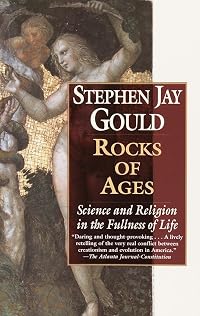
Rocks of Ages: Science and Religion in the Fullness of Life
by Stephen Jay Gould
On This Page
Description
"People of good will wish to see science and religion at peace. . . . I do not see how science and religion could be unified, or even synthesized, under any common scheme of explanation or analysis; but I also do not understand why the two enterprises should experience any conflict." So states internationally renowned evolutionist and bestselling author Stephen Jay Gould in the simple yet profound thesis of his brilliant new book. Writing with bracing intelligence and elegant clarity, Gould show more sheds new light on a dilemma that has plagued thinking people since the Renaissance. Instead of choosing between science and religion, Gould asks, why not opt for a golden mean that accords dignity and distinction to each realm? At the heart of Gould's penetrating argument is a lucid, contemporary principle he calls NOMA (for nonoverlapping magisteria)--a "blessedly simple and entirely conventional resolution" that allows science and religion to coexist peacefully in a position of respectful noninterference. Science defines the natural world; religion, our moral world, in recognition of their separate spheres of influence. In elaborating and exploring this thought-provoking concept, Gould delves into the history of science, sketching affecting portraits of scientists and moral leaders wrestling with matters of faith and reason. Stories of seminal figures such as Galileo, Darwin, and Thomas Henry Huxley make vivid his argument that individuals and cultures must cultivate both a life of the spirit and a life of rational inquiry in order to experience the fullness of being human. In his bestselling books Wonderful Life, The Mismeasure of Man, and Questioning the Millennium, Gould has written on the abundance of marvels in human history and the natural world. In Rocks of Ages, Gould's passionate humanism, ethical discernment, and erudition are fused to create a dazzling gem of contemporary cultural philosophy. As the world's preeminent Darwinian theorist writes, "I believe, with all my heart, in a respectful, even loving concordat between . . . science and religion." show lessTags
Recommendations




Member Reviews
This is not one of Stephen Jay Gould's best books and should be seen as a polemic about the relationship between science and religion peculiar to its time and place - the struggle against creationism in the US in the last years of the last century.
To most Europeans, the core proposition is self-evident - science is a description of the world, 'religion' is the ascription by humans of value or meaning to the world. The two exist in separate spheres of understanding, each is an independent 'magisterium'.
From this point of view, the book might be interesting to Americans but less so to the rest of the world. His account of science is, as one would expect from him, unimpeachable. His account of religion less so. His desire to accord respect show more to religion equalises it and concedes too much ground.
In fact religion is simply a matter of power relations, the imposition of value by some on others, and value and meaning exist as much outside religion as within it. Gould's defensive posture, designed to win a local cultural debate, lets down those struggling for freedom elsewhere.
As a result, I am not sure anyone on the materialist side of the debate is going to get very much from it except concessionary arguments in debate with a room full of holy types. The book seems to buttress the religious establishment in order to shore up its support for science.
However, the old Stephen Jay Gould, a rational and incisive historian of science shines through with the best and most humane account of the Scopes trial and William Jennings Bryan that I have read to date. He is also good on his pet subject, the malignity and bad science of social Darwinism.
The passages on Jennings show how liberal East Coast readings of the Scopes trial have utterly misread the situation and that Bryan's critique at the time was more complex and nuanced than they allow themselves to admit - and the 'Darwinist' side more self-serving and less honest.
Gould is right that, in the context of the use of Darwinism in the interwar period ('bad science'), Bryan was trying to reinculcate some sense of value. He also accepted 'bad science' but his 'good value' was still superior in many ways to the misuse of science by his opponents.
Gould's conclusion is a sound one - science should be value-free in its exercise and presentation to the world but that means having strong values in deciding what must be done with the knowledge. Social Darwinism is the type-case of bad social policies arising from an over-reading of science.
If there is a take home message of this book that I would want to emphasise, it is that value is entirely separate from science (though not to be assumed to be a matter of religion alone) and that religious language is often a means of establishing value against complete absence of value.
But the use of religion to establish value is always second best because value and meaning stand outside not only science but also outside religion itself. 'Religio' is simply the inculcation of chosen value in society, ritual, dogma, custom and text. It is not value in and of itself.
If a person needs religion to bring value to the world shown to us by science, then he or she has not mastered the independence of value from the world. Value and meaning are intrinsic to the human condition, found from within not imposed from without.
The book is, overall, a distraction. The defence of science here is excellent and certainly it needs saying over and over again, especially against those fluff merchants trying to merge science and 'spirituality' (whatever that is), that science can tell us nothing about value.
However, the transfer of value to religion is conservative and anti-progressive and far too much of a compromise by a writer known to have been at the leading edge of progressive thinking in the scientific community, unravelling conservative mythologies embedded in past scientific ideologies.
In short, he defends religion at the expense of philosophy to shore up a political position. Not impressed! show less
To most Europeans, the core proposition is self-evident - science is a description of the world, 'religion' is the ascription by humans of value or meaning to the world. The two exist in separate spheres of understanding, each is an independent 'magisterium'.
From this point of view, the book might be interesting to Americans but less so to the rest of the world. His account of science is, as one would expect from him, unimpeachable. His account of religion less so. His desire to accord respect show more to religion equalises it and concedes too much ground.
In fact religion is simply a matter of power relations, the imposition of value by some on others, and value and meaning exist as much outside religion as within it. Gould's defensive posture, designed to win a local cultural debate, lets down those struggling for freedom elsewhere.
As a result, I am not sure anyone on the materialist side of the debate is going to get very much from it except concessionary arguments in debate with a room full of holy types. The book seems to buttress the religious establishment in order to shore up its support for science.
However, the old Stephen Jay Gould, a rational and incisive historian of science shines through with the best and most humane account of the Scopes trial and William Jennings Bryan that I have read to date. He is also good on his pet subject, the malignity and bad science of social Darwinism.
The passages on Jennings show how liberal East Coast readings of the Scopes trial have utterly misread the situation and that Bryan's critique at the time was more complex and nuanced than they allow themselves to admit - and the 'Darwinist' side more self-serving and less honest.
Gould is right that, in the context of the use of Darwinism in the interwar period ('bad science'), Bryan was trying to reinculcate some sense of value. He also accepted 'bad science' but his 'good value' was still superior in many ways to the misuse of science by his opponents.
Gould's conclusion is a sound one - science should be value-free in its exercise and presentation to the world but that means having strong values in deciding what must be done with the knowledge. Social Darwinism is the type-case of bad social policies arising from an over-reading of science.
If there is a take home message of this book that I would want to emphasise, it is that value is entirely separate from science (though not to be assumed to be a matter of religion alone) and that religious language is often a means of establishing value against complete absence of value.
But the use of religion to establish value is always second best because value and meaning stand outside not only science but also outside religion itself. 'Religio' is simply the inculcation of chosen value in society, ritual, dogma, custom and text. It is not value in and of itself.
If a person needs religion to bring value to the world shown to us by science, then he or she has not mastered the independence of value from the world. Value and meaning are intrinsic to the human condition, found from within not imposed from without.
The book is, overall, a distraction. The defence of science here is excellent and certainly it needs saying over and over again, especially against those fluff merchants trying to merge science and 'spirituality' (whatever that is), that science can tell us nothing about value.
However, the transfer of value to religion is conservative and anti-progressive and far too much of a compromise by a writer known to have been at the leading edge of progressive thinking in the scientific community, unravelling conservative mythologies embedded in past scientific ideologies.
In short, he defends religion at the expense of philosophy to shore up a political position. Not impressed! show less
Stephen Jay Gould’s central theme in Rocks of Ages is that – far from being in eternal, irreconcilable conflict – science and religion are non-overlapping realms of human endeavor that proceed from different premises, ask different questions, and use different methods to seek answers. Not only are the two realms (he calls them “non-overlapping magisteria”), not in conflict, they cannot be in conflict. Episodes like the trial of Galileo in 1632 and the Scopes Trial of 1925 – routinely cited as major battles religion’s in eternal “war” with science – have their real roots, Gould argues, in the cultural anxieties of specific places and times. So, for that matter, does the idea of the “war” itself.
Gould has a track show more record of writing well -- sometimes brilliantly – both about broad, abstract concepts and about small, telling details. He writes well -- though not brilliantly – about both here. His explanation of the “separate spheres” argument is clear and careful, and his analysis of the Galileo and Scopes affairs vivid and compelling. Neither will surprise professional historians or philosophers, both neither is meant to. Both, however, will come as revelations to much of the general public that is his intended audience.
Both book and author, however, get into trouble in the broad middle ground between abstract philosophical arguments and concrete historical details. Gould offers up his two-spheres model as a solution to the real-world conflict over science and religion in late-twentieth-century America. If only both sides would see the truth of it, he argues, the conflict would evaporate, and “intelligent design” advocates like Michael Behe would be free to lie down (metaphorically, anyway) with militant atheists like Richard Dawkins.
Alas, it’s not that easy, particularly in large swaths of the American South and Midwest. Gould – culturally Jewish and religiously agnostic; New Yorker by birth and Bostonian by choice; grad student at Columbia and professor at Harvard – fatally underestimates the commitment of culturally conservative evangelical Protestants to the idea that science and religion do overlap, pronouncing on the same questions of fact. For the substantial number of Americans who see Biblical texts as literally true, the core ideas of a half-dozen scientific disciplines – which flatly contradict them – must then be false. The encounter between science and religion thus becomes, for such believers, precisely the zero-sum game that Gould wishes it were not. Rocks of Ages, eloquent thought it often is, stands little chance of reversing that position. show less
Gould has a track show more record of writing well -- sometimes brilliantly – both about broad, abstract concepts and about small, telling details. He writes well -- though not brilliantly – about both here. His explanation of the “separate spheres” argument is clear and careful, and his analysis of the Galileo and Scopes affairs vivid and compelling. Neither will surprise professional historians or philosophers, both neither is meant to. Both, however, will come as revelations to much of the general public that is his intended audience.
Both book and author, however, get into trouble in the broad middle ground between abstract philosophical arguments and concrete historical details. Gould offers up his two-spheres model as a solution to the real-world conflict over science and religion in late-twentieth-century America. If only both sides would see the truth of it, he argues, the conflict would evaporate, and “intelligent design” advocates like Michael Behe would be free to lie down (metaphorically, anyway) with militant atheists like Richard Dawkins.
Alas, it’s not that easy, particularly in large swaths of the American South and Midwest. Gould – culturally Jewish and religiously agnostic; New Yorker by birth and Bostonian by choice; grad student at Columbia and professor at Harvard – fatally underestimates the commitment of culturally conservative evangelical Protestants to the idea that science and religion do overlap, pronouncing on the same questions of fact. For the substantial number of Americans who see Biblical texts as literally true, the core ideas of a half-dozen scientific disciplines – which flatly contradict them – must then be false. The encounter between science and religion thus becomes, for such believers, precisely the zero-sum game that Gould wishes it were not. Rocks of Ages, eloquent thought it often is, stands little chance of reversing that position. show less
If you've read any of the clutter of recent books on evolutionary science or popular atheism, you'll know that Stephen Jay Gould - and particularly this book, Rocks of Ages comes with something of a health warning: Gould, despite great eminence and magisterial publishing history, is seen by a certain clique of like-minded authors within the biological community as being damaged goods and this attempt at popular philosophy, with its central thesis of "Non-Overlapping Magisteria" ("NOMA") - an attempt at peaceful mediation between science and religion - is given short shrift by such authors, and elsewhere tends to be put down to Gould's compromised situation when he wrote it (terminally ill with cancer). Since his death a few years ago, show more Rocks of Ages has lost an able champion and as a result looks set to disappear quietly beneath the waves of the current, squally debate.
Which is a pity. While I didn't find Gould's particular formulation entirely convincing, his starting point: that it would be a great shame if neither of the two greatest intellectual traditions on the planet could rest without destroying the other, seems to me to be thoroughly pragmatic and worthwhile, since each has an awful lot of merit and utlity if only they could agree a means of peacable separation.
The likes of Dawkins, Harris and Hitchens, of course, will have none of that, and while the great majority of the liberal religious happily would, this only furthers the militant atheists' conclusion that they are therefore right, and the god-botherers must be crushed. Very childish indeed, if you ask me. For the record, I'm not religious myself: just more pleasantly disposed to religious people than some of my atheist confreres.
All the same, I'm not persuaded by NOMA, because, like all the participants in that pointless debate, Gould believes he can hold onto transcendental truth, and is therefore hoist by the same petard: using NOMA simply as a means of deciding which truth is the province of which discipline is as forlorn as the forensic search for any kind of transcendental truth, and worthy of the same criticisms that Rorty, Kuhn, Wittgenstein and others make of that idea.
But enough of what I think. NOMA is, at least, a good try and along the way Gould has written an elegantly phrased, beautifully learned, contemplative, reflective book and made some very pithy observations, that Richard Dawkins might have done well to note.
In particular, the observation that hardly any of the modern religions take young-earth creationism literally. Once it is seen as metaphorical (and this may be heresy in the deep south, but it's been taken as read in all of the churches I've ever been to), the atheistic thrust of Darwin's Dangerous Idea (a wonderful book in other respects) comes to nought. Gould notes that it can only be taken figuratively, if for no other reason than that it makes no sense whatsoever otherwise: the literal text refers to the making of the sun on the fourth "day" - but it's difficult to see how days 1-3 could have been measured! Additionally, pretty much the only place where religion strays more than nonchalantly into the scientific magisterium (certainly the only one you'll find Dawkins obsessing about, since it is his chosen field) is in the creation myth, which as far as I know is over and done with in about ten pages, which leaves much of the balance of the Good Book unscathed.
Erudition of Gould's sort (absent without official leave in the The God Delusion) lives on every page, and the book is worth its value for these alone. The myth of the flat earthers is similarly surprising: read it and see.
Lastly, I found Gould's book valuable because it faces up to and accomodates what, for fundamentalists (of either stripe) is a rather uncomfortable fact: there are millions, if not billions, of thoughtful, well educated, scientifically literate, liberal people who are able to hold to religious devotion and scientific practice contemporaneously, without unease or mental torment. Dawkin's best guess is that these people are systematically deluded: hardly a useful or scientific approach, you would think. Gould's more mature reaction is to say: these are the facts: science has not supplanted religion; these ideas can co-exist in our heads; now how can we reconcile that.
There are better explanations, I believe, of the particulars, but Gould's book is a worthwhile and charming entry all the same. show less
Which is a pity. While I didn't find Gould's particular formulation entirely convincing, his starting point: that it would be a great shame if neither of the two greatest intellectual traditions on the planet could rest without destroying the other, seems to me to be thoroughly pragmatic and worthwhile, since each has an awful lot of merit and utlity if only they could agree a means of peacable separation.
The likes of Dawkins, Harris and Hitchens, of course, will have none of that, and while the great majority of the liberal religious happily would, this only furthers the militant atheists' conclusion that they are therefore right, and the god-botherers must be crushed. Very childish indeed, if you ask me. For the record, I'm not religious myself: just more pleasantly disposed to religious people than some of my atheist confreres.
All the same, I'm not persuaded by NOMA, because, like all the participants in that pointless debate, Gould believes he can hold onto transcendental truth, and is therefore hoist by the same petard: using NOMA simply as a means of deciding which truth is the province of which discipline is as forlorn as the forensic search for any kind of transcendental truth, and worthy of the same criticisms that Rorty, Kuhn, Wittgenstein and others make of that idea.
But enough of what I think. NOMA is, at least, a good try and along the way Gould has written an elegantly phrased, beautifully learned, contemplative, reflective book and made some very pithy observations, that Richard Dawkins might have done well to note.
In particular, the observation that hardly any of the modern religions take young-earth creationism literally. Once it is seen as metaphorical (and this may be heresy in the deep south, but it's been taken as read in all of the churches I've ever been to), the atheistic thrust of Darwin's Dangerous Idea (a wonderful book in other respects) comes to nought. Gould notes that it can only be taken figuratively, if for no other reason than that it makes no sense whatsoever otherwise: the literal text refers to the making of the sun on the fourth "day" - but it's difficult to see how days 1-3 could have been measured! Additionally, pretty much the only place where religion strays more than nonchalantly into the scientific magisterium (certainly the only one you'll find Dawkins obsessing about, since it is his chosen field) is in the creation myth, which as far as I know is over and done with in about ten pages, which leaves much of the balance of the Good Book unscathed.
Erudition of Gould's sort (absent without official leave in the The God Delusion) lives on every page, and the book is worth its value for these alone. The myth of the flat earthers is similarly surprising: read it and see.
Lastly, I found Gould's book valuable because it faces up to and accomodates what, for fundamentalists (of either stripe) is a rather uncomfortable fact: there are millions, if not billions, of thoughtful, well educated, scientifically literate, liberal people who are able to hold to religious devotion and scientific practice contemporaneously, without unease or mental torment. Dawkin's best guess is that these people are systematically deluded: hardly a useful or scientific approach, you would think. Gould's more mature reaction is to say: these are the facts: science has not supplanted religion; these ideas can co-exist in our heads; now how can we reconcile that.
There are better explanations, I believe, of the particulars, but Gould's book is a worthwhile and charming entry all the same. show less
Gould hits a sour note in this book, presenting his idea of Non-Overlapping Magesteria, totally ignoring the fact that for many religiously devout, there is considerable overlap, since science touches on our origin through the despised theory of evolution. When Gould discusses his own experience with a creationist student, it is important to remember that he was teachign at Harvard, not at a small college in the Midwest or the Bible Belt, and that as a well-known evolutionist, his classes were probably already somewhat self-selected. In fact, as I read this book, I began to wonder if Gould had ever actually met any "true" Christians in his life.
http://nwhyte.livejournal.com/1176111.html
In Rocks of Ages: Science and Religion in the Fullness of Life, Gould makes a strong and eloquent case that science and religion can and do normally get on just fine; that despite the extremes of creationists on the one side and (though Gould does not name him) Richard Dawkins on the other, in fact most practitioners of both science and religion recognise that they are answering different questions, and are sensible enough to stay out of areas in which they are not experts. I agreed with almost everything in it, and recommend the book to anyone interested in a saner take on the issue than we sometimes get.
In Rocks of Ages: Science and Religion in the Fullness of Life, Gould makes a strong and eloquent case that science and religion can and do normally get on just fine; that despite the extremes of creationists on the one side and (though Gould does not name him) Richard Dawkins on the other, in fact most practitioners of both science and religion recognise that they are answering different questions, and are sensible enough to stay out of areas in which they are not experts. I agreed with almost everything in it, and recommend the book to anyone interested in a saner take on the issue than we sometimes get.
Gould is attempting something subtle here: by arguing “Render unto Caesar the things which are Caesar’s, and unto God the things that are God’s”, he's confirming that science and religion are non-overlapping realms.
Some may never realize that - taking a long view - the "respectful - even loving concordat between science and religion" that Gould hopes for will doom religion to irrelevance.
Some may never realize that - taking a long view - the "respectful - even loving concordat between science and religion" that Gould hopes for will doom religion to irrelevance.
Clear cogent argument in favor of keeping science and religion separate. Gould considers the peculiarly American phenomenon of creation science and biblical literalism in its historical and cultural context, correcting some popular myths about its history along the way.
Members
- Recently Added By
Lists

Works cited in Palimpsest: A History of the Written Word by Matthew Battles
79 works; 2 members

Books in the Bibliography of Freethinkers by Susan Jacoby
155 works; 1 member
Author Information

115+ Works 30,433 Members
Born in New York City in 1941, Stephen Jay Gould received his B.A. from Antioch College in New York in 1963 and a Ph.D. in paleontology from Columbia University in 1967. Gould spent most of his career as a professor at Harvard University and curator of invertebrate paleontology at Harvard's Museum of Comparative Zoology. His research was mainly in show more the evolution and speciation of land snails. Gould was a leading proponent of the theory of punctuated equilibrium. This theory holds that few evolutionary changes occur among organisms over long periods of time, and then a brief period of rapid changes occurs before another long, stable period of equilibrium sets in. Gould also made significant contributions to the field of evolutionary developmental biology, most notably in his work, Ontogeny and Phylogeny. An outspoken advocate of the scientific outlook, Gould had been a vigorous defender of evolution against its creation-science opponents in popular magazines focusing on science. He wrote a column for Natural History and has produced a remarkable series of books that display the excitement of science for the layperson. Among his many awards and honors, Gould won the National Book Award and the National Book Critics Circle Award. His titles include; Ever Since Darwin, The Panda's Thumb, Hen's Teeth and Horse's Toes, Time's Arrow, Time's Cycle, Wonderful Life: The Burgess Shale and the Nature of History, The Structure of Evolutionary Theory and Full House: The Spread of Excellence from Plato to Darwin. Stephen Jay Gould died on May 20, 2002, following his second bout with cancer. (Bowker Author Biography) show less
Some Editions
Series
Belongs to Publisher Series
Common Knowledge
- Canonical title
- Rocks of Ages: Science and Religion in the Fullness of Life
- Original title
- Rocks of Ages: Science and Religion in the Fullness of Life
- Original publication date
- 1999-03-09
- Original language
- English
Classifications
- Genres
- Nonfiction, Science & Nature, Religion & Spirituality, General Nonfiction, Philosophy
- DDC/MDS
- 500 — Natural sciences & mathematics Science Natural sciences and mathematics
- LCC
- BL240.2 .G68 — Philosophy, Psychology and Religion Religions. Mythology. Rationalism Religions. Mythology. Rationalism Natural theology Religion and science
- BISAC
Statistics
- Members
- 1,014
- Popularity
- 25,616
- Reviews
- 14
- Rating
- (3.47)
- Languages
- 7 — Dutch, English, French, Italian, Polish, Portuguese, Spanish
- Media
- Paper, Audiobook, Ebook
- ISBNs
- 20
- ASINs
- 6