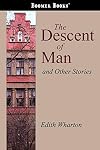
The Descent of Man and Other Stories
by Edith Wharton
On This Page
Description
When Professor Linyard came back from his holiday in the Maine woods the air of rejuvenation he brought with him was due less to the influences of the climate than to the companionship he had enjoyed on his travels.Tags
Recommendations















Member Reviews
Not great, but plenty entertaining. Heck, even a mediocre Wharton story is better than most. One I found to be very well done: The Other Two, about the awkwardness of all the exes showing up at the same time.
Throughout the short stories there is such a wonderful command of language that is a delight in itself. This collections' theme was romance, mostly of the old married couples type and that is where she seems to shine the best. Her descriptions of the relationship between husbands and wives can be absolutely stabbing, done by sharp cuts down to the vital truth.
It was more feminist than I expected, which is a good thing. I was afraid it would be of a lot of Victorian shrinking violets being abused by brute husbands. And certainly the show more roles of men and women were different then, but she gives women their own power which was a refreshing surprise. It's been ages since I read The House of Mirth and the sad vulnerability of Lily Bart wasn't something I connected to. After the breadth of females in this collection, I'm thinking I should add another Wharton novel to my To Read list.
(I did notice an odd thing that stood out as awkward to me in this group: blushing. Was there really so much blushing in 1904?)
I listened to the Librivox recording by Nicholas Clifford which was superb. show less
Throughout the short stories there is such a wonderful command of language that is a delight in itself. This collections' theme was romance, mostly of the old married couples type and that is where she seems to shine the best. Her descriptions of the relationship between husbands and wives can be absolutely stabbing, done by sharp cuts down to the vital truth.
It was more feminist than I expected, which is a good thing. I was afraid it would be of a lot of Victorian shrinking violets being abused by brute husbands. And certainly the show more roles of men and women were different then, but she gives women their own power which was a refreshing surprise. It's been ages since I read The House of Mirth and the sad vulnerability of Lily Bart wasn't something I connected to. After the breadth of females in this collection, I'm thinking I should add another Wharton novel to my To Read list.
(I did notice an odd thing that stood out as awkward to me in this group: blushing. Was there really so much blushing in 1904?)
I listened to the Librivox recording by Nicholas Clifford which was superb. show less
A sense of having been decoyed by some world-old conspiracy into this bondage of body and soul filled her with despair. If marriage was the slow life-long acquittal of a debt contracted in ignorance, then marriage was a crime against human nature. She, for one, would have no share in maintaining the pretence of which she had been a victim: the pretence that a man and a woman, forced into the narrowest of personal relations, must remain there till the end, though they may have outgrown the span of each other's natures as the mature tree outgrows the iron brace about the sapling.
A short story collection from 1904.
The majority of the stories were about marriage and other relationships between men and women, but there were a couple about show more the trials of being a published author and a couple of historical stories. In general I preferred the stories in the second half of the book. My favourite was The Quicksand in which a widow tells a younger woman her feelings about her own marriage and why she doesn't want the same fate to befall her, followed by The Reckoning, whose protagonist discovers that what's sauce for the goose is also sauce for the gander, much to her regret.
The Lady's Maid's Bell was shaping up to be an atmospheric if not frightening ghost story about a ladys' maid her mistress and her mistress's late lady's maid, but then just fizzled out and stopped. I'm hoping that the stories in her 1910 collection Tales of Men and Ghosts will be better. I was less keen on The Descent of Man, The Other Two and The Dilettante, and A Venetian Night's Entertainment would have been better if the twist at the end had come as a surprise (unfortunately I cottoned on to what was happening straightaway). show less
A short story collection from 1904.
The majority of the stories were about marriage and other relationships between men and women, but there were a couple about show more the trials of being a published author and a couple of historical stories. In general I preferred the stories in the second half of the book. My favourite was The Quicksand in which a widow tells a younger woman her feelings about her own marriage and why she doesn't want the same fate to befall her, followed by The Reckoning, whose protagonist discovers that what's sauce for the goose is also sauce for the gander, much to her regret.
The Lady's Maid's Bell was shaping up to be an atmospheric if not frightening ghost story about a ladys' maid her mistress and her mistress's late lady's maid, but then just fizzled out and stopped. I'm hoping that the stories in her 1910 collection Tales of Men and Ghosts will be better. I was less keen on The Descent of Man, The Other Two and The Dilettante, and A Venetian Night's Entertainment would have been better if the twist at the end had come as a surprise (unfortunately I cottoned on to what was happening straightaway). show less
Some silly, romantic fripperies to leaven out some searingly intense social criticism. Full review at my blog.
Ratings
Members
- Recently Added By
Author Information

378+ Works 63,654 Members
Edith Wharton was a woman of extreme contrasts; brought up to be a leisured aristocrat, she was also dedicated to her career as a writer. She wrote novels of manners about the old New York society from which she came, but her attitude was consistently critical. Her irony and her satiric touches, as well as her insight into human character, show more continue to appeal to readers today. As a child, Wharton found refuge from the demands of her mother's social world in her father's library and in making up stories. Her marriage at age 23 to Edward ("Teddy") Wharton seemed to confirm her place in the conventional role of wealthy society woman, but she became increasingly dissatisfied with the "mundanities" of her marriage and turned to writing, which drew her into an intellectual community and strengthened her sense of self. After publishing two collections of short stories, The Greater Inclination (1899) and Crucial Instances (1901), she wrote her first novel, The Valley of Decision (1902), a long, historical romance set in eighteenth-century Italy. Her next work, the immensely popular The House of Mirth (1905), was a scathing criticism of her own "frivolous" New York society and its capacity to destroy her heroine, the beautiful Lily Bart. As Wharton became more established as a successful writer, Teddy's mental health declined and their marriage deteriorated. In 1907 she left America altogether and settled in Paris, where she wrote some of her most memorable stories of harsh New England rural life---Ethan Frome (1911) and Summer (1917)---as well as The Reef (1912), which is set in France. All describe characters forced to make moral choices in which the rights of individuals are pitted against their responsibilities to others. She also completed her most biting satire, The Custom of the Country (1913), the story of Undine Spragg's climb, marriage by marriage, from a midwestern town to New York to a French chateau. During World War I, Wharton dedicated herself to the war effort and was honored by the French government for her work with Belgian refugees. After the war, the world Wharton had known was gone. Even her Pulitzer Prize-winning novel, The Age of Innocence (1920), a story set in old New York, could not recapture the former time. Although the new age welcomed her---Wharton was both a critical and popular success, honored by Yale University and elected to The National Institute of Arts and Letters---her later novels show her struggling to come to terms with a new era. In The Writing of Fiction (1925), Wharton acknowledged her debt to her friend Henry James, whose writings share with hers the descriptions of fine distinctions within a social class and the individual's burdens of making proper moral decisions. R.W.B. Lewis's biography of Wharton, published in 1975, along with a wealth of new biographical material, inspired an extensive reevaluation of Wharton. Feminist readings and reactions to them have focused renewed attention on her as a woman and as an artist. Although many of her books have recently been reprinted, there is still no complete collected edition of her work. (Bowker Author Biography) show less
Work Relationships
Is contained in
Common Knowledge
- First words
- When Professor Linyard came back from his holiday in the Maine woods the air of rejuvenation he brought with him was due less to the influences of the climate than to the companionship he had enjoyed on his travels.
- Last words
- (Click to show. Warning: May contain spoilers.)"All's well that ends well, as the fellow says in the play; and now, if you please, Mr . Bracknell, if you'll take the reverend gentleman's arm there, we'll bid adieu to our hospitable entertainers, and right about face for the Hepzibah.”
Classifications
Statistics
- Members
- 57
- Popularity
- 536,882
- Reviews
- 3
- Rating
- (3.64)
- Languages
- English
- Media
- Paper, Ebook
- ISBNs
- 31
- ASINs
- 7