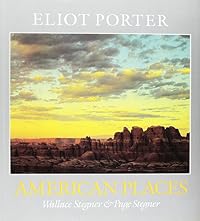
American Places
by Wallace Stegner, Eliot Porter (Photographer), Page Stegner
On This Page
Description
A book about America by one of the greatest writers of the American West "This book is an attempt, by sampling, to say something about how the American people and the American land have interacted, how they have shaped one another; what patterns of life, with what chances of continuity, have arisen out of the confrontations between an unformed society and a virgin continent. Perhaps it is less a book about the American land than some ruminationsabout the making of America. . . . We are the show more unfinished product of a long becoming." --from American Places For more than seventy years, Penguin has been the leading publisher of classic literature in the English-speaking world. With more than 1,700 titles, Penguin Classics represents a global bookshelf of the best works throughout history and across genres and disciplines. Readers trust the series to provide authoritative texts enhanced by introductions and notes by distinguished scholars and contemporary authors, as well as up-to-date translations by award-winning translators. show lessTags
Recommendations















Member Reviews
[American Places] is a collection of thirteen essays, eight by [Wallace Stegner] and 4 by his son [Page Stegner] and one they wrote together. The essays celebrate the beauties of America, its varying geography and fascinating history. At the same time, they are heavily apologist, decrying the "conquering spirit" of the immigrants and their pillaging of the land and its resources. At first glance, Mr. Stegner and his son seem very similar in their attitude and environmentalism. I did note some interesting differences. Wallace writes in pictures. His prose is lyrical and evokes memories of place and a desire to see the things he has seen. While Wallace is a bit curmudgeonly and grumpily complains about the desecration of his beloved show more wildernesses, his love for the country shines through.
In the essay "The River", which made me want to embark on a river boat cruise immediately, Stegner writes:
Creator, destroyer, highway, sewer, the Mississippi is also a dream and a myth. For a time it imposed itself as a boundary across the flow of America's westward movement; briefly, it seemed a line at which settlement might stop, or at least pause. then almost at once its tributary the Missouri, and its tributary the Platte, led the nation on west. The Mississippi stayed put, generating its own north-south dream that was made immortal in [Huckleberry Finn]. Europe troubles the East Coast, Asia troubles the West, but nothing troubles the Mississippi.
Page writes a little less lyrically and a little more loosely, but still skillfully and with fondness for the American places. He discusses questions on both sides - whether it's possible to find a balance between growth and sustainability. In addition, he brings up some of the vital questions about the consequences of the social revolution of the 1960's and where it leaves things 25 years later.
In "Life Along the Fault Line", Page writes:
The concept of an individual's civil rights began to eclipse the assumption of community standards of behavior. Much of the new permissiveness was long overdue, and if it inspired people to go out and stump for everything from prison reform to nude sunbathing, the world was probably a better place for it. But for a few people it seems that public restraints were the only measure of personal restraint, and as the lid came off, some subtle, and finally not so subtle, changes began to occur... The "oppressed" had become the oppressors.
In "The Redwood Curtain", Page writes about the cultural divide he saw in Humboldt county. Loggers, whose life depends on the continuance of the lumber business and the younger "hipper" citizens who moved to the area to attend Humboldt University and liked it and stayed. It is the conflict between:
...growth is not necessarily progress, that less is often more... and the fact that (the loggers) are concerned with beans on the table and a roof over the kids' heads, not metaphysics.
"There It Is: Take It" had the most personal impact on me. This essay covers the history of the Los Angeles aqueduct and the federal government's (Teddy Roosevelt's) decision that "the interests of the few must unfortunately be disregarded in view of the infinitely greater interest to be served by putting the water in Los Angeles." The long term effects of this decision include the near emptying of Mono Lake, the drying up of springs and loss of native vegetation leading to dust storms, artesian wells drying and then the ground water at risk. The disregard of the needs of the Owens Valley and the long term effects on the entire ecosystem to feed the insatiable greed Los Angeles had for water was a subtext of my childhood. I grew up near Los Angeles. My water came on the aqueduct. Water conservation and drought, water rights and limitation of growth were subjects any kid over the age of 10 could discuss with some intelligence. "Save Mono Lake" bumper stickers were prevalent in the Bay area in the early 90's when we went to Berkeley for graduate school, and finally after more than a decade of litigation, Mono Lake and its tributaries were finally protected.
Here's the conflict. The water shouldn't have been given exclusively to Los Angeles. The resources of the Owens Valley and other parts of the west should not have been preempted by the needs of a population so far away that the consequences of their wanton use of water were invisible. I fully understand the objection of the citizens who sued to regain some of their water rights. On the other hand, those that lobby for the environment can do just as much damage, whether intentional or not. For an example, have a look at the water wars fought in Northern California over the last decade between farmers and environmentalists trying to save the delta smelt, a fish that will probably go extinct anyway. Is the loss of property and untold acres of fruit and nut trees worth it? And now that those orchards are gone and dry, and only empty, dusty fields remain, what will be the environmental impact of that? It's not zero.
Man, the great creator and destroyer of environments, is also part of what he creates or destroys, and rises and falls with it. In the West, water is life. From the very beginning, when people killed each other with shovels over the flow of a primitive ditch, down to the present, when cities kill each other for precisely the same reasons and with the same self-justifications, water is the basis for western growth, western industry, western communities.
As Page says, only a policy made with the wisdom of Solomon might be capable of both protecting rights of communities and conserving the country we love. show less
In the essay "The River", which made me want to embark on a river boat cruise immediately, Stegner writes:
Creator, destroyer, highway, sewer, the Mississippi is also a dream and a myth. For a time it imposed itself as a boundary across the flow of America's westward movement; briefly, it seemed a line at which settlement might stop, or at least pause. then almost at once its tributary the Missouri, and its tributary the Platte, led the nation on west. The Mississippi stayed put, generating its own north-south dream that was made immortal in [Huckleberry Finn]. Europe troubles the East Coast, Asia troubles the West, but nothing troubles the Mississippi.
Page writes a little less lyrically and a little more loosely, but still skillfully and with fondness for the American places. He discusses questions on both sides - whether it's possible to find a balance between growth and sustainability. In addition, he brings up some of the vital questions about the consequences of the social revolution of the 1960's and where it leaves things 25 years later.
In "Life Along the Fault Line", Page writes:
The concept of an individual's civil rights began to eclipse the assumption of community standards of behavior. Much of the new permissiveness was long overdue, and if it inspired people to go out and stump for everything from prison reform to nude sunbathing, the world was probably a better place for it. But for a few people it seems that public restraints were the only measure of personal restraint, and as the lid came off, some subtle, and finally not so subtle, changes began to occur... The "oppressed" had become the oppressors.
In "The Redwood Curtain", Page writes about the cultural divide he saw in Humboldt county. Loggers, whose life depends on the continuance of the lumber business and the younger "hipper" citizens who moved to the area to attend Humboldt University and liked it and stayed. It is the conflict between:
...growth is not necessarily progress, that less is often more... and the fact that (the loggers) are concerned with beans on the table and a roof over the kids' heads, not metaphysics.
"There It Is: Take It" had the most personal impact on me. This essay covers the history of the Los Angeles aqueduct and the federal government's (Teddy Roosevelt's) decision that "the interests of the few must unfortunately be disregarded in view of the infinitely greater interest to be served by putting the water in Los Angeles." The long term effects of this decision include the near emptying of Mono Lake, the drying up of springs and loss of native vegetation leading to dust storms, artesian wells drying and then the ground water at risk. The disregard of the needs of the Owens Valley and the long term effects on the entire ecosystem to feed the insatiable greed Los Angeles had for water was a subtext of my childhood. I grew up near Los Angeles. My water came on the aqueduct. Water conservation and drought, water rights and limitation of growth were subjects any kid over the age of 10 could discuss with some intelligence. "Save Mono Lake" bumper stickers were prevalent in the Bay area in the early 90's when we went to Berkeley for graduate school, and finally after more than a decade of litigation, Mono Lake and its tributaries were finally protected.
Here's the conflict. The water shouldn't have been given exclusively to Los Angeles. The resources of the Owens Valley and other parts of the west should not have been preempted by the needs of a population so far away that the consequences of their wanton use of water were invisible. I fully understand the objection of the citizens who sued to regain some of their water rights. On the other hand, those that lobby for the environment can do just as much damage, whether intentional or not. For an example, have a look at the water wars fought in Northern California over the last decade between farmers and environmentalists trying to save the delta smelt, a fish that will probably go extinct anyway. Is the loss of property and untold acres of fruit and nut trees worth it? And now that those orchards are gone and dry, and only empty, dusty fields remain, what will be the environmental impact of that? It's not zero.
Man, the great creator and destroyer of environments, is also part of what he creates or destroys, and rises and falls with it. In the West, water is life. From the very beginning, when people killed each other with shovels over the flow of a primitive ditch, down to the present, when cities kill each other for precisely the same reasons and with the same self-justifications, water is the basis for western growth, western industry, western communities.
As Page says, only a policy made with the wisdom of Solomon might be capable of both protecting rights of communities and conserving the country we love. show less
Ratings
Members
- Recently Added By
Author Information

92+ Works 20,811 Members
In 1972, Wallace Earle Stegner won a Pulitzer Prize for Angle of Repose (1971), a novel about a wheelchair-bound man's recreation of his New England grandmother's experience in a late nineteenth-century frontier town. Stegner was born on February 18, 1909 in Lake Mills, Iowa. He was an American novelist, short story writer, environmentalist, and show more historian; he has been called "The Dean of Western Writers". He also won the US National Book Award in 1977 for The Spectator Bird. Stegner grew up in Great Falls, Montana; Salt Lake City, Utah; and in the village of Eastend, Saskatchewan, which he wrote about in his autobiography Wolf Willow. Stegner taught at the University of Wisconsin and Harvard University. Eventually he settled at Stanford University, where he initiated the creative writing program. His students included Wendell Berry, and Sandra Day O'Connor. The Stegner Fellowship program at Stanford University is a two-year creative writing fellowship. The house Stegner lived in from age 7 to 12 in Eastend, Saskatchewan, Canada, was restored by the Eastend Arts Council in 1990 and established as a Residence for Artists; the Wallace Stegner Grant For The Arts offers a grant of $500 and free residency at the house for the month of October for published Canadian writers. Stegner died in Santa Fe, New Mexico, on April 13, 1993, from a car accident on March 28, 1993. (Bowker Author Biography) show less

13+ Works 500 Members
Page Stegner is a novelist, literary critic, and journalist. He has written extensively on the American West, and has been a frequent contributor to numerous publications, including Harper's, The Atlantic, Esquire, Audubon, Outside, The New York Review of Books, and Arizona Highways. From 1967 to 1995 he was Professor of American Literature, and show more Director of the Creative Writing Program at the University of California, Santa Cruz show less
Common Knowledge
- Important places
- USA
- Original language
- English
Classifications
Statistics
- Members
- 241
- Popularity
- 134,466
- Reviews
- 1
- Rating
- (4.27)
- Languages
- English, Italian
- Media
- Paper
- ISBNs
- 6
- UPCs
- 1
- ASINs
- 7