On This Page
Description
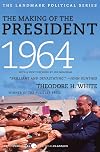
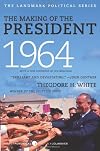
"[White] revolutionized the art of political reporting." -William F. Buckley A national bestseller, The Making of the President 1964 is the critically acclaimed account of the 1964 presidential campaign, from the assassination of JFK though the battle for power between Lyndon B. Johnson and Barry Goldwater. Author Theodore H. White made history with his Pulitzer Prize-winning The Making of the President series-detailed narrative histories that revolutionized the way presidential campaigns show more were reported. Now back in print with a new foreword by fellow Pulitzer Prize-winning author Jon Meacham, The Making of the President 1964 joins The Making of the President 1960, 1968, and 1972, as well as Theodore Sorensen's Kennedy and other classics, in the burgeoning Harper Perennial Political Classics series. show lessTags
Recommendations
















Member Recommendations

Member Reviews
Hillary Rodham Clinton was a high-school Young Republican and "Goldwater Girl" in 1964 but swung to supporting Democrat Eugene McCarthy’s campaign in 1968 and George McGovern’s in 1972. "I wasn’t born a Democrat," she writes on page one of her autobiography Living HistoryLiving History, but was a "rock-ribbed, up-by-your-bootstraps, conservative Republican and proud of it" (page 11). Her 9th-grade history teacher was also a very conservative Republican who encouraged her to read Arizona Sen. Barry Goldwater’s 1960 book, Conscience of a Conservative, which inspired Clinton to write a term paper on the American conservative movement. "I was also an active Young Republican and, later, a Goldwater girl, right down to my cowgirl show more outfit and straw cowboy hat emblazoned with the slogan 'AuH20.' … I liked Senator Goldwater because he was a rugged individualist who swam against the political tide."
I think this association with Clinton and similar contexts had given me the perception that "Goldwater Republican" meant someone more progressive or at least centrist compared to a typical Republican. However, as the excellent and detailed reportage clarifies, here, ultra-conservative Goldwater differs from today's libertarians (both big-L and little-L) in that he was an advocate for strong national defense and even a hawkish interventionist and pro-tactical nukes, etc.. This is the guy, remember, who suggested we should “lob a nuke into the men's room at the Kremlin." This alarmed many and reinforced LBJ's determination to defeat him - the Trump of his day it seems - and eventually out-hawk him with The Gulf of Tonkin Resolution and run the unforgettable "Daisy" ad. I wish the book went into more detail on the Johnson machine that led to that ad and the organized operatives detailed to hound and disrupt the Goldwater campaign.
This book does go into detail on how LBJ was not the shoo-in some may think in retrospect and his ship almost got caught up on the rocky shoals of the sudden scandal around Walter Jenkins, longtime top aide to Johnson. Jenkins' career ended after a sex scandal was reported weeks before the 1964 presidential election, when Jenkins was arrested and charged with disorderly conduct with another man in a public restroom in Washington, D.C.'s YMCA ("so notorious a gathering place of homosexuals that the District police had long since staked it out with peepholes for surveillance"). LBJ was largely saved by sudden events that pushed voters away from supposed Goldwater warmongering and toward the stability hoped from continuity of government:
* On October 14, 1964, the Presidium and the Central Committee accepted Khrushchev's "voluntary" request to retire from his offices for reasons of "advanced age and ill health." Brezhnev was now on the scene and there was a new Soviet government for the U.S. to be concerned about
* "596", the People's Republic of China's first nuclear weapons test, detonated on October 16, 1964, at the Lop Nur test site.
* Labour won the 1964 UK general election with a narrow majority of four seats, and Harold Wilson became Prime Minister, the youngest person to hold that office since Lord Rosebery 70 years earlier. The election was held on 15 October 1964, just over five years after the previous election, and 13 years after the Conservative Party had retaken power.
While the term "October surprise" did not come into usage until the 1972 election and the Kissinger-Nixon secret talks over Vietnam, there was certainly fortuitous October surprises for LBJ that pushed Jenkins' story off the headlines. show less
I think this association with Clinton and similar contexts had given me the perception that "Goldwater Republican" meant someone more progressive or at least centrist compared to a typical Republican. However, as the excellent and detailed reportage clarifies, here, ultra-conservative Goldwater differs from today's libertarians (both big-L and little-L) in that he was an advocate for strong national defense and even a hawkish interventionist and pro-tactical nukes, etc.. This is the guy, remember, who suggested we should “lob a nuke into the men's room at the Kremlin." This alarmed many and reinforced LBJ's determination to defeat him - the Trump of his day it seems - and eventually out-hawk him with The Gulf of Tonkin Resolution and run the unforgettable "Daisy" ad. I wish the book went into more detail on the Johnson machine that led to that ad and the organized operatives detailed to hound and disrupt the Goldwater campaign.
This book does go into detail on how LBJ was not the shoo-in some may think in retrospect and his ship almost got caught up on the rocky shoals of the sudden scandal around Walter Jenkins, longtime top aide to Johnson. Jenkins' career ended after a sex scandal was reported weeks before the 1964 presidential election, when Jenkins was arrested and charged with disorderly conduct with another man in a public restroom in Washington, D.C.'s YMCA ("so notorious a gathering place of homosexuals that the District police had long since staked it out with peepholes for surveillance"). LBJ was largely saved by sudden events that pushed voters away from supposed Goldwater warmongering and toward the stability hoped from continuity of government:
* On October 14, 1964, the Presidium and the Central Committee accepted Khrushchev's "voluntary" request to retire from his offices for reasons of "advanced age and ill health." Brezhnev was now on the scene and there was a new Soviet government for the U.S. to be concerned about
* "596", the People's Republic of China's first nuclear weapons test, detonated on October 16, 1964, at the Lop Nur test site.
* Labour won the 1964 UK general election with a narrow majority of four seats, and Harold Wilson became Prime Minister, the youngest person to hold that office since Lord Rosebery 70 years earlier. The election was held on 15 October 1964, just over five years after the previous election, and 13 years after the Conservative Party had retaken power.
While the term "October surprise" did not come into usage until the 1972 election and the Kissinger-Nixon secret talks over Vietnam, there was certainly fortuitous October surprises for LBJ that pushed Jenkins' story off the headlines. show less
Theodore White was an accurate and careful reporter on the presidential races of the time. He was of a progressive frame of mind, and so the reader should not look for lurid conspiracies, or much speculation about campaign finances here. But the account is clear, and readable.
This was a great book and such a interesting look at an election that should have never materialised. With the death of JFK, suddenly Johnson was President and had to face into an election. Theodore Whites books are essential reading for anyone Interested in American politics in the 60s and 70s.
This book is filled with detail and covers all aspects of the 1964 political landscape. Although this book does provide information and is true to its title, I foudn the book to be a tedious and boring read which is why I only gave it two stars. I think you would really need to be interested in the 1964 election to enjoy this book.
In all honesty, I never even finished it. That's how much I didn't enjoy it.
In all honesty, I never even finished it. That's how much I didn't enjoy it.
828 The Making of the President 1964, by Theodore H. White (read 7 Nov 1965) I found this a good review of the 1964 Presidential campaign--one of the most satisfying campaigns I ever lived through.
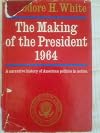
Good condition. Bookplate inside front cover. Dust jacket worn, creased, torn.
Department of History, University of Hong Kong
Members
- Recently Added By
Lists

Non-Fiction Worth Reading
1,015 works; 255 members

Publisher's Weekly NON-Fiction list - 1912 - 1975
486 works; 4 members
Author Information

22+ Works 4,747 Members
Theodore H. White (1915-1986) was an American political journalist, historian, and novelist, best known for the Making of the President series: his accounts of the 1960,1964,1968, and 1972 presidential elections, all of which are being reissued with new forewords by Harper Perennial Political Classics. His other books include Thunder Out of China, show more America in Search of Itself, and In Search of History: A Personal Adventure. show less
Awards and Honors
Awards
Distinctions
Series

Work Relationships
Common Knowledge
- Original publication date
- 1965
- People/Characters
- Lyndon Baines Johnson; Richard M. Nixon
- Important places
- USA
- Important events
- United States presidential election (1964)
- Related movies
- The Making of a President: 1964 (1966 | IMDb)
- Dedication
- For H. Chouteau Dyer (1935-1961)
- First words
- Forward: Every man who writes of politics shapes unknowingly in his mind some fanciful metaphor to embrace all the wild, apparently erratic events and personalities in the process he tries to describe.
It was hot; the sun was blinding; there would be a moment of cool shade ahead under the overpass they were approaching. - Last words
- (Click to show. Warning: May contain spoilers.)The ultimate paradox of 1964 was that the Americans had chosen one of the most passionately political of all Presidents, who proposed, if he could, to make the Presidency a non-political office; and if he succeeded, he might set the stage for yet further Acts of Recognition by all those unknown younger leaders of the future, also chosen in 1964.
Classifications
- Genres
- Nonfiction, History, Politics and Government, General Nonfiction, Biography & Memoir
- DDC/MDS
- 324.973 — Society, government, & culture Political science Politics & Elections Biography And History North America United States
- LCC
- E850 .W5 — History of the United States United States Later twentieth century, 1961-2000 Johnson's administrations, November 22, 1963-1969
- BISAC
Statistics
- Members
- 498
- Popularity
- 60,377
- Reviews
- 7
- Rating
- (3.88)
- Languages
- English
- Media
- Paper, Ebook
- ISBNs
- 10
- ASINs
- 17