The Conscience of a Conservative
by Barry Goldwater
On This Page
Description
When it was first published, The Conscience of a Conservative reignited the American conservative movement and made Barry Goldwater a political star. It influenced countless conservatives in the United States and helped to lay the foundation for the Reagan Revolution in 1980. Just as vital today as it was then, this book addresses many topics that could be torn from today's headlines. Goldwater discusses education, labor unions and policies, civil rights, agricultural policy and farm show more subsidies, social welfare programs, and income taxation. This significant book lays out the conservative position both politically and economically that would come to dominate the Conservative Movement in America. show lessTags
Recommendations


















Member Reviews
A very interesting and somewhat unsettling look at the philosophy (not sure what "conscience" really has to do with it) of a man who had hopes of occupying the White House. His view of the world, and the United States' place in it, could have taken us in a very different direction domestically and globally. He advocated the withdrawal of federal involvement in a "whole series of programs that are outside its constitutional mandate" including education, agriculture, public power and urban renewal; he favored a flat rate for income tax, and the development of a "variety of small, clean nuclear weapons" with which to meet the threat of Communism. (If anyone knows what those weapons would be, you're one up on this kid.) He proposed making show more participation in Social Security voluntary, and opposed the Civil Rights Act of 1964, which he viewed as an intrusion of the federal government into matters properly left to the individual states. (Despite this position, he later became a proponent of legalized abortion and gay rights, and took great exception to the growing influence of the religious right on the Republican Party.) In 1964, the electorate found Senator Goldwater too right-wing and/or too immoderate for its taste, and Lyndon Johnson soundly defeated him. Goldwater is a fascinating historical figure, and I'd love to read a biography of him written by someone like David McCullough. show less
(Originally written March 2017)
The Conscience of a Conservative, Senator Barry Goldwater's 1960 slim volume (ghostwritten by L. Brett Bozell, Jr.) advocating for conservative values, had more impact on right-wing and Republican politics in postwar America than any book besides The Bible and, perhaps, Atlas Shrugged. I sought the book out because I wanted to understand where conservatives are coming from and be able to have more productive political conversations. Since my political thinking operates with a different set of frames I was expecting to disagree with a lot of what Goldwater wrote, and I did. My focus in this review is therefore not to critique the book but to characterize it and highlight its arguments.
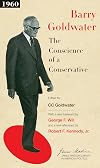
The book is an easy show more read. It's short and readable in an afternoon. My 50th anniversary copy, with foreword (George F. Will) and afterword (Robert F. Kennedy, Jr.) is 137 pages of roughly mass-market paperback size. It is not a work of technical political theory and is thus accessible to almost any American adult. It takes a personal and casual tone, clearly the broad appeal words of a politician and not the jargon of an academic. I think this accessibility is at least as important to the book's success in the conservative movement as any specific policy idea expressed in its pages.
The book starts with a few chapters on general principles followed by several chapters applying those principles to specific domestic issues that were prominent in the late 1950s.
Goldwater argues for Conservatism in opposition to Socialism and also in opposition to Liberalism and the (then-ascendant) moderate wing of the Republican Party. He starts by quoting Vice President Nixon, Republican candidates should be economic conservatives, but conservatives with a heart, and President Eisenhower, I am conservative when it comes to economic problems but liberal when it comes to human problems. Goldwater is conservative on both fronts and emphasizes that Conservatism isn't just about economics: The Conservative believes that man is, in part, an economic, an animal creature; but that he is also a spiritual creature with spiritual needs and spiritual desires. What is more, these needs and desires reflect the superior side of man's nature, and thus take precedence over his economic wants. Growing up in an Arizona which had recently gained statehood and in which the wild west didn't seem so long ago, it's not surprising that the focus of Goldwater's philosophy is individual freedom. Man's most sacred possession is his individual soul—which has an immortal side, but also a mortal one. The mortal side establishes his absolute differentness from every other human being. Only a philosophy that takes into account the essential differences between men, and, accordingly, makes provision for developing the different potentialities of each man can claim to be in accord with Nature. We have heard much in the time about “the common man.” It is a concept that pays little attention to the history of a nation that grew great through the initiative and ambition of uncommon men. The Conservative knows that to regard man as part of an undifferentiated mass is to consign him to ultimate slavery. (Despite this emphasis on spirit and soul, Goldwater did not want the church to be actively involved in politics and he did not like the rise of the Religious Right.)
Goldwater's political framework is focused on the Constitution and a limited federal government. While some people's political approach is to devise a solution to a problem first and then shape it to match the law, one gets the sense that Goldwater would prefer to start with what's constitutional and then work out a solution which is permitted. In the way that some folks on the right treat the Second Amendment as the most important while some on the left elevate the First, the Tenth Amendment is, I think, most fundamental for Goldwater. (The powers not delegated to the United States by the Constitution, nor prohibited by it to the States, are reserved to the States respectively, or to the people.) Goldwater objects to several federal programs not because they're bad policies but because he thinks the states should implement them, with structure and prioritization driven by local voters and legislators, not a nationwide legislature and bureaucracy. He argues against federal involvement in education because the Constitution doesn't grant any federal powers over education, thus leaving the subject up to states. Yet if there were a constitutional amendment in place regarding education, Goldwater would seem to have no objection to the execution of it.
Many on the left, citing rhetoric of the Confederate and Jim Crow South, characterize the phrase “states’ rights” as an innocuous phrase meant to mask an underlying policy of racial discrimination. Goldwater acknowledges this perception, writing It is quite true that the integration issue is affected by the State's Rights principle, and that the South's position on the issue is, today, the most conspicuous expression of the principle. So much so that the country is now in the grips of a spirited and sometimes ugly controversy over an imagined conflict between State's Rights, on the one hand, and what are called “civil rights” on the other. He goes on to argue that civil rights are not universal rights granted by virtue of our humanity but rather a right defined in law: Unless a right is incorporated in the law, it is not a civil right and is not enforceable by the instruments of the civil law. There may be some rights—“natural,” “human,” or otherwise—that should also be civil rights. But if we desire to give such rights the protection of the law, our recourse is to a legislature or to the amendment procedures of the Constitution. We must not look to politicians, or sociologists—or the courts—to correct the deficiency. Goldwater was not a racist, and although he spends much of the chapter on civil rights arguing against federal efforts to desegregate schools and questioning the legitimacy of the Supreme Court's ruling in Brown vs. Board of Education, he speaks in favor of the principle of desegregation.
In a political world following Goldwater's philosophy, one might expect a great many constitutional amendments be proposed. (He argues against high tax brackets, for instance, but not against income tax itself, since that power is granted by the Sixteenth Amendment.) Addressing an issue like education, air pollution, or Internet crime would start by passage of an amendment granting federal jurisdiction on the matter. Yet amending the Constitution is hard, and in the half century since The Conscience of a Conservative was published, the Constitution was only amended five times—thrice regarding voting rights, once regarding presidential succession, and once regarding congressional compensation. Only the latter came after Ronald Reagan and Goldwater's intellectual heirs took power in Washington (and that one was proposed with the initial Bill of Rights: https://en.wikipedia.org/wiki/Twenty-seventh_Amendment_to_the_United_States_Cons.... Many more amendments have, of course, been proposed but not passed in Congress—depending on one's perspective, this might speak in favor of or against an amend-first model.
Reading the book after it influenced half a century of politics provides an interesting sense of retrospective. For instance, a book written today wouldn't focus so much on the power of unions, yet it is precisely this book's arguments about unions which provided the framework for the legislation that weakened union power. Goldwater's arguments reverberate through contemporary conservatives: reading Goldwater's complaints about depression-era laws paying farmers to not grow crops (and thus avoid a market crash) reminded me of several folks I've heard rail against the same practice, even though it was ended by the 1996 Farm Bill.
Unfortunately, some of Goldwater's advice was not heeded by conservatives. He ends the “Freedom for Labor” chapter by saying Let us henceforth make war on all monopolies—whether corporate or union. The enemy of freedom is unrestrained power, and the champions of freedom will fight against the concentration of power wherever they find it. The Republicans who came to power with the help of Goldwater's rhetoric duly set about disarming the power of labor unions, yet they simultaneously enacted policies to boost the power of capital and corporations. Conservative-championed deregulation has led to a handful of companies controlling most broadcast and publishing media outlets, granting significant power and control of information to corporations. And despite the breakup of Ma Bell in the mid-80s, many consumers have no choice over telecommunications providers and the companies wield near-monopolistic power (Comcast revenues exceed every state government but California).
Goldwater's recommendations in “Taxes and Spending” were likewise only followed half-way. Goldwater wanted to reduce taxes by cutting back on federal programs: The government must begin to withdraw from a whole series of programs that are outside its constitutional mandate—from social welfare programs, education, public power, agriculture, public housing, urban renewal and all the other activities that can be better performed by lower levels of government or by private institutions or by individuals. I do not suggest that the federal government drop all of these programs overnight. But I do suggest that we establish, by law, a rigid timetable for a staged withdrawal. Yet the oft repeated mantra of today's Republican party is Reagan taught us that deficits don't matter, and Republicans have tended to propose tax cuts without spending cuts, program elimination without reducing taxes, and spending increases (particularly for military expenditure) without corresponding tax increases. While academic fiscal conservatives decry these policies, the party doesn't seem to care: tax cuts are a good way to get elected and eliminating popular programs are a good way to get voted out of office.
Goldwater's last chapter, “The Soviet Menace,” consumes the final third of the book and feels the most incongruous with the modern world. Goldwater begins in no uncertain terms: And still the awful truth remains: We can establish the domestic conditions for maximizing freedom, along the lines I have indicated, and yet become slaves. We can do this by losing the Cold War to the Soviet Union. He rails against the policies then in place to combat the USSR, from NATO and the UN to negotiation and diplomacy to foreign aid. He proposed instead an offensive (and quite so) strategy, The key guidepost is the Objective, and we must never lose sight of it. It is not to wage a struggle against Communism, but to win it. He proposed development and use of “small, clean nuclear weapons.” Recalling his fiscal conservatism, he writes As a Conservative, I deplore the huge tax levy that is needed to finance the world's number-one military establishment. But even more do I deplore the prospect of a foreign conquest, which the absence of that establishment would quickly accomplish. One wonders if he would similarly quiet his objections to spending on social programs if it were presented as a choice between liberal welfare or the election of an American communist or socialist party to congress. Goldwater's commitment to conservative constitutional law was also conspicuously absent from this chapter: socialist regimes generally installed a new constitution and American support for anti-socialist rebels would presumably violate the laws under which they found themselves.
While the flashpoints, proxy wars, and immense military buildups that characterized the Cold War definitely bore Goldwater's influence, the mechanism of victory fortunately took a significantly different tack than Goldwater's plan. He writes We may not make foreign peoples love us—no nation has ever succeeded in that—but we can make them respect us. And respect is the stuff of which enduring friendships and firm alliances are made. Yet despite the trillions of dollars spent on military hardware, the Socialist states collapsed not because of a respect-as-fear of U.S. power and might but thanks to a love-as-admiration we were able to foster in the people. While leaders threatened each other with weapons, support for the state was whittled away by rock 'n' roll, hip young people, material comforts, and the gradual awareness that there was a world where grocery stores were always full of food.
The Conscience of a Conservative deserves a place in collections of key American documents, alongside The Federalist Papers and the speeches of Martin Luther King, Jr. Like the others it took relatively few words to influence generations of political action and government policy. Many on the left believe its ideas were taken too far; many on the right that they weren't taken far enough. But taken they certainly were, and they continue to frame contemporary discourse. show less
The Conscience of a Conservative, Senator Barry Goldwater's 1960 slim volume (ghostwritten by L. Brett Bozell, Jr.) advocating for conservative values, had more impact on right-wing and Republican politics in postwar America than any book besides The Bible and, perhaps, Atlas Shrugged. I sought the book out because I wanted to understand where conservatives are coming from and be able to have more productive political conversations. Since my political thinking operates with a different set of frames I was expecting to disagree with a lot of what Goldwater wrote, and I did. My focus in this review is therefore not to critique the book but to characterize it and highlight its arguments.
The book is an easy show more read. It's short and readable in an afternoon. My 50th anniversary copy, with foreword (George F. Will) and afterword (Robert F. Kennedy, Jr.) is 137 pages of roughly mass-market paperback size. It is not a work of technical political theory and is thus accessible to almost any American adult. It takes a personal and casual tone, clearly the broad appeal words of a politician and not the jargon of an academic. I think this accessibility is at least as important to the book's success in the conservative movement as any specific policy idea expressed in its pages.
The book starts with a few chapters on general principles followed by several chapters applying those principles to specific domestic issues that were prominent in the late 1950s.
Goldwater argues for Conservatism in opposition to Socialism and also in opposition to Liberalism and the (then-ascendant) moderate wing of the Republican Party. He starts by quoting Vice President Nixon, Republican candidates should be economic conservatives, but conservatives with a heart, and President Eisenhower, I am conservative when it comes to economic problems but liberal when it comes to human problems. Goldwater is conservative on both fronts and emphasizes that Conservatism isn't just about economics: The Conservative believes that man is, in part, an economic, an animal creature; but that he is also a spiritual creature with spiritual needs and spiritual desires. What is more, these needs and desires reflect the superior side of man's nature, and thus take precedence over his economic wants. Growing up in an Arizona which had recently gained statehood and in which the wild west didn't seem so long ago, it's not surprising that the focus of Goldwater's philosophy is individual freedom. Man's most sacred possession is his individual soul—which has an immortal side, but also a mortal one. The mortal side establishes his absolute differentness from every other human being. Only a philosophy that takes into account the essential differences between men, and, accordingly, makes provision for developing the different potentialities of each man can claim to be in accord with Nature. We have heard much in the time about “the common man.” It is a concept that pays little attention to the history of a nation that grew great through the initiative and ambition of uncommon men. The Conservative knows that to regard man as part of an undifferentiated mass is to consign him to ultimate slavery. (Despite this emphasis on spirit and soul, Goldwater did not want the church to be actively involved in politics and he did not like the rise of the Religious Right.)
Goldwater's political framework is focused on the Constitution and a limited federal government. While some people's political approach is to devise a solution to a problem first and then shape it to match the law, one gets the sense that Goldwater would prefer to start with what's constitutional and then work out a solution which is permitted. In the way that some folks on the right treat the Second Amendment as the most important while some on the left elevate the First, the Tenth Amendment is, I think, most fundamental for Goldwater. (The powers not delegated to the United States by the Constitution, nor prohibited by it to the States, are reserved to the States respectively, or to the people.) Goldwater objects to several federal programs not because they're bad policies but because he thinks the states should implement them, with structure and prioritization driven by local voters and legislators, not a nationwide legislature and bureaucracy. He argues against federal involvement in education because the Constitution doesn't grant any federal powers over education, thus leaving the subject up to states. Yet if there were a constitutional amendment in place regarding education, Goldwater would seem to have no objection to the execution of it.
Many on the left, citing rhetoric of the Confederate and Jim Crow South, characterize the phrase “states’ rights” as an innocuous phrase meant to mask an underlying policy of racial discrimination. Goldwater acknowledges this perception, writing It is quite true that the integration issue is affected by the State's Rights principle, and that the South's position on the issue is, today, the most conspicuous expression of the principle. So much so that the country is now in the grips of a spirited and sometimes ugly controversy over an imagined conflict between State's Rights, on the one hand, and what are called “civil rights” on the other. He goes on to argue that civil rights are not universal rights granted by virtue of our humanity but rather a right defined in law: Unless a right is incorporated in the law, it is not a civil right and is not enforceable by the instruments of the civil law. There may be some rights—“natural,” “human,” or otherwise—that should also be civil rights. But if we desire to give such rights the protection of the law, our recourse is to a legislature or to the amendment procedures of the Constitution. We must not look to politicians, or sociologists—or the courts—to correct the deficiency. Goldwater was not a racist, and although he spends much of the chapter on civil rights arguing against federal efforts to desegregate schools and questioning the legitimacy of the Supreme Court's ruling in Brown vs. Board of Education, he speaks in favor of the principle of desegregation.
In a political world following Goldwater's philosophy, one might expect a great many constitutional amendments be proposed. (He argues against high tax brackets, for instance, but not against income tax itself, since that power is granted by the Sixteenth Amendment.) Addressing an issue like education, air pollution, or Internet crime would start by passage of an amendment granting federal jurisdiction on the matter. Yet amending the Constitution is hard, and in the half century since The Conscience of a Conservative was published, the Constitution was only amended five times—thrice regarding voting rights, once regarding presidential succession, and once regarding congressional compensation. Only the latter came after Ronald Reagan and Goldwater's intellectual heirs took power in Washington (and that one was proposed with the initial Bill of Rights: https://en.wikipedia.org/wiki/Twenty-seventh_Amendment_to_the_United_States_Cons.... Many more amendments have, of course, been proposed but not passed in Congress—depending on one's perspective, this might speak in favor of or against an amend-first model.
Reading the book after it influenced half a century of politics provides an interesting sense of retrospective. For instance, a book written today wouldn't focus so much on the power of unions, yet it is precisely this book's arguments about unions which provided the framework for the legislation that weakened union power. Goldwater's arguments reverberate through contemporary conservatives: reading Goldwater's complaints about depression-era laws paying farmers to not grow crops (and thus avoid a market crash) reminded me of several folks I've heard rail against the same practice, even though it was ended by the 1996 Farm Bill.
Unfortunately, some of Goldwater's advice was not heeded by conservatives. He ends the “Freedom for Labor” chapter by saying Let us henceforth make war on all monopolies—whether corporate or union. The enemy of freedom is unrestrained power, and the champions of freedom will fight against the concentration of power wherever they find it. The Republicans who came to power with the help of Goldwater's rhetoric duly set about disarming the power of labor unions, yet they simultaneously enacted policies to boost the power of capital and corporations. Conservative-championed deregulation has led to a handful of companies controlling most broadcast and publishing media outlets, granting significant power and control of information to corporations. And despite the breakup of Ma Bell in the mid-80s, many consumers have no choice over telecommunications providers and the companies wield near-monopolistic power (Comcast revenues exceed every state government but California).
Goldwater's recommendations in “Taxes and Spending” were likewise only followed half-way. Goldwater wanted to reduce taxes by cutting back on federal programs: The government must begin to withdraw from a whole series of programs that are outside its constitutional mandate—from social welfare programs, education, public power, agriculture, public housing, urban renewal and all the other activities that can be better performed by lower levels of government or by private institutions or by individuals. I do not suggest that the federal government drop all of these programs overnight. But I do suggest that we establish, by law, a rigid timetable for a staged withdrawal. Yet the oft repeated mantra of today's Republican party is Reagan taught us that deficits don't matter, and Republicans have tended to propose tax cuts without spending cuts, program elimination without reducing taxes, and spending increases (particularly for military expenditure) without corresponding tax increases. While academic fiscal conservatives decry these policies, the party doesn't seem to care: tax cuts are a good way to get elected and eliminating popular programs are a good way to get voted out of office.
Goldwater's last chapter, “The Soviet Menace,” consumes the final third of the book and feels the most incongruous with the modern world. Goldwater begins in no uncertain terms: And still the awful truth remains: We can establish the domestic conditions for maximizing freedom, along the lines I have indicated, and yet become slaves. We can do this by losing the Cold War to the Soviet Union. He rails against the policies then in place to combat the USSR, from NATO and the UN to negotiation and diplomacy to foreign aid. He proposed instead an offensive (and quite so) strategy, The key guidepost is the Objective, and we must never lose sight of it. It is not to wage a struggle against Communism, but to win it. He proposed development and use of “small, clean nuclear weapons.” Recalling his fiscal conservatism, he writes As a Conservative, I deplore the huge tax levy that is needed to finance the world's number-one military establishment. But even more do I deplore the prospect of a foreign conquest, which the absence of that establishment would quickly accomplish. One wonders if he would similarly quiet his objections to spending on social programs if it were presented as a choice between liberal welfare or the election of an American communist or socialist party to congress. Goldwater's commitment to conservative constitutional law was also conspicuously absent from this chapter: socialist regimes generally installed a new constitution and American support for anti-socialist rebels would presumably violate the laws under which they found themselves.
While the flashpoints, proxy wars, and immense military buildups that characterized the Cold War definitely bore Goldwater's influence, the mechanism of victory fortunately took a significantly different tack than Goldwater's plan. He writes We may not make foreign peoples love us—no nation has ever succeeded in that—but we can make them respect us. And respect is the stuff of which enduring friendships and firm alliances are made. Yet despite the trillions of dollars spent on military hardware, the Socialist states collapsed not because of a respect-as-fear of U.S. power and might but thanks to a love-as-admiration we were able to foster in the people. While leaders threatened each other with weapons, support for the state was whittled away by rock 'n' roll, hip young people, material comforts, and the gradual awareness that there was a world where grocery stores were always full of food.
The Conscience of a Conservative deserves a place in collections of key American documents, alongside The Federalist Papers and the speeches of Martin Luther King, Jr. Like the others it took relatively few words to influence generations of political action and government policy. Many on the left believe its ideas were taken too far; many on the right that they weren't taken far enough. But taken they certainly were, and they continue to frame contemporary discourse. show less
This version has two introductions by Patrick J. Buchanan. One, entitled "The Voice in the Desert," is a sort of history of the conservative movement, beginning with the disappointments of the Ike administration and ending with Reagan. Buchanan, when you account for his biography, gives far too much credit and nods to Richard M. Nixon, but that is okay. This was intriguing, and really explains well the strife in the soul of 1960s America.
The second introduction, "American Empire at Apogee," from his 2004 book Where the Right Went Wrong, is his indictment of the Bush Administration. Though I agree with several points of this section, for instance, Republicans under Bush forgot their economic conservatism, but I disagree that Bush's show more "Wilsonian" foreign policy is wrong. (I rather think Bush's foreign policy is Teddy Rooseveltian.) Buchanan, reveres the Reagan example of fighting by proxy and denigrates the Bush example of fighting the damned battle, conveniently forgetting that Reagan indeed sent troops into Grenada, Lebanon, and shot directly at Iranians when the need arose. Eh.
But, it is a nice little volume of the grounding document of the conservative movement of the late 1900s, conveniently small, nicely typeset, etc. The introduction bu Buchanan at least makes more sense than the recent Princeton University Press version. For some odd reason, the editor is his turncoat granddaughter, the introduction is by liberal Sean Wilentz, the foreword is by Rockefeller Republican George Will, and the afterword is by loony-nutcase socialist Robert F. Kennedy, Jr. Really? Who dreamed that up? I mean, imagine Obama's The Audacity of Hope introduced by Newt Gingrich with an afterword by Rush Limbaugh!
Now to The Conscience of a Conservative proper.
Okay, yes, J. Brent Bozell, Jr., ghost-wrote it, but this is Goldwater's philosophy throughout - and it sounds like him. As it should, Bozell was Goldwater's speechwriter in the 1950s. But, is it worthwhile to read this book now? Almost fifty years after it's release?
Yes.
A more succinct philosophical treatise against intrusive nanny/welfare statism does not exist. Goldwater's examples from the 1950s are still, creepily, relevant.
Some good ones:
"The root difference between Conservatives and Liberals of today is that Conservatives take account of the whole man, while the Liberals tend to look only at the material side of man's nature."
Nothing is more true, as Senator Obama keeps informing us that instead of guarding the freedom of men to succeed and fail, we should "spread the wealth around" so everyone is materially satisfied.
"...the Conservative has learned that the economic and spiritual aspects of man's nature are inextricably intertwined. He cannot be economically free, or even economically efficient, if he is enslaved politically; conversely, man's political freedom is illusory if he is dependent for his economic needs on the State."
Do liberals, still, not understand that if a government is big enough to give you everything you need, it can deny you everything you need?
"Our tendency to concentrate power in the hands of a few men deeply concerns me. We can be conquered by bombs or by subversion; but we can also be conquered by neglect -- by ignoring the Constitution and disregarding the principles of limited government."
What is limited government? It died in 1933.
"Nothing could so far advance the cause of freedom as for state officials throughout the land to assert their rightful claims to lost state power; and for the federal government to withdraw promptly and totally from every jurisdiction which the Constitution reserved to the states."
What is Goldwater talking about? I thought the Ninth and Tenth Amendments were repealed.
"Social and cultural change, however desirable, should not be effected by the engines of national power. Let us, through persuasion and education, seek to improve institutions we deem defective. But let us, in doing so, respect the orderly processes of the law. Any other course enthrones tyrants and dooms freedom."
For instance, if you want gay marriage, do it through education, persuasion, and legislatures, not through judicial fiat and made up "rights."
"And let us, by all means, remember the nation's interest in reducing taxes and spending. The need for "economic growth" that we hear so much about these days will be achieved, not by the government harnessing the nation's economic forces, but by emancipating them. By reducing taxes and spending we will not only return to the individual the means with which he can assert his freedom and dignity, but also guarantee to the nation the economic strength that will always be its ultimate defense against foreign foes."
Coolidge anyone?
Oh, if only Goldwater was elected in '64, or Reagan had Dr. Gingrich in control of the House! show less
The second introduction, "American Empire at Apogee," from his 2004 book Where the Right Went Wrong, is his indictment of the Bush Administration. Though I agree with several points of this section, for instance, Republicans under Bush forgot their economic conservatism, but I disagree that Bush's show more "Wilsonian" foreign policy is wrong. (I rather think Bush's foreign policy is Teddy Rooseveltian.) Buchanan, reveres the Reagan example of fighting by proxy and denigrates the Bush example of fighting the damned battle, conveniently forgetting that Reagan indeed sent troops into Grenada, Lebanon, and shot directly at Iranians when the need arose. Eh.
But, it is a nice little volume of the grounding document of the conservative movement of the late 1900s, conveniently small, nicely typeset, etc. The introduction bu Buchanan at least makes more sense than the recent Princeton University Press version. For some odd reason, the editor is his turncoat granddaughter, the introduction is by liberal Sean Wilentz, the foreword is by Rockefeller Republican George Will, and the afterword is by loony-nutcase socialist Robert F. Kennedy, Jr. Really? Who dreamed that up? I mean, imagine Obama's The Audacity of Hope introduced by Newt Gingrich with an afterword by Rush Limbaugh!
Now to The Conscience of a Conservative proper.
Okay, yes, J. Brent Bozell, Jr., ghost-wrote it, but this is Goldwater's philosophy throughout - and it sounds like him. As it should, Bozell was Goldwater's speechwriter in the 1950s. But, is it worthwhile to read this book now? Almost fifty years after it's release?
Yes.
A more succinct philosophical treatise against intrusive nanny/welfare statism does not exist. Goldwater's examples from the 1950s are still, creepily, relevant.
Some good ones:
"The root difference between Conservatives and Liberals of today is that Conservatives take account of the whole man, while the Liberals tend to look only at the material side of man's nature."
Nothing is more true, as Senator Obama keeps informing us that instead of guarding the freedom of men to succeed and fail, we should "spread the wealth around" so everyone is materially satisfied.
"...the Conservative has learned that the economic and spiritual aspects of man's nature are inextricably intertwined. He cannot be economically free, or even economically efficient, if he is enslaved politically; conversely, man's political freedom is illusory if he is dependent for his economic needs on the State."
Do liberals, still, not understand that if a government is big enough to give you everything you need, it can deny you everything you need?
"Our tendency to concentrate power in the hands of a few men deeply concerns me. We can be conquered by bombs or by subversion; but we can also be conquered by neglect -- by ignoring the Constitution and disregarding the principles of limited government."
What is limited government? It died in 1933.
"Nothing could so far advance the cause of freedom as for state officials throughout the land to assert their rightful claims to lost state power; and for the federal government to withdraw promptly and totally from every jurisdiction which the Constitution reserved to the states."
What is Goldwater talking about? I thought the Ninth and Tenth Amendments were repealed.
"Social and cultural change, however desirable, should not be effected by the engines of national power. Let us, through persuasion and education, seek to improve institutions we deem defective. But let us, in doing so, respect the orderly processes of the law. Any other course enthrones tyrants and dooms freedom."
For instance, if you want gay marriage, do it through education, persuasion, and legislatures, not through judicial fiat and made up "rights."
"And let us, by all means, remember the nation's interest in reducing taxes and spending. The need for "economic growth" that we hear so much about these days will be achieved, not by the government harnessing the nation's economic forces, but by emancipating them. By reducing taxes and spending we will not only return to the individual the means with which he can assert his freedom and dignity, but also guarantee to the nation the economic strength that will always be its ultimate defense against foreign foes."
Coolidge anyone?
Oh, if only Goldwater was elected in '64, or Reagan had Dr. Gingrich in control of the House! show less
Well written, concise, and to the point. Mr. Goldwater lays the issues of a nation at the feet of its people for close observation.
Reading this book decades after its release shows the cyclical nature of politics, and should encourage conservatives and libertarians alike.
Reading this book decades after its release shows the cyclical nature of politics, and should encourage conservatives and libertarians alike.
Okay, yes, J. Brent Bozell, Jr., ghost-wrote it, but this is Goldwater's philosophy throughout - and it sounds like him. As it should, Bozell was Goldwater's speechwriter in the 1950s. But, is it worthwhile to read this book now? Almost fifty years after it's release?
Yes.
A more succinct philosophical treatise against intrusive nanny/welfare statism does not exist. Goldwater's examples from the 1950s are still, creepily, relevant.
Some good ones:
"The root difference between Conservatives and Liberals of today is that Conservatives take account of the whole man, while the Liberals tend to look only at the material side of man's nature."
Nothing is more true, as Senator Obama keeps informing us that instead of guarding the freedom of men show more to succeed and fail, we should "spread the wealth around" so everyone is materially satisfied.
"...the Conservative has learned that the economic and spiritual aspects of man's nature are inextricably intertwined. He cannot be economically free, or even economically efficient, if he is enslaved politically; conversely, man's political freedom is illusory if he is dependent for his economic needs on the State."
Do liberals, still, not understand that if a government is big enough to give you everything you need, it can deny you everything you need?
"Our tendency to concentrate power in the hands of a few men deeply concerns me. We can be conquered by bombs or by subversion; but we can also be conquered by neglect -- by ignoring the Constitution and disregarding the principles of limited government."
What is limited government? It died in 1933.
"Nothing could so far advance the cause of freedom as for state officials throughout the land to assert their rightful claims to lost state power; and for the federal government to withdraw promptly and totally from every jurisdiction which the Constitution reserved to the states."
What is Goldwater talking about? I thought the Ninth and Tenth Amendments were repealed.
"Social and cultural change, however desirable, should not be effected by the engines of national power. Let us, through persuasion and education, seek to improve institutions we deem defective. But let us, in doing so, respect the orderly processes of the law. Any other course enthrones tyrants and dooms freedom."
For instance, if you want gay marriage, do it through education, persuasion, and legislatures, not through judicial fiat and made up "rights."
"And let us, by all means, remember the nation's interest in reducing taxes and spending. The need for "economic growth" that we hear so much about these days will be achieved, not by the government harnessing the nation's economic forces, but by emancipating them. By reducing taxes and spending we will not only return to the individual the means with which he can assert his freedom and dignity, but also guarantee to the nation the economic strength that will always be its ultimate defense against foreign foes."
Coolidge anyone?
Oh, if only Goldwater was elected in '64, or Reagan had Dr. Gingrich in control of the House! show less
Yes.
A more succinct philosophical treatise against intrusive nanny/welfare statism does not exist. Goldwater's examples from the 1950s are still, creepily, relevant.
Some good ones:
"The root difference between Conservatives and Liberals of today is that Conservatives take account of the whole man, while the Liberals tend to look only at the material side of man's nature."
Nothing is more true, as Senator Obama keeps informing us that instead of guarding the freedom of men show more to succeed and fail, we should "spread the wealth around" so everyone is materially satisfied.
"...the Conservative has learned that the economic and spiritual aspects of man's nature are inextricably intertwined. He cannot be economically free, or even economically efficient, if he is enslaved politically; conversely, man's political freedom is illusory if he is dependent for his economic needs on the State."
Do liberals, still, not understand that if a government is big enough to give you everything you need, it can deny you everything you need?
"Our tendency to concentrate power in the hands of a few men deeply concerns me. We can be conquered by bombs or by subversion; but we can also be conquered by neglect -- by ignoring the Constitution and disregarding the principles of limited government."
What is limited government? It died in 1933.
"Nothing could so far advance the cause of freedom as for state officials throughout the land to assert their rightful claims to lost state power; and for the federal government to withdraw promptly and totally from every jurisdiction which the Constitution reserved to the states."
What is Goldwater talking about? I thought the Ninth and Tenth Amendments were repealed.
"Social and cultural change, however desirable, should not be effected by the engines of national power. Let us, through persuasion and education, seek to improve institutions we deem defective. But let us, in doing so, respect the orderly processes of the law. Any other course enthrones tyrants and dooms freedom."
For instance, if you want gay marriage, do it through education, persuasion, and legislatures, not through judicial fiat and made up "rights."
"And let us, by all means, remember the nation's interest in reducing taxes and spending. The need for "economic growth" that we hear so much about these days will be achieved, not by the government harnessing the nation's economic forces, but by emancipating them. By reducing taxes and spending we will not only return to the individual the means with which he can assert his freedom and dignity, but also guarantee to the nation the economic strength that will always be its ultimate defense against foreign foes."
Coolidge anyone?
Oh, if only Goldwater was elected in '64, or Reagan had Dr. Gingrich in control of the House! show less
Short, but very important work for anyone interesting in actually understanding what Conservatism truly is, and not content to simply accept the frequent misrepresentations propagated by Progressivism. Yes, the longer ending section on Communism is dated, but can still serve as a lesson on foreign policy. This is the edition with 2 introductions by Pat Buchanan. Unfortunately, this version is also plagued by typographical errors, though the reader will have no trouble mentally correcting the misprints in context.
This Arizona Senator was a fixture in Washington D.C. for decades, and a presidential candidate. But, he did not seem a friendly presence on the scene at the time. His brand of conservatism was considered rather right-wing, and is now probably deeply centrist now-a-days in the post Trumpian era. Rather measured, and quite civilized for a Republican. A useful book for the student of the times.
Members
- Recently Added By
Lists

Red Books
30 works; 1 member

Read This Next
120 works; 3 members

Publisher's Weekly NON-Fiction list - 1912 - 1975
486 works; 4 members
Author Information

22+ Works 1,465 Members
All Editions
Some Editions
Awards and Honors
Distinctions
Notable Lists
Series
Belongs to Publisher Series
Common Knowledge
- Original publication date
- 1960
- People/Characters
- Barry Goldwater
- First words
- This book is not written with the idea of adding to or improving on the Conservative philosophy. (Foreword)
I have been much concerned that so many people today with Conservative instincts feel compelled to apologize for them.
Classifications
- Genres
- Politics and Government, Nonfiction, General Nonfiction, Philosophy, History
- DDC/MDS
- 320.520973 — Society, government, & culture Political science Types of Government Political ideologies Conservatism Standard subdivisions History, geographic treatment, biography North America United States
- LCC
- JK271 .G668 — Political Science Political institutions and public administration (United States) Political institutions and public administration United States
- BISAC
Statistics
- Members
- 878
- Popularity
- 30,787
- Reviews
- 14
- Rating
- (3.76)
- Languages
- English, Spanish
- Media
- Paper, Audiobook, Ebook
- ISBNs
- 31
- ASINs
- 36