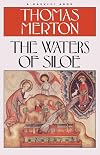
The Waters of Siloe
by Thomas Merton
On This Page
Description
From the author of The Seven Storey Mountain, this book looks at an order of Catholic monks dating back to eleventh-century France. "The word 'Trappist' has become synonymous with 'ascetic' and definitely indicates a monk who leads a very hard life. But... Penance and asceticism are not ends in themselves. If monks never succeeded in being more than pious athletes, they do not fulfill their purpose in the Church. If you want to understand why the monks lead the life they do, you will have to show more ask, first of all, What is their aim?" In his bestselling memoir, The Seven Storey Mountain, Catholic poet, theologian, and mystic Thomas Merton chronicled his journey to becoming a Cistercian monk of the Abbey of Gethsemani, Kentucky. In The Waters of Siloe, he provides an enlightening account of the Cistercian Order, better known as the Trappists. With clarity and wisdom, Merton explores the history of the Cistercian Order from its founding in 1098, its development and waning, and the seventeenth-century reforms by the Abbe? de Rance?, which began the second flowering that continues today. Throughout, Merton illuminates the purposes of monasticism and its surprising resurgence in America and elsewhere. "Only Thomas Merton could have written single-handed this history of Trappist monks, for it is a work of diverse gifts and skill, an ardent collaboration of scholar and story-teller, priest and poet." - The New York Times show lessTags
Recommendations









































Member Reviews
Summary: A history of the Trappist monks, from Cistercian beginnings to the reforms at La Trappe, foundations in America, and the contemplative life.
Thomas Merton entered the Trappist monastery at Gethsemani in 1941. Eight year later he penned this history of the Cistercians and the Trappist reform movement within that order. The title is a reference to the words of Jesus: “He that shall drink of the water that I shall give him, shall not thirst forever. But the water I give him shall become in him a fountain of water, springing up into life everlasting.” It conveys the hope of the contemplative life, that in silence, prayer, and penance, the contemplatives shall find the thirst for God satisfied. It also is a reminder of the show more location of so many of the monasteries in valleys, by streams of water.
Merton begins with a prologue describing the attraction, sometimes visionary, of the monastic life. It is an ascetic life of straw mattresses structured around prayer, penance, vigils, fasting, and work. It is life in a silent community, united in the contemplation of the excellence of God’s love.
Merton then turns to the history beginning with the founding of the Cistercian order at the turn of the twelfth century. The Cistercians sought to reform the Benedictine order. But by the seventeenth century, they were in need of reform. Father Jean-Armand de Rance, abbot of La Grande Trappe (hence the name!) led this reform, a return to a rigor of contemplative discipline. Merton traces the spread of the movement through Europe, the efforts to suppress them in France, and the turning to America.
The early efforts in America were driven by abbots who seemed knights on a quest. Consequently, zeal went ahead of strategic vision. A mission to educate conflicted with the silent, contemplative vision. The first foundation at Gethsemani was an example. The extreme rigors led to the early death of many.
However, a second foundation at Gethsemani led by Father Eutropius Proust was more successful and this work has continued down to the present. Merton traces this history under the different abbots and the growth of the work, resulting in new foundations. And he traces the upsurge of those entering the monasteries after the two wars. Even as these grew, there were others wiped out by the rise of communism. Particularly moving is his account of the martyrs of Yang Kia Ping.
The second and shorter part of the work paints a picture of the contemplative life. First he considers what this looked like under the twelfth century Cistercians and then more contemporary forms. There is a constant tension between external disciplines and allowing the inner space for contemplation. In this section, he sketches the lives of a number of contemplatives.
Merton’s account offers not only history but a word painting of the attractions of the contemplative life. The disciplines, the austerity, the silence all lead to a life available to God. As a result Merton not only informs but answers the question in the minds of many: why become a monk? show less
Thomas Merton entered the Trappist monastery at Gethsemani in 1941. Eight year later he penned this history of the Cistercians and the Trappist reform movement within that order. The title is a reference to the words of Jesus: “He that shall drink of the water that I shall give him, shall not thirst forever. But the water I give him shall become in him a fountain of water, springing up into life everlasting.” It conveys the hope of the contemplative life, that in silence, prayer, and penance, the contemplatives shall find the thirst for God satisfied. It also is a reminder of the show more location of so many of the monasteries in valleys, by streams of water.
Merton begins with a prologue describing the attraction, sometimes visionary, of the monastic life. It is an ascetic life of straw mattresses structured around prayer, penance, vigils, fasting, and work. It is life in a silent community, united in the contemplation of the excellence of God’s love.
Merton then turns to the history beginning with the founding of the Cistercian order at the turn of the twelfth century. The Cistercians sought to reform the Benedictine order. But by the seventeenth century, they were in need of reform. Father Jean-Armand de Rance, abbot of La Grande Trappe (hence the name!) led this reform, a return to a rigor of contemplative discipline. Merton traces the spread of the movement through Europe, the efforts to suppress them in France, and the turning to America.
The early efforts in America were driven by abbots who seemed knights on a quest. Consequently, zeal went ahead of strategic vision. A mission to educate conflicted with the silent, contemplative vision. The first foundation at Gethsemani was an example. The extreme rigors led to the early death of many.
However, a second foundation at Gethsemani led by Father Eutropius Proust was more successful and this work has continued down to the present. Merton traces this history under the different abbots and the growth of the work, resulting in new foundations. And he traces the upsurge of those entering the monasteries after the two wars. Even as these grew, there were others wiped out by the rise of communism. Particularly moving is his account of the martyrs of Yang Kia Ping.
The second and shorter part of the work paints a picture of the contemplative life. First he considers what this looked like under the twelfth century Cistercians and then more contemporary forms. There is a constant tension between external disciplines and allowing the inner space for contemplation. In this section, he sketches the lives of a number of contemplatives.
Merton’s account offers not only history but a word painting of the attractions of the contemplative life. The disciplines, the austerity, the silence all lead to a life available to God. As a result Merton not only informs but answers the question in the minds of many: why become a monk? show less
Wonderful
account of history of Trappists
deals with Cistercian history and life
Gethsemani trip, 4-2013
Ratings
Members
- Recently Added By
Author Information

397+ Works 38,287 Members
Born in France, Thomas Merton was the son of an American artist and poet and her New Zealander husband, a painter. Merton lost both parents before he had finished high school, and his younger brother was killed in World War II. Something of the ephemeral character of human endeavor marked all his works, deepening the pathos of his writings and show more drawing him close to Eastern, especially Buddhist, forms of monasticism. After an initial education in the United States, France, and England, he completed his undergraduate degree at Columbia University. His parents, nominally friends, had given him little religious guidance, and in 1938, he converted to Roman Catholicism. The following year he received an M.A. from Columbia University and in 1941, he entered Gethsemani Abbey in Kentucky, where he remained until a short time before his death. His working life was spent as a Trappist monk. At Gethsemani, he wrote his famous autobiography, "The Seven Storey Mountain" (1948); there he labored and prayed through the days and years of a constant regimen that began with daily prayer at 2:00 a.m. As his contemplative life developed, he still maintained contact with the outside world, his many books and articles increasing steadily as the years went by. Reading them, it is hard to think of him as only a "guilty bystander," to use the title of one of his many collections of essays. He was vehement in his opposition to the Vietnam War, to the nuclear arms race, to racial oppression. Having received permission to leave his monastery, he went on a journey to confer with mystics of the Hindu and Buddhist traditions. He was accidentally electrocuted in a hotel in Bangkok, Thailand, on December 10, 1968. (Bowker Author Biography) show less
Some Editions
Awards and Honors
Distinctions
Series
Belongs to Publisher Series
Common Knowledge
- Canonical title
- The Waters of Siloe
- Original publication date
- 1949
Classifications
- Genres
- Religion & Spirituality, Nonfiction, History, General Nonfiction, Biography & Memoir
- DDC/MDS
- 271.125 — Religion History of Christianity Religious congregations and orders in church history Benedictines Cistercians Trappists
- LCC
- BX4102 .M4 — Philosophy, Psychology and Religion Christian Denominations Christian Denominations Catholic Church Monasticism. Religious orders Religious orders of men
- BISAC
Statistics
- Members
- 489
- Popularity
- 62,202
- Reviews
- 5
- Rating
- (3.88)
- Languages
- Czech, English, French, Italian
- Media
- Paper, Ebook
- ISBNs
- 10
- ASINs
- 24