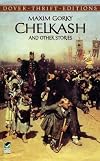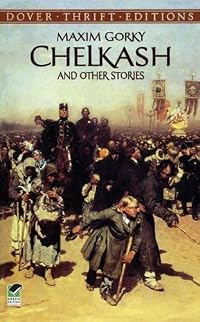
Chelkash and Other Stories (Dover Thrift Editions)
by Maxim Gorky
On This Page
Description
Three superb short stories from the first great Russian writer to emerge from the ranks of the proletariat, including the title story, in which a thieving vagrant takes on a young, unwilling apprentice; ""Makar Chudra,"" the story of a an ill-fated romance between two gypsy lovers; and ""Twenty-six Men and A Girl,"" widely regarded as Gorky's best short story, which describes how a wretched crew of bakery workers destroy their only source of joy and simple pleasure.
Tags
Recommendations






Member Reviews
All three stories are excellent. I am now a new fan of Maxim Gorky. I would like to add this of the main story Chelkash:
This is a fabulous short story that brilliantly depicts how a young naive person can be swept into a life of crime. The conflicting emotions between fear, greed, morals and need in a time of great poverty are so well portrayed in the young character. The sadness, compassion, anger, need, pride, and indifference of the elder criminal character are flawlessly portrayed. Though this story was written in the late 1890s, the message can easily be transferred into modern times. If you have ever wondered how decent young people in poverty can be driven into a life of crime you must read this book. It's one of the best show more depictions of the subject that I have ever read. show less
This is a fabulous short story that brilliantly depicts how a young naive person can be swept into a life of crime. The conflicting emotions between fear, greed, morals and need in a time of great poverty are so well portrayed in the young character. The sadness, compassion, anger, need, pride, and indifference of the elder criminal character are flawlessly portrayed. Though this story was written in the late 1890s, the message can easily be transferred into modern times. If you have ever wondered how decent young people in poverty can be driven into a life of crime you must read this book. It's one of the best show more depictions of the subject that I have ever read. show less
Russian/Reader
Ratings
Members
- Recently Added By
Author Information

923+ Works 8,213 Members
Alexei Maximovich Peshkov, better known as Maxim (Maksim) Gorky, was born on March 28th, 1968. Until the recent collapse of the Soviet state, Gorky was officially viewed as the greatest Russian writer of the twentieth century---an evaluation far above the true measure of his nevertheless considerable talent. Proclaimed the founder of socialist show more realism, he significantly influenced many Soviet writers, as well as others in Europe and in the developing world, and his works were for decades part of the Soviet school curriculum. His formal education was minimal. From the age of 11, he fended for himself with a variety of jobs. Self-taught, he published his first story, "Makar Chudra," in 1892. His first collection, Sketches and Stories (1898), is a romantic celebration of society's strong outcasts---the hobos and the drifters---and helped to popularize such literary protagonists. Foma Gordeyev (1899), Gorky's first novel, depicts generational conflict within the Russian bourgeoisie. A popular public figure on the left, Gorky was often in trouble with the tsarist government. During the 1900s, he was the central figure in the Znanie publishing house, which produced realist prose with a social conscience. Some of his own works were extremely successful. The play The Lower Depths (1902), set in a poorhouse and a strong indictment of social injustice, was not only a staple of Soviet theater but also influential in the United States. Eugene O'Neill's The Iceman Cometh was influenced by it. The propagandistic, extraordinarily influential novel Mother (1906) presents an iconic working-class woman who is transformed into a saint of the Revolution; its optimism in the ultimate triumph of the cause made it a prototype of socialist-realist fiction. During the years prior to 1917, Gorky published a number of autobiographical stories: All Over Russia (1912--18) (also Through Russia) and his memoirs; My Childhood (1913--14), My Apprenticeship (1915--16), and My Universities (1923). This trilogy shows his art at its best and includes some very lively reminiscences of such writers as Tolstoy and Chekhov. Although a Bolshevik party member since 1905, Gorky strongly criticized the new regime after the October Revolution: His collected articles from 1917-18, Untimely Thoughts, remained unpublished in the Soviet Union until recently. A cultural activist, he helped to save the lives of many writers, artists, and scholars during the cold and hungry years of the civil war. In 1921 he left Russia for Italy but returned permanently a decade later, recognized as the grand old man of Soviet literature. He then worked for Stalin's economic policies and presided over the institutionalization of socialist realism. At his death, he left unfinished a major novel of considerable interest, The Life of Klim Samgin, which he had been working on since 1925. (Bowker Author Biography) show less
Classifications
- Genres
- Fiction and Literature, General Fiction
- DDC/MDS
- 891.733 — Literature & rhetoric Asian Literature East Indo-European and Celtic literatures Russian and East Slavic languages Russian fiction 1800–1917
- LCC
- PG3463 .A15 — Language and Literature Slavic languages and literatures. Baltic languages. Albanian language Slavic. Baltic. Albanian Russian literature Individual authors and works 1870-1917 Gorky
- BISAC
Statistics
- Members
- 98
- Popularity
- 327,995
- Reviews
- 2
- Rating
- (3.54)
- Languages
- English, Russian
- Media
- Paper, Ebook
- ISBNs
- 3
- UPCs
- 1
- ASINs
- 3