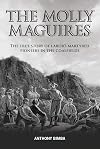
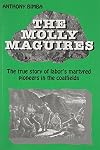
The Molly Maguires
by Anthony Bimba
On This Page
Description
The story of the 1870s frameup of the Pennsylvania Irish anthracite miners.Tags
Recommendations















Member Reviews
This is definitely a book that is trying too hard.
Let's get the background straight: In the 1870s, the coalfields of Pennsylvania were operated by bosses (especially one particular boss, Franklin Gowen) who had absolutely no regard for their miners and were willing to grind the workers into the ground to increase their profits. It was a case of ownership run amok, and since the government would not help, the miners had no recourse except to fight back.
The fighting back was violent, and those who did the fighting were known as the Molly Maguires. Against them, the owners hired the Pinkertons, and the Pinkertons did their best to infiltrate the Mollies. The man most involved in this was Agent McParland, whose eventual testimony would send show more at least nineteen alleged Mollies (other sources say twenty) to their death.
Let's be clear: My sympathies are all with the Mollies. I don't agree with their methods, but there is no question but that they were abused.
I still found this book unbearable. It's like a lot of communist/labor literature: So earnest in what it believes in that it ceases to be either readable or factual. Every story has two sides. In this case, one was much more wrong than the other, but there were real human beings on both sides. But Bimba doesn't even want to admit that there was any sort of conspiracy on the miner's side; it was the Bosses versus the Poor Innocent Miners, who loved fluffy bunnies and never hurt anybody. (I exaggerate only in the mention of bunnies.) To reach these conclusions, Bimba had to ignore many facts (as best I can tell, all of Bimba's facts are accurate, it's just that a lot are left out) and he had to maintain a ghastly rhetorical tone of moral superiority.
The only virtue of this travesty is that it's short. But not short enough that I could read it with any reasonable speed. I would manage a page or two and then have to go off and rest before plunging in again. It's that one-sided. show less
Let's get the background straight: In the 1870s, the coalfields of Pennsylvania were operated by bosses (especially one particular boss, Franklin Gowen) who had absolutely no regard for their miners and were willing to grind the workers into the ground to increase their profits. It was a case of ownership run amok, and since the government would not help, the miners had no recourse except to fight back.
The fighting back was violent, and those who did the fighting were known as the Molly Maguires. Against them, the owners hired the Pinkertons, and the Pinkertons did their best to infiltrate the Mollies. The man most involved in this was Agent McParland, whose eventual testimony would send show more at least nineteen alleged Mollies (other sources say twenty) to their death.
Let's be clear: My sympathies are all with the Mollies. I don't agree with their methods, but there is no question but that they were abused.
I still found this book unbearable. It's like a lot of communist/labor literature: So earnest in what it believes in that it ceases to be either readable or factual. Every story has two sides. In this case, one was much more wrong than the other, but there were real human beings on both sides. But Bimba doesn't even want to admit that there was any sort of conspiracy on the miner's side; it was the Bosses versus the Poor Innocent Miners, who loved fluffy bunnies and never hurt anybody. (I exaggerate only in the mention of bunnies.) To reach these conclusions, Bimba had to ignore many facts (as best I can tell, all of Bimba's facts are accurate, it's just that a lot are left out) and he had to maintain a ghastly rhetorical tone of moral superiority.
The only virtue of this travesty is that it's short. But not short enough that I could read it with any reasonable speed. I would manage a page or two and then have to go off and rest before plunging in again. It's that one-sided. show less
Revisiting this book while reading The Sons of Molly Maguire, which is phenomenal with its context. In contract, Bimba argues here that the Mollies never existed. True, this was published in 1950 and so Bimba had no access to the wealth of great research and writing on the Mollies, but given what else we know, this book is conspiracy theory.
Ratings
Members
- Recently Added By
Author Information
3 Works 98 Members
Common Knowledge
- Original publication date
- 1932
- People/Characters
- Michael J. Doyle; Franklin B. Gowen; James McParland; Thomas Munley; John Siney
- Important places
- Philadelphia, Pennsylvania, USA; Pennsylvania, USA; Schuylkill County, Pennsylvania, USA; Pennsylvania coal towns, USA
- Important events
- Trials of the Molly Maguires
- First words
- PREFACE
The American working class has a background of militant struggle.
CHAPTER I
THE REAL MOLLY MAGUIRES
Popular legends are still extant about the "Molly Maguires."
Classifications
- Genres
- Nonfiction, History, General Nonfiction, Politics and Government
- DDC/MDS
- 331.881 — Society, government, & culture Economics Labor economics Labor unions, labor-management bargaining and disputes Labor unions (Trade unions) Labor unions by industry and occupation
- LCC
- HD5325 .M62 .B55 — Social sciences Industries. Land use. Labor Industries. Land use. Labor Labor. Work. Working class Labor disputes. Strikes and lockouts
Statistics
- Members
- 71
- Popularity
- 442,415
- Reviews
- 2
- Rating
- (3.10)
- Languages
- English
- Media
- Paper
- ISBNs
- 1
- ASINs
- 2