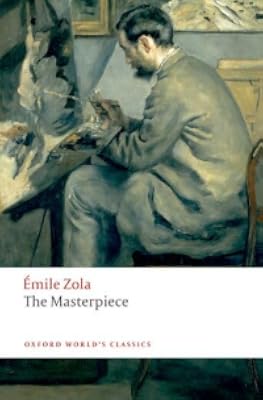
The Masterpiece
by Émile Zola
Les Rougon-Macquart (Zola's recommended reading order) (14), Les Rougon-Macquart (publication order) (14)
On This Page
Description
The Masterpiece is the tragic story of Claude Lantier, an ambitious and talented young artist who has come from the provinces to conquer Paris but is conquered instead by the flaws of his own genius. Set in the 1860s and 1870s, it is the most autobiographical of the twenty novels in Zola's Rougon-Macquart series. It provides a unique insight into Zola's career as a writer and his relationship with Cezanne, a friend since their schooldays in Aix-en-Provence. It also presents a well-documented show more account of the turbulent Bohemian world in which the Impressionists came to prominence despite the conservatism of the Academy and the ridicule of the general public. show lessTags
Recommendations














Member Recommendations
JuliaMaria Roman oder Sachbuch. Obwohl das Sachbuch von Ross King wirklich gut und lebendig geschrieben ist: noch besser, um das "Entstehen der modernen Malerei" und die Menschen dahinter zu verstehen, ist der Roman von Emile Zola.
Ross King bezieht sich im übrigen auf Zola als Quelle.
Member Reviews
So, how do you follow a coup de force like Germinal? If you’re Zola, then apparently the way to do it is with a jolly little vie-de-Bohème tragedy of young artists. Something completely different, in any case, and it’s somehow rather fitting that the hero of this book, the painter Claude Lantier, has finished up as one of Zola’s least-known characters, whilst everyone remembers his brother and sister.
The charm of this book comes from the way it draws so strongly on Zola’s friendship with his Aix-en-Provence schoolfellow Paul Cézanne. There are affectionate recollections of the walks they used to take in the hills around Aix, and glorious night-time rambles around Paris with a cantankerous bunch of young artists and writers. show more
But of course Claude is a Zola character, so his artistic brilliance is offset by a powerful self-destructive instinct. His canvases, achieved with so much blood, sweat and tears, are invariably designed to be rejected by the academic jury of the Paris Salon, but ten years later everyone is borrowing from his ideas. And he’s sucked into a kind of distorted Pygmalion plot, where his passion for the image-woman he is painting draws all the life out of his relationship with his wife, the model for the picture.
Not a top-flight Zola, perhaps, but probably deserves to be better known, not least for everything he tells us about the art-world in 1860s Paris. show less
The charm of this book comes from the way it draws so strongly on Zola’s friendship with his Aix-en-Provence schoolfellow Paul Cézanne. There are affectionate recollections of the walks they used to take in the hills around Aix, and glorious night-time rambles around Paris with a cantankerous bunch of young artists and writers. show more
But of course Claude is a Zola character, so his artistic brilliance is offset by a powerful self-destructive instinct. His canvases, achieved with so much blood, sweat and tears, are invariably designed to be rejected by the academic jury of the Paris Salon, but ten years later everyone is borrowing from his ideas. And he’s sucked into a kind of distorted Pygmalion plot, where his passion for the image-woman he is painting draws all the life out of his relationship with his wife, the model for the picture.
Not a top-flight Zola, perhaps, but probably deserves to be better known, not least for everything he tells us about the art-world in 1860s Paris. show less
"Wasn't a bunch of carrots, yes, a bunch of carrots, studied directly and painted simply, personally, as you see it yourself, as good as any of the run-of-the-mill, made-to-measure Ecole des Beaux-Arts stuff, painted with tobacco-juice? The day was not far off when one solitary, original carrot might be pregnant with revolution!"
In the 14th of Zola's 20 Rougon-Macquart novels (which, like most of them, stands alone), the young painter Claude Lantier rails against the 1860s artistic establishment as he attempts to define new methods of creating, of seeing, and of experiencing. Lantier and his friends, discovering the joys of Impressionism, are routinely dismissed by the bourgeois and laughed out of the Paris Salon. But unlike his show more friends, Lantier can find no subsidiary satisfaction in his private life, or other professions, or even his own thoughts. He is consumed by art, as his passion subsumes his career, his goals, his mental health, and the relationship with Christine, his friend and lover who stands by him through a long dark decade of the soul.
As is written about often, Lantier is a thinly veiled stand-in for Cezanne, one of Zola's childhood friends, and this is the most autobiographical of Zola's novels; the author himself appears in a less-than-humble role as the ambitious novelist Sandoz. By this point, Zola - in his mid-40s - was becoming the undisputed king of late 19th century French literature, and his naturalism - like Cezanne's Impressionism - was no longer a complete shock (although certainly still scandalous to the country's moralists). Although the latter half of the book does not follow Cezanne's trajectory - Zola had used the painter as an inspiration for the character, before morphing the tale into fiction - the obsessive downfall of the artist nevertheless caused great friction within the real-life community. Although they reportedly retained professional respect for one another, Cezanne and Zola were never to speak again.
Truthfully, I wouldn't consider The Masterpiece to be one of the more interesting volumes in the series. To speak in terms of the book's direct predecessors, the plot is nowhere as ingenious as in The Ladies' Paradise, the philosophical questions rarely as profound as those offered in The Bright Side of Life, and the milieu much less rewarding or haunting as that of Germinal. While Zola was known for his strict attention to detail and ponderous research into his book's subject matter, this was something of an anomaly. He needed to do far less work because this was a world known intimately to himself. Perhaps, dare I say, the very contemporary nature of this novel renders it less engaging to the average reader of the 2020s. No doubt those with a strong historical interest in the Impressionists will find much to savour, and those of us fascinated by Zola the man can utilise this text as something of a philosophical handbook; everyone of Sandoz's rants feels directly posted to us from the author's mouth.
To pinpoint my dissatisfaction, I suggest it lies in a very admirable place: the author's constant, cruel desire to force himself to innovate. No book in this series is like any other. Here, Zola attempts to tread a middle ground between the intense psychological studies of, say, L'Assommoir or La Joie de Vivre and the broader "social" novels like Nana. But in doing so, I think he doesn't quite render the world of the young Impressionists as open as was his custom. In Germinal for instance, we came to understand not just the striking miners but the lower management, the bourgeois, and the wealthy capitalists. Certainly very satirical in the latter cases, but no less deep for that. Here, the artistic establishment is largely a series of mocking smiles, like being haunted by so many Cheshire Cats, and as a result Lantier's fellow artists blur into one. (Interesting too, although fair enough given the format Zola was writing in, that Claude doesn't seek the assistance of - or show interest in the downfall of - his fellow family members, many of whom have been the stars of other novels by now. The idea of a "cinematic universe" could only go so far in the 1880s!)
Basically, this book comes perilously close to being what Stephen Sondheim calls a "why?" work. With most of Zola's novels in this series, we can see why he wrote them and what he wanted to say. It's clear from biographies that he had always intended a book on art to be included as part of the series. But when he came around to writing it, I feel that the character of Claude Lantier rather overwhelms the rationale. Is this a book about how society's judgements murder new ideas before they can even be born? If so, Claude's obsession gets in the way of that. Or is this a novel about how the creation of Art is all consuming? If so, then the success of those like Sandoz rather upsets that apple cart. Or is this just a psychological study of Claude? If so, great, but I'm not sure it has a place in the Rougon-Macquart. No, Zola wanted to write a book on art, and here was his audience. No more motivation, no less.
"The generation we belong to was brought up on Romanticism; it soaked into us and we can do nothing about it. It's all very well our plunging head first into violent reality, the stain remains and all the scrubbing in the world will never remove it."
I have focused on the negative but you will have noticed I still awarded this book 4 stars. Zola was simply a masterful writer - even if compelled rather to run on a bit. While I find the secondary material of this book underwhelming by his standards, his two central themes still come out very well. The relationship between Claude and Christine is immaculately rendered, especially in the first half of the novel as these two strangers become firm friends, until their friendship is undermined by a combination of lust and artistic desire. (Zola's feelings on sex were... complicated, to say the least. He hated homosexuals due to having been sexually abused as a child by a household servant and, although he loved his wife and later his mistress deeply, he always held a notion that human sexual interactions were an unpleasant distraction from pure thought and creation.) Although Christine's role in the plot inevitably renders her as "second banana" to Claude, she is still a fully realised human, not perhaps on the level of Zola's most compelling females, but still a lovely example of how well Zola was able to write all people, not just those who resembled himself.
And of course, Zola's views on the creation of art are oft exhilarating. The moment when Claude tries to explain to Christine how a tree can be blue even though trees aren't blue. The painter's eye taking in the islands outside Paris, or the city itself on a dark night. The creation of a massive canvas, enveloping the studio just as it dwarfs the relationship between the studio's two inhabitants. Zola loves nothing more than the creation of a monster from something inanimate, and here the burden of the imagination - given physical form on canvas - fits the bill nicely.
What came to mind as I read this book was Constantin Cavafy's poem The City (so memorably featured in Durrell's Justine). To quote:
"There's no new land, my friend, no
New sea; for the city will follow you,
In the same streets you'll wander endlessly,
The same mental suburbs slip from youth to age,
In the same house go white at last -
The city is a cage." show less
In the 14th of Zola's 20 Rougon-Macquart novels (which, like most of them, stands alone), the young painter Claude Lantier rails against the 1860s artistic establishment as he attempts to define new methods of creating, of seeing, and of experiencing. Lantier and his friends, discovering the joys of Impressionism, are routinely dismissed by the bourgeois and laughed out of the Paris Salon. But unlike his show more friends, Lantier can find no subsidiary satisfaction in his private life, or other professions, or even his own thoughts. He is consumed by art, as his passion subsumes his career, his goals, his mental health, and the relationship with Christine, his friend and lover who stands by him through a long dark decade of the soul.
As is written about often, Lantier is a thinly veiled stand-in for Cezanne, one of Zola's childhood friends, and this is the most autobiographical of Zola's novels; the author himself appears in a less-than-humble role as the ambitious novelist Sandoz. By this point, Zola - in his mid-40s - was becoming the undisputed king of late 19th century French literature, and his naturalism - like Cezanne's Impressionism - was no longer a complete shock (although certainly still scandalous to the country's moralists). Although the latter half of the book does not follow Cezanne's trajectory - Zola had used the painter as an inspiration for the character, before morphing the tale into fiction - the obsessive downfall of the artist nevertheless caused great friction within the real-life community. Although they reportedly retained professional respect for one another, Cezanne and Zola were never to speak again.
Truthfully, I wouldn't consider The Masterpiece to be one of the more interesting volumes in the series. To speak in terms of the book's direct predecessors, the plot is nowhere as ingenious as in The Ladies' Paradise, the philosophical questions rarely as profound as those offered in The Bright Side of Life, and the milieu much less rewarding or haunting as that of Germinal. While Zola was known for his strict attention to detail and ponderous research into his book's subject matter, this was something of an anomaly. He needed to do far less work because this was a world known intimately to himself. Perhaps, dare I say, the very contemporary nature of this novel renders it less engaging to the average reader of the 2020s. No doubt those with a strong historical interest in the Impressionists will find much to savour, and those of us fascinated by Zola the man can utilise this text as something of a philosophical handbook; everyone of Sandoz's rants feels directly posted to us from the author's mouth.
To pinpoint my dissatisfaction, I suggest it lies in a very admirable place: the author's constant, cruel desire to force himself to innovate. No book in this series is like any other. Here, Zola attempts to tread a middle ground between the intense psychological studies of, say, L'Assommoir or La Joie de Vivre and the broader "social" novels like Nana. But in doing so, I think he doesn't quite render the world of the young Impressionists as open as was his custom. In Germinal for instance, we came to understand not just the striking miners but the lower management, the bourgeois, and the wealthy capitalists. Certainly very satirical in the latter cases, but no less deep for that. Here, the artistic establishment is largely a series of mocking smiles, like being haunted by so many Cheshire Cats, and as a result Lantier's fellow artists blur into one. (Interesting too, although fair enough given the format Zola was writing in, that Claude doesn't seek the assistance of - or show interest in the downfall of - his fellow family members, many of whom have been the stars of other novels by now. The idea of a "cinematic universe" could only go so far in the 1880s!)
Basically, this book comes perilously close to being what Stephen Sondheim calls a "why?" work. With most of Zola's novels in this series, we can see why he wrote them and what he wanted to say. It's clear from biographies that he had always intended a book on art to be included as part of the series. But when he came around to writing it, I feel that the character of Claude Lantier rather overwhelms the rationale. Is this a book about how society's judgements murder new ideas before they can even be born? If so, Claude's obsession gets in the way of that. Or is this a novel about how the creation of Art is all consuming? If so, then the success of those like Sandoz rather upsets that apple cart. Or is this just a psychological study of Claude? If so, great, but I'm not sure it has a place in the Rougon-Macquart. No, Zola wanted to write a book on art, and here was his audience. No more motivation, no less.
"The generation we belong to was brought up on Romanticism; it soaked into us and we can do nothing about it. It's all very well our plunging head first into violent reality, the stain remains and all the scrubbing in the world will never remove it."
I have focused on the negative but you will have noticed I still awarded this book 4 stars. Zola was simply a masterful writer - even if compelled rather to run on a bit. While I find the secondary material of this book underwhelming by his standards, his two central themes still come out very well. The relationship between Claude and Christine is immaculately rendered, especially in the first half of the novel as these two strangers become firm friends, until their friendship is undermined by a combination of lust and artistic desire. (Zola's feelings on sex were... complicated, to say the least. He hated homosexuals due to having been sexually abused as a child by a household servant and, although he loved his wife and later his mistress deeply, he always held a notion that human sexual interactions were an unpleasant distraction from pure thought and creation.) Although Christine's role in the plot inevitably renders her as "second banana" to Claude, she is still a fully realised human, not perhaps on the level of Zola's most compelling females, but still a lovely example of how well Zola was able to write all people, not just those who resembled himself.
And of course, Zola's views on the creation of art are oft exhilarating. The moment when Claude tries to explain to Christine how a tree can be blue even though trees aren't blue. The painter's eye taking in the islands outside Paris, or the city itself on a dark night. The creation of a massive canvas, enveloping the studio just as it dwarfs the relationship between the studio's two inhabitants. Zola loves nothing more than the creation of a monster from something inanimate, and here the burden of the imagination - given physical form on canvas - fits the bill nicely.
What came to mind as I read this book was Constantin Cavafy's poem The City (so memorably featured in Durrell's Justine). To quote:
"There's no new land, my friend, no
New sea; for the city will follow you,
In the same streets you'll wander endlessly,
The same mental suburbs slip from youth to age,
In the same house go white at last -
The city is a cage." show less
In this novel, Zola explores the art world of 19th century Paris, focusing on struggling (and failing) painter Claude Lantier, Christine, the woman who loves him, and a group of his friends, painters, sculptors, musicians, and a writer, Sandoz, who seems to be a stand-in for Zola himself. This was not my favorite Rougon Macquart, and at times I struggled with it, which surprised me since I love art and art history. I sometimes found the discussions of Claude's struggles in conveying his vision repetitive and boring, and I enjoyed the parts about his relationship with Christine much more.
3 stars
3 stars
There's a character in this novel who decides to embark on an ambitious project to write a series of novels that "scientifically" demonstrate the effects of heredity and environment on a large family living during the regime of Napoleon III. (Whatever happened to Napoleon II?) The idea is that each book will examine some specific aspect of society and feature one member of the extended family as main protagonist. Which is odd, because Zola wrote a series of 20 books that examine the effects of environment and heredity on the fictional Rougon-Macquart family who live during Napoleon III's time in power...Yes, having abandoned (in practice if not by admission) his "scientific" plan fairly early in the 20 volume project, by the time Zola show more gets round to examining the world of artistic endeavor in Paris, he is entirely willing to model aspects of his characters on himself - and on his friends amongst the Impressionists, who, upon reading the book, variously, never spoke to him again, got really angry or found it flattering or funny.
Zola in this series is talking about a world only slightly in his past, that he lived through, and all of its members that I've read feel very believable in terms of the society and atmosphere portrayed, if possibly somewhat exaggerated, but in this one he is talking directly about his own experiences which differentiates this from the others in the series in a way beyond just that of being a separate plot about a seperate character in a different stratum of French society from the others - which is, of course, what they have in common. If you are interested in that kind of game you could spend hours pondering exactly which aspects of which characters are taken from which real-life world-famous Impressionist painters.
Strangely, the world of art portrayed seems entirely familiar; paintings used as investments, people trying to manipulate the market for profit, resultant hyper-inflation of prices. The public ridiculing works that later generations see as genius. Young artists spouting revolutionary theories about art and society, an old-guard establishment who try to keep the new-comers and their radical ideas down.
The main protagonist, Claude (yes, after that Claude) is the leader of just such a group of young, ambitious, would-be (art) world-changers. His battles with the establishment and his own flaws and genius are affectingly set out over the course of the book and leads to an end that many readers of other Rougon-Macquart novels can probably guess early. Other recognisable Zola themes are to be found; for instance promiscuity amongst the poor and attempts to describe the passionate aspects of romance explicitly that outraged many contemporary readers. A challenge as to what was permisable still being fought by D.H. Lawrence many decades later.
The style is also instantly recognisable, even across at least three different translators of his novels in the 6-10 Zola books I've read. The narrative voice, dramatic mood-swings and slow build-up (that can leave one bogged-down in the middle third) to a moving climax are all typically Zola. Despite the description of a man tortured by his obsessions and self-doubt, this member of the series was not for me as powerful as some of its more famous brethren, such as [b:Germinal|28407|Germinal (Les Rougon-Macquart, #13)|Émile Zola|http://d.gr-assets.com/books/1309206372s/28407.jpg|941651], [b:The Earth|28420|The Earth (Les Rougon-Macquart, #15)|Émile Zola|http://d.gr-assets.com/books/1167946519s/28420.jpg|1810722] or [b:La Débâcle|28419|La Débâcle (Les Rougon-Macquart, #19)|Émile Zola|http://d.gr-assets.com/books/1167946518s/28419.jpg|3522286]. Worth reading, then, but not the one to pick as one's first or even perhaps fifth work by Zola. show less
Zola in this series is talking about a world only slightly in his past, that he lived through, and all of its members that I've read feel very believable in terms of the society and atmosphere portrayed, if possibly somewhat exaggerated, but in this one he is talking directly about his own experiences which differentiates this from the others in the series in a way beyond just that of being a separate plot about a seperate character in a different stratum of French society from the others - which is, of course, what they have in common. If you are interested in that kind of game you could spend hours pondering exactly which aspects of which characters are taken from which real-life world-famous Impressionist painters.
Strangely, the world of art portrayed seems entirely familiar; paintings used as investments, people trying to manipulate the market for profit, resultant hyper-inflation of prices. The public ridiculing works that later generations see as genius. Young artists spouting revolutionary theories about art and society, an old-guard establishment who try to keep the new-comers and their radical ideas down.
The main protagonist, Claude (yes, after that Claude) is the leader of just such a group of young, ambitious, would-be (art) world-changers. His battles with the establishment and his own flaws and genius are affectingly set out over the course of the book and leads to an end that many readers of other Rougon-Macquart novels can probably guess early. Other recognisable Zola themes are to be found; for instance promiscuity amongst the poor and attempts to describe the passionate aspects of romance explicitly that outraged many contemporary readers. A challenge as to what was permisable still being fought by D.H. Lawrence many decades later.
The style is also instantly recognisable, even across at least three different translators of his novels in the 6-10 Zola books I've read. The narrative voice, dramatic mood-swings and slow build-up (that can leave one bogged-down in the middle third) to a moving climax are all typically Zola. Despite the description of a man tortured by his obsessions and self-doubt, this member of the series was not for me as powerful as some of its more famous brethren, such as [b:Germinal|28407|Germinal (Les Rougon-Macquart, #13)|Émile Zola|http://d.gr-assets.com/books/1309206372s/28407.jpg|941651], [b:The Earth|28420|The Earth (Les Rougon-Macquart, #15)|Émile Zola|http://d.gr-assets.com/books/1167946519s/28420.jpg|1810722] or [b:La Débâcle|28419|La Débâcle (Les Rougon-Macquart, #19)|Émile Zola|http://d.gr-assets.com/books/1167946518s/28419.jpg|3522286]. Worth reading, then, but not the one to pick as one's first or even perhaps fifth work by Zola. show less
I read this for my Impressionism class, and while I was at first annoyed that we had to read a novel, I'm so glad we did. It really is tragic watching the deterioration of the marriage and love story of Claude and Christine, feeling her pain at being upstaged by a painting that her husband is obsessed with and loves more than he loves her, but in an infatuating and obsessive way. This adds to the beautiful meeting they have at the beginning of the novel, as well as the loss of their child at the end. Jacques really is the victim in this entire piece, ignored by his father who doesn't notice him and always silenced by his mother who only wishes for the attention of her husband. The various other characters are miserable yet intriguing as show more well, and it's interesting to try and determine who their real life counterparts are in the Impressionism world. Nevertheless, what became a tragic story intrigued me, and I never regretted reading this for class once. show less
This novel follows the struggle and tormenting passions of an artist in 19th Century Paris, his friendships, and what family life he has when not striving to produce his definitive masterpiece. There is psychological depth here in understanding the inner workings of a variety of extreme and ordinary personalities. Though what we have here is one of the great novels of self-destruction, it is not on the whole an unbalanced representation of artistic passion, as the other artists and characters in the novel all manage in their own different ways. Each has a slightly different view on art, and while to start with this fosters intellectual exchange and fires their artistic work, this changes throughout the novel as different personal show more motivations emerge. As the group grows apart, we see the tensions of jealousy due to their varying degrees of success and recognition.
The main character Claude bears many similarities to the Impressionists and Post-impressionists who were among Zola's friends when he wrote the novel. This was at a point when Impressionism was maturing but not yet accepted by the establishment, and this fight to gain recognition in large part drives the story. Cezanne is perhaps the main inspiration for Claude and his artistic vision, though there are also definite aspects of Manet and other painters in evidence. Likewise, the other characters of the novel are also influenced by the author's contemporaries, and he writes himself into the story too in a somewhat autobiographical account as Claude's good friend Pierre.
There is so much of interest here – an insight onto the life of an artist, the historical and social colour of 19th Century Paris, the nature of inspiration and obsession, human feeling and strife, wealth and poverty, and at least one exquisitely moving emotional scene. However for some this will be a challenging and depressing novel due to the suffering of the artist and those who are nearest to him. I would recommend it to anyone with at least a vague interest in this artistic and intellectual era, on its own merit as a novel of excellent literary quality, and as a brilliantly conceived tale of what could be described as a Pygmalion in reverse (which I won't explain to avoid spoiling the plot). show less
The main character Claude bears many similarities to the Impressionists and Post-impressionists who were among Zola's friends when he wrote the novel. This was at a point when Impressionism was maturing but not yet accepted by the establishment, and this fight to gain recognition in large part drives the story. Cezanne is perhaps the main inspiration for Claude and his artistic vision, though there are also definite aspects of Manet and other painters in evidence. Likewise, the other characters of the novel are also influenced by the author's contemporaries, and he writes himself into the story too in a somewhat autobiographical account as Claude's good friend Pierre.
There is so much of interest here – an insight onto the life of an artist, the historical and social colour of 19th Century Paris, the nature of inspiration and obsession, human feeling and strife, wealth and poverty, and at least one exquisitely moving emotional scene. However for some this will be a challenging and depressing novel due to the suffering of the artist and those who are nearest to him. I would recommend it to anyone with at least a vague interest in this artistic and intellectual era, on its own merit as a novel of excellent literary quality, and as a brilliantly conceived tale of what could be described as a Pygmalion in reverse (which I won't explain to avoid spoiling the plot). show less
In this volume of the Rougon-Macquart cycle, Zola explores the Parisian art world and artistic creativity, principally that of the protagonist, painter Claude Lantier, but also that of other painters, sculptors, journalists, and even a writer loosely based on Zola himself. Lantier is a son of Gervaise, the force of nature from L'assommoir, but was sent back to Plassans to go to school. His friendship with Sandoz (the Zola figure) and Dubuche (who becomes an architect) dates from those years, when the three of them walked for hours and even days over the Provençal landscape, dreaming of coming to Paris and revolutionizing the art world. (This really happened with Zola and Cezanne and a man called Baptistin Baille, who Wikipedia tells me show more became a professor of science; more on Cezanne later.)
There is a lot about the politics of the art world in this novel, including how various dealers operate. The famous Salon des Refusés of 1863, when works rejected by the official Paris Salon for its exhibition were shown in an annex by the decree of the emperor, is a highlight early in the book. Manet exhibited his "Déjeuner sur l'herbe" there, and in the novel Lantier exhibits a painting similar in some ways called "Plein air"; it is roundly jeered. Nonetheless, his "plein air" ideas are eventually copied by other artists. Later in the novel, the description of the politics of selecting pictures for the annual Salon becomes much more pointed.
The novel follows the arc of Lantier's career starting with his early days in Paris and focuses a great deal on his obsession with painting, with working every hour of the day, with being blind and deaf to interruptions, and on his artistic theories about being realistic, using natural light from the outdoors, and much more. Observing the paintings in the Salon des Refusés exhibit, Lantier muses:
"Some of the efforts were clumsy, inevitably, and some were childish, but the general tone was admirable and so was the light, a fine, silvery, diffused light with all the sparkle of open air! It was like a window thrown open on all the drab concoctions and the stewing juices of tradition, letting the sun pour in until the walls were as gay as a morning in spring, and the clear light of his own picture, the blue effect that had caused so much amusement, shone out brighter than all the rest. This was surely the long-awaited dawn, the new day breaking on the world of art!" p. 122
Later Lantier gets involved with a woman, Christine; they move to the country for some years and have a son who has some ill-defined health and mental problems. While they are happy there for some time, the siren call of Paris, his friends, and the art world lure Lantier back. He becomes even more obsessed with his work, eventually starting a huge project, the "masterpiece" of the title, that he works on for years and years, never quite getting it the way he wants it. Christine, who adores Lantier, is jealous of his painting and tries to get him to pay more attention to her and the son. Eventually, the plot becomes a little melodramatic.
The stories of Sandoz and some of the other creative people in the novel provide a counterpoint to Lantier's story. Some are successful, some sell out, some fail. Not surprisingly, Sandoz comes off very well; although he too is obsessed with his writing, he has a more well rounded life than Lantier, marrying a woman who seems delightful and hosting regular Thursday night dinners for his friends, dinners that become more elaborate as his novels begin to sell. Like Zola himself, he is writing a cycle of novels with a purpose:
"Look. The idea is to study man as he really is. Not this metaphysical marionette they've made us believe he is, but the physiological human being, determined by his surroundings, motivated by the functioning of his organs . . . That's the point we start from, the only possible basis for our modern revolution. The inevitable death of the old conception of society and the birth of a new society, and that means a new art is bound to spring up in a new ground . . . Oh, that's bound to happen! A new literature for the coming century of science and democracy!" p. 154
In this book, Zola describes the scenery of Paris in a painterly manner; it is filled with light and visual imagery to a degree I don't recall from works of his I've read earlier. There are also funny parts, and earthy parts, but a lot of the novel is sad and even horrifying as the reader sees Lantier's obsession taking hold of him in an unproductive and unhealthy way; since he comes from the Macquart side of the family, the reader expects some self-destructive tendency to become apparent.
Now to the controversy. Zola sent a copy of the book to his friend Cezanne, who then never spoke to him again. According to the introduction to my Oxford World's Classics edition, Zola based some personal characteristics on Cezanne, others on Manet, and of course made others up. But this was much talked about back in the day.
This was not my favorite of Zola's novels -- parts of it moved slowly and parts were melodramatic -- but the ins and outs of the art world were fascinating and so was the portrait of Paris. show less
There is a lot about the politics of the art world in this novel, including how various dealers operate. The famous Salon des Refusés of 1863, when works rejected by the official Paris Salon for its exhibition were shown in an annex by the decree of the emperor, is a highlight early in the book. Manet exhibited his "Déjeuner sur l'herbe" there, and in the novel Lantier exhibits a painting similar in some ways called "Plein air"; it is roundly jeered. Nonetheless, his "plein air" ideas are eventually copied by other artists. Later in the novel, the description of the politics of selecting pictures for the annual Salon becomes much more pointed.
The novel follows the arc of Lantier's career starting with his early days in Paris and focuses a great deal on his obsession with painting, with working every hour of the day, with being blind and deaf to interruptions, and on his artistic theories about being realistic, using natural light from the outdoors, and much more. Observing the paintings in the Salon des Refusés exhibit, Lantier muses:
"Some of the efforts were clumsy, inevitably, and some were childish, but the general tone was admirable and so was the light, a fine, silvery, diffused light with all the sparkle of open air! It was like a window thrown open on all the drab concoctions and the stewing juices of tradition, letting the sun pour in until the walls were as gay as a morning in spring, and the clear light of his own picture, the blue effect that had caused so much amusement, shone out brighter than all the rest. This was surely the long-awaited dawn, the new day breaking on the world of art!" p. 122
Later Lantier gets involved with a woman, Christine; they move to the country for some years and have a son who has some ill-defined health and mental problems. While they are happy there for some time, the siren call of Paris, his friends, and the art world lure Lantier back. He becomes even more obsessed with his work, eventually starting a huge project, the "masterpiece" of the title, that he works on for years and years, never quite getting it the way he wants it. Christine, who adores Lantier, is jealous of his painting and tries to get him to pay more attention to her and the son. Eventually, the plot becomes a little melodramatic.
The stories of Sandoz and some of the other creative people in the novel provide a counterpoint to Lantier's story. Some are successful, some sell out, some fail. Not surprisingly, Sandoz comes off very well; although he too is obsessed with his writing, he has a more well rounded life than Lantier, marrying a woman who seems delightful and hosting regular Thursday night dinners for his friends, dinners that become more elaborate as his novels begin to sell. Like Zola himself, he is writing a cycle of novels with a purpose:
"Look. The idea is to study man as he really is. Not this metaphysical marionette they've made us believe he is, but the physiological human being, determined by his surroundings, motivated by the functioning of his organs . . . That's the point we start from, the only possible basis for our modern revolution. The inevitable death of the old conception of society and the birth of a new society, and that means a new art is bound to spring up in a new ground . . . Oh, that's bound to happen! A new literature for the coming century of science and democracy!" p. 154
In this book, Zola describes the scenery of Paris in a painterly manner; it is filled with light and visual imagery to a degree I don't recall from works of his I've read earlier. There are also funny parts, and earthy parts, but a lot of the novel is sad and even horrifying as the reader sees Lantier's obsession taking hold of him in an unproductive and unhealthy way; since he comes from the Macquart side of the family, the reader expects some self-destructive tendency to become apparent.
Now to the controversy. Zola sent a copy of the book to his friend Cezanne, who then never spoke to him again. According to the introduction to my Oxford World's Classics edition, Zola based some personal characteristics on Cezanne, others on Manet, and of course made others up. But this was much talked about back in the day.
This was not my favorite of Zola's novels -- parts of it moved slowly and parts were melodramatic -- but the ins and outs of the art world were fascinating and so was the portrait of Paris. show less
Members
- Recently Added By
Lists

Schwob Nederland
207 works; 2 members

Art History and Appreciation
36 works; 1 member
Author Information

677+ Works 35,760 Members
Zola was the spokesperson for the naturalist novel in France and the leader of a school that championed the infusion of literature with new scientific theories of human development drawn from Charles Darwin (see Vol. 5) and various social philosophers. The theoretical claims for such an approach, which are considered simplistic today, were show more outlined by Zola in his Le Roman Experimental (The Experimental Novel, 1880). He was the author of the series of 20 novels called The Rougon-Macquart, in which he attempted to trace scientifically the effects of heredity through five generations of the Rougon and Macquart families. Three of the outstanding volumes are L'Assommoir (1877), a study of alcoholism and the working class; Nana (1880), a story of a prostitute who is a femme fatale; and Germinal (1885), a study of a strike at a coal mine. All gave scope to Zola's gift for portraying crowds in turmoil. Today Zola's novels have been appreciated by critics for their epic scope and their visionary and mythical qualities. He continues to be immensely popular with French readers. His newspaper article "J'Accuse," written in defense of Alfred Dreyfus, launched Zola into the public limelight and made him the political conscience of his country. (Bowker Author Biography) show less
Some Editions
Series

Les Rougon-Macquart (Zola's recommended reading order)
20 works (14)

Les Rougon-Macquart (publication order)
21 works (14)
Belongs to Publisher Series
Work Relationships
Common Knowledge
- Canonical title
- The Masterpiece
- Original title
- L'Œuvre
- Original publication date
- 1886
- People/Characters
- Claude Lantier
- Important places
- Paris, France
- Important events
- Salon des Refusés (1863)
- Related movies*
- L'oeuvre (1967 | IMDb)
- First words
- Claude passait devant l'Hôtel de ville, et deux heures du matin sonnaient à l'horloge, quand l'orage éclata.
- Last words
- (Click to show. Warning: May contain spoilers.)"Allons travailler."
- Original language
- French
*Some information comes from Common Knowledge in other languages. Click "Edit" for more information.
Classifications
Statistics
- Members
- 1,090
- Popularity
- 23,395
- Reviews
- 17
- Rating
- (3.92)
- Languages
- 15 — Catalan, Czech, Dutch, English, French, German, Hebrew, Hungarian, Italian, Japanese, Norwegian, Portuguese, Russian, Spanish, Turkish
- Media
- Paper, Audiobook, Ebook
- ISBNs
- 104
- ASINs
- 35