
Long After Midnight
by Ray Bradbury
On This Page
Description
Two drifters caught in the backwash of space wander from city to dead city, sifting the rubble for the fabled Blue Bottle of Mars-and find in it two different, equally entrancing, dooms... A young boy in Green Town, Illinois, does not marry-yet marries-his beloved eighth-grade teacher... In the hell of a Manhattan July night, Will Morgan is offered a possibly Mephistophelean proposal by which he might gain a perfect love and a magical immunity... A jealous husband who orders an exact replica show more of his unfaithful wife from an android manufacturing company (purpose: murder) runs afoul of the compassionate new "live robot" law... At forty-eight, seized with an overwhelming desire to settle an old score, a man journeys back into the past under the spell of his "utterly perfect, incredibly delightful idea," only to recoil in stunned disbelief when he confronts, at last, his former tormentor... Bradbury's imaginative field is boundless. In this book, his stories carry us from the cozy familiarity of the small-town America we lived in in Dandelion Wine to the frozen desert and double moon that have been part of our interior landscape since The Martian Chronicles. His characters range from the "ordinary"-a rookie cop, an unhappy wife on vacation in Mexico, an old parish priest hearing confession-to the quite extraordinary: the parrot to whom Ernest Hemingway confided the plot of his last, greatest, never-put-down-on-paper novel, and a woman who, in New York City in the summer of 1974, hangs out a sign reading "Melissa Toad, Witch." Fantastic or conventional, chillingly suspenseful or hauntingly nostalgic, each of these stories has that aura of the unexpected combined with the special ring of absolute rightness that is brilliantly, uniquely Bradbury. show lessTags
Recommendations














Member Reviews
I'm thoroughly enjoying these short stories. They're the perfect length, each about 10 to 15 pages, just enough to build up the story and knock it over with a classic Bradbury twist. My favorite stories for far are "The Burning Man", which asks the reader to reexamine his or her own prejudices in the setting of a typical lone road hitchhiker horror story, and "The Perfect Murder" which shows that time is the ultimate judge and jury. I plan to finish reading the remaining stories and mail the book on Saturday.
A fabulous celebration of imagination, shady spots of the soul, and writing itself. Bradbury's confidence is intoxicating - how he pulls of his trapeze act of shouting the story as if in a fit and yet staying superbly readable, I'll never know.
Don't expect sci-fi or fantasy; it's anything but.
Don't expect sci-fi or fantasy; it's anything but.
The subtitle of this collection is "22 hauntings and celebrations." I suppose it is, but not much to celebrate. I would say it is about wishes also. Getting what you wished for isn't always good we are reminded (but sometimes it is.) These 22 stories were written between 1946 and 1976. The collection was first published in 1976 and 11 of the stories were published between 1971 and 1976. With only 2 stories from the early 60's and the rest from 1946-1954, there is a real time split in the collection between early stuff and contemporary (at publication). The stories are a broad mix of a lot of mainstream fiction, some zany stuff, horror/supernatural, science-fiction and surreal/fantasy. The zany stuff was entertaining at times, the show more angst-ridden modern material was really tiresome and it didn't seem like Bradbury.
Like many writers, Bradbury had a period early in his career where he produced a lot of really good work. Later Bradbury almost always suffers in comparison to his early great works. The later material in here, with a few exceptions seems much weaker, certainly different. Some of the early material isn't his best work either. Nevertheless of the 22 stories here perhaps 5 or so are very good stories (and come from across the years), and even the majority of lesser stories are OK, which leaves this reader with a mostly satisfied feeling at the end, but wishing it was better.
So, there is good and bad Bradbury in here, but mostly unmemorable. There were two "Green Town" stories that I had just read in "Summer Morning, Summer Night" as well as other Green Town stories including an early one from 1946, "One Timeless Spring" that I had not read before and that handles young Doug's first kiss pretty well, although I thought the first part of the story rather awful/weak. There is also an absolutely crazy Adolph Hitler story in here. My favorite stories or ones that I thought notable, included: "The Burning Man" (1976) which managed to create a pretty spooky bit of horror in a few pages without anything horrible actually happening on the page. "Long After Midnight" (1963) in some ways is the best story in the collection; it sure hits hard. "The October Game" (1948), a genuine horror story that I've read before. I must also give a nod to "The Better Part of Wisdom" (1976) for a sensitive, progressive handling of a homosexual relationship. I don't think it a great story, but a noteworthy one. There is also a story here, "The Messiah" (1973), which to me is a good add-on to "The Martian Chronicles" and I liked it. show less
Like many writers, Bradbury had a period early in his career where he produced a lot of really good work. Later Bradbury almost always suffers in comparison to his early great works. The later material in here, with a few exceptions seems much weaker, certainly different. Some of the early material isn't his best work either. Nevertheless of the 22 stories here perhaps 5 or so are very good stories (and come from across the years), and even the majority of lesser stories are OK, which leaves this reader with a mostly satisfied feeling at the end, but wishing it was better.
So, there is good and bad Bradbury in here, but mostly unmemorable. There were two "Green Town" stories that I had just read in "Summer Morning, Summer Night" as well as other Green Town stories including an early one from 1946, "One Timeless Spring" that I had not read before and that handles young Doug's first kiss pretty well, although I thought the first part of the story rather awful/weak. There is also an absolutely crazy Adolph Hitler story in here. My favorite stories or ones that I thought notable, included: "The Burning Man" (1976) which managed to create a pretty spooky bit of horror in a few pages without anything horrible actually happening on the page. "Long After Midnight" (1963) in some ways is the best story in the collection; it sure hits hard. "The October Game" (1948), a genuine horror story that I've read before. I must also give a nod to "The Better Part of Wisdom" (1976) for a sensitive, progressive handling of a homosexual relationship. I don't think it a great story, but a noteworthy one. There is also a story here, "The Messiah" (1973), which to me is a good add-on to "The Martian Chronicles" and I liked it. show less
I don’t like short story anthologies. Oh, I read them from time to time, I just almost always end up disappointed. Kind of like every time Christmas rolls around and you see those chocolate medley gift boxes and think to yourself, “I should try one of those. Maybe it won’t taste like burnt hair this time.”
There are multiple reasons for my dislike of short story compilations, not the least of which is the structure of the stories themselves. See the handy-dandy diagram!
I imagine most of you have seen something like this before. It’s called Freytag’s triangle, and it illustrates the elements of plot as they happen in most stories. There’s the exposition (characters are introduced, the plot gets rolling, etc.), rising action show more (things start to heat up), climax (the action/conflict is brought to a boil), denouement (the temperature is cranked down), and the final resolution. It’s worked this way since the days of classical Greek drama, though more attention was given to the denouement in those days, with the climax generally occurring in the middle of the play. The classical Freytag’s Triangle doesn’t look like a pyramid built by a bunch of drunk Egyptians.
What you see in the chart above is a more accurate representation of modern fiction, but it still serves as a great illustration of why short stories pose such an aggravation for me. In the “rising action” portion of the plot line, the pace of the narrative slowly picks up, as does the pace at which the audience reads (because they get excited about what’ll happen next). I don’t know about the rest of you out there, but my reading speed is greatly dependent upon this buildup. I read slower as I’m getting into the book and pick up steam as the action escalates. But imagine doing that over and over again inside of a 300 page book and you’ll start to understand my frustration. Oh, and then there’s the fact that most of the time in short stories, that triangle of Freytag’s is really just a huge honkin’ cliff. Climax, bam, done, and we start over again. So that constant speeding up and slowing down really cramps my style and makes it seem like it’s taking forever to get through the book. Mostly because it is.
And then there are other complications. Take, for instance, one of my recent reads, Ray Bradbury’s Long After Midnight. As is with most anthologies, not all short stories included in the collection are created equally. Some of them are mind-bogglingly good. Some of them make your eyes cross with the sheer pointlessness of them. You would think that, being such a world-renowned writer, even Ray Bradbury’s worst stories should still be tolerable. And you would be wrong. What I found out after the fact is that Long After Midnight was the literary equivalent of a “New Jersey Turnpike.” Don’t know what that is? It’s number 4 on this list of the 17 worst shots ever created. Read, laugh, and be disgusted.
Anyhow, the creation of Long After Midnight went down something like this: by 1976 Bradbury had 16 short story anthologies to his credit, but in the publication of those works there were a few stories that got left out of the mix. Either they didn’t fit with the overall milieu of the collection or there wasn’t enough room for another story or they just weren’t good enough. Take your pick. Some enterprising publishing exec (or, who knows, maybe even Bradbury himself) decided that all these derelicts needed to have a home of their own, so they mopped them up with the proverbial bar rag and squeezed them into a shot glass, slapped the label Long After Midnight onto the side, and sent it out to the masses for public consumption. Therefore, none of the stories make sense with one other.
Given the cover of the book, I was also expecting a sci-fi anthology. I mean, look at it! Who wouldn’t be expecting a heady rush of mind-expanding sci-fi goodness if they saw that cover? But in reality, only a third of the stories included were even tangentially related to science fiction. Far more prevalent were the tales of young love and friendship and old love and family—you know, uninteresting crap. I’m kidding, of course. Those are all worthwhile subjects for fiction; it’s just that the reversal of expectations was extremely off-putting. It’s kind of like putting a video in the VCR that you thought was Saving Private Ryan and finding out someone had taped it over with Fried Green Tomatoes—both good movies in their own rights, but for totally different reasons that appeal to totally different tastes. Now imagine that the recording of Fried Green Tomatoes has been spliced with alternating snippets and vignettes cut from a Lifetime movie, and you’ll have a fair approximation of what reading Long After Midnight was like.
Overall, I give the book three out of five stars. The only—and I repeat, only—reason it didn’t get two stars was because of the few stories that genuinely took my breath away. Brilliance lurks within Long After Midnight. You just have to wade through a lot of trash to get there—not unlike the real New Jersey Turnpike, if you think about it.
http://readabookonce.blogspot.com/2012/02/long-after-midnight-by-ray-bradbury-or... show less
There are multiple reasons for my dislike of short story compilations, not the least of which is the structure of the stories themselves. See the handy-dandy diagram!
I imagine most of you have seen something like this before. It’s called Freytag’s triangle, and it illustrates the elements of plot as they happen in most stories. There’s the exposition (characters are introduced, the plot gets rolling, etc.), rising action show more (things start to heat up), climax (the action/conflict is brought to a boil), denouement (the temperature is cranked down), and the final resolution. It’s worked this way since the days of classical Greek drama, though more attention was given to the denouement in those days, with the climax generally occurring in the middle of the play. The classical Freytag’s Triangle doesn’t look like a pyramid built by a bunch of drunk Egyptians.
What you see in the chart above is a more accurate representation of modern fiction, but it still serves as a great illustration of why short stories pose such an aggravation for me. In the “rising action” portion of the plot line, the pace of the narrative slowly picks up, as does the pace at which the audience reads (because they get excited about what’ll happen next). I don’t know about the rest of you out there, but my reading speed is greatly dependent upon this buildup. I read slower as I’m getting into the book and pick up steam as the action escalates. But imagine doing that over and over again inside of a 300 page book and you’ll start to understand my frustration. Oh, and then there’s the fact that most of the time in short stories, that triangle of Freytag’s is really just a huge honkin’ cliff. Climax, bam, done, and we start over again. So that constant speeding up and slowing down really cramps my style and makes it seem like it’s taking forever to get through the book. Mostly because it is.
And then there are other complications. Take, for instance, one of my recent reads, Ray Bradbury’s Long After Midnight. As is with most anthologies, not all short stories included in the collection are created equally. Some of them are mind-bogglingly good. Some of them make your eyes cross with the sheer pointlessness of them. You would think that, being such a world-renowned writer, even Ray Bradbury’s worst stories should still be tolerable. And you would be wrong. What I found out after the fact is that Long After Midnight was the literary equivalent of a “New Jersey Turnpike.” Don’t know what that is? It’s number 4 on this list of the 17 worst shots ever created. Read, laugh, and be disgusted.
Anyhow, the creation of Long After Midnight went down something like this: by 1976 Bradbury had 16 short story anthologies to his credit, but in the publication of those works there were a few stories that got left out of the mix. Either they didn’t fit with the overall milieu of the collection or there wasn’t enough room for another story or they just weren’t good enough. Take your pick. Some enterprising publishing exec (or, who knows, maybe even Bradbury himself) decided that all these derelicts needed to have a home of their own, so they mopped them up with the proverbial bar rag and squeezed them into a shot glass, slapped the label Long After Midnight onto the side, and sent it out to the masses for public consumption. Therefore, none of the stories make sense with one other.
Given the cover of the book, I was also expecting a sci-fi anthology. I mean, look at it! Who wouldn’t be expecting a heady rush of mind-expanding sci-fi goodness if they saw that cover? But in reality, only a third of the stories included were even tangentially related to science fiction. Far more prevalent were the tales of young love and friendship and old love and family—you know, uninteresting crap. I’m kidding, of course. Those are all worthwhile subjects for fiction; it’s just that the reversal of expectations was extremely off-putting. It’s kind of like putting a video in the VCR that you thought was Saving Private Ryan and finding out someone had taped it over with Fried Green Tomatoes—both good movies in their own rights, but for totally different reasons that appeal to totally different tastes. Now imagine that the recording of Fried Green Tomatoes has been spliced with alternating snippets and vignettes cut from a Lifetime movie, and you’ll have a fair approximation of what reading Long After Midnight was like.
Overall, I give the book three out of five stars. The only—and I repeat, only—reason it didn’t get two stars was because of the few stories that genuinely took my breath away. Brilliance lurks within Long After Midnight. You just have to wade through a lot of trash to get there—not unlike the real New Jersey Turnpike, if you think about it.
http://readabookonce.blogspot.com/2012/02/long-after-midnight-by-ray-bradbury-or... show less
The October Game was my favorite story in Long After Midnight. It's one of those tales where the last line punches you right in the gut.
Unfortunately, many of the rest of the stories didn't resonate with me. Perhaps I read this collection too close to The Martian Chronicles? I couldn't help but compare the two and The Chronicles always came out ahead.
I'm still happy that I read this collection, as my goal is to read all of Ray Bradbury's work. I guess not all of his stories are going to knock the ball out of the park, but a mediocre Bradbury story is still better than a good one from most other authors.
Recommended for fans of science fiction, dark fiction and short stories.
Unfortunately, many of the rest of the stories didn't resonate with me. Perhaps I read this collection too close to The Martian Chronicles? I couldn't help but compare the two and The Chronicles always came out ahead.
I'm still happy that I read this collection, as my goal is to read all of Ray Bradbury's work. I guess not all of his stories are going to knock the ball out of the park, but a mediocre Bradbury story is still better than a good one from most other authors.
Recommended for fans of science fiction, dark fiction and short stories.
Will add reviews for each story as I make my way through, not necessarily in order:
DRINK ENTIRE: AGAINST THE MADNESS OF CROWDS
One of the stranger shorts I've read by Bradbury. His poetic language has gone so mad in this one it's barely controlled, in danger of going off the rails. It doesn't, but not by much. There is a moral to this story of a witch and a broken middle-aged soul in NYC, I am sure, but it is late and the message eludes me. Carpe Diem, perhaps? Enjoyable, but not essential.
THE OCTOBER GAME
Somehow this story has evaded me up until now. If you've never read it before, by all means stop reading this review and go track it down immediately. It's short, cruel and wonderful. Bradbury at his darkest. How I wish he would've show more spent a little more time writing while in this frme of mind. One of the best closing lines in a short story, ever, period. show less
DRINK ENTIRE: AGAINST THE MADNESS OF CROWDS
One of the stranger shorts I've read by Bradbury. His poetic language has gone so mad in this one it's barely controlled, in danger of going off the rails. It doesn't, but not by much. There is a moral to this story of a witch and a broken middle-aged soul in NYC, I am sure, but it is late and the message eludes me. Carpe Diem, perhaps? Enjoyable, but not essential.
THE OCTOBER GAME
Somehow this story has evaded me up until now. If you've never read it before, by all means stop reading this review and go track it down immediately. It's short, cruel and wonderful. Bradbury at his darkest. How I wish he would've show more spent a little more time writing while in this frme of mind. One of the best closing lines in a short story, ever, period. show less
This is, by far, my favorite collection of [a:Ray Bradbury|1630|Ray Bradbury|http://photo.goodreads.com/authors/1190744775p2/1630.jpg]'s short stories.
[a:Ray Bradbury|1630|Ray Bradbury|http://photo.goodreads.com/authors/1190744775p2/1630.jpg] is a master of fantasy, of sci-fi, and of touching the dreams and the sweet innocence of childhood. He is a wonderful writer, a poetic genius, and stark reminder of how thoroughly writing can shape the mind and pluck the heart. [a:Ray Bradbury|1630|Ray Bradbury|http://photo.goodreads.com/authors/1190744775p2/1630.jpg] is a genius of the short story whose grandeur has only ever been matched by perhaps [a:Jonathan Carroll|23704|Jonathan show more Carroll|http://photo.goodreads.com/authors/1222900262p2/23704.jpg], if even that.
[a:Ray Bradbury|1630|Ray Bradbury|http://photo.goodreads.com/authors/1190744775p2/1630.jpg] is also a genius of horror.
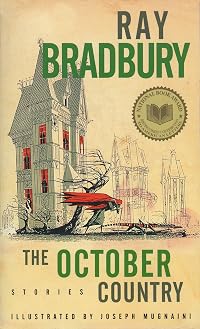
[a:Stephen King|3389|Stephen King|http://photo.goodreads.com/authors/1261866457p2/3389.jpg] has said that [b:October Country|93251|The October Country|Ray Bradbury|http://photo.goodreads.com/books/1266470604s/93251.jpg|1046266] is the best book that showcases this often-forgotten talent of [a:Ray Bradbury|1630|Ray Bradbury|http://photo.goodreads.com/authors/1190744775p2/1630.jpg], but I defy him to say that [b:Long After Midnight|94300|Long After Midnight|Iris Johansen|http://photo.goodreads.com/books/1320449781s/94300.jpg|2744509] is far better. This collection showcases the full talent that [a:Ray Bradbury|1630|Ray Bradbury|http://photo.goodreads.com/authors/1190744775p2/1630.jpg] had, as well as the versatility of his style. The horror stories are chilling, the sci-fi stories touching and full of literary wonder.
If you've not read this collection yet - read it. You will not be disappointed. show less
[a:Ray Bradbury|1630|Ray Bradbury|http://photo.goodreads.com/authors/1190744775p2/1630.jpg] is a master of fantasy, of sci-fi, and of touching the dreams and the sweet innocence of childhood. He is a wonderful writer, a poetic genius, and stark reminder of how thoroughly writing can shape the mind and pluck the heart. [a:Ray Bradbury|1630|Ray Bradbury|http://photo.goodreads.com/authors/1190744775p2/1630.jpg] is a genius of the short story whose grandeur has only ever been matched by perhaps [a:Jonathan Carroll|23704|Jonathan show more Carroll|http://photo.goodreads.com/authors/1222900262p2/23704.jpg], if even that.
[a:Ray Bradbury|1630|Ray Bradbury|http://photo.goodreads.com/authors/1190744775p2/1630.jpg] is also a genius of horror.
[a:Stephen King|3389|Stephen King|http://photo.goodreads.com/authors/1261866457p2/3389.jpg] has said that [b:October Country|93251|The October Country|Ray Bradbury|http://photo.goodreads.com/books/1266470604s/93251.jpg|1046266] is the best book that showcases this often-forgotten talent of [a:Ray Bradbury|1630|Ray Bradbury|http://photo.goodreads.com/authors/1190744775p2/1630.jpg], but I defy him to say that [b:Long After Midnight|94300|Long After Midnight|Iris Johansen|http://photo.goodreads.com/books/1320449781s/94300.jpg|2744509] is far better. This collection showcases the full talent that [a:Ray Bradbury|1630|Ray Bradbury|http://photo.goodreads.com/authors/1190744775p2/1630.jpg] had, as well as the versatility of his style. The horror stories are chilling, the sci-fi stories touching and full of literary wonder.
If you've not read this collection yet - read it. You will not be disappointed. show less
Members
- Recently Added By
Lists

Books Read in 2012
816 works; 34 members

Finish Strong 2015
15 works; 1 member
Author Information

Ray Bradbury was born in Waukegan, Illinois on August 22, 1920. At the age of fifteen, he started submitting short stories to national magazines. During his lifetime, he wrote more than 600 stories, poems, essays, plays, films, television plays, radio, music, and comic books. His books include The Martian Chronicles, Fahrenheit 451, The show more Illustrated Man, Dandelion Wine, Something Wicked This Way Comes, and Bradbury Speaks. He won numerous awards for his works including a World Fantasy Award for Life Achievement in 1977, the 2000 National Book Foundation Medal for Distinguished Contribution to American Letters, the 2004 National Medal of Arts, and the 2007 Pulitzer Prize Special Citation. He wrote the screen play for John Huston's classic film adaptation of Moby Dick, and was nominated for an Academy Award. He adapted 65 of his stories for television's The Ray Bradbury Theater, and won an Emmy for his teleplay of The Halloween Tree. The film The Wonderful Ice Cream Suit was written by Ray Bradbury and was based on his story The Magic White Suit. He was the idea consultant and wrote the basic scenario for the United States pavilion at the 1964 World's Fair, as well as being an imagineer for Walt Disney Enterprises, where he designed the Spaceship Earth exhibition at Walt Disney World's Epcot Center. He died after a long illness on June 5, 2012 at the age of 91. (Bowker Author Biography) show less
Some Editions
Awards and Honors
Series
Belongs to Publisher Series
Work Relationships
Is contained in
Contains
Common Knowledge
- Canonical title
- Long After Midnight
- Original title
- Long After Midnight: 22 Hauntings and Celebrations
- Original publication date
- 1976 (collection) (collection)
- Dedication
- This book, with love, is dedicated to William F. Nolan, amazing collector, fantastic researcher, dear friend.
- First words
- The sundials were tumbled into white pebbles.
- Last words
- (Click to show. Warning: May contain spoilers.)And on those occasions, not often but often enough, when he took a bite, it tasted (O thank you, God) it tasted incredibly sweet.
- Original language
- English
Classifications
- Genres
- Fiction and Literature, Science Fiction, Horror
- DDC/MDS
- 813.54 — Literature & rhetoric American literature in English American fiction in English 1900-1999 1945-1999
- LCC
- PZ3 .B72453 — Language and Literature Fiction and juvenile belles lettres Fiction and juvenile belles lettres Fiction in English
- BISAC
Statistics
- Members
- 1,248
- Popularity
- 19,804
- Reviews
- 24
- Rating
- (3.90)
- Languages
- 9 — Dutch, English, French, German, Hungarian, Italian, Japanese, Portuguese, Spanish
- Media
- Paper, Audiobook, Ebook
- ISBNs
- 34
- UPCs
- 1
- ASINs
- 22