On This Page
Description
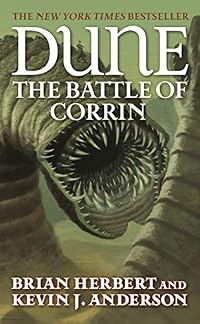
Dune: The Battle of CorrinIt has been fifty-six hard years since the events of The Machine Crusade. Following the death of Serena Butler, the bloodiest decades of the Jihad take place. Synchronized Worlds and Unallied Planets are liberated one by one, and at long last, after years of struggle, the human worlds begin to hope that the end of the centuries-long conflict with the thinking machines is finally in sight.
Unfortunately, Omnius has one last, deadly card to play. In a last-ditch show more effort to destroy humankind, virulent plagues are let loose throughout the galaxy, decimating the populations of whole planets . . . and once again, the tide of the titanic struggle shifts against the warriors of the human race. At last, the war that has lasted many lifetimes will be decided in the apocalyptic Battle of Corrin.
In the greatest battle in science fiction history, human and machine face off one last time. . . . And on the desert planet of Arrakis, the legendary Fremen of Dune become the feared fighting force to be discovered by Paul Muad'Dib in Frank Herbert's classic, Dune.
. show less
Tags
Recommendations












Member Reviews
This is actually more a review for the whole trilogy than just this one book...
This trilogy is a better read than the two horrid books that the Hacks Twain wrote for Dune 7. Despite that, this trilogy contains a good amount of retcons from the original Dune Novels and the Encyclopedia.
Here in this trilogy, the foundation of the Bene Gesserit School of Thought and the Suk Medical school doesn't quite work. If the Sorceresses of Rossak valued psychic powers so highly, you'd have thought that the BG of Dune and afterwards would have telekinetic ability passed down through at least some of their bloodlines. Franky, Brian and Kevin's version of the origins of the BG just did not work at all.
The Titans were an unnecessary addition to the show more Butlerian Jihad saga. One would think that people would still become cymeks after this, since they don't count as AI. There are other inconsistencies between the Butlerian Jihad trilogy and Frank Herbert's Dune books. The only thing that really worked for me was what the Tleilaxu did, and how that gained them a poor reputation among the other races.
The Arrakis-centered storyline also didn't swing for me. Too much was put in personal drama, and not enough about spice. The entire storyline did not feel well-thought out to me.
What bothered me most about the trilogy was the character of Serena Butler. Canonically, this character should be named Jehanne. What is wrong with Serena is that she carries the traits of a Mary-Sue... just about one of the worst things you can do in fanfiction. That's right, FANfiction. This trilogy, along with the other Dune books that Brian and Kevin wrote are all fanfiction and should not be regarded as any higher. I mean, come on. Beautiful? Purple eyes? Young and intelligent? Talented? Serena has all of these traits, and later on she suffers a horrible loss and becomes a martyr and everyone mourns for her, just like how crappy fanfiction authors write their Mary Sues.
Don't even get me started on Norma Cenva and Aurelius Venport. More hogwash. And the whole Butler family sidestory was another huge and unneccessary side-addition to this story.
Frank Herbert could have written about the entire Jihad in ONE book. Maybe two, if Frank had a lot of ideas. But whatever he would have done, it would have been a thousand times better than what his son and supposed number one fan have written together, or will ever. show less
This trilogy is a better read than the two horrid books that the Hacks Twain wrote for Dune 7. Despite that, this trilogy contains a good amount of retcons from the original Dune Novels and the Encyclopedia.
Here in this trilogy, the foundation of the Bene Gesserit School of Thought and the Suk Medical school doesn't quite work. If the Sorceresses of Rossak valued psychic powers so highly, you'd have thought that the BG of Dune and afterwards would have telekinetic ability passed down through at least some of their bloodlines. Franky, Brian and Kevin's version of the origins of the BG just did not work at all.
The Titans were an unnecessary addition to the show more Butlerian Jihad saga. One would think that people would still become cymeks after this, since they don't count as AI. There are other inconsistencies between the Butlerian Jihad trilogy and Frank Herbert's Dune books. The only thing that really worked for me was what the Tleilaxu did, and how that gained them a poor reputation among the other races.
The Arrakis-centered storyline also didn't swing for me. Too much was put in personal drama, and not enough about spice. The entire storyline did not feel well-thought out to me.
What bothered me most about the trilogy was the character of Serena Butler. Canonically, this character should be named Jehanne. What is wrong with Serena is that she carries the traits of a Mary-Sue... just about one of the worst things you can do in fanfiction. That's right, FANfiction. This trilogy, along with the other Dune books that Brian and Kevin wrote are all fanfiction and should not be regarded as any higher. I mean, come on. Beautiful? Purple eyes? Young and intelligent? Talented? Serena has all of these traits, and later on she suffers a horrible loss and becomes a martyr and everyone mourns for her, just like how crappy fanfiction authors write their Mary Sues.
Don't even get me started on Norma Cenva and Aurelius Venport. More hogwash. And the whole Butler family sidestory was another huge and unneccessary side-addition to this story.
Frank Herbert could have written about the entire Jihad in ONE book. Maybe two, if Frank had a lot of ideas. But whatever he would have done, it would have been a thousand times better than what his son and supposed number one fan have written together, or will ever. show less
This was better than the previous two books in this Legends of Dune Trilogy. I found the pacing better and the plot more engaging in The Battle of Corrin than in either The Butlerian Jihad or The Machine Crusade. Brian Herbert and Kevin Anderson threw in a couple of nice twists before the end of the book and clearly set up the possibility that humanity will still need to deal with thinking machines in the future despite their victory on Corrin. But this is still not as good as the original six Dune books authored by Frank Herbert.
The last of the Machine Wars trilogy which sets the foundation myths for Dune. Virtually every institution in place thousands of years later in the time of Dune traces it's roots to the 100 years or so covered by this series. To put things in perspective, that would be akin to us still paying homage to still-ruling Julio-Claudian Caesars, worshipping Greco-Roman gods, and waxing philosophic over the ever-relevant musings of Plato and Aristotle. Dune does give a lot of stories to tell, and I suppose a trilogy is probably the maximum mileage the authors thought they could wring from telling these foundation stories.
What I thought was interesting was the way they turn on it's ear the assumption that Atreides was always the embodiment of show more good and Harkonnen evil. Vorian Atreides is more of an anti-hero, a figure to be pitied for the decisions history had thrust upon him. In the end, it's his drive to win at all costs that prevents him from having compassion for the ancestral Harkonnen, declaring the family name to be forever a pariah and enemy to his kin. The Harkonnen, meanwhile, was merely trying everything in the power to prevent what he thought to be needless collateral deaths of 2 million people.
The only Dune book I haven't read is the very last one Brian Herbert wrote after his father's death. He is in the midst of a trilogy set between Dune and Dune Messiah, I think I will wait for him to finish this before I re-read the last 5 Frank Herbert books (some which were painful to get through the first time, but may be easier to read now with more "history" behind them). show less
What I thought was interesting was the way they turn on it's ear the assumption that Atreides was always the embodiment of show more good and Harkonnen evil. Vorian Atreides is more of an anti-hero, a figure to be pitied for the decisions history had thrust upon him. In the end, it's his drive to win at all costs that prevents him from having compassion for the ancestral Harkonnen, declaring the family name to be forever a pariah and enemy to his kin. The Harkonnen, meanwhile, was merely trying everything in the power to prevent what he thought to be needless collateral deaths of 2 million people.
The only Dune book I haven't read is the very last one Brian Herbert wrote after his father's death. He is in the midst of a trilogy set between Dune and Dune Messiah, I think I will wait for him to finish this before I re-read the last 5 Frank Herbert books (some which were painful to get through the first time, but may be easier to read now with more "history" behind them). show less
I started this installment in the Dune series about 5 years ago, and it has been sitting on the shelf with a bookmark about 200 pages from the end ever since. This trilogy is less compelling that the Houses trilogy, which is less rich than Frank Herbert's original series. I'm invested in the story though, so every so often I have a compulsion to continue reading, in spite of the lack of richness and meaning in Herbert the Younger's continuation of the series.
Frank Herbert had so much to say regarding religion and faith, ecology, political machinations, indeed you could point an accusing finger at heinleinesque editorializing in the original series. (I must confess, I love these sections.) The trilogies, however, never realize the same show more heart that was invested in Dune,et al., and while it does more than a passable job of space opera/battle fiction, there always seems to be something missing.
I keep reminding myself that Frank Herbert left copious notes on his continuing story ideas, and for this reason, I keep reading these. Sometimes I like to imagine that I see a bit of Frank peeking through these novels, especially where he has something potentially profound to observe on his original themes. My primary reason for diving in and finishing this, is to close that storyline in anticipation of Sisterhood. The Bene Gesserit threads are by far the most interesting to me, so I will be reading that one soon. show less
Frank Herbert had so much to say regarding religion and faith, ecology, political machinations, indeed you could point an accusing finger at heinleinesque editorializing in the original series. (I must confess, I love these sections.) The trilogies, however, never realize the same show more heart that was invested in Dune,et al., and while it does more than a passable job of space opera/battle fiction, there always seems to be something missing.
I keep reminding myself that Frank Herbert left copious notes on his continuing story ideas, and for this reason, I keep reading these. Sometimes I like to imagine that I see a bit of Frank peeking through these novels, especially where he has something potentially profound to observe on his original themes. My primary reason for diving in and finishing this, is to close that storyline in anticipation of Sisterhood. The Bene Gesserit threads are by far the most interesting to me, so I will be reading that one soon. show less
This is the last of a trilogy (Legends of Dune) that sets the stage for many of the key elements in the original Dune series. I read the first book (The Butlerian Jihad) in early 2005 and the second book (The Machine Crusade) in late 2006. I've also read the first two "house" prequels (House Atriedes and House Harkonnen) but I don't think that series is as good as this one.
These are huge books (actually did them all on audio about 22 CDs each) but I can honestly say that I don't remember being bored at all while reading (listening to) them. In this trilogy you get the origins of the Mentat's, Suk Doctors, Spacing Guild, Swordmasters, the Atriedes-Harkonnen blood feud and the Bene Gessert!
Many reviewers (on amazon at least) have skewered show more these books but really that is so predictable. If you want to read -Dune- then read -Dune-, don't pick up the author's son's attempt to recreate the magic with a chip on your shoulder ready to hate it. If you don't want to like it then you won't.
The only negative things I can say about this last book is that some of the origin stories were kind of crammed in at the end.
Also Vorien's reaction to Abelard's attempt to save the hostages at the end didn't really ring true to me. It seems like Vorien would have mellowed out after everything was over and forgiven him but they need him to hate Abelard so that they could start the Atriedes-harkonnen feud. show less
These are huge books (actually did them all on audio about 22 CDs each) but I can honestly say that I don't remember being bored at all while reading (listening to) them. In this trilogy you get the origins of the Mentat's, Suk Doctors, Spacing Guild, Swordmasters, the Atriedes-Harkonnen blood feud and the Bene Gessert!
Many reviewers (on amazon at least) have skewered show more these books but really that is so predictable. If you want to read -Dune- then read -Dune-, don't pick up the author's son's attempt to recreate the magic with a chip on your shoulder ready to hate it. If you don't want to like it then you won't.
The only negative things I can say about this last book is that some of the origin stories were kind of crammed in at the end.
Also Vorien's reaction to Abelard's attempt to save the hostages at the end didn't really ring true to me. It seems like Vorien would have mellowed out after everything was over and forgiven him but they need him to hate Abelard so that they could start the Atriedes-harkonnen feud. show less
The conclusion of the trilogy ended up playing out really well, and taking a few surprising turns. The changes to some of the existing characters worked really well,however some of the newer characters were a bit one dimensional. Granted, the character I hated the most died in a pretty painful and terrible way, but a lot of the other characters came off as flat and annoying. The only exception I found to this was Vorian's granddaughter, an interesting new character that got a decent amount of of the story dedicated to her. The story really made up for an shortcomings I found in some of the new characters, and I would say this trilogy ended in a really strong way. I am very much looking forward to the rest of the Brian Herbert and Kevin show more J. Anderson Dune novels and feel they have made a very positive contribution to the Dune series. show less
While I enjoyed this book, I feel that it was (a) flawed in execution and (b) a weak ending to the trilogy. All but a small few of the main characters of the first two books were dead by this volume and the new characters weren't as interesting. Many plot elements never seemed to be wrapped up and numerous times I found myself thinking, "now why would they did that" or "why not do this, instead?" I also felt that the book needed a few more chapters to tie up a few loose ends; but, then, that is what further sequels are for, I guess. This one is only for the die-hard Dune fans.
Members
- Recently Added By
Lists

Epic Science Fiction
15 works; 4 members
Author Information

136+ Works 35,285 Members
Brian Herbert is an author and the son of Frank Herbert, the creator of the Dune series. Brian Herbert has had several stand-alone novels published but he is perhaps most well-known for his books that expand on his father's Dune novels. Written with author Kevin J. Anderson, these novels have been commercially successful and generally well show more received by the public. Brian Herbert is the co-author of the Dune novels House Atreides, House Harkonnen, House Corrino, The Butlerian Jihad, The Machine Crusade, The Battle of Corrin, The Road To Dune, Hunters of Dune, Sandworms Of Dune, Paul Of Dune, The Winds Of Dune, and Sisterhood of Dune. Brian Herbert has also edited several works relating to the Dune universe and to his father. In 2003, he authored Dreamer of Dune, the biography of Frank Herbert, a Hugo Award finalist nomination. (Bowker Author Biography) show less

460+ Works 86,087 Members
Kevin J. Anderson was born on March 27, 1962. Before becoming a full-time author, he worked in California for twelve years as a technical writer and editor at the Lawrence Livermore National Laboratory. His science fiction books include Resurrection, Inc., the Star Wars Jedi Academy Trilogy, the Young Jedi Knights series, Ground Zero, Ruins, show more Climbing Olympus, Blindfold, and The Dark Between the Stars. He has also written several books with Doug Beason including Ignition, Virtual Destruction, Fallout, and Ill Wind. (Bowker Author Biography) Kevin J. Anderson has written twenty seven bestsellers and has been nominated for the Nebula Award, the Bram Stoker Award, and the SFX Reader's Choice Award. He also holds the Guinness world record for "The Largest Single-Author Signing". (Publisher Provided) show less
Some Editions
Awards and Honors
Distinctions
Series

Belongs to Publisher Series
Heyne Allgemeine Reihe (52503)
Work Relationships
Common Knowledge
- Canonical title
- The Battle of Corrin; The Battle of Corrin
- Original title
- The Battle of Corrin
- Original publication date
- 2004
- People/Characters
- Abulurd Harkonnen; Ajax; Yorek Thurr; Rekur Van; Erasmus; Vorian Atreides (show all 39); Omnius; Serena Butler; Xavier Harkonnen; Rivego; Four-Arms; Four-Legs; Agamemnon; Leronica Tergiet; Quentin Vigar; Wandra Butler; Faykan Butler; Rikov Butler; Estes Atreides; Kagin Atreides; Istian Goss; Seurat; Dante; Juno; Beowulf; Rayna Butler; Raquella Berto-Anirul; Mohandas Suk; Ishmael; El'hiim; Norma Cenva; Adrien Venport; Ticia Cenva; Naam the Elder; Nar Trig; Xander Boro-Ginjo; Tuk Keedair; Chamal; Dirdos Harkonnen
- Important places
- Arrakis; Arrakis City, Arrakis; Salusa Secundus; Cathedral of Serena, Zimia, Salusa Secundus; City of Introspection, Salusa Secundus; Rossak (show all 33); Poritrin; Tanzerouft, Arrakis; Old Earth; Parmentier; Caladan; Bela Tegeuse; Richese; Thalim; Tlulax, Thalim; Kolhar; Hessra; Corrin; Ginaz; Ix; Peridot Colony; Wallach IX; Mao Tse-Tung (mentioned only); Aristotle (mentioned only); Tio Holtzman (mentioned only); Selim Wormrider (mentioned only); Marcel Proust (mentioned only); Aurelius Venport (mentioned only); Zufa Cenva (mentioned only); Tlaloc (mentioned only); Iblis Ginjo (mentioned only); Manion Butler (mentioned only); Irulan Corrino (mentioned only)
- Important events
- Butlerian Jihad; 108 B.G.; 88 B.G.; Great Purge; Omnius Scourge; Battle of Corrin (show all 10); Time of Titans (Mentioned only); Battle of Ix (Mentioned only); Liberation of Parmentier (Mentioned only); Honru Massacre (Mentioned only)
- Dedication*
- Pour Pat Lo Brutto
Pour son soutien permanent depuis le début de notre projet pour Dune. Pour son enthousiasme, ses connaissances et sa sensibilité qui ont fait que ces livres soient plus que ce que nous aurions pu f... (show all)aire seuls. Pat, vous êtes une éditrice de la Renaissance. - First words
- Erasmus empfand die Hackordnung unter den todgeweihten, hoffnungslosen Menschen faszinierend, ja amüsant.
Erasmus found the pecking order among the dying and hopeless humans fascinating, even amusing. - Last words
- (Click to show. Warning: May contain spoilers.)Während Imperien aufstiegen und untergingen, wandte Arrakis, der Wüstenplanet, dem Universum unerschütterlich sein Gesicht zu.
(Click to show. Warning: May contain spoilers.)Even as empires rose and fell, Arrakis, the desert planet, would turn its face to the universe and endure. - Publisher's editor
- LoBrutto, Pat
- Original language
- English
- Canonical DDC/MDS
- 813.087625
*Some information comes from Common Knowledge in other languages. Click "Edit" for more information.
Classifications
- Genres
- Science Fiction, Fiction and Literature
- DDC/MDS
- 813.087625 — Literature & rhetoric American literature in English American fiction in English By type Genre fiction Adventure fiction Speculative fiction Science fiction Space opera
- LCC
- PS3558 .E617 .D88 — Language and Literature American literature American literature Individual authors 1961-
- BISAC
Statistics
- Members
- 2,487
- Popularity
- 7,715
- Reviews
- 24
- Rating
- (3.45)
- Languages
- 12 — Chinese, Czech, Dutch, English, French, German, Greek, Hebrew, Hungarian, Polish, Spanish, Turkish
- Media
- Paper, Audiobook, Ebook
- ISBNs
- 40
- ASINs
- 16