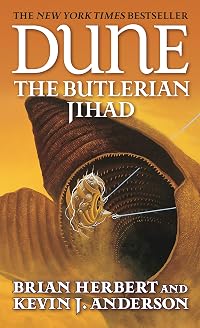
The Butlerian Jihad
by Brian Herbert (Author), Kevin J. Anderson (Author)
Dune (Legends of Dune — Legends 1)
On This Page
Description
Welcome to the far future on the desert planet Arrakis where Pardot Kynes seeks its secrets. Meanwhile, a violent coup is planned by the son of Emperor Elrood; an eight-year-old slave Duncan Idaho seeks to escape his cruel masters; and a young man named Leto Atreides begins a fateful journey. These unlikely souls will come together as renegades and soon discover that fate has decreed they will change the very shape of history.Tags
Recommendations

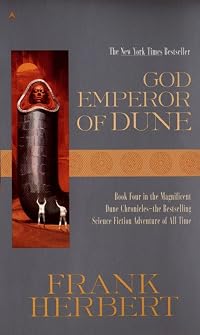
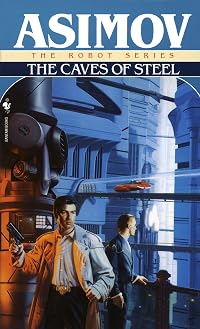
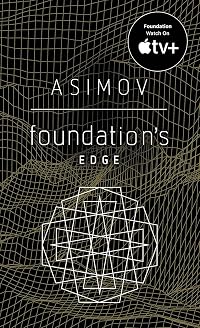
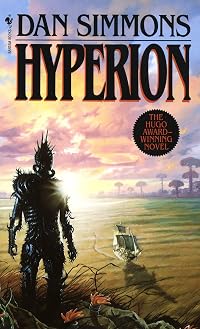










Member Recommendations
by bertilak
Member Reviews
This is more 3.5 stars but I am rounding it to four.
This was a book I had my eye on for a long, long time. Due to the very present critique of this series I was postponing actual start on it until few days back and I have to say, considering what the book is, it is not bad one. But does it match up with Herbert's original works? I have to say no, but then again Herbert, after Children of Dune in my opinion, could never match up with his own earlier works.
So what is this book about......
Book is about the beginning of the Dune society (as we know it from original Dune novel) - we are given world where lines are drawn between humans (League) and thinking machines (Synchronized Worlds). These two are in constant struggle with each other, show more humans fighting to survive and machines exercising their muscles to eradicate the humans using Cymeks, cybernetic organisms (basically various combat vehicles and armor to which [human] operator's brain is attached to so they can do switcheroo whenever required - Cyberpunk folks' wet dream) at the forefront of their legions. First amongst the Cymeks are Titans, group of humans who took control of old human empire (thousands of years before this story begins) but were such an a**hole group in general that AI they inadvertently created crossed them and took power itself, making Titans its servants, basically conquering generals.
One of the comments I usually hear is why would robots and AIs behave the way they behave? Well.... considering they were created by humans with all the biases but also very rational thought process (I mean this is why AI is created, right, not for discussing weather channel) is it surprising that machines would determine at some point that humans are just sort of a ballast for further progress? I mean, do we need to doubt that machines would think like that when even today you have so many anti-humanists amongst humans that are all very "rational" but ready to see couple of billion under ground for the betterment of all? So, no, I do not think that machines would be any better than their makers when it comes to coping with conflict with biological forms. Very soon they would develop equivalent of emotions and with it all nasty things like aggression and violence. I mean it is all part of the nature (and one reason I cannot figure out why are we speeding uncontrollably to create AI without any idea why (except why not)..... it is like breeding new biological species that can outsmart us, outpace us and generally wipe us out just to have us say hey, we did it! Wait, biological weapons are that something - right? Hmm....) and to expect that any living organism (biological or not) would act differently is wishful thinking.
So, to say that is a fantastic part here ...... nope, pretty normal and expected.
Then we get to Titans and Cymeks. These guys and gals are borderline psychopaths and few comments are there saying they are so off chart they seem like cackling bad guys from every cartoon or low budget SF. So lets put this into perspective - these are people that took over power from the old empire, subjugated everyone, for all means and purposes became immortal (went through the life longevity extension process), later found out they can extract themselves (brains) and basically use any combat vehicle- ground, air or space - to roam around and destroy things with impunity, become synonym with divinity and basically answer to no-one and start considering the ordinary humans as livestock? So, basically, minus the immortality and cybernetic bodies we are talking about all these Metuselah's that run the world politics nowadays? And treat the rest of us like unwashed masses?
This part of the story is very realistic, if not the most realistic part of the book. If it weren't for the last few years I would be wondering, but now.... oh, no, no doubt at all. And they do not even need to be Metuselah level old, just look at all the righteous amongst us (they would shame Inquisition). So, in short, very believable.
On the other hand you have Humanity, split across the League of Nobles and Unaligned worlds. Here we have a more nuanced view of this future society. While they no longer use highly capable machines (for reasons apparent) thy do have some technology available and can build ground mechanization and airplanes and space ships, armor etc. But at the core they are feudal - reason being that without machines they need to use biological machines (people) for same production results (I especially enjoyed the mathematical calculation pipeline). Because of this (and lets be honest no ruling body wants to pay if they do not need to) population is stratified into ruling class and worker class, but depending on the level of enlightenment mentioned worker classes can be wither actual worker classes or out of the box slaves (as they keep saying in the book, necessary evil). And although feudal, this society, interestingly, seems to be more or less without the large religious structure and influence (so unlike Dune as we know it). Nobody cites the equivalent of Orange Bible, even witches from Rossak are more practical psykers then religiously oriented people. Only ones with very strong religious feeling are people everybody is hunting down for the conceived act of treason and cowardice - Zensunni's and Zenshiite's.
Here we have some very interesting element that is unfortunately present in our times again and again - dehumanization. You see, to have slaves you need to have reason for their existence. In this society reason is punishment of the above mentioned Zensunni's and Zenshiite's because they did not confront Titans when these took over control (because, you know peace loving is always dangerous). So, as it usually goes (hmmm, again those last few years) they went from cowards to slaves, because that is where they belong because they betrayed the humanity (man, again those last few years).
And when this happens, when one part of humanity is ostracized, new work positions open - for people to hunt them and sell them and unfortunately use them for some other sick purposes (enter the Tleilaxu).
All in all book does give a very interesting overview of human society with all its shortcomings. It is much more vivid and, well, interesting to read about. Parts about Arakis and nomads (Zensunni's) that will become a blood thirsty legions of Paul Atreides, are great, especially taking into account that they start as peace loving and violence avoiding people.
All taken into account, very interesting world building takes place.
But the Achilles' heel of the book is scope. It is humongous because author's try to put everything in, thinking machines, Titans, League of Nobles, initial creation of Benne Gesserit (witches from Rossak) initial dealings with the Arrakis' melange, initial development of Fremen movement, origins of Atreides, origins of Harkonnen, how Butlerian Jihad got triggered (Iblis is such a good character) with major battles in between, conflicts and insights into both thinking machine and human civilization (Erazmus the crazy robot, Tio Holtzman and Norma Cenva) to name just the few.
There is materiel here for at least 10 books with average length of maybe 300 pages.
I guess author's decided that would be too long and too much so they compressed this and as a result we are given hundreds of pages of short, very to the point, chapters but no space to properly put everything into words. This is why everything ends up rather clumsy (especially when compared to Frank Herbert's books [again ending with Children of the Dune, those after it feel like reading a phone book]). Thankfully we do not end up with constant mumbo-jumbo that marked the Dune books after the Children of the Dune, but we end up with extreme, very short, almost news-reporter-like chapters where even epic scenes like battle of Earth are given in some weird what-ah?-ummmm-taddaaaa-done approach.
So for those looking for meaning of life and high philosophy from SF setting - look elsewhere. You will definitely not like this series.
For those who look for interesting story and characters and can handle a bit clumsy approach to the story telling I would recommend the book, it is fun and interesting ride. show less
This was a book I had my eye on for a long, long time. Due to the very present critique of this series I was postponing actual start on it until few days back and I have to say, considering what the book is, it is not bad one. But does it match up with Herbert's original works? I have to say no, but then again Herbert, after Children of Dune in my opinion, could never match up with his own earlier works.
So what is this book about......
Book is about the beginning of the Dune society (as we know it from original Dune novel) - we are given world where lines are drawn between humans (League) and thinking machines (Synchronized Worlds). These two are in constant struggle with each other, show more humans fighting to survive and machines exercising their muscles to eradicate the humans using Cymeks, cybernetic organisms (basically various combat vehicles and armor to which [human] operator's brain is attached to so they can do switcheroo whenever required - Cyberpunk folks' wet dream) at the forefront of their legions. First amongst the Cymeks are Titans, group of humans who took control of old human empire (thousands of years before this story begins) but were such an a**hole group in general that AI they inadvertently created crossed them and took power itself, making Titans its servants, basically conquering generals.
One of the comments I usually hear is why would robots and AIs behave the way they behave? Well.... considering they were created by humans with all the biases but also very rational thought process (I mean this is why AI is created, right, not for discussing weather channel) is it surprising that machines would determine at some point that humans are just sort of a ballast for further progress? I mean, do we need to doubt that machines would think like that when even today you have so many anti-humanists amongst humans that are all very "rational" but ready to see couple of billion under ground for the betterment of all? So, no, I do not think that machines would be any better than their makers when it comes to coping with conflict with biological forms. Very soon they would develop equivalent of emotions and with it all nasty things like aggression and violence. I mean it is all part of the nature (and one reason I cannot figure out why are we speeding uncontrollably to create AI without any idea why (except why not)..... it is like breeding new biological species that can outsmart us, outpace us and generally wipe us out just to have us say hey, we did it! Wait, biological weapons are that something - right? Hmm....) and to expect that any living organism (biological or not) would act differently is wishful thinking.
So, to say that is a fantastic part here ...... nope, pretty normal and expected.
Then we get to Titans and Cymeks. These guys and gals are borderline psychopaths and few comments are there saying they are so off chart they seem like cackling bad guys from every cartoon or low budget SF. So lets put this into perspective - these are people that took over power from the old empire, subjugated everyone, for all means and purposes became immortal (went through the life longevity extension process), later found out they can extract themselves (brains) and basically use any combat vehicle- ground, air or space - to roam around and destroy things with impunity, become synonym with divinity and basically answer to no-one and start considering the ordinary humans as livestock? So, basically, minus the immortality and cybernetic bodies we are talking about all these Metuselah's that run the world politics nowadays? And treat the rest of us like unwashed masses?
This part of the story is very realistic, if not the most realistic part of the book. If it weren't for the last few years I would be wondering, but now.... oh, no, no doubt at all. And they do not even need to be Metuselah level old, just look at all the righteous amongst us (they would shame Inquisition). So, in short, very believable.
On the other hand you have Humanity, split across the League of Nobles and Unaligned worlds. Here we have a more nuanced view of this future society. While they no longer use highly capable machines (for reasons apparent) thy do have some technology available and can build ground mechanization and airplanes and space ships, armor etc. But at the core they are feudal - reason being that without machines they need to use biological machines (people) for same production results (I especially enjoyed the mathematical calculation pipeline). Because of this (and lets be honest no ruling body wants to pay if they do not need to) population is stratified into ruling class and worker class, but depending on the level of enlightenment mentioned worker classes can be wither actual worker classes or out of the box slaves (as they keep saying in the book, necessary evil). And although feudal, this society, interestingly, seems to be more or less without the large religious structure and influence (so unlike Dune as we know it). Nobody cites the equivalent of Orange Bible, even witches from Rossak are more practical psykers then religiously oriented people. Only ones with very strong religious feeling are people everybody is hunting down for the conceived act of treason and cowardice - Zensunni's and Zenshiite's.
Here we have some very interesting element that is unfortunately present in our times again and again - dehumanization. You see, to have slaves you need to have reason for their existence. In this society reason is punishment of the above mentioned Zensunni's and Zenshiite's because they did not confront Titans when these took over control (because, you know peace loving is always dangerous). So, as it usually goes (hmmm, again those last few years) they went from cowards to slaves, because that is where they belong because they betrayed the humanity (man, again those last few years).
And when this happens, when one part of humanity is ostracized, new work positions open - for people to hunt them and sell them and unfortunately use them for some other sick purposes (enter the Tleilaxu).
All in all book does give a very interesting overview of human society with all its shortcomings. It is much more vivid and, well, interesting to read about. Parts about Arakis and nomads (Zensunni's) that will become a blood thirsty legions of Paul Atreides, are great, especially taking into account that they start as peace loving and violence avoiding people.
All taken into account, very interesting world building takes place.
But the Achilles' heel of the book is scope. It is humongous because author's try to put everything in, thinking machines, Titans, League of Nobles, initial creation of Benne Gesserit (witches from Rossak) initial dealings with the Arrakis' melange, initial development of Fremen movement, origins of Atreides, origins of Harkonnen, how Butlerian Jihad got triggered (Iblis is such a good character) with major battles in between, conflicts and insights into both thinking machine and human civilization (Erazmus the crazy robot, Tio Holtzman and Norma Cenva) to name just the few.
There is materiel here for at least 10 books with average length of maybe 300 pages.
I guess author's decided that would be too long and too much so they compressed this and as a result we are given hundreds of pages of short, very to the point, chapters but no space to properly put everything into words. This is why everything ends up rather clumsy (especially when compared to Frank Herbert's books [again ending with Children of the Dune, those after it feel like reading a phone book]). Thankfully we do not end up with constant mumbo-jumbo that marked the Dune books after the Children of the Dune, but we end up with extreme, very short, almost news-reporter-like chapters where even epic scenes like battle of Earth are given in some weird what-ah?-ummmm-taddaaaa-done approach.
So for those looking for meaning of life and high philosophy from SF setting - look elsewhere. You will definitely not like this series.
For those who look for interesting story and characters and can handle a bit clumsy approach to the story telling I would recommend the book, it is fun and interesting ride. show less
Jesus only hung on the cross for three days. I have read four hundred and fifty-four PAGES of Dune: The Butlerian Jihad.
And I did it to save your soul.
...
When I was ten years old I was quite precocious. I read and loved Asimov's Foundation trilogy, and had a voracious appetite for new books. So I picked up Frank Herbert's Dune without a second thought.
I never saw it coming.
A hundred pages later I was startled to feel tears pouring down my young face; tears of pure frustration. The book was hard, too hard and complex for my ten-year-old mind to cope with. In a fit of fury, I threw the book across the room.
I hated Dune for years. Herbert, too. But my reading speed is way too fast, so by the time I was sixteen or so I couldn't avoid show more reading some other Herbert books. Not in the Dune series, of course - the memory of those tears still stung - but Whipping Star. It was also hard, quite complex, but not (I thought) as hard as Dune had been. It certainly made me think.
And more and more I came to realize that it was a damned impressive book, one worth reading again and again. The concepts were difficult to grasp, but each re-reading brought something new, a fuller understanding; and it was a really good book. So I looked up the sequel (also good, although not quite as endearing). I looked up other short stories that Herbert had set in the same universe. Excellent, and all too rare. From there it was natural to move into Herbert's other short science fiction; the early stuff was a little bit clunky and formulaic, but the later stories were masterful and quite deep.
And so of course I found myself moving, step by step, back to Dune.
And it was good.
Not perfect, but very very good indeed; it could easily even be called "great". Over the years my mind had developed enough to be able to take on Frank Herbert's vision and comprehend it. I went on to read all the books in the series, and while some of the later ones were uneven, I enjoyed them all.
Cut to 2003. I am desperately poor, struggling to pay the mortgage and support my family (including our toddler) on a single income. This is a deadly situation. Where once I went to Avenue Victor Hugo and other great used bookstores at least two or three times a week and bought a dozen books at a time, now I haven't picked up even ONE new book - new or used - in months.
Thank Shai-Halud for the public library! I hadn't been to the library in years, but I started taking Sebastian (my son) there on Saturday mornings. He loved it. While the Woonsocket library is comparatively small and poorly-stocked, it still has a number of books worth reading - and of course far more are available through inter-library loan.
Since I spend two hours a day on the train, I need lots of reading material...so I've been taking out a lot of books. I'll write about most of them later, but right now there's one that is crying, screaming, howling for treatment.
The Son Is Not The Father
Oh dear god. I cannot express the horror. The sheer...stupidity that is Dune: The Butlerian Jihad. Frank Herbert wrote with incredible depth and complexity, giving hints of a world far deeper than the portion he showed in his books. It gave a feeling of magic, a sensation of thousands of years of unknown (and unknowable) history underlying every paragraph. At the same time he took elements of modern culture and extrapolated from them brilliantly.
I will be kind to Brian Herbert, Frank's son. His hands should not be cut off. He simply commited the sin of cashing in on his famous father's talent, and prostituting his family name - which is unforgivable, since he isn't a writer. But he should never have been allowed to "write" a book, particularly not a Dune book.
Good god, he sucks. The writing is dreadful; where his father's prose was complex, Brian's is not just simplistic, but downright childish - even moronic. Where Frank used hidden depths to intrigue and add luster, Brian has taken many of those elements and simply ruined them, directly tying them to modern Earth issues and repeating them over and over. Frank had the gift of names, occasionally tying them in with ancient Earth history; Brian names ALL of his characters after famous historical figures from Earth history, for NO &^%#ing REASON.
Ah yes. Over and over. The degree of repetition in this hellish book is more extreme than anything I have ever seen in my life. EVERY point is hammered home with astonishingly dull and lifeless prose, and then repeated again every twenty pages or so. EVERY moral point (cretinous as they are) is made so clear that a vegetable couldn't help but get it, and then repeated again a few dozen times for good measure.
Let me give you a taste of what I went through:
PARODY: The mighty robot Evil Badd entered the room.
As he did, his mekkano-taste-probe tasted the brain of
the baby human child he was gnawing on. The blonde-haired,
blue-eyed tot had died in Evil Badd's cruel mekkano-claw
with scarcely a whimper. The lovely human slave Beauty Goode
looked up lifelessly at the entry of the mighty and evil robot.
"Ah-ha, Beauty Goode, I see you have awoken from what you humans call "unconsciousness", said Evil Badd. "I am Evil Badd, your new master. I am a robot. I like to eat babies. Some think that I am evil and bad. But I am a robot of pure logic."
"Yes, Master", said Beauty Goode submissively. Secretly she thought "I must find a way to resist the evil Evil Badd. He is evil, and that could be...bad!"
"Mind if I rip your uterus out for no reason, and eat your baby?" asked Evil Badd, ripping out Beauty Goode's uterus with his rapacious mekkano-claw.
Sorry to inflict that on you. But what you have just read is ONE THOUSAND TIMES BETTER than the hundreds pages of fetid so-called writing that I had to wade through.
Ah, but nothing could prepare me for the horror of
3. 2. 4.
Page 324, not a parody this time but the ACTUAL TEXT:
[There has been a huge accident, and a number of slaves have been killed. The nobles look on at the carnage.]
"In a wry voice, Bludd said, "Not one of your most successful efforts, Tio."
"But you must admit, the concept shows promise, Lord Bludd. Look at the destructive potential," Holtzman said, looking at the unruffled nobles without even considering the dead and injured slaves. "We can be thankful that no one was hurt."
Get it? There were lots of dead slaves, but the nobles were saying that no one was hurt! That's irony! Get it? Don't you GET IT, you moron?
I'll give Brian Herbert this: he certainly knows his audience.
Okay. Now, apart from the fact that any book with a character named "Lord Bludd" should automatically earn the death penalty for its authors, please note that the authors nonetheless feel it necessary to point out the TOTALLY OBVIOUS. "without even considering the dead and injured slaves" - gosh, thanks for pointing out that irony, because we readers are SO STUPID that we'd have missed it, yes sirree!
I don't know if the authors assumed that the readers were total morons, or if they're just so incredibly stupid themselves that they didn't realize that hammering the irony breaks it.
Enough. I've tortured myself enough with this astonishingly inept and painful book. Let it be noted that some moron named Kevin J. Anderson co-wrote it, and that since he is NOT related to Frank Herbert, there is no reason that his hands shouldn't be cut off. Supposedly he has written 29 national bestsellers. If that's the case, it only justifies my belief that virtually all modern genre fiction is utter garbage.
Speaking of which, The New York Times, The Philadelphia Inquirer, The Oregonian, Kirkus Reviews, Booklist, and Publishers Weekly all apparently have had rave reviews of the new "Dune" books, according to excerpts printed on the back cover. Unless these have been taken wildly out of context or out-and-out fabricated, they merit the death penalty for every one of these publications and everyone associated with them. It need not be painful; I am not vengeful by nature. As long as they never kill a single tree or brain cell with their so-called "writing" ever again.
That is all. show less
And I did it to save your soul.
...
When I was ten years old I was quite precocious. I read and loved Asimov's Foundation trilogy, and had a voracious appetite for new books. So I picked up Frank Herbert's Dune without a second thought.
I never saw it coming.
A hundred pages later I was startled to feel tears pouring down my young face; tears of pure frustration. The book was hard, too hard and complex for my ten-year-old mind to cope with. In a fit of fury, I threw the book across the room.
I hated Dune for years. Herbert, too. But my reading speed is way too fast, so by the time I was sixteen or so I couldn't avoid show more reading some other Herbert books. Not in the Dune series, of course - the memory of those tears still stung - but Whipping Star. It was also hard, quite complex, but not (I thought) as hard as Dune had been. It certainly made me think.
And more and more I came to realize that it was a damned impressive book, one worth reading again and again. The concepts were difficult to grasp, but each re-reading brought something new, a fuller understanding; and it was a really good book. So I looked up the sequel (also good, although not quite as endearing). I looked up other short stories that Herbert had set in the same universe. Excellent, and all too rare. From there it was natural to move into Herbert's other short science fiction; the early stuff was a little bit clunky and formulaic, but the later stories were masterful and quite deep.
And so of course I found myself moving, step by step, back to Dune.
And it was good.
Not perfect, but very very good indeed; it could easily even be called "great". Over the years my mind had developed enough to be able to take on Frank Herbert's vision and comprehend it. I went on to read all the books in the series, and while some of the later ones were uneven, I enjoyed them all.
Cut to 2003. I am desperately poor, struggling to pay the mortgage and support my family (including our toddler) on a single income. This is a deadly situation. Where once I went to Avenue Victor Hugo and other great used bookstores at least two or three times a week and bought a dozen books at a time, now I haven't picked up even ONE new book - new or used - in months.
Thank Shai-Halud for the public library! I hadn't been to the library in years, but I started taking Sebastian (my son) there on Saturday mornings. He loved it. While the Woonsocket library is comparatively small and poorly-stocked, it still has a number of books worth reading - and of course far more are available through inter-library loan.
Since I spend two hours a day on the train, I need lots of reading material...so I've been taking out a lot of books. I'll write about most of them later, but right now there's one that is crying, screaming, howling for treatment.
The Son Is Not The Father
Oh dear god. I cannot express the horror. The sheer...stupidity that is Dune: The Butlerian Jihad. Frank Herbert wrote with incredible depth and complexity, giving hints of a world far deeper than the portion he showed in his books. It gave a feeling of magic, a sensation of thousands of years of unknown (and unknowable) history underlying every paragraph. At the same time he took elements of modern culture and extrapolated from them brilliantly.
I will be kind to Brian Herbert, Frank's son. His hands should not be cut off. He simply commited the sin of cashing in on his famous father's talent, and prostituting his family name - which is unforgivable, since he isn't a writer. But he should never have been allowed to "write" a book, particularly not a Dune book.
Good god, he sucks. The writing is dreadful; where his father's prose was complex, Brian's is not just simplistic, but downright childish - even moronic. Where Frank used hidden depths to intrigue and add luster, Brian has taken many of those elements and simply ruined them, directly tying them to modern Earth issues and repeating them over and over. Frank had the gift of names, occasionally tying them in with ancient Earth history; Brian names ALL of his characters after famous historical figures from Earth history, for NO &^%#ing REASON.
Ah yes. Over and over. The degree of repetition in this hellish book is more extreme than anything I have ever seen in my life. EVERY point is hammered home with astonishingly dull and lifeless prose, and then repeated again every twenty pages or so. EVERY moral point (cretinous as they are) is made so clear that a vegetable couldn't help but get it, and then repeated again a few dozen times for good measure.
Let me give you a taste of what I went through:
PARODY: The mighty robot Evil Badd entered the room.
As he did, his mekkano-taste-probe tasted the brain of
the baby human child he was gnawing on. The blonde-haired,
blue-eyed tot had died in Evil Badd's cruel mekkano-claw
with scarcely a whimper. The lovely human slave Beauty Goode
looked up lifelessly at the entry of the mighty and evil robot.
"Ah-ha, Beauty Goode, I see you have awoken from what you humans call "unconsciousness", said Evil Badd. "I am Evil Badd, your new master. I am a robot. I like to eat babies. Some think that I am evil and bad. But I am a robot of pure logic."
"Yes, Master", said Beauty Goode submissively. Secretly she thought "I must find a way to resist the evil Evil Badd. He is evil, and that could be...bad!"
"Mind if I rip your uterus out for no reason, and eat your baby?" asked Evil Badd, ripping out Beauty Goode's uterus with his rapacious mekkano-claw.
Sorry to inflict that on you. But what you have just read is ONE THOUSAND TIMES BETTER than the hundreds pages of fetid so-called writing that I had to wade through.
Ah, but nothing could prepare me for the horror of
3. 2. 4.
Page 324, not a parody this time but the ACTUAL TEXT:
[There has been a huge accident, and a number of slaves have been killed. The nobles look on at the carnage.]
"In a wry voice, Bludd said, "Not one of your most successful efforts, Tio."
"But you must admit, the concept shows promise, Lord Bludd. Look at the destructive potential," Holtzman said, looking at the unruffled nobles without even considering the dead and injured slaves. "We can be thankful that no one was hurt."
Get it? There were lots of dead slaves, but the nobles were saying that no one was hurt! That's irony! Get it? Don't you GET IT, you moron?
I'll give Brian Herbert this: he certainly knows his audience.
Okay. Now, apart from the fact that any book with a character named "Lord Bludd" should automatically earn the death penalty for its authors, please note that the authors nonetheless feel it necessary to point out the TOTALLY OBVIOUS. "without even considering the dead and injured slaves" - gosh, thanks for pointing out that irony, because we readers are SO STUPID that we'd have missed it, yes sirree!
I don't know if the authors assumed that the readers were total morons, or if they're just so incredibly stupid themselves that they didn't realize that hammering the irony breaks it.
Enough. I've tortured myself enough with this astonishingly inept and painful book. Let it be noted that some moron named Kevin J. Anderson co-wrote it, and that since he is NOT related to Frank Herbert, there is no reason that his hands shouldn't be cut off. Supposedly he has written 29 national bestsellers. If that's the case, it only justifies my belief that virtually all modern genre fiction is utter garbage.
Speaking of which, The New York Times, The Philadelphia Inquirer, The Oregonian, Kirkus Reviews, Booklist, and Publishers Weekly all apparently have had rave reviews of the new "Dune" books, according to excerpts printed on the back cover. Unless these have been taken wildly out of context or out-and-out fabricated, they merit the death penalty for every one of these publications and everyone associated with them. It need not be painful; I am not vengeful by nature. As long as they never kill a single tree or brain cell with their so-called "writing" ever again.
That is all. show less
Out of all the McDune books that Brian and Kevin wrote, I found the Butlerian Jihad trilogy to be the most enjoyable out of them all. However, the same writing problems abound in all of the books, regardless of what it's about - useless detail, flat characters, and clunky writing in some places.
Serena Butler was such a Mary Sue that it was not even funny. Beautiful, purple eyes, graceful, sweet, etc. I just couldn't stand her. I found the parts with the Titans more interesting, to be honest. Overall the Butlerian Jihad is better than any of the other MdDune books, but it doesn't stand much on its own. This story would have been better if it was an entirely original creation by Brian and Kevin instead of a non-canon, fanfiction-esque show more extension of the Dune universe. show less
Serena Butler was such a Mary Sue that it was not even funny. Beautiful, purple eyes, graceful, sweet, etc. I just couldn't stand her. I found the parts with the Titans more interesting, to be honest. Overall the Butlerian Jihad is better than any of the other MdDune books, but it doesn't stand much on its own. This story would have been better if it was an entirely original creation by Brian and Kevin instead of a non-canon, fanfiction-esque show more extension of the Dune universe. show less
This book started out slow and took a long time to take off. The actual jihad begins about two-thirds of the way through the book and then the plot becomes fast-paced. Before this the characters are not particularly likeable; Brian Herbert and Kevin Anderson write characters who are careless and uncaring or blind to the impact of their own lifestyles be they AIs or human. This is the universe they clearly wished to create. But unlike Frank Herbert's Dune, we don't come to care for the characters to the same extent. Having said that, I completed the book. The last quarter of the book swept me along. But it is not Frank Herbert's Dune - this is something different set in the same universe. I will probably read the next two into this show more Legends of Dune trilogy: The Machine Crusade and The Battle of Corrin.
I like this rating system by ashleytylerjohn of LibraryThing (https://www.librarything.com/profile/ashleytylerjohn) that I have also adopted:
(Note: 5 stars = rare and amazing, 4 = quite good book, 3 = a decent read, 2 = disappointing, 1 = awful, just awful.) show less
I like this rating system by ashleytylerjohn of LibraryThing (https://www.librarything.com/profile/ashleytylerjohn) that I have also adopted:
(Note: 5 stars = rare and amazing, 4 = quite good book, 3 = a decent read, 2 = disappointing, 1 = awful, just awful.) show less
Something of a disappointment, to say the least, when compared with the original Dune saga by Frank Herbert. There is little of Herbert Snr.'s subtlety and complexity here, and it really does seem to be more of a cashing in on the affection in which the original books are held.
That said, it is a workmanlike space opera which is fine as a book to take to the beach: read it, donate it to a charity book shop. (And yet I have kept my copy - damn you, OCD hoarding disorder!)
19/09/10: Need more space on the bookshelf, so this book and I have finally parted company. It's a moment of personal growth!
That said, it is a workmanlike space opera which is fine as a book to take to the beach: read it, donate it to a charity book shop. (And yet I have kept my copy - damn you, OCD hoarding disorder!)
19/09/10: Need more space on the bookshelf, so this book and I have finally parted company. It's a moment of personal growth!
I can see why people (Dune fans especially) can hate this book. The writing is flimsy and the characters flat.
Still I endured because I enjoyed reading about the mythological Butlerian Jihad of the Dune Universe. There were whiffs of some wonderful stories and conflicts ... Erasumus curiosity to understanding human, Norma Cenva struggling to become more than an accident, the legend of Selim Wormrider .... any of them alone and focused on could have been a tremendous story.
A lot of the book is tedious and I approached many a time reading this book as a chore. Not recommended.
I think you would be better served by just reading the Wikipedia entries of the Dune mythos and letting your imagination fill in the blanks.
The Butlerian Jihad is a tantalizingly-alluded-to history from Frank Herbert's Dune series. This is set 10,000 years before the events of Dune and is the precursor to the Great House books Brian has also wrote. This was difficult for me to finish. Which is probably why it took me 2 months. I'd start and almost immediately get bored and stop. I love Dune by Frank Herbert, but I'm not sure that these "prequels" that Brian has added are for me. I didn't connect with really any of the characters. It served mostly as a history class for this world. I like getting the stories behind events mentioned in the later books, but there seemed to be a disconnect between the author(s) and the characters. I knew going into it that the prose would vary show more greatly from Senior. His stories flowed and ebbed to build. Brian's story here is episodic and I felt it was abrupt at that.
I also see where Brian and Kevin both took liberties with the timelines suggested in the original Dune series, and their interpretations of many Frank Herbert's hints are entirely too literal. The obvious and unimaginative interpretation of slavery under the machines is a good example. It seemed pretty clear that the slavery referred to in Dune was a voluntary dependence on thinking machines that increasingly weakend the human race. That's the basis of the religious connotation implied in the Jihad--not an afterthought intended to make a potentially unpopular war more appealing to the people. The characters in Dune remembered that the Great Revolt was headlong and uncontrolled, a blurry and bloody time in history that vented unimaginable excesses of violence and terror. Not the lackluster, even boring battles described. This history is not the kind of history that would give birth to the Great Convention, solidify the already existing Great Schools, or build the conventions of the Dune universe.
When a writer decides to continue a work or world that someone else created, there is no option but to compare. That, is probably the biggest set back for me. I went from knowing the Dune universe to reading a space opera written like pulp. It's not bad, it just falls short for the world most have come to know and love. show less
I also see where Brian and Kevin both took liberties with the timelines suggested in the original Dune series, and their interpretations of many Frank Herbert's hints are entirely too literal. The obvious and unimaginative interpretation of slavery under the machines is a good example. It seemed pretty clear that the slavery referred to in Dune was a voluntary dependence on thinking machines that increasingly weakend the human race. That's the basis of the religious connotation implied in the Jihad--not an afterthought intended to make a potentially unpopular war more appealing to the people. The characters in Dune remembered that the Great Revolt was headlong and uncontrolled, a blurry and bloody time in history that vented unimaginable excesses of violence and terror. Not the lackluster, even boring battles described. This history is not the kind of history that would give birth to the Great Convention, solidify the already existing Great Schools, or build the conventions of the Dune universe.
When a writer decides to continue a work or world that someone else created, there is no option but to compare. That, is probably the biggest set back for me. I went from knowing the Dune universe to reading a space opera written like pulp. It's not bad, it just falls short for the world most have come to know and love. show less
Members
- Recently Added By
Lists

Epic Science Fiction
15 works; 4 members
Author Information

Brian Herbert is an author and the son of Frank Herbert, the creator of the Dune series. Brian Herbert has had several stand-alone novels published but he is perhaps most well-known for his books that expand on his father's Dune novels. Written with author Kevin J. Anderson, these novels have been commercially successful and generally well show more received by the public. Brian Herbert is the co-author of the Dune novels House Atreides, House Harkonnen, House Corrino, The Butlerian Jihad, The Machine Crusade, The Battle of Corrin, The Road To Dune, Hunters of Dune, Sandworms Of Dune, Paul Of Dune, The Winds Of Dune, and Sisterhood of Dune. Brian Herbert has also edited several works relating to the Dune universe and to his father. In 2003, he authored Dreamer of Dune, the biography of Frank Herbert, a Hugo Award finalist nomination. (Bowker Author Biography) show less

Kevin J. Anderson was born on March 27, 1962. Before becoming a full-time author, he worked in California for twelve years as a technical writer and editor at the Lawrence Livermore National Laboratory. His science fiction books include Resurrection, Inc., the Star Wars Jedi Academy Trilogy, the Young Jedi Knights series, Ground Zero, Ruins, show more Climbing Olympus, Blindfold, and The Dark Between the Stars. He has also written several books with Doug Beason including Ignition, Virtual Destruction, Fallout, and Ill Wind. (Bowker Author Biography) Kevin J. Anderson has written twenty seven bestsellers and has been nominated for the Nebula Award, the Bram Stoker Award, and the SFX Reader's Choice Award. He also holds the Guinness world record for "The Largest Single-Author Signing". (Publisher Provided) show less
Some Editions
Awards and Honors
Awards
Distinctions
Series

Belongs to Publisher Series
Pocket (5939)
Work Relationships
Is contained in
Common Knowledge
- Canonical title
- The Butlerian Jihad
- Original title
- The Butlerian Jihad
- Original publication date
- 2002
- People/Characters
- Serena Butler; Xavier Harkonnen; Vorian Atreides; Agamemnon; Omnius; Erasmus (show all 61); Tio Holtzman; Norma Cenva; Iblis Ginjo; Zufa Cenva; Aurelius Venport; Manion Butler (Viceroy); Selim Wormrider; Naib Dhartha; Juno; Barbarossa; Xerxes; Ajax; Seurat; Tuk Keedair; Octa Butler; Lord Niko Bludd; Livia Butler; Ort Wibsen (Commander); Pinquer Jibb; Brigit Paterson; Ishmael; Cogitor Eklo; Aquim; Cuarto Jaymes Powder; Emil Tantor; Lucille Tantor; Vergyl Tantor; Cogitor Kwyna; Magnus Sumi; Heoma; Camio; Dante; Aliid; Bel Moulay; Ebrahim; Tlaloc; Irulan Corrino; Primero Vannibal Meach; Quinto Wilby; Cuarto Steff Young; Cuarto Chiry; Glyffa; Tirbes; Silin; Rucia; Ryx Hannem; Weyop; Mahmad; Ebbin; Ohan; Manion Butler; Roella Harkonnen; Andrew Skourous; Julianna Parhi; Vilhelm Jayther
- Important places
- Salusa Secundus; Earth; Corrin; Arrakis; Giedi Prime; Poritrin (show all 10); Rossak; Dream Voyager; Harmonthep; Arrakis City, Arrakis
- Important events
- Butlerian Jihad
- Dedication
- To our agents,
ROBERT GOTTLIEB and MATT BIALER
of Trident Media Group,
who saw the potential in this project from the very beginning and whose enthusiasm helped us to make it a success... (show all)i> - First words
- Princess Irulan writes: Any true student must realize that History has no beginning.
- Quotations*
- Toutes nos déceptions doivent nous rapprocher.
- Last words
- (Click to show. Warning: May contain spoilers.)"And especially not for you, Serena Butler."
- Publisher's editor
- LoBrutto, Pat
- Original language
- English
- Canonical DDC/MDS
- 813.087625
- Disambiguation notice*
- Édition Pocket (fr) les titres ont été inversé par rapport à l'édition originale anglaise
The Butlerian Jihad (en) = La guerre des machines (fr)
The Machine Crusade (en) = Le Jihad Butlérien (fr)
*Some information comes from Common Knowledge in other languages. Click "Edit" for more information.
Classifications
- Genres
- Science Fiction, Fiction and Literature
- DDC/MDS
- 813.087625 — Literature & rhetoric American literature in English American fiction in English By type Genre fiction Adventure fiction Speculative fiction Science fiction Space opera
- LCC
- PS3558 .E617 .D89 — Language and Literature American literature American literature Individual authors 1961-
- BISAC
Statistics
- Members
- 3,433
- Popularity
- 4,865
- Reviews
- 43
- Rating
- (3.37)
- Languages
- 12 — Czech, Dutch, English, French, German, Greek, Hebrew, Hungarian, Polish, Romanian, Spanish, Turkish
- Media
- Paper, Audiobook, Ebook
- ISBNs
- 62
- ASINs
- 17