On This Page
Description
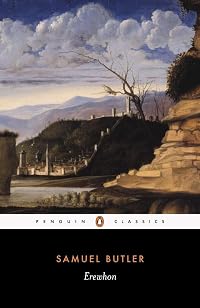
Samuel Butler's Erewhon, or Over the Range was published anonymously 1872. In this satire of Victorian society, the main character Higgs discovers an unknown country, the seeming utopia called Erewhon, Nowhere backwards with the "h" and "w" transposed. The starting chapters detailing the discovery of Erewhon were based on Butler's experiences in New Zealand as a young man. Butler was possibly the first to write about the idea that machines might one day develop consciousness through the show more process of Darwinian Selection.. show less
Tags
Recommendations


























Member Recommendations
KayCliff Both books are satirical accounts of supposedly perfect societies, found by a strange voyage.
30

Hav by Jan Morris
by Cecrow
Member Reviews
Social satire tale bookended by the adventure sections needed to travel to and from Erewhon (aka nowhere). These sections i found slow going but can't quite figure out why. The satire elements have some GREAT ideas. The author has a wonderful way of making you think by showing things in an absurd light. Also theres some amazing stuff about the fear of machines rising up and taking over, remember this is 1872!!!!. Eat your heart our James Cameron.
The narrator of this story (anonymous, of course) discovers an entire civilization hidden beyond a mountain range in a nonspecific British colony very much like New Zealand. As the title implies, the civilization is very much like Victorian Britain, but backwards-- people go to jail for being sick, and are treated for committing crimes. The novel, published just a year after The Coming Race and similarly lacking in incident, really succeeds on the basis of this inversion, which Butler manages to stick to with amazing depth, exploring how people go to court for losing wives and how people fake crimes to get out of unwanted social obligations! In doing so, the novel exposes the somewhat arbitrary ways that Victorian Britain had show more constructed its own discourses of knowledge-- why should crime being entirely the perpetrator's fault and sickness entirely not?-- and these are discourses that continue to the present in many ways. Plus, these little reversals were just fun to read about: people are said to have "got the socks" when they have an urge to steal something trivial. (There's even a woman who fakes alcoholism to gain sympathy, but everyone knows she's lying as she never touches the stuff!)
There's also some material about the weird "Musical Banks" (everyone puts money in them, but no one quite knows why) and the very familiar "Colleges of Unreason" (where having a good idea is grounds for failure), but the most fascinating part of the novel is the excerpt from The Book of the Machines, the text that caused the Erewhonians to give up all technology. Well, up to a certain arbitrary point anyway, as it's admittedly impossible to have a civilization with no technology. Butler pulls together technological fears with Darwin's theories of natural selection, pointing out that machines are evolving-- continuously improving themselves, as inferior machines die out and better adapted ones take their place. And given how much faster machines evolve, shouldn't humanity be worried? The Erewhonians thought so, but there's also an excerpt from another philosopher who thought this was wrong because the evolution of machines is now the way humanity evolves, and they're essentially just an extension of ourselves. It's great, clever stuff: not only has Butler written what is surely one of the first oh-my-god-machines-are-going-to-take-over-the-world-and-kill-us-all stories, but he's also come up with the counterargument that precious few people are able to see, a full eleven decades before Donna Haraway's cyborg theory, and even eight decades before Asimov's greatest robot story, "The Evitable Conflict." It still stands up as a clever and thoughtful piece of writing, all the moreso for the fact that I can't figure out where Butler himself stands on the issue! show less
There's also some material about the weird "Musical Banks" (everyone puts money in them, but no one quite knows why) and the very familiar "Colleges of Unreason" (where having a good idea is grounds for failure), but the most fascinating part of the novel is the excerpt from The Book of the Machines, the text that caused the Erewhonians to give up all technology. Well, up to a certain arbitrary point anyway, as it's admittedly impossible to have a civilization with no technology. Butler pulls together technological fears with Darwin's theories of natural selection, pointing out that machines are evolving-- continuously improving themselves, as inferior machines die out and better adapted ones take their place. And given how much faster machines evolve, shouldn't humanity be worried? The Erewhonians thought so, but there's also an excerpt from another philosopher who thought this was wrong because the evolution of machines is now the way humanity evolves, and they're essentially just an extension of ourselves. It's great, clever stuff: not only has Butler written what is surely one of the first oh-my-god-machines-are-going-to-take-over-the-world-and-kill-us-all stories, but he's also come up with the counterargument that precious few people are able to see, a full eleven decades before Donna Haraway's cyborg theory, and even eight decades before Asimov's greatest robot story, "The Evitable Conflict." It still stands up as a clever and thoughtful piece of writing, all the moreso for the fact that I can't figure out where Butler himself stands on the issue! show less
I first read this about a decade ago and didn't remember much aside from the sporking of vegetarianism. I now understand a lot more about the context of when this was written and I think was able to get a bit more value out of it.
Interestingly some stuff seemed still relevant today, especially the part about smashing statues - the Erewhonians believing that all statues should be destroyed after 50 years unless a jury of people picked from the street can be found to declare it should stay. With the debates going on right now, perhaps we ought to take a page from their book!
The chapters on machines also show that the fear of the inevitable machine takeover is not new.
On my last reading I thought that the "crime is a sickness" think was show more satirising rehabilitative justice, which it may well be, but this time I realised that the whole "sickness is a crime" thing is pretty much just eugenics laid out bare. Considering some of the book was a response to Darwin, it's possible this was intended. show less
Interestingly some stuff seemed still relevant today, especially the part about smashing statues - the Erewhonians believing that all statues should be destroyed after 50 years unless a jury of people picked from the street can be found to declare it should stay. With the debates going on right now, perhaps we ought to take a page from their book!
The chapters on machines also show that the fear of the inevitable machine takeover is not new.
On my last reading I thought that the "crime is a sickness" think was show more satirising rehabilitative justice, which it may well be, but this time I realised that the whole "sickness is a crime" thing is pretty much just eugenics laid out bare. Considering some of the book was a response to Darwin, it's possible this was intended. show less
I loved Butler's 'The Way of All Flesh', but to be frank I found this one more work than it was worth, and really struggled to the end. I love the idea - sending up social and religious mores by reflecting them in a society where up is down, left is right (and where being sick makes you a criminal, and the possession of any technological device can get you in real trouble), but unlike Swift - who accomplished much the same thing in Gulliver's Travels - you never really feel carried along for the ride by Butler. And that's the problem - this is a novel that feels much more like a textbook than like a story book, and after having sat through my own schooling like anyone at the College of Unreason, I'm rather glad not to have to do that show more anymore. show less
Despite a truly impressive level of irony throughout, ‘Erewhon’ takes a lot more effort to read than I expected for such a short book. There are several reasons for this, the most important being the deeply annoying narrator. While he is almost certainly meant to be annoying, this fact in no way detracts from the overall annoyance. Seventy pages pass before he even gets to the mysterious lost civilisation of Erewhon, during which time the reader gets mighty tired of Victorian colonialist attitudes. Rapacious greed is complemented by ugly racism and patronising hypocrisy. From the perspective of nearly 150 years later, it’s very difficult to tell how much of this is parody and how much sincere. From the introduction (read last, as show more ever), this has always been a problem with Butler’s work, given his tendency to argue both sides. It obviously isn’t necessary to know the author’s intentions, however it’s also depressing to contemplate how realistic the narrator’s perspective may have seemed in the 1870s.
‘Erewhon’ became a more interesting and worthwhile read in the latter half, when attempts at travelogue are largely abandoned in favour of lectures on Erewhon’s ideological and social idiosyncrasies. Butler has no gift for plotting or characterisation, but some of his absurdist philosophisification is genuinely fascinating. I also found the sting in the tail shocking: the narrator plans to sell the Erewhonians into slavery, which he justifies on the basis that they aren’t Christians. Holy fuck, that’s absolutely monstrous .
Here’s an example of Butler making me wonder to what extent he was being ironic:
Conversely, here is an example of where I was more confident of parodic intent, yet Butler managed to prefigure current debates about mechanisation and AI in a manner that verges on uncanny:
There is some interesting philosophical wrangling to be found in here, unfortunately you have to dig for it rather. I also get the impression that Butler would be one of those irritating conversation partners who insists on perpetually playing devil’s advocate for no good reason. This vintage dystopia includes some clever ideas, although the modern reader can easily get frustrated by the manner of their expression. show less
‘Erewhon’ became a more interesting and worthwhile read in the latter half, when attempts at travelogue are largely abandoned in favour of lectures on Erewhon’s ideological and social idiosyncrasies. Butler has no gift for plotting or characterisation, but some of his absurdist philosophisification is genuinely fascinating. I also found the sting in the tail shocking
Here’s an example of Butler making me wonder to what extent he was being ironic:
Who shall limit the right of society except society itself? And what consideration for the individual is tolerable unless society is the gainer thereby? Wherefore should a man be so richly rewarded for having been son to a millionaire, were it not clearly provable that the common welfare is thus better furthered? We cannot serious detract from a man’s merit in having been the son of a rich father without imperilling our own tenure of things which we do not wish to jeopardise; if this were otherwise we should not let him keep his money for a single hour; we would have it ourselves at once. For property is robbery, but then, we are all robbers or would-be robbers together, and have found it essential our thieving, as we have found it necessary to organise our lust and our revenge.
Conversely, here is an example of where I was more confident of parodic intent, yet Butler managed to prefigure current debates about mechanisation and AI in a manner that verges on uncanny:
I would repeat that I fear none of the existing machines; what I fear is the extraordinary rapidity with which they are becoming something very different to what they are at present. No class of beings have in any time past made so rapid a movement forward. Should not that movement be jealously watched, and checked while we still can check it? [...] We cannot calculate on any corresponding advance in man’s intellectual or physical powers which shall be a set-off against the far greater development which seems in store for the machines. Some people may say that man’s moral influence will suffice to rule them; but I cannot think it will ever be safe to repose such much trust in the moral sense of any machine.
There is some interesting philosophical wrangling to be found in here, unfortunately you have to dig for it rather. I also get the impression that Butler would be one of those irritating conversation partners who insists on perpetually playing devil’s advocate for no good reason. This vintage dystopia includes some clever ideas, although the modern reader can easily get frustrated by the manner of their expression. show less
Erewhon is an anagram for Nowhere. Butler's novel is a satire of late 19th century England. Erewhon is a kind of Shangri La, a medieval, European-like country, populated by what might be the lost 13th tribe of Israel. Their customs are odd - they are frozen in time having a deep distrust of technology, they are rational thinkers but esteem hypothetical knowledge over common sense, they punish the sick for the the crime of being ill but consider felony a mere misdemeanor. It's a strange, upside down society, and Butler's descriptions alternate between light humor and parody and deep philosophy. The novel's main weakness is a lack of deep character development; its primary strength its prescience and intellectual heft. If your'e looking show more for contemporary parody that's more relevant and funnier, I'd steer you to The Onion before recommending this somewhat outdated novel. show less
'Erewhon' podría enmarcarse en la llamada pre-ciencia ficción. El libro, escrito en 1872, nos cuenta el tiempo que vivió el protagonista y narrador en el país de Erewhon, una sociedad claramente distópica, pero que para sus habitantes es todo lo contrario, y aquí es donde entra en juego la parte utópica.
La historia comienza cuando el protagonista llega a una nueva región (aunque no se nombra en ningún momento, ésta parece ser Nueva Zelanda, lugar al que viajó el autor en su juventud), donde igual te encuentras zonas inhóspitas que montañas con nieves eternas. Su mayor ambición es encontrar buenas tierras para ganado, y es por ello que un buen día sale a explorar. Así es como da con un país oculto entre montañas del que show more no se tenía noticia alguna, Erewhon, cuyos habitantes tienen unas leyes y costumbres totalmente desquiciadas, y me quedo corto con el apelativo.
En Erewhon la enfermedad física está mal vista y según su gravedad puedes ir a la cárcel condenado a trabajos forzados. Sin embargo, la enfermedad moral no está tan mal vista. Si has estafado, el gobierno hará todo lo posible por rehabilitarte. El tema de los nacimientos tampoco tiene desperdicio. Un recien nacido es una gran ofensa para la familia, y más le valdría a éste haberse quedado en el reino de los nonatos. Con decir que el protagonista, a pesar de ser un extranjero, está bien visto por ser rubio, por ser inusual, está todo dicho. Y eso que llevaba un reloj de bolsillo, una aberración para los erewhonianos.
Los capítulos dedicados al Libro de las Máquinas son los mejores. En ellos se nos aclara porqué se prohibieron todas las máquinas en el país hace cientos de años. Es decir, que habiéndose adelantado al resto del mundo, renunciaron al progreso. Butler, el autor, realiza aquí un análisis sorprendente para la época: "¿No puede durar el mundo veinte millones de años todavía? Si así fuere, ¡qué no llegarán a ser las máquinas! ¿No sería más prudente cortar el mal de raíz prohibiendo los nuevos adelantos?"
El libro rezuma reflexiones de este tipo, la mar de interesantes. Pero también se hace muy aburrido. Butler se pone demasiado pedagógico a veces, y la historia se hace pesada. Una novela interesante sin más. show less
La historia comienza cuando el protagonista llega a una nueva región (aunque no se nombra en ningún momento, ésta parece ser Nueva Zelanda, lugar al que viajó el autor en su juventud), donde igual te encuentras zonas inhóspitas que montañas con nieves eternas. Su mayor ambición es encontrar buenas tierras para ganado, y es por ello que un buen día sale a explorar. Así es como da con un país oculto entre montañas del que show more no se tenía noticia alguna, Erewhon, cuyos habitantes tienen unas leyes y costumbres totalmente desquiciadas, y me quedo corto con el apelativo.
En Erewhon la enfermedad física está mal vista y según su gravedad puedes ir a la cárcel condenado a trabajos forzados. Sin embargo, la enfermedad moral no está tan mal vista. Si has estafado, el gobierno hará todo lo posible por rehabilitarte. El tema de los nacimientos tampoco tiene desperdicio. Un recien nacido es una gran ofensa para la familia, y más le valdría a éste haberse quedado en el reino de los nonatos. Con decir que el protagonista, a pesar de ser un extranjero, está bien visto por ser rubio, por ser inusual, está todo dicho. Y eso que llevaba un reloj de bolsillo, una aberración para los erewhonianos.
Los capítulos dedicados al Libro de las Máquinas son los mejores. En ellos se nos aclara porqué se prohibieron todas las máquinas en el país hace cientos de años. Es decir, que habiéndose adelantado al resto del mundo, renunciaron al progreso. Butler, el autor, realiza aquí un análisis sorprendente para la época: "¿No puede durar el mundo veinte millones de años todavía? Si así fuere, ¡qué no llegarán a ser las máquinas! ¿No sería más prudente cortar el mal de raíz prohibiendo los nuevos adelantos?"
El libro rezuma reflexiones de este tipo, la mar de interesantes. Pero también se hace muy aburrido. Butler se pone demasiado pedagógico a veces, y la historia se hace pesada. Una novela interesante sin más. show less
Members
- Recently Added By
Lists

1001 Books You Must Read Before You Die
1,448 works; 1,136 members

The Guardian's 1000 Novels Everyone Must Read
1,005 works; 552 members

Best Science Fiction Novels
816 works; 426 members
Best Dystopias
280 works; 277 members

Western World's Greatest Books - Project Gutenberg
295 works; 15 members

1,001 BYMRBYD Concensus
723 works; 27 members

Books Read in 2023
5,638 works; 147 members

Welcome to Ruritania!
22 works; 4 members

CCE 1000 Good Books List
1,033 works; 12 members

Read These Too
458 works; 9 members

Harold Bloom - The Western Canon: C. The Democratic Age
336 works; 15 members

Trinity College Booklist (1951): Class Ten, English Literature
358 works; 5 members

My TBR
371 works; 3 members

2025 Reading List
51 works; 2 members
Author Information

62+ Works 7,238 Members
The son of a clergyman and grandson of an Anglican bishop, Samuel Butler seemed destined for a life in the church. After graduating from Cambridge, however, he spent some time in New Zealand as a sheep-rancher. When he returned to England, he settled down as a journalist and writer. He engaged in many controversies over Darwinism. Butler is best show more known by two satirical novels, Erewhon (1872) and The Way of All Flesh (1903). Erewhon, an anagram for "nowhere," attacked contemporary attitudes in science, religion, and social mores. The Way of All Flesh was a study of the Pontifex family in a surprisingly modern tone. Erewhon Revisited (1901) continues his attack on religion. Another work, The Fair Haven (1873), is another subtle attack on religion, presented in the guise of a defense of the Gospels, though it actually undermines them. The Family Letters is a selection from the correspondence of Butler and his father, with several letters to and from his mother and sisters and one or two other relatives. Those between Butler and his father show how close the early part of The Way of All Flesh was to the events in the son's life. A brilliant, versatile writer, Butler was one of the most searching critics of his time. Butler died in 1902. (Bowker Author Biography) show less
Some Editions
Awards and Honors
Notable Lists
Series

Belongs to Publisher Series
Gregynog Press (1932)
Florin Books (4)
D'ací i d'allà (73)
Limited Editions Club (S:5.06)
Penguin Books (20)
Goldmann (6793)
Die Andere Bibliothek (120)
Airmont Classics (130)
Work Relationships
Is contained in
Is abridged in
Is replied to in
Has as a reference guide/companion
Common Knowledge
- Canonical title*
- Erewhon
- Original title
- Erewhom: or, Over the Range; Erewhon, or Over the Range
- Alternate titles
- Erewhon, or Over the Range
- Original publication date
- 1872
- People/Characters
- Higgs; Chowbok; Yram; Senoj Nosnibor; Zulora; Arowhena (show all 8); Mahaina; Ydgrun
- First words
- If the reader will excuse me, I will say nothing of my antecedents, nor of the circumstances which led me to leave my native country; the narrative would be tedious to him and painful to myself.
The author wishes it to be understood that Erewhon is pronounced as a word of three syllables, all short - thus, E-re-whon. (Preface to the First Edition)
My publisher wishes me to say a few words about the genesis of the work, a revised and enlarged edition of which he is herewith laying before the public. (Preface to the Revised Edition)
Having been enabled by the kindness of the public to get through an unusually large edition of Erewhon in a very short time, I have taken the opportunity of a second edition to make some necessary corrections, and to a... (show all)dd a few passages where it struck me that they would be appropriately introduced; the passages are few, and it is my fixed intention never to touch the work again. (Preface to the Second Edition) - Last words
- (Click to show. Warning: May contain spoilers.)At the last moment I see a probability of a complication which causes me much uneasiness. Please subscribe quickly. Address to the Mansion-House, care of the Lord Mayor, whom I will instruct to receive names and subscriptions for me until I can organise a committee.
(Click to show. Warning: May contain spoilers.)Address to the Mansion House, care of the Lord Mayor, whom I will instruct to receive names and subscriptions for me until I can organise a committee.
(Click to show. Warning: May contain spoilers.)Nevertheless, though in literary workmanship I do not doubt that this last-named book is an improvement on the first, I shall be agreeably surprised if I am not told that Erewhon, with all its faults, is the better reading of the two. (Preface to the Revised Edition)
(Click to show. Warning: May contain spoilers.)I must not conclude without expressing my most sincere thanks to my critics and to the public for the leniency and consideration with which they have treated my adventures. (Preface to the Second Edition) - Original language
- English
- Canonical DDC/MDS
- 823.8
- Canonical LCC
- PR4349.B7 E6
*Some information comes from Common Knowledge in other languages. Click "Edit" for more information.
Classifications
Statistics
- Members
- 2,359
- Popularity
- 8,374
- Reviews
- 43
- Rating
- (3.23)
- Languages
- 14 — Catalan, Danish, Dutch, English, Esperanto, Estonian, Finnish, French, German, Greek, Italian, Spanish, Swedish, Turkish
- Media
- Paper, Audiobook, Ebook
- ISBNs
- 148
- UPCs
- 1
- ASINs
- 99