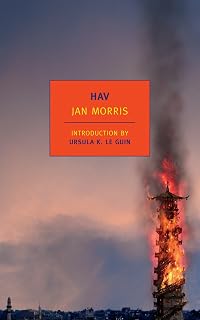
Hav
by Jan Morris
On This Page
Description
"Hav is like no place on earth. Rumored to be the site of Troy, captured during the crusades and recaptured by Saladin, visited by Tolstoy, Hitler, Grace Kelley, and Princess Diana, this Mediterranean city-state is home to several architectural marvels and an annual rooftop race that is a feat of athleticism and insanity. As Jan Morris guides us through the corridors and quarters of Hav, we hear the mingling of Italian, Russian, and Arabic in its markets, delight in its famous snow show more raspberries, and meet the denizens of its casinos and cafe?s. When Morris published Last Letters from Hav in 1985, it was short-listed for the Booker Prize. Here it is joined by Hav of the Myrmidons, a sequel that brings the story up-to-date. Twenty-first century Hav is nearly unrecognizable. Sanitized and monetized, it is ruled by a group of fanatics who have rewritten its history to reflect their own blinkered view of the past."--Page 4 of cover. show lessTags
Recommendations













Member Recommendations
ed.pendragon Miéville's The City and the City acknowledges Jan Morris as an influence on his fractured cities novel, and Morris' travel book novel Hav (fictional trips to a fictional state) is the most likely reference.
20

ed.pendragon Two imaginary countries, Hav and Orsinia, which are almost mind maps of their respective authors.
31
CGlanovsky Short story beginning with the discovery of an encyclopedia article about a non-existent country called Uqbar.

by Cecrow
DarthFisticuffs Both books are about a person exploring a fictional city as a tourist/academic, and are about what it means to be in and of a place, regardless of whether it exists at all
Member Reviews
A travel writer arrives at a tiny, once thriving Levantine city-state on the shores of the Mediterranean. She meets the people, sees the sights, evokes past and present through delicate description and historical anecdote, not always reliable, but even the stories are indicative of some aspect of the personality of the place. It is rich with culture and full of history, and yet it is an odd, elusive place, all surface, all smiles, hard to pin down, hard to truly understand. She will never understand the place. Her account is occasionally interrupted by odd little hints of things beneath the surface. They never coalesce into any real threat or danger or suspense, until the final pages, when with discreet and refined bewilderment she is show more ushered to the border, building to the incredible, subtle crescendo of the final line of Letters To Hav.
Hav, of course, is fictional, an invention by travel writer Jan Morris, who is also a character in this book. It is a 'hazy allegory,' but its true allegory is the difficulty of understanding a place. In Hav of The Myrmidons she returns, briefly, and discovers it transformed. It is more surface, louder, brighter, richer. And though she clearly prefers to withhold judgement and let people's own words speak for them, she cannot hide her frustration and even her anger that the changes have made the place even more hidden and ambiguous and secret.
A brilliant book, beautifully written, an astonishing piece of worldbuilding that hauntingly evokes modern dilemmas and confusions as much as it evokes a place. show less
Hav, of course, is fictional, an invention by travel writer Jan Morris, who is also a character in this book. It is a 'hazy allegory,' but its true allegory is the difficulty of understanding a place. In Hav of The Myrmidons she returns, briefly, and discovers it transformed. It is more surface, louder, brighter, richer. And though she clearly prefers to withhold judgement and let people's own words speak for them, she cannot hide her frustration and even her anger that the changes have made the place even more hidden and ambiguous and secret.
A brilliant book, beautifully written, an astonishing piece of worldbuilding that hauntingly evokes modern dilemmas and confusions as much as it evokes a place. show less
Jan Morris has travelled more than you or I ever will, and has likewise thought about traveling more deeply and written about traveling more prolifically than all but a few people alive today. In Hav, Morris distills that experience for the reader, giving us a guided tour through the city of her imagination, which amalgamates many of the locations- and more importantly, the experiences- that Morris has been through during her life.
Don't expect fully realized characters or much of a plot, this book is almost pure setting. Hav has a dash of a dozen different cultures mixed together, both ancient and contemporary, less a melting pot than a salad with every piece distinct despite having been squished together. Impressively, despite the fact show more that intellectually you know that such a city can't exist, Morris makes it feel real. During the first fictional trip to Hav (entitled Last Letters from Hav) the character Jan visits the many different realms contained in Hav, from Chinese settlements to ancient Greek monuments to troglodytes living in the mountains to a caliph in hiding to a middle eastern medina to a meeting of a secret society. In her epilogue Morris discusses this first part as creating a city where the tension stems from overlapping history, motivated by Morris' realization that despite her extensive experience traveling she very rarely feels like she gets to know the places she is visiting, or understands exactly what is happening. It's the traveller's curse, and in the first part of the book Morris makes such a feeling manifest by presenting us a city so complex it can probably never be understood even by natives, much less by tourists. The first part ends as tensions begin to rise in Hav, and a war of sorts approaches. Morris expertly captures the extra layer of uncertainty felt by a traveller during such times of crises, when you sense things are going wrong but you don't quite have a firm enough footing on the underlying culture and society to say for sure.
The second part of the book is perhaps even more impressive, as Morris returns to Hav after the rise of certain ill-defined powers in the wake of the military intervention that ended the first part. Though it's not always entirely clear who the powers at work are, what they are doing is made obvious: the new administration is transforming Hav from the old clutter of cultures and ideologies into a streamlined economic hub and tourist destination. The ancient and strange bits of character that used to make the city special are being sanded down, the history of the city being manipulated- "brainwashing really"- for the sake of commercialization. Yet though this shift seems terrible through the eyes of a tourist, this new Hav often seems better for the actual inhabitants of the city. Better houses, more jobs, greater safety (the narrator and another character lament that the famous roof-race of Hav has been revamped to make it safer and more uniform, stripping it of all it's charm. Of course it's important to remember that the charm brought on by the old race's danger regularly resulted in the deaths of the participants). These benefits come at the cost of much of Hav's former culture, and it's strongly suggested that the new government is totalitarian in nature, but the transformation is still not black-and-white.
Hav is a fascinating book, letting you experience the many questions that Morris has wrestled with throughout her travels without ever beating you over the head with them. Through the city of Hav you experience the feel of a dozen different cities, and experience a city changing from one of old but unique delights to one of generic manufactured cleanliness and prosperity. It's not for everyone, as the volume is essentially just the wanderings and wonderings of a travel writer through a fictional city sans plot or characters, and there's rarely any sense of urgency for you to turn the page, but if the idea of experiencing how a travel writer has seen the world and its evolution appeals to you then I highly recommend that you pick it up. show less
Don't expect fully realized characters or much of a plot, this book is almost pure setting. Hav has a dash of a dozen different cultures mixed together, both ancient and contemporary, less a melting pot than a salad with every piece distinct despite having been squished together. Impressively, despite the fact show more that intellectually you know that such a city can't exist, Morris makes it feel real. During the first fictional trip to Hav (entitled Last Letters from Hav) the character Jan visits the many different realms contained in Hav, from Chinese settlements to ancient Greek monuments to troglodytes living in the mountains to a caliph in hiding to a middle eastern medina to a meeting of a secret society. In her epilogue Morris discusses this first part as creating a city where the tension stems from overlapping history, motivated by Morris' realization that despite her extensive experience traveling she very rarely feels like she gets to know the places she is visiting, or understands exactly what is happening. It's the traveller's curse, and in the first part of the book Morris makes such a feeling manifest by presenting us a city so complex it can probably never be understood even by natives, much less by tourists. The first part ends as tensions begin to rise in Hav, and a war of sorts approaches. Morris expertly captures the extra layer of uncertainty felt by a traveller during such times of crises, when you sense things are going wrong but you don't quite have a firm enough footing on the underlying culture and society to say for sure.
The second part of the book is perhaps even more impressive, as Morris returns to Hav after the rise of certain ill-defined powers in the wake of the military intervention that ended the first part. Though it's not always entirely clear who the powers at work are, what they are doing is made obvious: the new administration is transforming Hav from the old clutter of cultures and ideologies into a streamlined economic hub and tourist destination. The ancient and strange bits of character that used to make the city special are being sanded down, the history of the city being manipulated- "brainwashing really"- for the sake of commercialization. Yet though this shift seems terrible through the eyes of a tourist, this new Hav often seems better for the actual inhabitants of the city. Better houses, more jobs, greater safety (the narrator and another character lament that the famous roof-race of Hav has been revamped to make it safer and more uniform, stripping it of all it's charm. Of course it's important to remember that the charm brought on by the old race's danger regularly resulted in the deaths of the participants). These benefits come at the cost of much of Hav's former culture, and it's strongly suggested that the new government is totalitarian in nature, but the transformation is still not black-and-white.
Hav is a fascinating book, letting you experience the many questions that Morris has wrestled with throughout her travels without ever beating you over the head with them. Through the city of Hav you experience the feel of a dozen different cities, and experience a city changing from one of old but unique delights to one of generic manufactured cleanliness and prosperity. It's not for everyone, as the volume is essentially just the wanderings and wonderings of a travel writer through a fictional city sans plot or characters, and there's rarely any sense of urgency for you to turn the page, but if the idea of experiencing how a travel writer has seen the world and its evolution appeals to you then I highly recommend that you pick it up. show less
Despite irritating minor typos (not even corrected in the paperback edition) this is a wonderful book obsessing on dualities: ancient and modern, East and West, Light and Dark, land and sea, transparency and the occluded. The addition of Hav of the Myrmidons in 2006 to the 1985 Last Letters from Hav (presumably written as if to Morris' partner Elizabeth) adds to that sense of duality: as the earlier Letters ended a half year of somnolent unreality with the brutal suddenness of the Intervention, so does the mirroring second half of Hav end a six day tour of puzzling contradictions with a brusque departure.
Hav appears to be an independent state on a peninsula of Asia Minor, close enough to the known site of Troy to have been considered, show more Morris suggests, a contender; like Troy it has been coveted by other nation states, squabbled over by invading armies and temporarily ruled by transient empires. Hav itself is like an amalgam of all those liminal territories such as Hong Kong or Trieste that Morris herself has visited for her travelogues, and resonant with echoes of a few other polities such as Istanbul or Malta which have been at the crossroads of cultures. The Hav of the 1980s is a little quaint, a relic of its past histories but decaying in its inertia. While no less Kafkaesque post-9/11 Hav no longer retains its picture postcard attraction: all that has mostly been swept away by the sinister but shadowy forces behind the Intervention, leaving tourists in a modernist enclave and a population that is even more reticent to disclose what, if anything, is controlling Hav.
Morris' persona observes topography and demography alike with poetry and seeming ingenuousness, her descriptive and narrative skills making much of her imaginary land very real and believable. In the 1980s you mourn the imminent passing of an exotic state that has become anachronistic; in the new millennium you despair of the faceless machine that it has become. While Morris gets to meet many of her previous 1986 acquaintances in 2005, she is unable to get to the heart of what Hav has really become, though we can guess that the state has succumbed to the fate of many a nation turned totalitarian and subjected to a cultural revolution.
For anyone remotely interested in history and culture and in dialogue and interaction Morris' book has much to admire and celebrate. Aided by two outline maps separated by two decades, plus uncredited sketches presumably by Morris herself (the second group clearly being executed in seeming haste), she artlessly delineates the surviving architecture and hinterland of Hav City, blending the rich heritages of the Mediterranean and beyond into what at first seems an idealised backwater jewel surviving on past glories but which violently metamorphoses into another faceless metropolis of thrusting highrise structures, epitomised by the 2000-ft Myrmidonic Tower rivalling anything that Dubai can offer and twice as high as the Eiffel Tower or the London Shard.
I've already mentioned the notion of dualities that permeates Hav which is underlined by the Manichaean religion of the Cathar sect that emerges in the first part to rule the Holy Myrmidonic Republic in the second. The other notion that saturates the novel is the circular labyrinth, and though Morris never illustrates the exact form that this takes it is clear that it is not the simple unicursal or Cretan labyrinth that we have to imagine but the multicursal maze with numerous dead ends, where often as we seem to be approaching the centre the path veers off confusingly in another direction. And it is in the conjunction of duality and labryrinth that I think we have to find a key to what Hav is about.
Morris seems well aware of the contradictions that she encapsulates: gender-reassigned herself, she has veered from active service as a soldier in World War II to reportage as a travel-writer post-surgery. Her mother was English, and she was born in Somerset (perhaps the region referred to in a medieval Latin pun as 'the Summer Country'); her father was Welsh, however, and she certainly regards herself as Welsh, so it is noteworthy that she surmises that the name of Hav is derived from a pan-Celtic word meaning 'summer'. The puns don't just stop there. Morris is of course a common Welsh name, which may owe its popularity not just to medieval Norman influence but also ultimately to the Roman name Mauricius, from maurus meaning Moorish or dark-skinned, and which is thus a wonderfully ambivalent name.
A solution of sorts to the enigma that is Hav may come from the image of the pencil-thin Myrmidonic Tower that ends the novel. Standing moreorless centrally on the Lazaretto island, with its streets deliberately laid out in labyrinthine fashion, the tower looks down on a Borgesian pattern that most resembles the folds of a human brain. At the very close of the final chapter, as Morris flies from Hav for the last time as a persona non grata, she spies the giant letter M at the Tower's summit "shining there fainter and fainter, smaller and smaller," and she speculates on what the letter really stands for. Myrmidons, the legendary warriors of Achilles? Manichaean? Maze? "Or, could it possibly be ... 'M' for Me?" She can't really be clearer, I think: M is for Morris, the tourist who visits liminal places which exist only in her mind. What a privilege then that she agrees to share her experiences with us.
http://calmgrove.wordpress.com/?s=a+new+troy show less
Hav appears to be an independent state on a peninsula of Asia Minor, close enough to the known site of Troy to have been considered, show more Morris suggests, a contender; like Troy it has been coveted by other nation states, squabbled over by invading armies and temporarily ruled by transient empires. Hav itself is like an amalgam of all those liminal territories such as Hong Kong or Trieste that Morris herself has visited for her travelogues, and resonant with echoes of a few other polities such as Istanbul or Malta which have been at the crossroads of cultures. The Hav of the 1980s is a little quaint, a relic of its past histories but decaying in its inertia. While no less Kafkaesque post-9/11 Hav no longer retains its picture postcard attraction: all that has mostly been swept away by the sinister but shadowy forces behind the Intervention, leaving tourists in a modernist enclave and a population that is even more reticent to disclose what, if anything, is controlling Hav.
Morris' persona observes topography and demography alike with poetry and seeming ingenuousness, her descriptive and narrative skills making much of her imaginary land very real and believable. In the 1980s you mourn the imminent passing of an exotic state that has become anachronistic; in the new millennium you despair of the faceless machine that it has become. While Morris gets to meet many of her previous 1986 acquaintances in 2005, she is unable to get to the heart of what Hav has really become, though we can guess that the state has succumbed to the fate of many a nation turned totalitarian and subjected to a cultural revolution.
For anyone remotely interested in history and culture and in dialogue and interaction Morris' book has much to admire and celebrate. Aided by two outline maps separated by two decades, plus uncredited sketches presumably by Morris herself (the second group clearly being executed in seeming haste), she artlessly delineates the surviving architecture and hinterland of Hav City, blending the rich heritages of the Mediterranean and beyond into what at first seems an idealised backwater jewel surviving on past glories but which violently metamorphoses into another faceless metropolis of thrusting highrise structures, epitomised by the 2000-ft Myrmidonic Tower rivalling anything that Dubai can offer and twice as high as the Eiffel Tower or the London Shard.
I've already mentioned the notion of dualities that permeates Hav which is underlined by the Manichaean religion of the Cathar sect that emerges in the first part to rule the Holy Myrmidonic Republic in the second. The other notion that saturates the novel is the circular labyrinth, and though Morris never illustrates the exact form that this takes it is clear that it is not the simple unicursal or Cretan labyrinth that we have to imagine but the multicursal maze with numerous dead ends, where often as we seem to be approaching the centre the path veers off confusingly in another direction. And it is in the conjunction of duality and labryrinth that I think we have to find a key to what Hav is about.
Morris seems well aware of the contradictions that she encapsulates: gender-reassigned herself, she has veered from active service as a soldier in World War II to reportage as a travel-writer post-surgery. Her mother was English, and she was born in Somerset (perhaps the region referred to in a medieval Latin pun as 'the Summer Country'); her father was Welsh, however, and she certainly regards herself as Welsh, so it is noteworthy that she surmises that the name of Hav is derived from a pan-Celtic word meaning 'summer'. The puns don't just stop there. Morris is of course a common Welsh name, which may owe its popularity not just to medieval Norman influence but also ultimately to the Roman name Mauricius, from maurus meaning Moorish or dark-skinned, and which is thus a wonderfully ambivalent name.
A solution of sorts to the enigma that is Hav may come from the image of the pencil-thin Myrmidonic Tower that ends the novel. Standing moreorless centrally on the Lazaretto island, with its streets deliberately laid out in labyrinthine fashion, the tower looks down on a Borgesian pattern that most resembles the folds of a human brain. At the very close of the final chapter, as Morris flies from Hav for the last time as a persona non grata, she spies the giant letter M at the Tower's summit "shining there fainter and fainter, smaller and smaller," and she speculates on what the letter really stands for. Myrmidons, the legendary warriors of Achilles? Manichaean? Maze? "Or, could it possibly be ... 'M' for Me?" She can't really be clearer, I think: M is for Morris, the tourist who visits liminal places which exist only in her mind. What a privilege then that she agrees to share her experiences with us.
http://calmgrove.wordpress.com/?s=a+new+troy show less
Hav by the Welsh travel writer Jan Morris is a very Borgesian work, bringing to mind the Argentinean writer’s love for mirrors and labyrinths. There is even a character named Dr. Borge and Hav’s major cultural motif is the labyrinth. Morris achieves distinction in creating a place that goes beyond being a second-rate pastiche of Borges themes. Unfortunately, the field of science fiction is riddled with examples of good ideas soured when executed. Poor execution usually involves with sloppy writing that denotes the author received payment by the word.
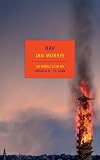
New York Review Books has released a stellar volume with Jan Morris’s Hav. The book compiles her two works of science fiction, Last Letters from Hav (1985) and Hav of the Myrmidons show more (2006). The volume also includes an introduction by science fiction writer Ursula K. Le Guin and an epilogue by the author. In the introduction Le Guin notes how readers began booking trips to Hav, not knowing it was fiction. After reading Morris’s Destinations: Essays from Rolling Stone, one can understand the reader’s oversight of Hav’s non-existence. Her travel essays for Rolling Stone, written in the 1970s, envelop the reader with a keenly constructed sense of place, quirky characters, and a narrative drive, though not necessarily plot-based. This non-fiction writing is reflected in her fiction, creating a plausible locale. Hav, a tiny Mediterranean peninsula off of Anatolia, possesses a culture frozen in amber, isolated from the world at large, but also an amalgamation of Eastern and Western cultures reflective of the wars, conquests, and commerce that passed through the area.
Last Letters sees Hav as a sleepy community with an outdated bureaucracy, an ambiguous British colonial political presence, and a multicultural kaleidoscope. On the Escarpment reside the primitive Kretevs. Arabs, Greeks, and Chinese reside in their own ethnic enclaves. Hav has the westernmost settlement of Chinese, owing to the proximity of the Silk Road. The Venetian and Russian empires made their marks in art and architecture. A muezzin cries along with Missakian’s trumpet call, a remnant of the Crusader’s retreat. The back cover summary describes Hav as having “chaotic and contradictory splendor.”
One should note that this is not alternate history. Hav’s fate follows the ebb and tide of history, albeit from the perspective of a geographic asterisk. A humorous passage in Last Letters involves the local intellectual circle hating Ferdinand Braudel because he never mentioned Hav in his monumental survey The Mediterranean and the Mediterranean World in the Age of Philip II. Le Guin states in the introduction,
"Probably Morris, certainly her publisher, will not thank me for saying Hav is in fact science fiction, of a perfectly recognizable type and superb quality. The “sciences” or areas of expertise involved are social – ethnology, sociology, political science, and above all, history."
Morris’s writing is what makes Hav such a treasure to read. Described as a “romantic traditionalist Welsh author,” she approaches travel at a different speed and pitch than Anthony Bourdain. Morris’s character of Jan Morris is indistinguishable from her presence in her non-fiction travel essays. She seems like a nice middle-aged lady who, despite all evidence to the contrary, sees the best in people and has the bad habit of asking awkward questions to stage-managed power brokers. Not conservative in the vulgar faux populist mutation common to the United States, but one whose conservatism cherishes the artifacts and lessons of the past and seeks to preserve them for future generations.
Morris’s “traditionalist” leaning comes to the fore in the sequel, Hav of the Myrmidons. Morris returns to Hav twenty years later to find a series of unsettling changes. Following the Intervention, Hav is now a theocracy run by the Cathars, a Christian heresy long thought extinct. The Holy Myrmidonic Republic of Hav exists both as a Catharist theocracy and as an emerging capitalist power. A new airport, highway, and resort hotel – the Lanzaretto! tower – have been carved out of the rubble. One thinks of Dubai and China’s emergent industrial hubs, whereas Old Hav bespoke of Danzig or Trieste, political “free cities” with their own syncretic cultures.
A chilling episode occurs when Jan is invited to a meeting at the ominously named Office of Ideology. She meets Hav’s political deputies. “They reminded me of the ideologues of apartheid who, long before, had greeted me with similar earnest solemnity at Stellenbosch in South Africa.” Nothing is more stultifying and possibly unintentionally comical than the long-winded prattling of a totalitarian state’s cog, all ideological purity and true believer crazy eyes. In Destinations (1980), she summarized the ideology of apartheid as “the intricate political device – part mysticism, part economics, part confidence trick – by which the white race maintains its supremacy over the blacks.” With its omnipresent icon of Achilles’s helmet, Hav expresses that same combination. The Greek community on San Spiridon, an outlying island, has become reborn, albeit with a troubling fanaticism.
This new iteration of Hav reflects the Post-911 world in its admixture of aggressive free market capitalism and political authoritarianism. One need only look at China (and the countless Chinese products we all buy without a second thought) or the political autarkies of Silvio Berlusconi and Vladimir Putin. The United States has catered to the whims of dictators, so long as the bananas were cheap and the despot made the appropriate anti-communist slogans. Morris reverses Marx’s quote by showing the old Hav as a farce and New Hav as tragedy. Hav is on the make, aspiring to rekindle its Venetian or Arabic drive to link itself again to a global marketplace. Morris wonders at the human and cultural costs of those aspirations. Is the material gain accrued from integrating with globalization really worth it, especially if all one caters to are incurious tourists blathering on about a place’s safety and comfort? Travel without risk, at least the risk of random discovery, is a pointless endeavor. Reading Hav is not.
http://driftlessareareview.wordpress.com/2011/10/02/hav-by-jan-morris/ show less
New York Review Books has released a stellar volume with Jan Morris’s Hav. The book compiles her two works of science fiction, Last Letters from Hav (1985) and Hav of the Myrmidons show more (2006). The volume also includes an introduction by science fiction writer Ursula K. Le Guin and an epilogue by the author. In the introduction Le Guin notes how readers began booking trips to Hav, not knowing it was fiction. After reading Morris’s Destinations: Essays from Rolling Stone, one can understand the reader’s oversight of Hav’s non-existence. Her travel essays for Rolling Stone, written in the 1970s, envelop the reader with a keenly constructed sense of place, quirky characters, and a narrative drive, though not necessarily plot-based. This non-fiction writing is reflected in her fiction, creating a plausible locale. Hav, a tiny Mediterranean peninsula off of Anatolia, possesses a culture frozen in amber, isolated from the world at large, but also an amalgamation of Eastern and Western cultures reflective of the wars, conquests, and commerce that passed through the area.
Last Letters sees Hav as a sleepy community with an outdated bureaucracy, an ambiguous British colonial political presence, and a multicultural kaleidoscope. On the Escarpment reside the primitive Kretevs. Arabs, Greeks, and Chinese reside in their own ethnic enclaves. Hav has the westernmost settlement of Chinese, owing to the proximity of the Silk Road. The Venetian and Russian empires made their marks in art and architecture. A muezzin cries along with Missakian’s trumpet call, a remnant of the Crusader’s retreat. The back cover summary describes Hav as having “chaotic and contradictory splendor.”
One should note that this is not alternate history. Hav’s fate follows the ebb and tide of history, albeit from the perspective of a geographic asterisk. A humorous passage in Last Letters involves the local intellectual circle hating Ferdinand Braudel because he never mentioned Hav in his monumental survey The Mediterranean and the Mediterranean World in the Age of Philip II. Le Guin states in the introduction,
"Probably Morris, certainly her publisher, will not thank me for saying Hav is in fact science fiction, of a perfectly recognizable type and superb quality. The “sciences” or areas of expertise involved are social – ethnology, sociology, political science, and above all, history."
Morris’s writing is what makes Hav such a treasure to read. Described as a “romantic traditionalist Welsh author,” she approaches travel at a different speed and pitch than Anthony Bourdain. Morris’s character of Jan Morris is indistinguishable from her presence in her non-fiction travel essays. She seems like a nice middle-aged lady who, despite all evidence to the contrary, sees the best in people and has the bad habit of asking awkward questions to stage-managed power brokers. Not conservative in the vulgar faux populist mutation common to the United States, but one whose conservatism cherishes the artifacts and lessons of the past and seeks to preserve them for future generations.
Morris’s “traditionalist” leaning comes to the fore in the sequel, Hav of the Myrmidons. Morris returns to Hav twenty years later to find a series of unsettling changes. Following the Intervention, Hav is now a theocracy run by the Cathars, a Christian heresy long thought extinct. The Holy Myrmidonic Republic of Hav exists both as a Catharist theocracy and as an emerging capitalist power. A new airport, highway, and resort hotel – the Lanzaretto! tower – have been carved out of the rubble. One thinks of Dubai and China’s emergent industrial hubs, whereas Old Hav bespoke of Danzig or Trieste, political “free cities” with their own syncretic cultures.
A chilling episode occurs when Jan is invited to a meeting at the ominously named Office of Ideology. She meets Hav’s political deputies. “They reminded me of the ideologues of apartheid who, long before, had greeted me with similar earnest solemnity at Stellenbosch in South Africa.” Nothing is more stultifying and possibly unintentionally comical than the long-winded prattling of a totalitarian state’s cog, all ideological purity and true believer crazy eyes. In Destinations (1980), she summarized the ideology of apartheid as “the intricate political device – part mysticism, part economics, part confidence trick – by which the white race maintains its supremacy over the blacks.” With its omnipresent icon of Achilles’s helmet, Hav expresses that same combination. The Greek community on San Spiridon, an outlying island, has become reborn, albeit with a troubling fanaticism.
This new iteration of Hav reflects the Post-911 world in its admixture of aggressive free market capitalism and political authoritarianism. One need only look at China (and the countless Chinese products we all buy without a second thought) or the political autarkies of Silvio Berlusconi and Vladimir Putin. The United States has catered to the whims of dictators, so long as the bananas were cheap and the despot made the appropriate anti-communist slogans. Morris reverses Marx’s quote by showing the old Hav as a farce and New Hav as tragedy. Hav is on the make, aspiring to rekindle its Venetian or Arabic drive to link itself again to a global marketplace. Morris wonders at the human and cultural costs of those aspirations. Is the material gain accrued from integrating with globalization really worth it, especially if all one caters to are incurious tourists blathering on about a place’s safety and comfort? Travel without risk, at least the risk of random discovery, is a pointless endeavor. Reading Hav is not.
http://driftlessareareview.wordpress.com/2011/10/02/hav-by-jan-morris/ show less
Ms Morris is widely regarded as one of the most pre-eminent living travel writers in English. With books on Spain, Hong Kong, Trieste, Venice, Wales and the Middle East, as well as a magisterial three volume history of the British Empire, she combines an eye for metonymic detail, a nose for the weird, the fabulous or the eccentric, and a writing style that is at once lyrical, sensuous and gently witty. In the two novellas that comprise this book, Morris puts her gifts to work to describe an entirely fictional place, with its own fictional culture, and a fictional history to go with it.
Last Letters from Hav
This first novella describes a visit Morris made to Hav in 1985. She weaves together the strands of history and images from her show more travels in real places to conjure up a place that is part Ottoman Empire, part Chinatown, part Eastern Europe, including Greece and Turkey, part Moorish Spain, Venice and the Levant.
Hav is a south-pointing, self-contained peninsula cut off from the world by an escarpment, and only accessible by sea, or by a spiral tunnel carved through the cliff. It appears to be located on the north shore of the Mediterranean, east of the Chersonese, but west of Galipoli. Due to its location, it has been the possession at various times throughout its history of the Arabs, the Seljuks, The Ottomans, the Venetians, the Russian Empire, the British and the UN.
All these historical influences are woven together to create an unforgettable portrait of a place that doesn’t exist, replete with detailed and evocative descriptions of squares, streets, public buildings, parks and slums; offshore islands, a lagoon, salt marshes and windy promontories; historical anecdotes and oral traditions; mores and manners; food, language and costume; and people: hoteliers, intellectuals, public servants, and other visitors.
Verisimilitude is strengthened by the inclusions of real travellers who have left records of their visits to Hav, including Marco Polo, DH Lawrence, Mark Twain, Chekhov and Ibn Battuta; Diaghelev and the Ballet Russe visited, Nijinsky walked alone on the windswept cliffs, Rimsky- Korsakov played for the Romanov Governor, and Freud gained new insights into the human personality while staying in the House of the Chinese Master.
Throughout wanders the traveller ‘dirleddy’ (a Havian title) Morris, with her copy of Braudel’s History of the Mediterranean and the Mediterranean World in the Age of Phillip II, her yellow sunhat from Australia and her sensible slacks, and her keen, observant intelligence, sitting in cafes on the waterfront watching the people, musing in the mazes of the medieval Arab medina, taking notes, visiting the sights, and making friends.
Hav of the Myrmidons
The second novella describes a visit made to the peninsula in 2005, as a guest of the Government. In the intervening period, Hav has been saved from external invasion by a seizure of power from within by a group called the Perfects, a mysterious oligarchical sect, who have dragged Hav into the modern world, built over the ruins of the past and established a strong society based on a spurious ideology in which the Perfects claim descent from Achilles’s Myrmidons.
Morris’s first book on Hav has been banned by the state, or rather, it is unobtainable for administrative reasons, but she has nonetheless been invited back, ostensibly, to write glowingly about the achievements of the new Hav. She is carefully chaperoned by guides, who gush the official party line about the greatness of the Perfects, the nobility, antiquity and authenticity of their origins, and the great miracle they worked in saving Hav from foreign oppressors. She is allowed to drive around the city and see for herself the changes that have been wrought.
The graceful strata of the past have been forcibly eradicated, and the elegant streets and squares of Hav have been transformed into something of a cross between Pyong Yang, Los Angeles, and a theme park. The Arab medina and the elegant quarter of the foreign legations have been replaced by freeways, impersonal shopping malls and featureless government buildings; the islands in the lagoon have been joined by landfill and transformed into a giant hotel and leisure complex called the Lazaretto! the name written with an exclamation mark because we believe you will find it a truly exclamatory experience, complete with golf buggies and guards to prevent visitors from roaming into the city; the slums have been cleared away and replaced with a huge (but useless and underused) international airport, and the salt marshes have been reclaimed and turned into industrial farms growing GM crops year round under plastic. Her old friends have been given futile jobs in the bureaucracy, or have fled, or are under constant surveillance, and all the phones are bugged.
The Peninsula is dominated by an enormous Tower, capped with a giant neon M, and the logo of the Perfects -a Myrmidon helmet- is a ubiquitous feature of the new Hav. Morris muses on the meaning of this M. The great ‘M’! ‘M’ for what? ‘M’ really for Myrmidon, or ‘M’ for Mammon? For Mohammed the Prophet? For Mani the Manichean? ‘M’ for Macdonald’s, or Monsanto, or Microsoft? ‘M’ for Melchik? ‘M’ for Minoan? ‘M for Maze? Or, could it possibly be, I wondered as we droned on through the darkness, and I fell into an uneasy slumber, ‘M’ for Me?
oooOOOooo
Morris’s book is a pleasure for armchair travellers, those who like to look at maps of places they have never been to, and dream of the things they might see there. It’s also a delightful addition to the literature of the spurious, of the fake, of the illegitimate, of fantasy. Morris carefully blurs the boundary between the real and the fantastic, including spurious citations from real writers, fake appearances by real people, and pseudo incursions from otherwise real historical trends. The text wittily signals its self-conscious spuriousness in a number of ways: by the obviously faked ideology of the Perfects, by the visits of two renowned con artists, Sir Edmund Backhouse, notorious forger of ancient Chinese documents, and Anna Anderson, the self-styled Grand Duchess Anastasia; and by the use of the maze as a traditional Havian symbol, an oblique homage to the father of all things spurious, Jorge Luis Borges.
Morris makes a few important points about the nature of travel writing and about the spurious in general. I read a book about a real place I have never been to (Jan Morris’s book on Venice, for example), and through this reading create its features and uniqueness in my mind. This place has the same status in my imagination as a fake place that doesn’t exist: both are ultimately wholly imaginary. In the absence of actually physically going there and seeing for myself, the only way I can check the veracity of Morris’s description of Venice is by reading or seeing other documentation of it, but this documentation might also very well be spurious. I have to take its authenticity on trust, or on received wisdom. The literature of the spurious illuminates the weakness of the foundations, the shaky status, of real knowledge.
Hav is an allegory, but Morris is not sure of what. In her Afterword, she states that she leaves it to us to decide what the allegory is. The two views of Hav lay bare the fundamental but often unspoken impulse behind all travel writing – nostalgia. At the same time, they suggest that it is an allegory of the gradual eradication of the layers of the past, and their replacement by a kind of totalitarian corporatism in which the physical signs of historical awareness are erased and replaced by an environment invented by marketers, architects and social engineers all in the name of progress, convenience, a higher standard of living for all, internal stability, and of course higher profits. Like Macdonald’s in the Louvre, or Starbucks in the Forbidden City, the present defiles the past, rather than existing in harmony alongside it. The delightfully idiosyncratic and eclectic is swept away by uniformity, comfort and the demands of consumerist materialism.
This process has happened and is happening all over the world, in the most jewel like of cities, and traveller and citizen are equally impoverished by this process.
From The Lectern. show less
Last Letters from Hav
This first novella describes a visit Morris made to Hav in 1985. She weaves together the strands of history and images from her show more travels in real places to conjure up a place that is part Ottoman Empire, part Chinatown, part Eastern Europe, including Greece and Turkey, part Moorish Spain, Venice and the Levant.
Hav is a south-pointing, self-contained peninsula cut off from the world by an escarpment, and only accessible by sea, or by a spiral tunnel carved through the cliff. It appears to be located on the north shore of the Mediterranean, east of the Chersonese, but west of Galipoli. Due to its location, it has been the possession at various times throughout its history of the Arabs, the Seljuks, The Ottomans, the Venetians, the Russian Empire, the British and the UN.
All these historical influences are woven together to create an unforgettable portrait of a place that doesn’t exist, replete with detailed and evocative descriptions of squares, streets, public buildings, parks and slums; offshore islands, a lagoon, salt marshes and windy promontories; historical anecdotes and oral traditions; mores and manners; food, language and costume; and people: hoteliers, intellectuals, public servants, and other visitors.
Verisimilitude is strengthened by the inclusions of real travellers who have left records of their visits to Hav, including Marco Polo, DH Lawrence, Mark Twain, Chekhov and Ibn Battuta; Diaghelev and the Ballet Russe visited, Nijinsky walked alone on the windswept cliffs, Rimsky- Korsakov played for the Romanov Governor, and Freud gained new insights into the human personality while staying in the House of the Chinese Master.
Throughout wanders the traveller ‘dirleddy’ (a Havian title) Morris, with her copy of Braudel’s History of the Mediterranean and the Mediterranean World in the Age of Phillip II, her yellow sunhat from Australia and her sensible slacks, and her keen, observant intelligence, sitting in cafes on the waterfront watching the people, musing in the mazes of the medieval Arab medina, taking notes, visiting the sights, and making friends.
Hav of the Myrmidons
The second novella describes a visit made to the peninsula in 2005, as a guest of the Government. In the intervening period, Hav has been saved from external invasion by a seizure of power from within by a group called the Perfects, a mysterious oligarchical sect, who have dragged Hav into the modern world, built over the ruins of the past and established a strong society based on a spurious ideology in which the Perfects claim descent from Achilles’s Myrmidons.
Morris’s first book on Hav has been banned by the state, or rather, it is unobtainable for administrative reasons, but she has nonetheless been invited back, ostensibly, to write glowingly about the achievements of the new Hav. She is carefully chaperoned by guides, who gush the official party line about the greatness of the Perfects, the nobility, antiquity and authenticity of their origins, and the great miracle they worked in saving Hav from foreign oppressors. She is allowed to drive around the city and see for herself the changes that have been wrought.
The graceful strata of the past have been forcibly eradicated, and the elegant streets and squares of Hav have been transformed into something of a cross between Pyong Yang, Los Angeles, and a theme park. The Arab medina and the elegant quarter of the foreign legations have been replaced by freeways, impersonal shopping malls and featureless government buildings; the islands in the lagoon have been joined by landfill and transformed into a giant hotel and leisure complex called the Lazaretto! the name written with an exclamation mark because we believe you will find it a truly exclamatory experience, complete with golf buggies and guards to prevent visitors from roaming into the city; the slums have been cleared away and replaced with a huge (but useless and underused) international airport, and the salt marshes have been reclaimed and turned into industrial farms growing GM crops year round under plastic. Her old friends have been given futile jobs in the bureaucracy, or have fled, or are under constant surveillance, and all the phones are bugged.
The Peninsula is dominated by an enormous Tower, capped with a giant neon M, and the logo of the Perfects -a Myrmidon helmet- is a ubiquitous feature of the new Hav. Morris muses on the meaning of this M. The great ‘M’! ‘M’ for what? ‘M’ really for Myrmidon, or ‘M’ for Mammon? For Mohammed the Prophet? For Mani the Manichean? ‘M’ for Macdonald’s, or Monsanto, or Microsoft? ‘M’ for Melchik? ‘M’ for Minoan? ‘M for Maze? Or, could it possibly be, I wondered as we droned on through the darkness, and I fell into an uneasy slumber, ‘M’ for Me?
oooOOOooo
Morris’s book is a pleasure for armchair travellers, those who like to look at maps of places they have never been to, and dream of the things they might see there. It’s also a delightful addition to the literature of the spurious, of the fake, of the illegitimate, of fantasy. Morris carefully blurs the boundary between the real and the fantastic, including spurious citations from real writers, fake appearances by real people, and pseudo incursions from otherwise real historical trends. The text wittily signals its self-conscious spuriousness in a number of ways: by the obviously faked ideology of the Perfects, by the visits of two renowned con artists, Sir Edmund Backhouse, notorious forger of ancient Chinese documents, and Anna Anderson, the self-styled Grand Duchess Anastasia; and by the use of the maze as a traditional Havian symbol, an oblique homage to the father of all things spurious, Jorge Luis Borges.
Morris makes a few important points about the nature of travel writing and about the spurious in general. I read a book about a real place I have never been to (Jan Morris’s book on Venice, for example), and through this reading create its features and uniqueness in my mind. This place has the same status in my imagination as a fake place that doesn’t exist: both are ultimately wholly imaginary. In the absence of actually physically going there and seeing for myself, the only way I can check the veracity of Morris’s description of Venice is by reading or seeing other documentation of it, but this documentation might also very well be spurious. I have to take its authenticity on trust, or on received wisdom. The literature of the spurious illuminates the weakness of the foundations, the shaky status, of real knowledge.
Hav is an allegory, but Morris is not sure of what. In her Afterword, she states that she leaves it to us to decide what the allegory is. The two views of Hav lay bare the fundamental but often unspoken impulse behind all travel writing – nostalgia. At the same time, they suggest that it is an allegory of the gradual eradication of the layers of the past, and their replacement by a kind of totalitarian corporatism in which the physical signs of historical awareness are erased and replaced by an environment invented by marketers, architects and social engineers all in the name of progress, convenience, a higher standard of living for all, internal stability, and of course higher profits. Like Macdonald’s in the Louvre, or Starbucks in the Forbidden City, the present defiles the past, rather than existing in harmony alongside it. The delightfully idiosyncratic and eclectic is swept away by uniformity, comfort and the demands of consumerist materialism.
This process has happened and is happening all over the world, in the most jewel like of cities, and traveller and citizen are equally impoverished by this process.
From The Lectern. show less
A travel book about a fictional city-state: what a fabulous conceit. Jan Morris handles it well, filling the book with details of the city -- its odd mishmash of cultural influences, its people, its architecture -- that made me wish I could visit. The pretense at many famous figures' involvement with Hav adds to the entertainment. And then the tragic changes, a city becoming more uniform and false, tourists remaining on one glitzy island away from the remains of the real city. I mourned for the destroyed Arab buildings and Chinese tower, though it pleased me to know that other people fear homogeneity. Overall, Hav is a fascinating book and well worth a read: a marvellous combination of fiction and travel narrative
Odd. I'm not really sure what the point was, if indeed there was any at all. Nothing really happens except for the Intervention at the end of the author's first 'visit'.
It's a travel memoir to a fictional city, 6 months in 1985 and then 6 days in 2005. It may help to have read anything prior by the author. There is an epilogue where the author explains that she's travelled a lot, but some things defy physical location and understanding and so she's coalesced them inot a fictional town to bring them into the light. I'm not sure it helps. Although apparently back when only the first half was available in 1985 many readers thought it a real place they simply hadn't heard of.
Hav is a tiny country set on a an unclaimed bit of the Med. show more Access is either by train (or equally a car and this just never made any sense as she got off the train to a car journey to meet the train again). One of those threshold cities part european part arabic, a mix of everything. The author dragged in various real historical personalities to provide a background of political views.
Once it got going as a travel memoir it was ok - the author goes out to meet various notable peoples, but the beginning was particularly slow. It did sound liek the sort of slow casual place I'd have loved to visit. The Intervension was a weird corporate take-over backed by real gunboats, of chinese influence and religious orthodxy control. It very much sounded unlike any place I'd ever want to be - and this perhaps was the point Jan is making: the world is changing and hidden influences are taking it away from the direction you would choose for yourself.
Odd. Unlike anything else I've ever read. I think I should have liked it more than I did. show less
It's a travel memoir to a fictional city, 6 months in 1985 and then 6 days in 2005. It may help to have read anything prior by the author. There is an epilogue where the author explains that she's travelled a lot, but some things defy physical location and understanding and so she's coalesced them inot a fictional town to bring them into the light. I'm not sure it helps. Although apparently back when only the first half was available in 1985 many readers thought it a real place they simply hadn't heard of.
Hav is a tiny country set on a an unclaimed bit of the Med. show more Access is either by train (or equally a car and this just never made any sense as she got off the train to a car journey to meet the train again). One of those threshold cities part european part arabic, a mix of everything. The author dragged in various real historical personalities to provide a background of political views.
Once it got going as a travel memoir it was ok - the author goes out to meet various notable peoples, but the beginning was particularly slow. It did sound liek the sort of slow casual place I'd have loved to visit. The Intervension was a weird corporate take-over backed by real gunboats, of chinese influence and religious orthodxy control. It very much sounded unlike any place I'd ever want to be - and this perhaps was the point Jan is making: the world is changing and hidden influences are taking it away from the direction you would choose for yourself.
Odd. Unlike anything else I've ever read. I think I should have liked it more than I did. show less
Members
- Recently Added By
Published Reviews
Except such a statement, though it perhaps conveys a certain sense of Hav, is too reductive for what Morris has accomplished here in a book that is quietly but consistently true to its own internal logic, and to the vision it presents. The proof of Hav's excellence lies in its inability to be summarized in any satisfactory way. The book, then, is like the place it describes: impossible to pin show more down, an evocative enigma, a dream construction that spreads itself beyond the borders of a dream. show less
added by John_Vaughan
added by doomjesse
Lists

Metafiction
86 works; 23 members

Top Five Books of 2020
982 works; 348 members

Speculative Fiction: Slipstream Literature
166 works; 16 members

Welcome to Ruritania!
22 works; 4 members

Arthur C. Clarke Award Winners and Shortlisted Books
219 works; 14 members

Books Read in 2013
1,630 works; 51 members
Author Information

88+ Works 10,650 Members
Jan Morris served as an intelligence officer with the 9th Queen's Royal Lancers, studied at Oxford University, and was a reporter for the Times and the Guardian before launching a successful career as a novelist, history author, and travel writer
Awards and Honors
Awards
Notable Lists
Series
Belongs to Publisher Series
Work Relationships
Contains
Common Knowledge
- Canonical title
- Hav
- Original publication date
- 2006
- People/Characters
- Jan Morris; Yasar Yeğen; Fatima Yeğen; Missakian Costas; Mario Biancheri (Hav Casino); Mahmoud Azzam (show all 24); Dr Borge; Armand Sauvignon; Signora Vattani; Caliph Nadik Abdulhamid; Mr Chimoun (Port captain); Anna Novochka; Magda; Ronald Thorne (British Agent); Rosa Thorne; Mitko Butterworth; Tomas Chevallaz (Hav Casino manager); Oberführer Boschendorf; Dr Porvic (Director, Office of Ideology and Ethnic Authority); Arthur Ponsonby; Vera Ponsonby; Henri; Arianna Laskaris; Anthony Ho
- Important places
- The Escarpment; Casino Cove; Yuan Wan Kuo; The Balad; Malaya Yalta; Pyramid Rock (show all 21); Medina, Hav; Serai; Lazaretto Island; San Pietro Island; San Spiridon Island; China Bay; The Hermitage, Hav; New Hav; Boulevard Catinje; Pendeh Square; Hav Castle; Conveyor Bridge; Iron Dog; Hav Centrum Station; Qai Chen Bo, the House of the Chinese Master
- Epigraph
- But what if light and shade should be reversed?
If you press the switch then, will you turn the darkness on?
Avzar Melchik, Bağlılık ('Dependence') - Original language
- English
- Disambiguation notice
- Hav (also called Hav: Comprising Last Letters from Hav; Hav of the Myrmidons; 2006) was published twenty years after Last Letters from Hav (1985), and includes the original work plus an extension (thus th... (show all)e explanatory subtitle). The extension is a significant addition to the work. Please do not combine Hav with Last Letters from Hav. Thank you.
Classifications
Statistics
- Members
- 490
- Popularity
- 62,045
- Reviews
- 12
- Rating
- (3.99)
- Languages
- English, Portuguese, Turkish
- Media
- Paper, Ebook
- ISBNs
- 6
- ASINs
- 2