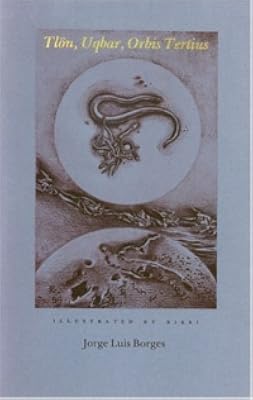
Tlön, Uqbar, Orbis Tertius [short story]
by Jorge Luis Borges
On This Page
Description
`Here is a handsome edition of one of Borges' ficciones, in a translation first published in Labyrinths in 1962. It's an important story in the Borges' canon, incorporating most of the author's philosophical and esthetic preoccupations in a typically brief compass. With great solemnity and a convincing array of scholarly detail (including annotated references to imaginary books and articles), Borges contocts a fable of an alternate world and its infiltration of our own. The reality of Tlon show more is idealist: material objects have no existence; language has no nouns; its principal discipline is psychology, since its inhabitants see the universe as nothing but a series of mental processes. A series of 24 illustrations accompanies the text. Their disturbing resemblances to our reality make them appropriate reflections of Borges's imaginative constructs.' -- The Kingston Whig-Standard show lessTags
Recommendations

















Member Recommendations

Member Reviews
When I've heard others speak (or write) about Borges I have noticed a certain reverence, and perhaps a sort of addiction, like nothing else will do. In any case, it was a sensation that I felt I might not be able to drum up, that Borges would be too advanced for me.
Well, he is advanced.
BUT I LOVED IT.
What an intelligent weird short story chocked full of fascinating metaphoric, linguistic, philosophical and mathematical concepts. The story mixes the real with the fictional, certainly purposefully, and creates a world that makes you wonder about our own world, our perceptions, and our inherent weirdness, increasing our curiosity about the planet Tlön AND Earth.
Oddly, by the end, I wished I could literally read Orbis Tertius.
A short story show more masterpiece. show less
Well, he is advanced.
BUT I LOVED IT.
What an intelligent weird short story chocked full of fascinating metaphoric, linguistic, philosophical and mathematical concepts. The story mixes the real with the fictional, certainly purposefully, and creates a world that makes you wonder about our own world, our perceptions, and our inherent weirdness, increasing our curiosity about the planet Tlön AND Earth.
Oddly, by the end, I wished I could literally read Orbis Tertius.
A short story show more masterpiece. show less
O conto favorito do meu conto favorito do meu mundo favorito; abri em uma página aleatória só pra sentir o gostinho:
Não digo muito, basta o chapear de camadas do pequeno parágrafo: se acho que é uma piscadela do Borges pra nós, show more acabo por cair nos mesmos (ou bem próximo dos) hábitos literários da querida e enigmática Tlön; que não é nada mais que fruto da literatura e imaginação dos eruditos de Uqbar; Uqbar que é fruto de.... e go on show less
"Nos hábitos literários [de Tlön] também é todo-poderosa a ideia de um sujeito único. É raro que os livros estejam assinados. Não existe o conceito de plágio: estabeleceu-se que todas as obras são obra de um único autor, que é intemporal e anônimo. A crítica tem o costume de inventar autores: escolhe duas obras distintas — o Tao Te King e as Mil e uma noites, digamos —, atribui-as a um mesmo escritor e depois determina com probidade a psicologia desse interessante homme de lettres…"
Não digo muito, basta o chapear de camadas do pequeno parágrafo: se acho que é uma piscadela do Borges pra nós, show more acabo por cair nos mesmos (ou bem próximo dos) hábitos literários da querida e enigmática Tlön; que não é nada mais que fruto da literatura e imaginação dos eruditos de Uqbar; Uqbar que é fruto de.... e go on show less
At work, I have a book called "Building the Uqbar Dinghy." It had never occurred to me, although I was aware of this Borges story's existence, that before the publication of this boatbuilding book, there was no such thing as an Uqbar dinghy. Now there is - presumably. Of course, that's exactly what the author was getting at when he titled the book (Borges is credited).
"Tlön, Uqbar, Orbis Tertius" is a wonderful musing on the relationships between ideas, the written word, and reality. The narrator tells the reader of discovering a seemingly unique article slipped into a single copy of an encyclopedia, detailing (but vaguely) the profile of a country called Uqbar. As it turns out, Uqbar may not exist (or, may not have existed?) in our show more world, but may exist in a parallel world called Tlön. Tlön may be wholly the invention of a secret group of intellectuals who have conspired to create a hidden imaginary history - but their fabulist inventions seem to be sneakily creeping their way into our existence.
The story is aesthetically appealing to any lover of fantasy worlds - and any bibliophile. It's delightfully multi-layered, with truth and fiction inextricably tangled. And it's beautifully written.
Read due to its nomination for the 1941 Retro-Hugos. This one gets my vote. show less
"Tlön, Uqbar, Orbis Tertius" is a wonderful musing on the relationships between ideas, the written word, and reality. The narrator tells the reader of discovering a seemingly unique article slipped into a single copy of an encyclopedia, detailing (but vaguely) the profile of a country called Uqbar. As it turns out, Uqbar may not exist (or, may not have existed?) in our show more world, but may exist in a parallel world called Tlön. Tlön may be wholly the invention of a secret group of intellectuals who have conspired to create a hidden imaginary history - but their fabulist inventions seem to be sneakily creeping their way into our existence.
The story is aesthetically appealing to any lover of fantasy worlds - and any bibliophile. It's delightfully multi-layered, with truth and fiction inextricably tangled. And it's beautifully written.
Read due to its nomination for the 1941 Retro-Hugos. This one gets my vote. show less
At work, I have a book called "Building the Uqbar Dinghy." It had never occurred to me, although I was aware of this Borges story's existence, that before the publication of this boatbuilding book, there was no such thing as an Uqbar dinghy. Now there is - presumably. Of course, that's exactly what the author was getting at when he titled the book (Borges is credited).
"Tlön, Uqbar, Orbis Tertius" is a wonderful musing on the relationships between ideas, the written word, and reality. The narrator tells the reader of discovering a seemingly unique article slipped into a single copy of an encyclopedia, detailing (but vaguely) the profile of a country called Uqbar. As it turns out, Uqbar may not exist (or, may not have existed?) in our show more world, but may exist in a parallel world called Tlön. Tlön may be wholly the invention of a secret group of intellectuals who have conspired to create a hidden imaginary history - but their fabulist inventions seem to be sneakily creeping their way into our existence.
The story is aesthetically appealing to any lover of fantasy worlds - and any bibliophile. It's delightfully multi-layered, with truth and fiction inextricably tangled. And it's beautifully written.
Read due to its nomination for the 1941 Retro-Hugos. This one gets my vote. show less
"Tlön, Uqbar, Orbis Tertius" is a wonderful musing on the relationships between ideas, the written word, and reality. The narrator tells the reader of discovering a seemingly unique article slipped into a single copy of an encyclopedia, detailing (but vaguely) the profile of a country called Uqbar. As it turns out, Uqbar may not exist (or, may not have existed?) in our show more world, but may exist in a parallel world called Tlön. Tlön may be wholly the invention of a secret group of intellectuals who have conspired to create a hidden imaginary history - but their fabulist inventions seem to be sneakily creeping their way into our existence.
The story is aesthetically appealing to any lover of fantasy worlds - and any bibliophile. It's delightfully multi-layered, with truth and fiction inextricably tangled. And it's beautifully written.
Read due to its nomination for the 1941 Retro-Hugos. This one gets my vote. show less
Here are my top ten reasons you will enjoy this most inventive and ingenious tale:
1. Fabulist gone wild: This Jorge Luis Borges tale, especially the first few pages, reads like a cross between Philip K. Dick and a bibliophile on acid. There are enough references, many real, many fabricated, to keep a team of researchers burning the midnight oil. My advice: Have fun reading. I sense an author with initials JLB playing literary, metaphysical and many other types of games with his tongue deep in his cheek.
2. Mysterious Narrator: “From the remote depths of the corridor, the mirror spied upon us. We discovered (such a discovery is inevitable in the late hours of the night) that mirrors have something monstrous about them.” Mirrors are show more monstrous? Inevitable at night, really? Have to admit I’ve never myself had such a thought. Maybe I should correct ‘bibliophile on acid’ to ‘bibliophile stoned on cannabis’. The story is told in first person but are we entirely sure who is doing the telling?
3. Strange Uqbar: Those ancient orthodox believers from Uqbar exiled to a nearby island owned obelisks and lived in a way, as archeologists discovered “where it is not uncommon to unearth stone mirrors.” Stone mirrors? How exactly does a stone mirror work? Perhaps a mirror in a stone frame? Well, the narrator admits the document he and Bioy Casares are reading are less than clear, “Reading it over again, we discovered beneath its rigorous prose a fundamental vagueness.” Sound vaguely familiar? Like this fourteen page short story we have in our hands, perhaps?
4. Stranger Tlön: We learn Tlön isn’t a chaos or an irresponsible license of the imagination but it has its own set laws, at least provisionally. Provisionally? So, in a real sense, the license of the imagination rules out. This being the case, I’d love to travel there sometime.
5. Mind Games: For the inhabitants of Tlön, the world for them is not a concourse of objects in space; rather, it’s a series of independent acts. Wow! How cool is that? Whatever you are looking at, hearing, feeling, tasting or smelling – it is all in the mind.
6. Mooning: There are serious language games and tricks going down in Tlön and the inhabitants are entirely serious. For example, when you point to the moon, you don’t see the moon or say the word ‘moon’; you are mooning.
7. The Right Word: On Tlön, there are poems made up of one enormous word. Now that’s poetry I could get into. Does anybody have one long word poem they would care to share?
8. Timeless: On Tlön, they do not perceive the spacial exists in time. Everything is seen as merely an association of ideas. I love it – a world without watches. Sounds like the inhabitants of Tlön take their leisure seriously, since without time and watches, it would be rather difficult to adhere to a work schedule.
9. Touchy-Feely: The geometry of Tlön is made up of two different disciplines – the visual and the tactile. I always wanted to know what all those triangles and circles and lines and points felt like.
10. The Unsaid: All the many subtle references to various theories and ideas. For example, one text states that “Mirrors and fatherhood are abominable because they multiply and disseminate that universe.” This written statement compared to what the narrator says Bioy Casares remembers the text saying – “mirrors and copulation are abominable because they increase the number of men.” Sounds like the narrator might be noting a Freudian slip made by his friend. show less
Here are my top ten reasons you will enjoy this most inventive and ingenious tale:
1. Fabulist gone wild: This Jorge Luis Borges tale, especially the first few pages, reads like a cross between Philip K. Dick and a bibliophile on acid. There are enough references, many real, many fabricated, to keep a team of researchers burning the midnight oil. My advice: Have fun reading. I sense an author with initials JLB playing literary, metaphysical and many other types of games with his tongue deep in his cheek.
2. Mysterious Narrator: “From the remote depths of the corridor, the mirror spied upon us. We discovered (such a discovery is inevitable in the late hours of the night) that mirrors have something monstrous about them.” Mirrors are show more monstrous? Inevitable at night, really? Have to admit I’ve never myself had such a thought. Maybe I should correct ‘bibliophile on acid’ to ‘bibliophile stoned on cannabis’. The story is told in first person but are we entirely sure who is doing the telling?
3. Strange Uqbar: Those ancient orthodox believers from Uqbar exiled to a nearby island owned obelisks and lived in a way, as archeologists discovered “where it is not uncommon to unearth stone mirrors.” Stone mirrors? How exactly does a stone mirror work? Perhaps a mirror in a stone frame? Well, the narrator admits the document he and Bioy Casares are reading are less than clear, “Reading it over again, we discovered beneath its rigorous prose a fundamental vagueness.” Sound vaguely familiar? Like this fourteen page short story we have in our hands, perhaps?
4. Stranger Tlön: We learn Tlön isn’t a chaos or an irresponsible license of the imagination but it has its own set laws, at least provisionally. Provisionally? So, in a real sense, the license of the imagination rules out. This being the case, I’d love to travel there sometime.
5. Mind Games: For the inhabitants of Tlön, the world for them is not a concourse of objects in space; rather, it’s a series of independent acts. Wow! How cool is that? Whatever you are looking at, hearing, feeling, tasting or smelling – it is all in the mind.
6. Mooning: There are serious language games and tricks going down in Tlön and the inhabitants are entirely serious. For example, when you point to the moon, you don’t see the moon or say the word ‘moon’; you are mooning.
7. The Right Word: On Tlön, there are poems made up of one enormous word. Now that’s poetry I could get into. Does anybody have one long word poem they would care to share?
8. Timeless: On Tlön, they do not perceive the spacial exists in time. Everything is seen as merely an association of ideas. I love it – a world without watches. Sounds like the inhabitants of Tlön take their leisure seriously, since without time and watches, it would be rather difficult to adhere to a work schedule.
9. Touchy-Feely: The geometry of Tlön is made up of two different disciplines – the visual and the tactile. I always wanted to know what all those triangles and circles and lines and points felt like.
10. The Unsaid: All the many subtle references to various theories and ideas. For example, one text states that “Mirrors and fatherhood are abominable because they multiply and disseminate that universe.” This written statement compared to what the narrator says Bioy Casares remembers the text saying – “mirrors and copulation are abominable because they increase the number of men.” Sounds like the narrator might be noting a Freudian slip made by his friend. show less
I have the Collected Fictions (with copious translator's notes), but am splitting my review of that into its components, in publication order: Collected Fictions - all reviews. This is the longest story in The Garden of Forking Paths, and deservedly so, published in 1941.
This is very post-modern, meta, or whatever such term you like, with references to Spinoza and Russell. It’s a first-person narration, mentioning real people, telling of a presumably fictitious group of people who plant clues about an imaginary world in authoritative sources (Orbis Tertius being a more comprehensive work in progress). Nowadays, con-langers or believers in Sherlock Holmes might do the same sort of thing on Wikipedia and elsewhere on the internet. show more Alternatively, conspiracy theorists would latch on to every snippet and claim the almost total lack of further evidence was proof of a sinister cover-up by malign and powerful forces.
“Mirrors and copulation are abominable, for they multiply the number of mankind.” This is paraphrased in "Hakim, The Masked Dyer of Merv", which is in the previous volume, A Universal History of Iniquity, and is the starting point here. It’s allegedly a saying from Uqbar, but investigation finds no mention of such a place – except in one (and only one) copy of an encyclopaedia, which has several pages about its geography, climate, culture and language. The fact (I use the word advisedly) they have “stone mirrors” and a “literature of fantasy” is pertinent.
“Tlon may well be a labyrinth, but it is a labyrinth forged by men, a labyrinth destined to be deciphered by men.”
Furthermore, the idea and language of Tlon has infiltrated the real world (or rather, the real world within this piece of fiction penned by Borges), so what is real now? “A fictitious past has supplanted in men’s memories that other past, of which we now know nothing certain.” Is life imitating art, and Earth becoming Tlon?
The final challenge to reality is the “postscript” dated 1947, several years AFTER it was first published.
The much later story, Brodie’s Report, in the collection of the same name, has a similar idea: a mysterious document, describing strange people, found in a book: Brodie’s Report
Time and Language
This fascinating aspect has since been echoed by many, including perhaps Alan Lightman in Einstein’s Dreams.
Tlon is a planet in Uqbar’s mythology: “the world is successive, temporal, but not spatial” and about actions, not objects, so their language is based on verbs, not nouns (examples are given). In this fictional world, in some sense, things are not directly expressible – maybe fictional, even?
Some “deny the existence of time… the present is undefined and indefinite, the future has no reality except as present hope, and the past has no reality except as present recollection” (or even false memories of the past).
Even the maths is different; “the act of counting can modify the amount, turning indefinites into definites”, and they have two types of geometry, “tactile geometry” (like ours) and the more important “visual geometry”, which “is based on the surface, not the point; it has no parallel lines… as one’s body moves through space, it modifies the shapes that surround it”.
These philosophical beliefs mean “their fiction has but a single plot, with every imaginable permutation”. show less
This is very post-modern, meta, or whatever such term you like, with references to Spinoza and Russell. It’s a first-person narration, mentioning real people, telling of a presumably fictitious group of people who plant clues about an imaginary world in authoritative sources (Orbis Tertius being a more comprehensive work in progress). Nowadays, con-langers or believers in Sherlock Holmes might do the same sort of thing on Wikipedia and elsewhere on the internet. show more Alternatively, conspiracy theorists would latch on to every snippet and claim the almost total lack of further evidence was proof of a sinister cover-up by malign and powerful forces.
“Mirrors and copulation are abominable, for they multiply the number of mankind.” This is paraphrased in "Hakim, The Masked Dyer of Merv", which is in the previous volume, A Universal History of Iniquity, and is the starting point here. It’s allegedly a saying from Uqbar, but investigation finds no mention of such a place – except in one (and only one) copy of an encyclopaedia, which has several pages about its geography, climate, culture and language. The fact (I use the word advisedly) they have “stone mirrors” and a “literature of fantasy” is pertinent.
“Tlon may well be a labyrinth, but it is a labyrinth forged by men, a labyrinth destined to be deciphered by men.”
Furthermore, the idea and language of Tlon has infiltrated the real world (or rather, the real world within this piece of fiction penned by Borges), so what is real now? “A fictitious past has supplanted in men’s memories that other past, of which we now know nothing certain.” Is life imitating art, and Earth becoming Tlon?
The final challenge to reality is the “postscript” dated 1947, several years AFTER it was first published.
The much later story, Brodie’s Report, in the collection of the same name, has a similar idea: a mysterious document, describing strange people, found in a book: Brodie’s Report
Time and Language
This fascinating aspect has since been echoed by many, including perhaps Alan Lightman in Einstein’s Dreams.
Tlon is a planet in Uqbar’s mythology: “the world is successive, temporal, but not spatial” and about actions, not objects, so their language is based on verbs, not nouns (examples are given). In this fictional world, in some sense, things are not directly expressible – maybe fictional, even?
Some “deny the existence of time… the present is undefined and indefinite, the future has no reality except as present hope, and the past has no reality except as present recollection” (or even false memories of the past).
Even the maths is different; “the act of counting can modify the amount, turning indefinites into definites”, and they have two types of geometry, “tactile geometry” (like ours) and the more important “visual geometry”, which “is based on the surface, not the point; it has no parallel lines… as one’s body moves through space, it modifies the shapes that surround it”.
These philosophical beliefs mean “their fiction has but a single plot, with every imaginable permutation”. show less
Members
- Recently Added By
Author Information

865+ Works 58,765 Members
Born in Buenos Aires, Argentina, in 1899, Jorge Borges was educated by an English governess and later studied in Europe. He returned to Buenos Aires in 1921, where he helped to found several avant-garde literary periodicals. In 1955, after the fall of Juan Peron, whom he vigorously opposed, he was appointed director of the Argentine National show more Library. With Samuel Beckett he was awarded the $10,000 International Publishers Prize in 1961, which helped to establish him as one of the most prominent writers in the world. Borges regularly taught and lectured throughout the United States and Europe. His ideas have been a profound influence on writers throughout the Western world and on the most recent developments in literary and critical theory. A prolific writer of essays, short stories, and plays, Borges's concerns are perhaps clearest in his stories. He regarded people's endeavors to understand an incomprehensible world as fiction; hence, his fiction is metaphysical and based on what he called an esthetics of the intellect. Some critics have called him a mystic of the intellect. Dreamtigers (1960) is considered a masterpiece. A central image in Borges's work is the labyrinth, a mental and poetic construct, that he considered a universe in miniature, which human beings build and therefore believe they control but which nevertheless traps them. In spite of Borges's belief that people cannot understand the chaotic world, he continually attempted to do so in his writing. Much of his work deals with people's efforts to find the center of the labyrinth, symbolic of achieving understanding of their place in a mysterious universe. In such later works as The Gold of the Tigers, Borges wrote of his lifelong descent into blindness and how it affected his perceptions of the world and himself as a writer. Borges died in Geneva in 1986. (Bowker Author Biography) show less
Some Editions
Work Relationships
Is contained in
Common Knowledge
- Canonical title
- Tlön, Uqbar, Orbis Tertius [short story]
- Original title
- Tlön, Uqbar, Orbis Tertius
- Original publication date
- 1940-05
- First words
- I owe the discovery of Uqbar to the conjunction of a mirror and an encyclopedia.
- Last words
- (Click to show. Warning: May contain spoilers.)I pay no attention to all this and go on revising, in the still days at the Adrogué hotel, an uncertain Quevedian translation (which I do not intend to publish) of Browne's Urn Burial.
Classifications
- Genres
- Fiction and Literature, General Fiction, Fantasy
- DDC/MDS
- 813 — Literature & rhetoric American literature in English American fiction in English
- LCC
- PQ7797 .B635 .T413 — Language and Literature French, Italian, Spanish and Portuguese literatures Spanish literature Provincial, local, colonial, etc. Spanish America
- BISAC
Statistics
- Members
- 90
- Popularity
- 356,392
- Reviews
- 8
- Rating
- (4.25)
- Languages
- English, Russian
- Media
- Paper
- ISBNs
- 1