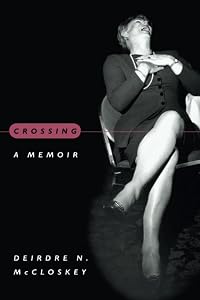
Crossing: A Memoir
by Deirdre N. McCloskey
On This Page
Description
A New York Times Book Review Notable Book of the Year "I visited womanhood and stayed. It was not for the pleasures, though I discovered many I had not imagined, and many pains too. But calculating pleasures and pains was not the point. The point was who I am." Once a golden boy of conservative economics and a child of 1950s privilege, Deirdre McCloskey (formerly Donald) had wanted to change genders from the age of eleven. But it was a different time, one hostile to any sort of straying from show more the path-against gays, socialists, women with professions, men without hats, and so on-and certainly against gender transition. Finally, in 1995, at the age of fifty-three, it was time for McCloskey to cross the gender line. Crossing is the story of McCloskey's dramatic and poignant transformation from Donald to Dee to Deirdre. She chronicles the physical procedures and emotional evolution required and the legal and cultural roadblocks she faced in her journey to womanhood. By turns searing and humorous, this is the unflinching, unforgettable story of her transformation-what she lost, what she gained, and the women who lifted her up along the way. show lessTags
Recommendations


























Member Reviews
“Being a woman is what you do... not what your wear. Caring, watching, noticing.” So says Deirdre N. McCloskey, quoting lessons learned when she was still Donald. He contrasts “the self-deprecating style women use when charming others of their tribe” with “the boasting of my tribe.” And he realizes, like a New Yorker whose heart is really in the South, that he wants to be someone else.
I was an adult when I became an American. My husband and I forced a whole new world and culture on our children. There were times we wondered if family and friends would forgive us. But for Deirdre, the change is even bigger, and forgiveness can be hard to find. Doctors might easily offer a nose-job to woman who wants to change her face, but show more when a man wants plastic surgery to seem more womanly, the psychiatrists have to be called, and sometimes even lawyers. After expensive legal procedures (oh yes, we had those to become American) and stays in mental wards (we had none of those, but we did have to be physically examined to prove we were healthy), Deirdre finally embarks on a long series of operations. Insurance won’t pay, claiming she’s either ill, but not treatable, or mad and shouldn’t be treated. Complaining that “gender crossing is not a psychosis, and there is no medical evidence that it is...” Deirdre finally concludes “Identity is both made and not made,” while making for herself a very human, very normal new identity.
As an economist, Deirdre is well-established, multiply published, very observant and very learned. One thing I particularly enjoyed about this book was her recognition of differences between male and female points of view of economics in relationships. “People have two ways, exchange and identity. Men can grasp only exchange,” she says, illustrating her point with a lovely scene where a wife recites who gave her each ornament in the collection around her house. To a man they’re just items of property; to a woman they stand in for the friends who gave them.
The biggest surprise for me in this book was the author’s faith. I wasn’t expecting to see a connection drawn between finding gender and finding religion, though “rebirth” certainly makes sense in both realms. Faith does too; when he couldn’t imagine continuing as he was, Donald had the faith (and the money) to embark on his journey to Deirdre. While some readers might find it hard to imagine why, and some people of faith might find it hard to accept, Deirdre’s advice to “try to think of Jesus as a God of love” is wisely given and well-taken.
A fascinating, absorbing memoir, Crossing invites us to examine who we are, and how much we care for our neighbor, in the light of someone who learned who s/he was not.
Disclosure: I was lucky enough to get a free ecopy of this book. show less
I was an adult when I became an American. My husband and I forced a whole new world and culture on our children. There were times we wondered if family and friends would forgive us. But for Deirdre, the change is even bigger, and forgiveness can be hard to find. Doctors might easily offer a nose-job to woman who wants to change her face, but show more when a man wants plastic surgery to seem more womanly, the psychiatrists have to be called, and sometimes even lawyers. After expensive legal procedures (oh yes, we had those to become American) and stays in mental wards (we had none of those, but we did have to be physically examined to prove we were healthy), Deirdre finally embarks on a long series of operations. Insurance won’t pay, claiming she’s either ill, but not treatable, or mad and shouldn’t be treated. Complaining that “gender crossing is not a psychosis, and there is no medical evidence that it is...” Deirdre finally concludes “Identity is both made and not made,” while making for herself a very human, very normal new identity.
As an economist, Deirdre is well-established, multiply published, very observant and very learned. One thing I particularly enjoyed about this book was her recognition of differences between male and female points of view of economics in relationships. “People have two ways, exchange and identity. Men can grasp only exchange,” she says, illustrating her point with a lovely scene where a wife recites who gave her each ornament in the collection around her house. To a man they’re just items of property; to a woman they stand in for the friends who gave them.
The biggest surprise for me in this book was the author’s faith. I wasn’t expecting to see a connection drawn between finding gender and finding religion, though “rebirth” certainly makes sense in both realms. Faith does too; when he couldn’t imagine continuing as he was, Donald had the faith (and the money) to embark on his journey to Deirdre. While some readers might find it hard to imagine why, and some people of faith might find it hard to accept, Deirdre’s advice to “try to think of Jesus as a God of love” is wisely given and well-taken.
A fascinating, absorbing memoir, Crossing invites us to examine who we are, and how much we care for our neighbor, in the light of someone who learned who s/he was not.
Disclosure: I was lucky enough to get a free ecopy of this book. show less
In 1995, economics professor Donald McCloskey's second child had gone off to college, and in the empty nest he indulged a little bit more in a habit of decades: cross-dressing. But with the new freedom he found it wasn't just an isolated habit and he wanted to take it further and further, become more and more a woman: by the end of the year he'd changed his name to Deirdre and was living full-time as a woman, and by summer of 1996 Deirdre had gone to Australia for The Operation. His wife had divorced her (he was already a she), his daughter wouldn't talk to her—but in his profession and elsewhere, Deirdre found new support and friends.
Deirdre McCloskey doesn't want to get in your face about gender roles; she just wants to tell what show more it's like to want to become a woman, and then to actually do it. She tells the book in the third person, giving clear attribution to Donald's thoughts and experiences, Deirdre's, and those of "Dee" (the interim stage). It's a very quickly written book—it came out in 1999, less than two years after the last events it recounts—but that comes across not as sloppiness so much as looseness and lightness in the structure and a clear sense that there was no editing or censoring of what's on the page. This is what Deirdre thinks, period. As Deirdre the economist might say: either you find it of value, or you don't.
She's thrilled about the new social avenues and acknowledgements open to her, less thrilled about learning makeup and worrying about passing. She's grateful for the easy acceptance of her sex change in academic circles, distraught over her family's rejection (including twice being arrested and committed for psychiatric evaluation, at her sister's instigation). It's hard not to read this book as an action thriller, where the protagonist's goal is simply to make the crossing safely from hero to heroine. Several times, in fact, McCloskey brings up immigrants and others who managed "crossings" which she sees as more courageous—and, going by this example, changing sex really shouldn't be that big a deal. show less
Deirdre McCloskey doesn't want to get in your face about gender roles; she just wants to tell what show more it's like to want to become a woman, and then to actually do it. She tells the book in the third person, giving clear attribution to Donald's thoughts and experiences, Deirdre's, and those of "Dee" (the interim stage). It's a very quickly written book—it came out in 1999, less than two years after the last events it recounts—but that comes across not as sloppiness so much as looseness and lightness in the structure and a clear sense that there was no editing or censoring of what's on the page. This is what Deirdre thinks, period. As Deirdre the economist might say: either you find it of value, or you don't.
She's thrilled about the new social avenues and acknowledgements open to her, less thrilled about learning makeup and worrying about passing. She's grateful for the easy acceptance of her sex change in academic circles, distraught over her family's rejection (including twice being arrested and committed for psychiatric evaluation, at her sister's instigation). It's hard not to read this book as an action thriller, where the protagonist's goal is simply to make the crossing safely from hero to heroine. Several times, in fact, McCloskey brings up immigrants and others who managed "crossings" which she sees as more courageous—and, going by this example, changing sex really shouldn't be that big a deal. show less
Such anger and bitterness at everyone. Such arrogance to believe that she is the only one in her life to suffer from her to choice to be a male-to-female transsexual. Such a victim.
At the age of 50-something, Donald McCloskey figures out that he's really meant to be a woman, and charges into the fray. At almost every point he is challenged; by his doctors, the psychiatrists (she has especially brutal thoughts on the mental health care field), his family (who are bewildered and brutal), and colleagues.
I get that being an outsider, especially in your own body, is hard. And I understand that needing to change genders is a fearsome undertaking. I applaud and support anyone who makes this choice. But Dierdre McCloskey writes as though no one show more else should have difficulty with her choice and should just accept and love her as they had Donald.
She also spends a great deal of ink delineating the binary roles of men and women. Women are softer and more helpful and bored by sports. Men are egoistic, chauvinistic and only interested in cars and sports. Women automatically keep cleaner homes than men, who expect their wives to take care of them.
No Dierdre, as Donald you were those things. Now, as Dierdre, you have opened yourself to the others, while slamming the door on anything (except her profession) Donald.
I kept reading because the thought occurred that surely at some point she would just get over it. Finding yourself and being happy with yourself is indeed wondrous, but I kept asking myself, "Can we be done now?" show less
At the age of 50-something, Donald McCloskey figures out that he's really meant to be a woman, and charges into the fray. At almost every point he is challenged; by his doctors, the psychiatrists (she has especially brutal thoughts on the mental health care field), his family (who are bewildered and brutal), and colleagues.
I get that being an outsider, especially in your own body, is hard. And I understand that needing to change genders is a fearsome undertaking. I applaud and support anyone who makes this choice. But Dierdre McCloskey writes as though no one show more else should have difficulty with her choice and should just accept and love her as they had Donald.
She also spends a great deal of ink delineating the binary roles of men and women. Women are softer and more helpful and bored by sports. Men are egoistic, chauvinistic and only interested in cars and sports. Women automatically keep cleaner homes than men, who expect their wives to take care of them.
No Dierdre, as Donald you were those things. Now, as Dierdre, you have opened yourself to the others, while slamming the door on anything (except her profession) Donald.
I kept reading because the thought occurred that surely at some point she would just get over it. Finding yourself and being happy with yourself is indeed wondrous, but I kept asking myself, "Can we be done now?" show less
Ratings
Members
- Recently Added By
Lists

List of Removed Books from Nimitz Library
353 works; 1 member

Transgender Awareness Week 2025
33 works; 1 member
Author Information

43 Works 1,903 Members
Deirdre Nansen McCloskey is distinguished professor emerita of economics and history and professor emerita of English and communication at the University of Illinois at Chicago.
Awards and Honors
Awards
Classifications
- Genres
- Biography & Memoir, Sexuality and Gender Studies, LGBTQ+, Nonfiction, General Nonfiction
- DDC/MDS
- 305.9 — Society, government, & culture Social sciences, sociology & anthropology Social group - Age, Gender, Ethnicity People by occupation and miscellaneous social statuses
- LCC
- HQ77.8 .M39 .A3 — Social sciences The family. Marriage, Women and Sexuality The Family. Marriage. Women Sexual life Transexualism
- BISAC
Statistics
- Members
- 201
- Popularity
- 163,168
- Reviews
- 3
- Rating
- (3.57)
- Languages
- English
- Media
- Paper, Ebook
- ISBNs
- 5
- ASINs
- 2