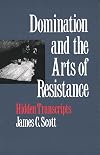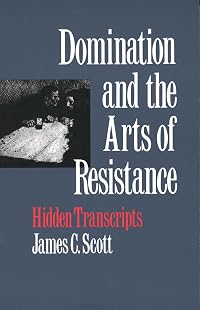
Domination and the Arts of Resistance: Hidden Transcripts
by James C. Scott
On This Page
Description
Confrontations between the powerless and the powerful are laden with deception--the powerless feign deference and the powerful subtly assert their mastery. Peasants, serfs, untouchables, slaves, labourers, and prisoners are not free to speak their minds in the presence of power. These subordinate groups instead create a secret discourse that represents a critique of power spoken behind the backs of the dominant. At the same time, the powerful also develop a private dialogue about practices show more and goals of their rule that cannot be openly avowed. In this book, the author, a social scientist, offers a discussion both of the public roles played by the powerful and powerless and the mocking, vengeful tone they display off stage--what he terms their public and hidden transcripts. Using examples from the literature, history, and politics of cultures around the world, the author examines the many guises this interaction has taken throughout history and the tensions and contradictions it reflects. The author describes the ideological resistance of subordinate groups--their gossip, folktales, songs, jokes, and theater--their use of anonymity and ambiguity. He also analyzes how ruling elites attempt to convey an impression of hegemony through such devices as parades, state ceremony, and rituals of subordination and apology. Finally he identifies--with quotations that range from the recollections of American slaves to those of Russian citizens during the beginnings of Gorbachev's glasnost campaign--the political electricity generated among oppressed groups when, for the first time, the hidden transcript is spoken directly and publicly in the face of power. show lessTags
Recommendations





































Member Reviews
Another interesting work from Scott about what mostly powerless people do to resist domination. The key argument: you can’t necessarily tell what people believe by what they say, especially in public/in front of more powerful people. If noblesse oblige is the duty the elites owe to maintain face before peasants, paysan oblige is the public duty that peasants owe to make elites feel superior; that doesn’t mean they’re committed to it in private. But it’s full of interesting insights from this starting point. Scott argues that the very justifications for domination (divine right to rule or otherwise) supply the rhetoric that people can use to object that the currently powerful have lost the plot (or mandate of heaven). Thus, “if show more the czar only knew!” is not necessarily an actual claim about the benevolence of the czar, but rather an attack on local powers—and a reason for the czar to allow at least some local rebellions to succeed, as long as they stop quietly once the immediate pain stops. He also suggests that it’s the members of oppressed classes who believed the dominant ideology but were then betrayed by it who make the most likely revolutionaries/terrorists/etc. Likewise, the carnivalesque—per Bakhtin—may be a safety valve to bleed off resentment, but the history of powerful elites’ attempts to suppress it also suggests that it teaches the tools of resistance; the mobs who wear masks when they tar and feather people are taking instruction from carnival. This can of course just increase injustice—Scott is well aware that people who are disrespected may hurt anyone they can, which often means people even weaker than them. Likewise, gender and age hierarchies can be extra sticky because they hold out the promise of higher status to people who survive them long enough (and, in the case of gender, become a mother of a powerful enough son). show less
In their conclusion to Michel Foucault: Beyond Structuralism and Hermeneutics, Dreyfus & Rabinow posed the question: 'Is there any way to resist the disciplinary society other than to understand how it works....? Is there a way to make resistance positive...?
This book offers insight into how that resistance has (and can still) manifest itself.
This book offers insight into how that resistance has (and can still) manifest itself.
This is what piqued my interest: http://www.annleckie.com/2013/07/11/92/
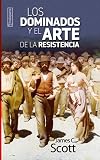
Con base en un conocimiento profundo de la historia y la literatura, James C. Scott ofrece una propuesta original para el estudio de las relaciones de poder. Parte de un hecho incuestionable: que los actores de la vida social y la política no reducen sus intervenciones al escenario público. Por el contrario, los temas de mayor importancia se dirimen fuera del alcance del adversario, y los mecanismos con que los dominados ocultan o disimulan sus propósitos resultan vitales, aun en situaciones de relativa estabilidad. Esta obra ha suscitado el replanteamiento de las nociones de subordinación y resistencia, hegemonía, cultura popular y movimientos sociales. Está considerada como una de las mayores contribuciones teóricas al debate show more contemporáneo sobre las relaciones de poder. show less
Dec 23, 2022Spanish
Ratings
Members
- Recently Added By
Lists

Books in the Bibliography of The Dawn of Everything by Graeber & Wengrow
478 works; 2 members
Author Information

17+ Works 4,853 Members
James C. Scott is Sterling Professor of Political Science and codirector of the Agrarian Studies Program at Vale University. His previous books include Domination and the Arts of Resistance, Seeing Like a State, and The Art of Not Being Governed.
Awards and Honors
Classifications
- Genres
- Anthropology, Nonfiction, Sociology, General Nonfiction, Politics and Government, Philosophy, History
- DDC/MDS
- 303.6 — Society, government, & culture Social sciences, sociology & anthropology Social processes Conflict and conflict resolution ; Violence
- LCC
- HM278 .S37 — Social sciences Sociology (General) Sociology These are obsolete numbers no longer used
- BISAC
Statistics
- Members
- 473
- Popularity
- 64,474
- Reviews
- 4
- Rating
- (4.41)
- Languages
- 5 — English, French, Portuguese, Spanish, Turkish
- Media
- Paper, Ebook
- ISBNs
- 10
- ASINs
- 1