On Tyranny
by Leo Strauss
On This Page
Description
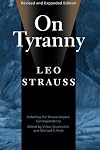
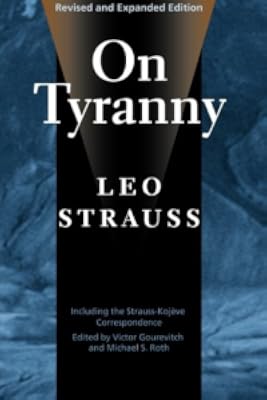
On Tyranny is Leo Strauss's classic reading of Xenophon's dialogue Hiero, or Tyrannicus, in which the tyrant Hiero and the poet Simonides discuss the advantages and disadvantages of exercising tyranny. Included are a translation of the dialogue from its original Greek, a critique of Strauss's commentary by the French philosopher Alexandre Kojève, and the complete correspondence between the two. This revised and expanded edition introduces important corrections throughout and expands show more Strauss's restatement of his position in light of Kojève's commentary to bring it into conformity with the text as it was originally published in France. show lessTags
Recommendations






Member Reviews
This revised and expanded edition of On Tyranny is made up of a linked set of texts ranging over more than two millennia of authorship. First is the translation of Xenophon's Hiero or Tyrannicus, in which the poet Simonides debates and counsels the tyrant Hiero regarding the enjoyability of a tyrant's life. Then comes On Tyranny "proper," the study of Xenophon's dialogue by twentieth-century philosopher Leo Strauss. Strauss' contemporary Alexandre Kojève, the eminent interpreter of Hegel, wrote a reaction to On Tyranny which appears in this volume as "Tyranny and Wisdom" and Strauss replied with a "Restatement." These two texts are paired here as The Strauss-Kojève Debate. Finally, the volume concludes with a publication of all of the show more personal correspondence between Strauss and Kojève that the editors were able to obtain.
As a US American in 2025 reading the original Xenophon text and Strauss' immediate analysis, I could not help casting our current tyrant in the role of Hiero. It was interesting to see that the dictator played the victim even in antiquity. (It certainly gives the comedian too much credit, but recent events incited me to flesh out the dialogue in my imagination by giving Bill Maher the part of Simonides.) The commentaries' post-WW II perspective on "modern tyranny" was of compelling interest as a sort of veiled prophecy regarding how thinkers might in the future reflect on the dismal episode of the MAGA hegemony.
A simplistic view of Strauss and Kojève places the former on the political "right" and the latter on the "left," and on that account I might have expected to have some serious sympathy with Kojève, but I found Strauss to be the clearer and more penetrating writer throughout, and I confess that like Strauss I see no way around Nietzsche's dismal assessment of the Hegelian chiliasm. The friendly and long-sustained personal correspondence between Strauss and Kojève was surprisingly rewarding. On the basis of some of their early exchanges, I have realized that I might profitably defer my ambitions to read Hegel's Phenomenology of Spirit in favor of a prior reading of Thomas Hobbes (who has already been keyed to my interests by Ada Palmer's Terra Ignota).
As part of my larger reading project of Strauss' works, I was interested to note a condensed exposition of the thesis underlying Persecution and the Art of Writing. In his "Restatement," he writes that "in former ages, philosophy ... accommodated itself in its explicit or exoteric teaching to the unfounded commands of rulers who believed they knew things which they did not know. Yet its very exoteric teaching undermined the commands or dogmas of the rulers in such a way as to guide the potential philosophers toward the eternal and unsolved problems" (211). show less
As a US American in 2025 reading the original Xenophon text and Strauss' immediate analysis, I could not help casting our current tyrant in the role of Hiero. It was interesting to see that the dictator played the victim even in antiquity. (It certainly gives the comedian too much credit, but recent events incited me to flesh out the dialogue in my imagination by giving Bill Maher the part of Simonides.) The commentaries' post-WW II perspective on "modern tyranny" was of compelling interest as a sort of veiled prophecy regarding how thinkers might in the future reflect on the dismal episode of the MAGA hegemony.
A simplistic view of Strauss and Kojève places the former on the political "right" and the latter on the "left," and on that account I might have expected to have some serious sympathy with Kojève, but I found Strauss to be the clearer and more penetrating writer throughout, and I confess that like Strauss I see no way around Nietzsche's dismal assessment of the Hegelian chiliasm. The friendly and long-sustained personal correspondence between Strauss and Kojève was surprisingly rewarding. On the basis of some of their early exchanges, I have realized that I might profitably defer my ambitions to read Hegel's Phenomenology of Spirit in favor of a prior reading of Thomas Hobbes (who has already been keyed to my interests by Ada Palmer's Terra Ignota).
As part of my larger reading project of Strauss' works, I was interested to note a condensed exposition of the thesis underlying Persecution and the Art of Writing. In his "Restatement," he writes that "in former ages, philosophy ... accommodated itself in its explicit or exoteric teaching to the unfounded commands of rulers who believed they knew things which they did not know. Yet its very exoteric teaching undermined the commands or dogmas of the rulers in such a way as to guide the potential philosophers toward the eternal and unsolved problems" (211). show less
Philosophy and the World It Rules, November 30, 2006
This book is composed of a translation of Xenophon's Hiero, a commentary by Leo Strauss ('On Tyranny') on it, two essays (one by Kojève, one by Strauss) outlining the controversy between them and finally, in the latest edition, the correspondence between them. After reading the essays Kojève and Strauss aimed at each other one comes to suspect that the major difference between the two is how, precisely, philosophy is to rule the world. Strauss prefers the ancient way of moderately (and occasionally) influencing the Nomos while Kojève insists that Nomos (i.e., Law) must be exactly equal to Philosophy - or, more precisely, equal to exactly what philosophy wants of it. Thus Strauss is show more for 'ruling' while Kojève wants to Rule.
Thus it really is very funny how Kojève 'accuses' Strauss of insanity! By this, Kojève only means that if a philosopher does not go forth and change the World he can never know that his understanding is not mere private fancy - that is, madness. Since Kojève believes that in order to be rational philosophy must rule all he accuses the practical moderation defended by Strauss of madness. Of course, one could moderately accuse Kojève's 'Enlightened' dream of One World of the same thing...
Thus the argument between them is not whether philosophy should rule - but exactly how it should rule. Kojève believes that without the arrival of the Final Philosophical Artifact -the Universal Homogenous State (UHS)- philosophy is only a private mania. But Strauss says that the UHS will make philosophy impossible. To Kojève, the UHS is a monument to Philosophical Reason while for Strauss it is its tomb. Kojève invites Strauss to join him in making the UHS -it is a great honor!- but Strauss declines because he cannot bring himself to preside over the End of Philosophy.
Thus it is very amusing that over the years, thanks primarily to Allan Bloom (who studied with both Kojève and Strauss) and students (of students) of Bloom there has arisen the 'Straussian' neoconservative position that it is the duty of US foreign policy to make the World into good democratic, liberal capitalists in the Euro-American vein. But this 'Straussian' neoconservative position really is at most a hybrid of Kojève and Strauss which leans decidedly in the Kojèvean direction.
No? Then have the courage to read the exchange between Kojève and Strauss (Essays and Correspondence) and decide for yourself.
For those that only have the old 1983 edition I want to point out, even insist, that the correspondence adds some nice touches to the argument between Kojève and Strauss that should not be missed. For instance, we see here quite clearly how important the Criterion of Knowledge is to Kojève's thought:
"As regards myself, I came to Hegel by way of the question of criteria. I see only three possibilities:
(a) Plato's-Husserl's "intuition of essences" (which I do not believe [for one has to believe it]); (b) relativism (in which one cannot live); (c) Hegel and "circularity." If, however, one assumes circularity as the only criterion of truth (including the moral), then everything else follows automatically." (Kojève, Letter of Sept 19, 1950, p 256.)
Thus when one sees that between the extremes of what Kojève is pleased to call 'intuition' (Religion, Phenomenology, 'esoteric' silence) and its failure ('chatter', relativism, postmodernism) there is only the 'Circularity of the Concept' then one begins to see why Kojève must proclaim the 'End of History' - it is to protect the 'Absolute Knowledge' such Circularity requires. (Absolute Knowledge, btw, means unchanging knowledge while circularity means that wherever we begin our research we end, if we proceed scientifically (i.e., in a Hegelian manner), always in the same place.)
Kojève, in the same letter, goes on to concede that there was for him once a fourth possibility:
"For a time I believed in a fourth possibility: nature is "identical," hence the classical criterion can be retained for nature. But now I believe that one can only be silent about nature (mathematics). Hence: either one remains "classically" silent (cp. Plato's Parmenides and Seventh Epistle), or one chatters "in the modern manner" (Pierre Bayle), or one is an Hegelian." (p. 256)
Thus we see that nature was at one time also a possible 'criterion' for Kojève. But he abandons it and with it the Hegelian 'Philosophy of Nature'. Strauss, however, is insistent that there is a 'human nature' and he continually throws it in the face of Kojève. Of this Kojève writes:
"Regarding the issue, I can only keep repeating the same thing. If there is something like "human nature," then you are surely right in everything. But to deduce from premises is not the same as to prove these premises. And to infer premises from (anyway questionable) consequences is always dangerous." (Kojève, Letter of October 29, 1953, p 261.)
Thus Kojève says to Strauss that he can't prove what he says and, of course, Kojève can. -But he can do so if, and only if, History Ends as Kojève says it will. But the proof of success is no proof of Reason but only of power...
In any case, we see Strauss still pressing the point on nature a few years later:
"You have never given me an answer to my questions: a) was Nietzsche not right in describing the Hegelian-Marxian end as "the last man"? and b) what would you put into the place of Hegel's philosophy of nature?" (Strauss, Letter of Sept 11, 1957, p 291.)
It is my belief that Strauss is convinced that this lack of what the ancients would have thought of as a cosmology (i.e., cosmogony) allows ordinary people in the secular, atheistic UHS to turn to religion. He argues that Wisdom in the UHS can only belong to a tiny few and that:
"...if wisdom does not become common property, the mass remains in the thrall of religion, that is to say of an essentially particular and particularizing power (Christianity, Islam, Judaism...), which means that the decline and fall of the universal-homogenous state is unavoidable." (Strauss, Letter August, 22, 1948, p 238.)
Without some sort of Cosmogony the atheistic UHS cannot hold onto its citizens. Of course, this is true only if the UHS must be entirely secular. However, if somehow a right-Hegelian (i.e., religious) interpretation were to prevail in the UHS this would no longer be necessary. And the UHS could survive indefinitely... But Kojève, of course, discounts this possibility, for him there are only two Hegelian possibilities:
"If the Westerners remain capitalist (that is to say, also nationalist), they will be defeated by Russia, and that is how the End-State will come about. If, however, they "integrate" their economies and policies (they are on their way to doing so), then they can defeat Russia. And that is how the End-State will be reached (the same universal and homogenous State). But in the first case it will be spoken about in "Russian" (with Lysenko, etc.), and in the second case - in "European"." (Kojève, Letter of Sept. 19, 1950, p 256.)
But historically this is false. The first interpretation of Hegel (during his lifetime) was religious. Thus one wonders if the UHS with a universal Hegelian religion could somehow be brought about... But that is another story.
So, for those of you familiar with an earlier edition I hope I have given some hint of how the letters amplify and expand the argument between Kojève and Strauss that we first saw in the essays included in earlier editions. This book is superb - I have only hinted at its intricate arguments - do not pass it up! show less
This book is composed of a translation of Xenophon's Hiero, a commentary by Leo Strauss ('On Tyranny') on it, two essays (one by Kojève, one by Strauss) outlining the controversy between them and finally, in the latest edition, the correspondence between them. After reading the essays Kojève and Strauss aimed at each other one comes to suspect that the major difference between the two is how, precisely, philosophy is to rule the world. Strauss prefers the ancient way of moderately (and occasionally) influencing the Nomos while Kojève insists that Nomos (i.e., Law) must be exactly equal to Philosophy - or, more precisely, equal to exactly what philosophy wants of it. Thus Strauss is show more for 'ruling' while Kojève wants to Rule.
Thus it really is very funny how Kojève 'accuses' Strauss of insanity! By this, Kojève only means that if a philosopher does not go forth and change the World he can never know that his understanding is not mere private fancy - that is, madness. Since Kojève believes that in order to be rational philosophy must rule all he accuses the practical moderation defended by Strauss of madness. Of course, one could moderately accuse Kojève's 'Enlightened' dream of One World of the same thing...
Thus the argument between them is not whether philosophy should rule - but exactly how it should rule. Kojève believes that without the arrival of the Final Philosophical Artifact -the Universal Homogenous State (UHS)- philosophy is only a private mania. But Strauss says that the UHS will make philosophy impossible. To Kojève, the UHS is a monument to Philosophical Reason while for Strauss it is its tomb. Kojève invites Strauss to join him in making the UHS -it is a great honor!- but Strauss declines because he cannot bring himself to preside over the End of Philosophy.
Thus it is very amusing that over the years, thanks primarily to Allan Bloom (who studied with both Kojève and Strauss) and students (of students) of Bloom there has arisen the 'Straussian' neoconservative position that it is the duty of US foreign policy to make the World into good democratic, liberal capitalists in the Euro-American vein. But this 'Straussian' neoconservative position really is at most a hybrid of Kojève and Strauss which leans decidedly in the Kojèvean direction.
No? Then have the courage to read the exchange between Kojève and Strauss (Essays and Correspondence) and decide for yourself.
For those that only have the old 1983 edition I want to point out, even insist, that the correspondence adds some nice touches to the argument between Kojève and Strauss that should not be missed. For instance, we see here quite clearly how important the Criterion of Knowledge is to Kojève's thought:
"As regards myself, I came to Hegel by way of the question of criteria. I see only three possibilities:
(a) Plato's-Husserl's "intuition of essences" (which I do not believe [for one has to believe it]); (b) relativism (in which one cannot live); (c) Hegel and "circularity." If, however, one assumes circularity as the only criterion of truth (including the moral), then everything else follows automatically." (Kojève, Letter of Sept 19, 1950, p 256.)
Thus when one sees that between the extremes of what Kojève is pleased to call 'intuition' (Religion, Phenomenology, 'esoteric' silence) and its failure ('chatter', relativism, postmodernism) there is only the 'Circularity of the Concept' then one begins to see why Kojève must proclaim the 'End of History' - it is to protect the 'Absolute Knowledge' such Circularity requires. (Absolute Knowledge, btw, means unchanging knowledge while circularity means that wherever we begin our research we end, if we proceed scientifically (i.e., in a Hegelian manner), always in the same place.)
Kojève, in the same letter, goes on to concede that there was for him once a fourth possibility:
"For a time I believed in a fourth possibility: nature is "identical," hence the classical criterion can be retained for nature. But now I believe that one can only be silent about nature (mathematics). Hence: either one remains "classically" silent (cp. Plato's Parmenides and Seventh Epistle), or one chatters "in the modern manner" (Pierre Bayle), or one is an Hegelian." (p. 256)
Thus we see that nature was at one time also a possible 'criterion' for Kojève. But he abandons it and with it the Hegelian 'Philosophy of Nature'. Strauss, however, is insistent that there is a 'human nature' and he continually throws it in the face of Kojève. Of this Kojève writes:
"Regarding the issue, I can only keep repeating the same thing. If there is something like "human nature," then you are surely right in everything. But to deduce from premises is not the same as to prove these premises. And to infer premises from (anyway questionable) consequences is always dangerous." (Kojève, Letter of October 29, 1953, p 261.)
Thus Kojève says to Strauss that he can't prove what he says and, of course, Kojève can. -But he can do so if, and only if, History Ends as Kojève says it will. But the proof of success is no proof of Reason but only of power...
In any case, we see Strauss still pressing the point on nature a few years later:
"You have never given me an answer to my questions: a) was Nietzsche not right in describing the Hegelian-Marxian end as "the last man"? and b) what would you put into the place of Hegel's philosophy of nature?" (Strauss, Letter of Sept 11, 1957, p 291.)
It is my belief that Strauss is convinced that this lack of what the ancients would have thought of as a cosmology (i.e., cosmogony) allows ordinary people in the secular, atheistic UHS to turn to religion. He argues that Wisdom in the UHS can only belong to a tiny few and that:
"...if wisdom does not become common property, the mass remains in the thrall of religion, that is to say of an essentially particular and particularizing power (Christianity, Islam, Judaism...), which means that the decline and fall of the universal-homogenous state is unavoidable." (Strauss, Letter August, 22, 1948, p 238.)
Without some sort of Cosmogony the atheistic UHS cannot hold onto its citizens. Of course, this is true only if the UHS must be entirely secular. However, if somehow a right-Hegelian (i.e., religious) interpretation were to prevail in the UHS this would no longer be necessary. And the UHS could survive indefinitely... But Kojève, of course, discounts this possibility, for him there are only two Hegelian possibilities:
"If the Westerners remain capitalist (that is to say, also nationalist), they will be defeated by Russia, and that is how the End-State will come about. If, however, they "integrate" their economies and policies (they are on their way to doing so), then they can defeat Russia. And that is how the End-State will be reached (the same universal and homogenous State). But in the first case it will be spoken about in "Russian" (with Lysenko, etc.), and in the second case - in "European"." (Kojève, Letter of Sept. 19, 1950, p 256.)
But historically this is false. The first interpretation of Hegel (during his lifetime) was religious. Thus one wonders if the UHS with a universal Hegelian religion could somehow be brought about... But that is another story.
So, for those of you familiar with an earlier edition I hope I have given some hint of how the letters amplify and expand the argument between Kojève and Strauss that we first saw in the essays included in earlier editions. This book is superb - I have only hinted at its intricate arguments - do not pass it up! show less
This book includes, in addition to the titular essay by Leo Strauss the following essays: "Hiero or Tyrannicus" by Xenophon, "Tyranny and Wisdom" by Alexandre Kojeve, and "Restatement on Xenophon's Hiero" by Leo Strauss. All of these are considered classics of political philosophy.
Ratings
Members
- Recently Added By
Author Information

78+ Works 4,780 Members
Leo Strauss (1899-1973) was one of the preeminent political philosophers of the twentieth century. From 1949 to 1968 he was professor of political science at the University of Chicago. He is the author of many books, among them The Political Philosophy of Hobbes, Natural Right and History, and Spinoza's Critique of Religion, all published by the show more University of Chicago Press. Catherine H. Zuciert is the Nancy R. Dreux Professor of Political Science Emeritus at the University of Notre Dame. show less
Some Editions
Common Knowledge
- Canonical title
- On Tyranny
- Original title
- On tyranny. De la tyrannie
- Original publication date
- 1963
- People/Characters
- Xenophon; Hiero; Simonides
- First words*
- Hieron / Xenophon: Der Dichter Simonides besuchte einmal den Tyrannen Hieron.
Über Tyrannis / Leo Strauss: Es erscheint mir angebracht zu erklären, was mich bewogen hat, die Aufmerksamkeit aller, die sich mit politischer Wissenschaft befassen, auf einen vergessenen Dialog über die Tyrannis zu lenken... (show all) und eine so ausführliche Analyse dieses Dialoges vorzulegen.
Tyrannis und Weisheit / Alexandre Kojève: Meines Erachtens kommt es auf Xenophon in diesem Buch, das Strauss ihm gewidmet hat, nicht allein an. - Last words
- (Click to show. Warning: May contain spoilers.)Hiero / Xenophon: And if you do all these things, know well, of all things you will acquire the most noble and most blessed possessions to be met with among human beings, for while being happy, you will not be envied for being happy.
(Click to show. Warning: May contain spoilers.)On Tyranny / Leo Strauss: What the attitude of the citizen-philosopher Socrates was can be ascertained only by a comprehensive and detailed analysis of Xenophon's Socratic writings.
(Click to show. Warning: May contain spoilers.)Tyranny and Wisdom / Alexandre Kojève: In general terms, it is history itself that attends to "judging" (by "achievement" or "success") the deeds of statesmen or tyrants, which they perform (consciously or not) as a function of the ideas of philosophers, adapted for practical purposes by intellectuals.
(Click to show. Warning: May contain spoilers.)Restatement on Xenophon's Hiero / Leo Strauss: But we have been constantly mindful of it, for both of us appear to turn our attention away from Being and toward tyranny because we saw that those who lacked the courage to face the consequences of tyranny, who, therefore et humiliter serviebant et superbe dominabantur, were at the same time forced to escape the consequences of Being precisely because they did nothing but speak about Being. - Original language
- Greek; English; French; German
- Disambiguation notice
- This edition includes multiple works: Hiero by Xenophon, On Tyranny by Leo Strauss, and the subsequent writings of Strauss and Kojève. Please do not combine with editions that only include one or two of the component texts.
*Some information comes from Common Knowledge in other languages. Click "Edit" for more information.
Classifications
- Genres
- Philosophy, Politics and Government, Nonfiction, General Nonfiction
- DDC/MDS
- 321.9 — Society, government, & culture Political science Systems of governments and states Authoritarian government: Despotism, dictatorship, totalitarianism [formerly : Anarchism as political system]
- LCC
- PA4494 .H6 .S8 — Language and Literature Greek language and literature. Latin language and literature Greek literature Individual authors Xenophon
- BISAC
Statistics
- Members
- 346
- Popularity
- 91,333
- Reviews
- 4
- Rating
- (3.79)
- Languages
- 6 — English, French, German, Italian, Polish, Spanish
- Media
- Paper, Ebook
- ISBNs
- 16
- ASINs
- 4