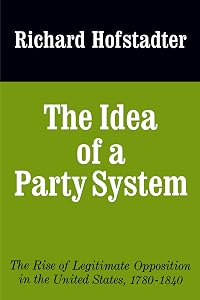
The Idea of a Party System: The Rise of Legitimate Opposition in the United States, 1780-1840
by Richard Hofstadter
Jefferson Memorial Lectures (1966)
On This Page
Description
This work traces the historical processes in thought by which American political leaders slowly edged away from their complete philosophical rejection of a party and hesitantly began to embrace a party system. In the author's words, "The emergence of legitimate party opposition and of a theory of politics that accepted it was something new in the history of the world; it required a bold new act of understanding on the part of its contemporaries and it still requires study on our part." show more Professor Hofstadter's analysis of the idea of party and the development of legitimate opposition offers fresh insights into the political crisis of 1797-1801, on the thought of George Washington, Thomas Jefferson, James Madison, James Monroe, Martin Van Buren, and other leading figures, and on the beginnings of modern democratic politics. show lessTags
Recommendations









Member Reviews
The book begins with a discussion of different models of how parties should exist, finding parallels in England and the US.
Bolingbroke in the UK and Washington and Monroe in the US supported a model of a single party that would provide for everyone (but without the government preventing other parties).
Hume in the UK and Madison in the US supported the idea of qualified support for parties. Parties as a necessary evil.
Jefferson tended to be with Madison early on, but veered toward the Monrovian attitude later.
The third view is from Burke in the UK and (not yet stated in the book) probably from Van Buren in the US, that parties, beyond being a necessary evil, are actually a necessary good. A loyal opposition keeps the government honest show more and permits synthetic policy arriving out of differing views.
Suggests that the American Revolution was special because of the relative lack of internal violence and infighting. Here this 1970 book is a little out of date. More recently, colonial revolutions are construed as differing in basic nature from those that are internal to a nation, such as French and Russian examples.
"Washington apparently hoped at first that the unanimity shown in his election would be echoed in at least a near-unanimity on basic ideas. He was bitterly disappointed at the early show of sharp opposition, and in good time, without ever giving up his conception of himself as a man above party, he became a strong partisan of the Hamiltonian Fedearlists. So far as he was concerned, the onus for strife, which at first he distributed almost with impartiality, was in the end placed entirely upon the opposition. When the Jay Treaty was at stake, he angrily charged that the opposition to it was the work of a party, without seeming to realize that its supporters also constituted a party."
Very interesting regarding Jefferson and the spoils system. Jefferson began his administration with the following idea regarding officeholders: "Malconduct is a just ground for removal; mere difference of political opinion is not". He expected to replace Federalists with Republicans when the former died or retired. But as time went on, not many Federalists did. Even worse, Jefferson practiced frugal government so he was not adding positions. Pressure to appoint party loyalists grew. So he adopted a new policy. The most politically partisan Federalists would also be removed. "In his eight years Jefferson removed 109 out of 433 men who held office by presidential appointment; and, of these, 40 were in a special category, the "midnight appointments" of the Adams administration, whose validity he never conceded."
After Monroe was elected, he received a letter from Andrew Jackson urging him to appoint a Federalist (!), General William Drayton Secretary of War, due to his loyal service during the War of 1812. Others also requested that the Cabinet include at least one Federalist. But Monroe felt this would be too indulgent to the party of the Hartford Convention and refused. Monroe's strategy was not to give the opposition jobs, but to give them ceremonial events to make them feel included, such as his 1817 trip to the North, which proved astonishingly successful.
Ah, so it is Van Buren the book was leading up to, and also Thurlow Weed.
Hofstadter was advocating the value of party differentiation in the late 60s and early 70s, a time of relative similarity between the parties. He got his wish, and then some more. One wonders what he would say today amid the numerous complaints of too much polarization. show less
Bolingbroke in the UK and Washington and Monroe in the US supported a model of a single party that would provide for everyone (but without the government preventing other parties).
Hume in the UK and Madison in the US supported the idea of qualified support for parties. Parties as a necessary evil.
Jefferson tended to be with Madison early on, but veered toward the Monrovian attitude later.
The third view is from Burke in the UK and (not yet stated in the book) probably from Van Buren in the US, that parties, beyond being a necessary evil, are actually a necessary good. A loyal opposition keeps the government honest show more and permits synthetic policy arriving out of differing views.
Suggests that the American Revolution was special because of the relative lack of internal violence and infighting. Here this 1970 book is a little out of date. More recently, colonial revolutions are construed as differing in basic nature from those that are internal to a nation, such as French and Russian examples.
"Washington apparently hoped at first that the unanimity shown in his election would be echoed in at least a near-unanimity on basic ideas. He was bitterly disappointed at the early show of sharp opposition, and in good time, without ever giving up his conception of himself as a man above party, he became a strong partisan of the Hamiltonian Fedearlists. So far as he was concerned, the onus for strife, which at first he distributed almost with impartiality, was in the end placed entirely upon the opposition. When the Jay Treaty was at stake, he angrily charged that the opposition to it was the work of a party, without seeming to realize that its supporters also constituted a party."
Very interesting regarding Jefferson and the spoils system. Jefferson began his administration with the following idea regarding officeholders: "Malconduct is a just ground for removal; mere difference of political opinion is not". He expected to replace Federalists with Republicans when the former died or retired. But as time went on, not many Federalists did. Even worse, Jefferson practiced frugal government so he was not adding positions. Pressure to appoint party loyalists grew. So he adopted a new policy. The most politically partisan Federalists would also be removed. "In his eight years Jefferson removed 109 out of 433 men who held office by presidential appointment; and, of these, 40 were in a special category, the "midnight appointments" of the Adams administration, whose validity he never conceded."
After Monroe was elected, he received a letter from Andrew Jackson urging him to appoint a Federalist (!), General William Drayton Secretary of War, due to his loyal service during the War of 1812. Others also requested that the Cabinet include at least one Federalist. But Monroe felt this would be too indulgent to the party of the Hartford Convention and refused. Monroe's strategy was not to give the opposition jobs, but to give them ceremonial events to make them feel included, such as his 1817 trip to the North, which proved astonishingly successful.
Ah, so it is Van Buren the book was leading up to, and also Thurlow Weed.
Hofstadter was advocating the value of party differentiation in the late 60s and early 70s, a time of relative similarity between the parties. He got his wish, and then some more. One wonders what he would say today amid the numerous complaints of too much polarization. show less
Ratings
Members
- Recently Added By
Author Information

53+ Works 6,894 Members
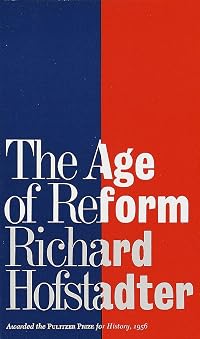
DeWitt Clinton Professor of History at Columbia University from 1959 until the time of his death, Richard Hofstadter was one of the most influential historians in post--World War II America. His political, social, and intellectual histories raised serious questions about assumptions that had long been taken for granted and cast the American show more experience in an interesting new light. His 1948 work, The American Political Tradition, is an enduring classic study in political history. His 1955 work, The Age of Reform, which still commands respect among both historians and general readers, won him that year's Pulitzer Prize. A measure of Hofstadter's standing in literary and scholarly circles is the honors he received in 1964 for Anti-Intellectualism in American Life (1963)---Pulitzer Prize for general nonfiction, the Ralph Waldo Emerson Prize of Phi Beta Kappa, and the Sidney Hillman Prize Award. Hofstadter's greatest talent, however, may have been his ability to order complex events and issues and to synthesize from them a rational, constructively critical perspective on American history. (Bowker Author Biography) show less
Series

Common Knowledge
- Canonical title
- The Idea of a Party System: The Rise of Legitimate Opposition in the United States, 1780-1840
- Important places
- USA
- Dedication
- To the Columbia historians My teachers, 1937-1942 My colleagues, 1946-
Classifications
- Genres
- Nonfiction, Politics and Government, History, General Nonfiction
- DDC/MDS
- 329.020973 — Society, government, & culture Political science [Formerly: Political Parties and conventions]
- LCC
- JK2260 .H73 — Political Science Political institutions and public administration (United States) Political institutions and public administration United States Political parties
- BISAC
Statistics
- Members
- 180
- Popularity
- 181,512
- Reviews
- 1
- Rating
- (3.50)
- Languages
- English, Spanish
- Media
- Paper, Ebook
- ISBNs
- 4
- ASINs
- 3