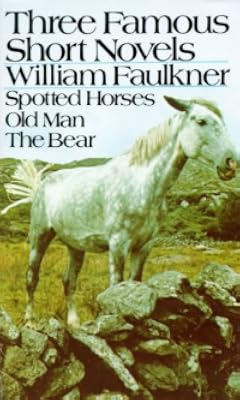
Three Famous Short Novels: Spotted Horses / Old Man / The Bear
by William Faulkner
On This Page
Description
These short works offer three different approaches to Faulkner, each representative of his work as a whole. "Spotted Horses" is a hilarious account of a horse auction, and pits the "cold practicality" of women against the boyish folly of men. "Old Man" is something of an adventure story. When a flood ravages the countryside of the lower Mississippi, a convict finds himself adrift with a pregnant woman. And "The Bear," perhaps his best known shorter work, is the story of a boy's coming to show more terms with the adult world. By learning how to hunt, the boy is taught the real meaning of pride, humility, and courage. show lessTags
Recommendations












Member Reviews
[The Bear] is quintessential Faulkner, I think. Dense prose. Fragmented timeline. Astonishingly long sentences that rush you along with surprising power, crashing headlong like wild rapids, leaving you breathless and not entirely sure you got it all. Guys doing guy stuff. Family heritage, family destiny. Culturally suppressed racial tension.
A coming of age story, it has Isaac (Ike) McCaslin at its center, although man's relationship with the land and with his fellow men is the thematic core of the story. Initially, The Bear focuses on annual two-week-long November hunts at a vast wilderness tract. The narrator reports:
Isaac is ten when he first goes on the hunt; he is chaperoned--rather...taught, coached, mentored in woods and hunting lore--by Sam Fathers, son of a Negro slave and a Chickasaw chief. Isaac learns to navigate the wilderness using a compass, then without the compass. By the third year, he's rising before the others and striking out on his own. He's motivated by tales of Old Ben, a massive, wiley old bear, a legend--hind paw damaged by a trap, carrying in his hide dozens of slugs that didn't kill him, feared by all the hunting dogs, many of which he's killed over the years.
Isaac and Sam eventually do see Ben, up close too, but neither takes a shot at him. All too soon, the hunters focus on actually bagging this bear, instead of simply trading Old Ben tales. They've got to find a dog big enough and fearless enough to track and attack the bear.
And when the deed is done, the entire annual hunt ritual collapses. Another life lesson for Isaac.
But Faulkner kept this story going, with a section that works best, I think, in the context of Go Down, Moses. The Bear has appeared in several forms, first as a story/novella, then integrated into [Go Down, Moses], a collection of interrelated stories that Faulkner viewed as a novel, both versions being published in 1942. In 1955, a third version was published in Faulkner's collection of hunting stories, [Big Woods]. In 1958, it was published yet again in [Three Famous Short Novels] (the other short novels being Spotted Horses and Old Man). This is the version I re-read. (And since I now feel compelled to re-read Go Down, Moses I'll be revisiting The Bear again soon.) show less
A coming of age story, it has Isaac (Ike) McCaslin at its center, although man's relationship with the land and with his fellow men is the thematic core of the story. Initially, The Bear focuses on annual two-week-long November hunts at a vast wilderness tract. The narrator reports:
show more
It was of the men, not white nor black nor red but men, hunters, with the will and hardihood to endure and the humility
and skill to survive, and the dogs and the bear and deer juxtaposed and reliefed against it, ordered and compelled by and within the wilderness in the ancient and unremitting contest according to the ancient and immitigable rules which voided all regrets and brooked no quarter…
Isaac is ten when he first goes on the hunt; he is chaperoned--rather...taught, coached, mentored in woods and hunting lore--by Sam Fathers, son of a Negro slave and a Chickasaw chief. Isaac learns to navigate the wilderness using a compass, then without the compass. By the third year, he's rising before the others and striking out on his own. He's motivated by tales of Old Ben, a massive, wiley old bear, a legend--hind paw damaged by a trap, carrying in his hide dozens of slugs that didn't kill him, feared by all the hunting dogs, many of which he's killed over the years.
…[O]ne morning, it was in the second week, he heard the dogs...They didn't sound like any running dogs he had ever heard before even. Then he found that Sam...had himself moved up beside him. "There," he said. "Listen." The boy listened...He could hear Sam breathing at his shoulder. He saw the arched curve of the old man's inhaling nostrils.
"It's Old Ben!" he cried, whispering.
Sam didn't move save for the slow gradual turning of his head as the voices faded on and the faint steady rapid arch and collapse of his nostrils. "Hah," he said. "Not even running. Walking."
"But up here!" the boy cried. "Way up here!"
"He do it every year," Sam said. "Once. Ash and Boon say he comes up here to run the other little bears away. Tell them to get to hell out of here and stay out until the hunters are gone. Maybe...He dont care no more for bears than he does for dogs or men neither. He come to see who's here, who's new in camp this year, whether he can shoot or not, can stay or not. Whether we got the dog yet that can bay and hold him until a man gets there with a gun. Because he's the head bear. He's the man."
Isaac and Sam eventually do see Ben, up close too, but neither takes a shot at him. All too soon, the hunters focus on actually bagging this bear, instead of simply trading Old Ben tales. They've got to find a dog big enough and fearless enough to track and attack the bear.
And when the deed is done, the entire annual hunt ritual collapses. Another life lesson for Isaac.
But Faulkner kept this story going, with a section that works best, I think, in the context of Go Down, Moses. The Bear has appeared in several forms, first as a story/novella, then integrated into [Go Down, Moses], a collection of interrelated stories that Faulkner viewed as a novel, both versions being published in 1942. In 1955, a third version was published in Faulkner's collection of hunting stories, [Big Woods]. In 1958, it was published yet again in [Three Famous Short Novels] (the other short novels being Spotted Horses and Old Man). This is the version I re-read. (And since I now feel compelled to re-read Go Down, Moses I'll be revisiting The Bear again soon.) show less
Everybody reads The Bear but The Old Man is the must read story. "The old man" is the Mississippi River in full flood. A lot of this is clearly based on an actual historic event, but it is told as only Faulkner can tell it. Wonderful stuff, even for readers who don't "get" Faulkner.
Faulkner is definitely hygienic for the writer's soul (and the reader's). Gutsy, original, precise. Spotted Horses was hilarious, I didn't know Faulkner did slapstick. Old Man was super exciting and profoundly real. The Bear you need to be deep in the southern consciousness to read it correctly. As a Californian beach bum I was a little in the weeds for the famous second half until I got the hang of it. First half was as exciting as Old Man. My copy is banged up but I'm taping and keeping it!
Reading Faulkner is kind of like taking heroin. You get hooked too quickly, you can't think about anything else when you aren't reading it, you work your ass off to finish what you are reading so you never have to read it again, and then you pick up another one of his books and there you are again wallowing in your own sweat and feces and forgoing food just to keep reading. I hate this man.
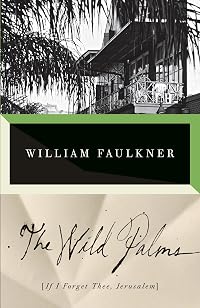
"Old Man" I've now read twice and neither time have I read it in its full context. The first time I read it, it was part of The Famous Short Novels which I read and released through BookCrossing but didn't review on this blog. I've since done some research on "Old Man" and have learned that it is actually part of a longer and more typical Faulkner novel, If I Forget Thee, Jerusalem, consisting of two different but complimentary narratives: "The Wild Palms" and "Old Man". Some reviews say these two narratives are separate novellas and an equal number says that the two are one novel and can't be separated out as unique stories (even though a variety of book editors would disagree).
From my BookCrossing review I can see that last time I show more didn't like the book. I know that when I read it I was rushed and also suffering from the early stages of morning sickness (although I didn't know it at the time). With both readings I picked up on a O Brother Where Art Thou? vibe, the only difference being that this time I found the story humorous and entertaining.
I don't know if I've matured as a reader in 18 months or I was just in the right mind set but this second reading of "Old Man" was the first time that I really felt like I understood what all the fuss was about William Faulkner as a writer. show less
From my BookCrossing review I can see that last time I show more didn't like the book. I know that when I read it I was rushed and also suffering from the early stages of morning sickness (although I didn't know it at the time). With both readings I picked up on a O Brother Where Art Thou? vibe, the only difference being that this time I found the story humorous and entertaining.
I don't know if I've matured as a reader in 18 months or I was just in the right mind set but this second reading of "Old Man" was the first time that I really felt like I understood what all the fuss was about William Faulkner as a writer. show less
These short works offer three different approaches to Faulkner, each representative of his work as a whole. Spotted Horses is a hilarious account of a horse auction and pits the 'cold practicality' of woe=men against the boyish folly of men. Old Man is something of an adventure story. When a flood ravages the countryside of the lower Mississippi, a convict finds himself adrift with a pregnant woman. And The Bear, perhaps his most shorter work, is the story of a boy's coming to terms with the adult world. By learning how to hunt, the boy is taught the real meaning of pride, humility, and courage. - from book jacket
I could have used a guide or Cliff's Notes to make it through The Bear. The first part was fine, as it told the story of a boy learning to hunt in the forest with older relatives and friends. But after the death of Old Ben, the style changed dramatically and I had a much more difficult time figuring out what was going on, and even who was speaking. The other two short works were not as difficult. Spotted Horses was interesting and moved quickly, but felt unfinished to me, as if there should have been more to the story. Old Man was my favorite of the three. I enjoyed the strange journey of the convict and the women in a boat on the flooding river.
Members
- Recently Added By
Author Information

462+ Works 99,022 Members
Born in an old Mississippi family, William Faulkner made his home in Oxford, seat of the University of Mississippi. After the fifth grade he went to school only off and on-lived, read, and wrote much as he pleased. In 1918, refusing to enlist with the "Yankees," he joined the Canadian Air Force, and was transferred to the British Royal Air Force. show more After the war he studied a little at the University, did house painting, worked as a night superintendent at a power plant, went to New Orleans and became a friend of Sherwood Anderson, then to Europe and back home to Oxford. By this time he had written two novels. The Sound and the Fury followed in 1929. Financial success came with Sanctuary in 1931, which he assisted in filming. Faulkner 's novels are intense in their character portrayals of disintegrating Southern aristocrats, poor whites, and African Americans. A complex stream-of-consciousness rhetoric often involves Faulkner in lengthy sentences of anguished power. Most of his tales are set in the mythical Yoknapatawpha County, Mississippi, and are characterized by the use of many recurring characters from families of different social levels spanning more than a century. His best subjects are the old, dying South and the newer materialistic South. As I Lay Dying (1930), is a grotesquely tragicomic story about a family of poor southern whites. With Absalom, Absalom! (1936); the difficult parts of his famous short novel "The Bear" (published in Go Down, Moses, 1942); and the allegorical A Fable (1954), a non-Yoknapatawpha novel set in France during World War I; Faulkner returned to an innovative and difficult style that most readers have trouble with. Yet, interspersed among such works are collections of easily read stories originally published in popular magazines. There seems to be a growing sentiment among critics that the Snopes trilogy-The Hamlet (1940), The Town (1957), and The Mansion (1959)-for the most part an example of Faulkner's "moderate" style, could well be among his most important works. Faulkner was awarded the 1949 Nobel Prize for literature "for his powerful and artistically independent contribution to the new American novel," but it would appear now that he also deserved to win that honor for his contribution to world literature. When reporting his death, the Boston Globe quoted Faulkner's having once told an interviewer: "Since man is mortal, the only immortality for him is to leave something behind him that is immortal since it will always move. That is the artist's way of scribbling "Kilroy was here" on the wall of the final and irrevocable oblivion through which he must some day pass." In addition to the Nobel Prize, Faulkner received the Howells Medal of the American Academy of Arts and Letters in 1950, and in 1951 he was given the National Book Award for his Collected Stories Collected Stories. For his novel A Fable he received the National Book Award for the second time, as well as the Pulitzer Prize in 1955. The Reivers (1962) was awarded the Pulitzer Prize in 1963. In 1957 and 1958, he was the University of Virginia's first writer-in-residence, and in January 1959 he accepted an appointment as consultant on contemporary literature to the Alderman Library of that university. Although Faulkner was not without honors in his lifetime and has received world recognition since then, it is surprising to learn that, when Malcolm Cowley edited The Portable Faulkner in 1946, he found that almost all of Faulkner's books were out of print. By arranging selections from the works to form a continuous chronicle, Cowley deserves much of the credit for making readers aware of the way in which Faulkner was creating a fictive world on a scale grander than that of any novelist since Balzac. William Faulkner died in Oxford, Mississippi, in 1962. (Bowker Author Biography) show less
Work Relationships
Common Knowledge
Classifications
Statistics
- Members
- 1,182
- Popularity
- 21,089
- Reviews
- 14
- Rating
- (3.94)
- Languages
- English
- Media
- Paper, Ebook
- ISBNs
- 8
- ASINs
- 18