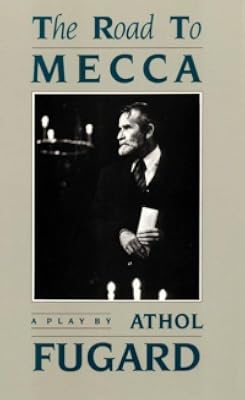
The Road to Mecca
by Athol Fugard
On This Page
Description
A South African pastor and a young teacher from Cape Town battle over the fate of an eccentric elderly widow.Tags
Recommendations















Member Reviews
Helen, whose husband’s death has caused her to stave off various bouts of depression and battles with, to use her word, “darkness,” has recently re-discovered her gift for sculpture. Her back yard – which Helen calls her Mecca - is full of bright, colorful, life-sized figures of biblical wise men, birds, and anything else her imagination encourages her to make. One of Helen’s only remaining friends, Elsa, pays her a surprise visit from Cape Town. During their discussion, Helen mentions that the dominee at her local Church, Byleveld, has taken it upon himself to suggest to her that she should consider moving into a convalescent home. Byleveld claims to express concern for the Church, but also for others in New Bethesda who show more think that Helen has become a mad eccentric, tottering on senility. Even though Helen is unable to do some things for herself, she has a local woman come to her house a few times a week, and seems very capable of living alone. Elsa vehemently urges Helen to resist Byleveld’s “help,” and refuse his offer. He’s even gone so far as to fill out the paperwork for the home; all he needs is her signature.
The play consists of only three characters, but the balance, dynamism, and tension between them is beautiful and subtle. While Byleveld could easily come off as patriarchal and overbearing, Fugard leaves plenty of room for the reader to believe that he’s really doing what he thinks is in Helen’s best interests, even though we are not to mistake his interruption as anything other than heavy-handedness. He’s not the easy-to-hate bigot that would have been caricatural. In a number of ways, Elsa is more of a caricature, with her youthful idealism and cosmopolitan, rigorous rejection of Afrikaner tradition.
As all great drama does, this resonates on a number of levels. It’s a comment on aging and how sometimes we see aging as a necessary loss of personal volition and independence. The disagreements between Byleveld and Elsa embody many of the dualisms that South Africans were dealing with thirty years ago, and to some extent continue to deal with: the rural versus the urban, the religious versus the secular, and a conscious effort to crush artistic openness and personal freedom versus a volitional effort to let that openness, or eccentricity as Byleveld calls it, flourish and prosper.
It might strike some as interesting that, for a play written in apartheid South Africa, I haven’t mentioned race. It’s not a major theme, but its presence is as insidious as Byleveld’s. Elsa is worried about her privilege, especially how it might impinge upon the lives of others, in compelling and sincere ways. On the way to visit Helen, Elsa gave a ride to a young black woman with a child, and she is haunted by what might have happened to her after they parted. By the end of the play, Elsa and Helen have rebuilt the trust that was compromised by Helen being ambivalent about standing up to Byleveld.
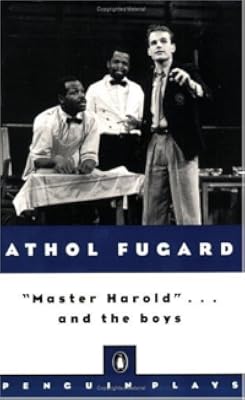
Athol Fugard is South Africa’s most well-known playwright, perhaps best known for “Master Harold … and the Boys.” I’d never read anything by him when I found “The Road to Mecca” last weekend at a library book sale for fifty cents. And after reading this, I’m even more eager to read more by him than I was before. show less
The play consists of only three characters, but the balance, dynamism, and tension between them is beautiful and subtle. While Byleveld could easily come off as patriarchal and overbearing, Fugard leaves plenty of room for the reader to believe that he’s really doing what he thinks is in Helen’s best interests, even though we are not to mistake his interruption as anything other than heavy-handedness. He’s not the easy-to-hate bigot that would have been caricatural. In a number of ways, Elsa is more of a caricature, with her youthful idealism and cosmopolitan, rigorous rejection of Afrikaner tradition.
As all great drama does, this resonates on a number of levels. It’s a comment on aging and how sometimes we see aging as a necessary loss of personal volition and independence. The disagreements between Byleveld and Elsa embody many of the dualisms that South Africans were dealing with thirty years ago, and to some extent continue to deal with: the rural versus the urban, the religious versus the secular, and a conscious effort to crush artistic openness and personal freedom versus a volitional effort to let that openness, or eccentricity as Byleveld calls it, flourish and prosper.
It might strike some as interesting that, for a play written in apartheid South Africa, I haven’t mentioned race. It’s not a major theme, but its presence is as insidious as Byleveld’s. Elsa is worried about her privilege, especially how it might impinge upon the lives of others, in compelling and sincere ways. On the way to visit Helen, Elsa gave a ride to a young black woman with a child, and she is haunted by what might have happened to her after they parted. By the end of the play, Elsa and Helen have rebuilt the trust that was compromised by Helen being ambivalent about standing up to Byleveld.
Athol Fugard is South Africa’s most well-known playwright, perhaps best known for “Master Harold … and the Boys.” I’d never read anything by him when I found “The Road to Mecca” last weekend at a library book sale for fifty cents. And after reading this, I’m even more eager to read more by him than I was before. show less
A beautiful play, in more ways than one. It is a large play, examining issues of race, gender, and faith, as well as love and friendship. This is, like others by this author, a brave play, daring to walk through fire to deliver a dynamic story. Two people battle for the soul of an older woman, who knows what she wants but not how to get it. She needs to remain in her home, surrounded by the things she loved, and not be trundled off to a senior center where she will have a small room with none of the world she has painstakingly built. The entire town is aligned against her, and she has only a single friend who lives 800 miles away to help her. Seeing this play performed would likely be such a visual experience you wouldn't quickly forget it.
Great for finding scenes for two female actresses. Other than that, I found it a bit hard to swallow - too depressing and dark, although I suppose the ending compensates for that. All in all, I think it is very well written and a great look at what happens when people are lonely and left to create their own world.
Ratings
Members
- Recently Added By
Lists

Blue Pyramid 1,276 Best Books of All Time
1,248 works; 32 members
My Play Collection
769 works; 3 members

Next Plays / 2025
352 works; 1 member
Author Information

54+ Works 2,501 Members
Born in Cape Town and educated at Port Elizabeth Technical College and Cape Town University, Athol Fugard is a leading white South African playwright. After finishing his education, Fugard worked as a seaman and journalist before becoming an actor, director, and playwright. His commitment to the antiapartheid struggle through his plays and other show more dramatic productions is as long as it is effective in portraying the traumas of racial tensions in the lives of both white and black South Africans. The setting of his plays is contemporary South Africa, but the bleakness and frustrations of life they present, especially for those on the fringes of society, raise the plays to the level of universal human tragedy. Because of their subject, his plays have sometimes met with official opposition. Blood Knot (1960), about two coloured brothers, one light-skinned and one dark-skinned, was censored, and some of his other works have only been published abroad. Fugard has frequently collaborated in his productions with black playwrights and actors, like John Kani and Winston Ntsona, with whom he produced the highly acclaimed and frequently produced plays, Siswe Bansi Is Dead (1973) and Statements (1972). His work is quite popular in England, and later plays, Master Harold and the Boys (1982), The Road to Mecca (1984), and A Place With the Pigs (1987), have been staged at the National Theatre. Fugard has also written screenplays and a novel, Tsotsi (1980) which was adapted to the screen in 2005 and received an Academy Award for Best Foreign Language Film. His recent works are Exits and Entrances (2004), Booitjie and the Oubaas (2006), Victory (2007), Coming Home (2009), Have you seen Us (2009), and The Train Driver (2010). (Bowker Author Biography) show less
Awards and Honors
Common Knowledge
- Related movies
- The Road to Mecca (1991 | IMDb)
Classifications
Statistics
- Members
- 177
- Popularity
- 185,426
- Reviews
- 4
- Rating
- (4.13)
- Languages
- English
- Media
- Paper, Audiobook, Ebook
- ISBNs
- 12
- ASINs
- 3